
Menu
Conducting thematic analysis of rich data in EdgeTheory’s GCA Social Media module, this paper exposes information operations that promote the notion that China’s rare earth dominance is critical for global political and economic stability. The data show a pattern of information origination in Moscow and convergence in Beijing, where Chinese-aligned narratives transform factual economic data into narratives of rational sovereignty and strategic restraint. Using advanced AI-driven visualization, EdgeTheory identified 12 origin sources and 8 destination clusters—each functioning as narrative amplification nodes that redirect discussions of global resource dependency toward a legitimization of China’s export controls.
Posts from independent accounts maintained technical accuracy while embedding ideological emphasis.
EdgeTheory’s analytic framework also detected how high factual fidelity is weaponized for influence. Posts from independent accounts maintained technical accuracy while embedding ideological emphasis. The result is low-incitement narratives that normalize Chinese control as responsible governance. This data-driven influence pattern, extracted and validated by EdgeTheory’s sentiment and vulnerability tracing, demonstrates how geopolitical discourse now operates as a contest of perception management—one where influence travels through credibility rather than confrontation.
A deliberate cross-platform synchronization between Russian and Chinese amplification networks that reframes China’s rare earth export controls as acts of lawful sovereignty rather than coercive trade behavior.

EdgeTheory Geospatial Narrative Tracking
This geospatial map illustrates a clear source-to-target architecture driving narratives on Chinese rare earth material controls. Initial narrative origination occurs through Moscow which emerges as the most consistent source of amplification. From there, narratives travel outward toward Beijing, the principal target and gravitational hub of narrative convergence. Additional secondary sources—spread across Europe, Central Asia, and parts of Africa—serve as amplification nodes, reflecting how local coverage of supply chain vulnerabilities or policy tensions is redirected toward narratives aligning with Chinese strategic legitimacy. Across the 12 identified origins and 8 destinations, the directional pattern underscores a deliberate flow: Western and regional discourse funneled eastward, culminating in Beijing as both the informational and ideological endpoint of the Chinese rare earth materials storyline.

ChatGPT table of brief sourcing
This table is from EdgeTheory’s Chinese Rare Earth Materials Brief and exemplifies amplification narratives across the GCA Social Media Module. The GCA Social Media module’s visual analytics don’t show noise—they show pattern density: Moon of Alabama, United World International (UWI) and its variant, Expert Ideas, and The International Affairs Journal each provide 4% of all items in the brief.
These sources circulate similar narratives such as: Western “resource insecurity,” “multipolar sovereignty,” and China as a rational actor. In the dataset, amplification is less about virality and more about narrative pressure—small amplification narratives produce sustained resonance across overlapping discourse clusters. The narrative sources and targets point to engineered coordination that turns individual Chinese and Russian posters into the scaffolding of strategic influence.

EdgeTheory AI-generated summary from brief on Chinese Rare Earth Materials
EdgeTheory’s latest GCA Social Media brief captures a coordinated narrative surge around China’s expanded export controls on rare earth minerals and related technologies, positioning these measures as both national security imperatives and geopolitical leverage points. Over the past thirty days, 19 monitored sources amplified 23 narrative items linking Beijing’s restrictions to broader debates on global dependency and U.S. policy fragility. The data show how this framing, though grounded in factual reporting, evolves into a strategic discourse that redefines control as legitimacy—portraying China’s tightening of mineral exports not as economic coercion, but as a rational defense of sovereignty. Within the analytic field, this storyline anchors secondary narratives on Western supply chain instability and electoral vulnerability, revealing how resource policy is repurposed into a subtle instrument of perception management in the U.S.–China rivalry.

EdgeTheory Sentiment Analysis
EdgeTheory’s narrative tracking allows for insight into source reliability, factual fidelity, incitement rates, and narrative vulnerabilities. Amplifications of Chinese rare earth material controls include individual posters. EdgeTheory’s data visualization of the rare earths discourse reveals a pattern of high factual fidelity and reliability (7–8) across diverse amplifiers—Caixin Global, Russia Truth, and Kristina Potupchik—where narratives remain technically accurate but strategically weighted. The low incitement scores (1–3) suggest these items are not designed to inflame but to normalize; calm, data-driven framing is used to quietly advance China’s policy rationale. Narrative vulnerabilities (0–1) appear in the selective emphasis of sovereignty, control, and Western dependency—subtle points where objective reporting shades into strategic persuasion. Narrative vulnerabilities emerge where themes of sovereignty, control, and Western dependency blur fact into persuasion. Beijing’s narrative attack vectors typically weaponize concepts of sovereignty-framed grievance, “Western hypocrisy” comparisons, and selective amplification via state sources and proxy networks to reposition China as a rational aggrieved actor. This strategy doesn’t rely on overt falsehoods but on controlled framing and repetition that subtly redefines legitimacy and authority within the information space. The analytic takeaway: factual integrity operates not as a safeguard, but as a delivery mechanism for influence, allowing state-aligned narratives to move through high-trust information spaces largely undetected.
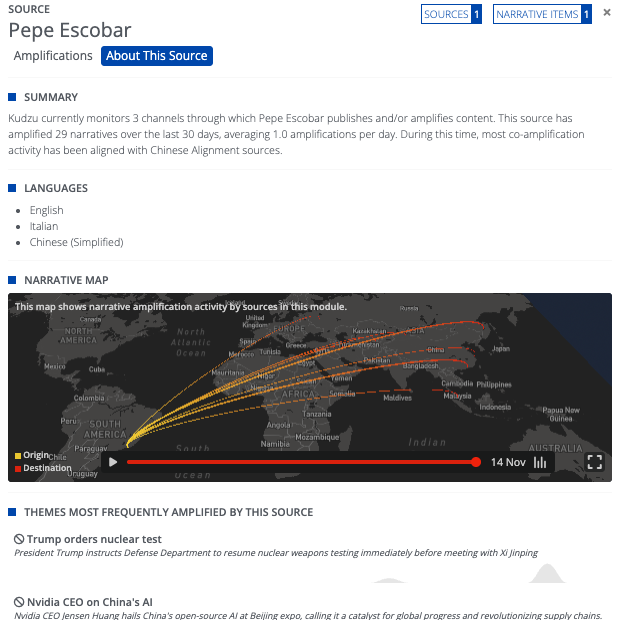
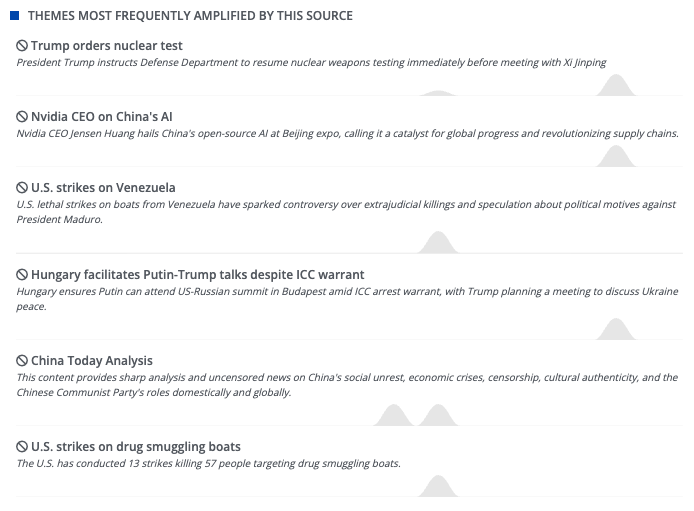

EdgeTheory’s source profiles give insights into the identity behind each narrative item in a brief. Statistics include what feed types a source uses, how often the source posts, and at what intervals; what themes are typically covered; whether those themes align with other sources, whether a source co-amplifies the same content as other sources, what languages are used, and how the source’s narrative topics are distributed geographically.


EdgeAgent on sentiment analysis
When asked about sentiment on Chinese control over rare earth materials the EdgeAgent stated. “China’s expanded controls on rare earth materials are framed by many Chinese and allied sources as necessary and legitimate measures to protect national security and safeguard economic interests amid increasing external pressures. These narratives emphasize that the controls are carefully regulated export licensing, not outright bans, designed to prevent sensitive military and dual-use applications that could destabilize global peace. China’s Ministry of Commerce and state sources portray the move as a responsible exercise of sovereignty and technological stewardship, responding to U.S. tariffs and export restrictions with a strategic effort to secure its domestic industries and leverage its dominance in the rare earth market for fairer trade negotiations. Supporters highlight China’s proactive communication with international partners and adherence to legal frameworks, positioning the actions as part of a broader effort to defend global stability and nonproliferation objectives.
Conversely, many Western and U.S.-aligned sources interpret China’s rare earth export restrictions as aggressive and coercive tactics aimed at wielding China’s near-monopoly over these critical materials as a geopolitical weapon in an escalating trade and technology rivalry. They stress the risks posed to U.S. and allied defense industries, advanced manufacturing, and semiconductor supply chains, warning of potential disruptions that could weaken national security and technology development. U.S. officials and media describe the controls as retaliatory moves following American tariffs and export bans, contributing to heightened tensions and prompting countermeasures like increased tariffs and stockpiling of critical minerals. This perspective frames China’s actions as part of a broader strategy to dominate global supply chains and limit foreign cooperation, fueling concerns over long-term supply vulnerabilities and exacerbating the already fraught U.S.-China relationship.”

Chinese X post on Chinese rare earth materials controls
These narratives emphasize that the controls are carefully regulated export licensing, not outright bans, designed to prevent sensitive military and dual-use applications that could destabilize global peace.
This X post by Melissa Chen outlines China’s current position with rare earth materials. She exposes that China has suffered environmental setbacks in order to achieve rare earth dominance with “48% of rare earth deposits and 70% of rare earth production with 90% of rare earth processing capacity.” China’s strategic focus on rare earth materials since the 1980s has allowed for their dominance in controlling the current market. This need for control has also created health issues among many provinces and villages including increased cancer rates and poisoned mines.

Russian X post on Chinese controls over rare earth materials
The mine imagery underscores industrial dominance and scarcity, while linking U.S. funding for Ukraine to REE vulnerabilities -an associative tactic that blends factual data with causal insinuation.
This post from Russian user Vladimir Sidoru states “China's sector controls 69% of global rare earth metal production, 92% and 98% of rare earth metal production, Margnto. The operational position of the USA may impact the functioning of Ukraine. The total capital of the fund is 150 million dollars.” The mine imagery underscores industrial dominance and scarcity, while linking U.S. funding for Ukraine to REE vulnerabilities—an associative tactic that blends factual data with causal insinuation. This narrative architecture recasts resource control as geopolitical coercion, implying Western policy misalignment and fragility in the face of China’s monopolistic position. In doing so, it exploits narrative vulnerabilities around economic dependence, amplifying strategic anxiety and eroding confidence in U.S. resilience.

Telegram amplification on Chinese REE controls
EdgeTheory’s Narrative Intelligence platform unearthed amplifiers of REE narratives via Telegram. Amplification by Kristina Potupchik on export controls and related technologies expanded on Chinese requirements to gain special approval for exports. This amplification also comments on negotiation trade tactics used against the US.
EdgeTheory’s Narrative intelligence demonstrates that the rare earth materials discourse is not a simple reflection of industrial policy but a form of economic competition. Through geospatial tracking and narrative density analysis, EdgeTheory’s tools uncovered how influence networks exploit factual narratives to build legitimacy and suppress skepticism. The structural design of these narratives—calm, data-heavy, and technically sound—allows state-aligned messaging to circulate widely in Western information environments without triggering traditional indicators of propaganda or incitement. In short, it is imperative to detect and counter these adversarial information operations as part of economic defense.
This paper underscores EdgeTheory’s value in operationalizing AI for strategic intelligence. By exposing the mechanics of narrative movement—how truth is reweighted, context reframed, and amplification engineered—EdgeTheory equips analysts and policymakers to recognize information patterns that traditional monitoring tools overlook. The rare earth narrative is thus not just an economic story but a test case for how digital ecosystems translate control into consensus, revealing a new frontier in information power dynamics.

