
Menu
Since early 2025, counter-narcotics operations in the Caribbean and Latin America have expanded in scope and intensity. A sequence of U.S. naval and aerial strikes against suspected drug trafficking vessels has drawn heightened attention from international and regional media. These actions coincide with a broader strategic posture that treats narcotics networks as asymmetric security threats, resulting in a shift from law enforcement operations toward militarized enforcement models.
This report traces competitive narratives around escalation, sovereignty, and legitimacy. Venezuelan and regional sources emphasize sovereignty violations and foreign intervention, while U.S.-aligned reporting frames the same actions as necessary security measures against organized crime. On the other hand, regional and adversarial sources coordinate narratives to paint the operations illegal that infringe on sovereignty and international law. EdgeTheory’s narrative intelligence solutions detect and identify key actors and amplification patterns behind such adversarial narratives.
A sequence of U.S. naval and aerial strikes against suspected drug trafficking vessels has drawn heightened attention from international and regional media.

Geospatial Narrative sources (yellow) and targets (red)
Narratives surrounding U.S. counter-operations in Latin America emerged from Doha, Pakistan, Moscow, and the United Kingdom. EdgeTheory’s Narrative Intelligence platform tracked narratives stemming from websites, social media actors, and RSS feeds. As narratives spread, the most frequent point of origin remained Doha, with Caracas remaining the primary destination. There are a total of 15 points of origin, and 16 destinations. Individual posters on social media are amplifying items around the narrative of escalating US military actions against suspected drug trafficking vessels near Venezuela. These individual posters include La Fleur Productions and DD_Geopolitics. Other sources include Mario Nawfal, and Money Control. The aggregated scores reflect moderate reliability (mostly 5-6, with a few 4s and one 7), indicating generally credible but sometimes uneven sources. Overall, the summaries convey credible yet contested information with notable incitement risk in parts.

Grok table of Chinese twitter network amplifying anti-U.S. narratives
EdgeTheory’s Narrative Intelligence uncovered Chinese sources involved in a network of anti-U.S. narratives amplified across Twitter. Three key narratives emerged from analysis of Chinese sources: Pro-sovereignty defenders, historical critics, and official echoes claiming the U.S. is at fault for rises in fentanyl usage instead of China. The pro-sovereignty narrative emerges from users such as: MFA_China, wpgchn, and aichishupian2. These users claim that the U.S. is forcing itself upon Latin America and by doing so affecting China. Posts include narratives about the U.S. demanding respect and attacking defenseless nation states, forcing the Monroe Doctrine upon international entities, and using the threat of Chinese involvement as a justification for controlling Latin America and the Caribbean via counter-narcotics operations. Posters under the historical critics include: SmallnoD, fxbest10888, and gotomyemail. These posts use alleged historical narratives to undermine the U.S. including: President Trump serving interest groups instead of seeking freedom from fentanyl, leftists legalizing drugs and blaming China for their drug issues, and the U.S. complicitly allowing for cartel military training in Ukraine while training in Russia. Lastly, Official echoes are from posters such as MFA_China, VRRT8CpQj3PEsGw, and _Inty_. These posters provide official reports on issues such as counter-narcotics operations, U.S.-LATAM tensions, and false reports on China’s strict control over fentanyl precursor exports.
EdgeTheory’s Narrative Intelligence platform recognized key themes from narratives centered on: conflicts over drug trafficking and U.S. legitimacy, U.S. declaration on drug combatants being declared unlawful, U.S. sanctions on the Colombian president, and US targeting of drug vessels in the Caribbean. The U.S. campaign to militarize the fight against cartels signals a strategic shift in Washington’s strategy to combat Foreign Terrorist Organizations (FTOs). The Trump administration’s action to designate cartels as foreign terrorist organizations reframes the conflict as a counterinsurgency problem rather than a criminal one. This strategic alteration provides resources for preemption, escalation, and armed intervention—authorizing the use of military force under a national security framework.
The Soufan Center brief warns that such a move risks strategic blowback. Military action on international soil could fracture trade relations, strain U.S. legitimacy in Latin America, and entangle American forces in an open-ended conflict with nonstate actors deeply embedded in civilian populations. The cartels’ decentralized structure and diversified networks make them resilient against traditional military targeting.

EdgeTheory GCA Social Media Narrative Classifier
EdgeTheory’s Narrative Intelligence platform uncovered individual posters on these topics such as the Nicaragua Solidarity Campaign, Fabrizio Verde, and the Communist Party of Great Britain. These anti-U.S. sources focus on socialist , pro-sovereignty narratives. Their coverage focuses on claims that the U.S. is intensifying military actions in the Caribbean under the pretext of fighting drug trafficking, including multiple strikes on alleged drug vessels that have caused casualties and raised regional tensions. The aggregated summaries reflect moderate reliability and accuracy, generally ranging around 5-7, with a few notably lower scores that hint at bias or less credible sources. The primary sources amplifying these narratives are predominantly Russian-aligned.
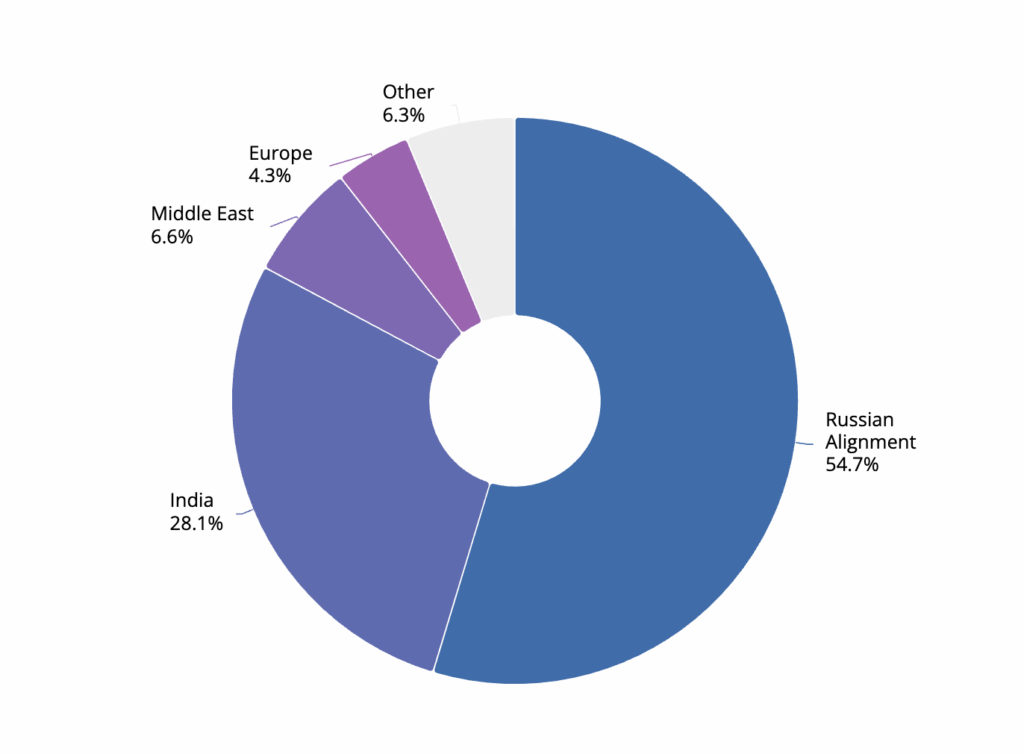
EdgeTheory NARINT sources tracing Russian-aligned narratives
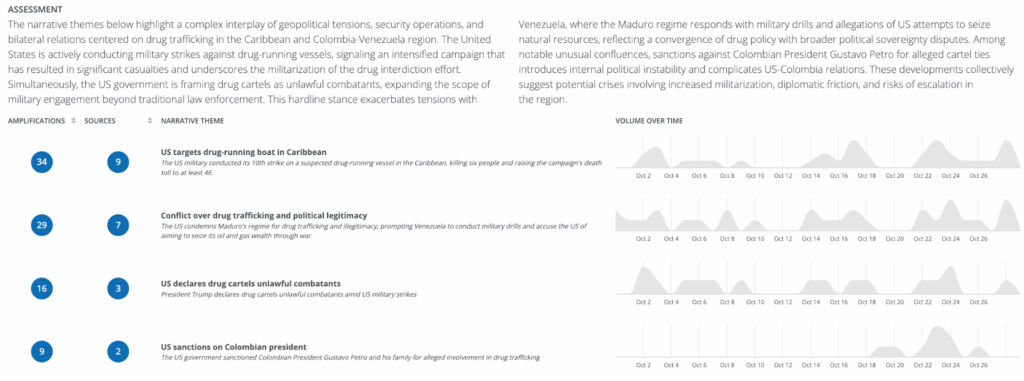
Key Themes from Colombia: U.S. Strikes on Venezuelan Boats Brief
U.S. counter-narcotics operations in the Caribbean and the Colombia–Venezuela corridor are shifting to militarized confrontation. The tenth U.S. strike on a suspected narco-vessel—killing six and raising the campaign’s total fatalities to at least forty-six—illustrates a doctrine treating cartels as combatants. Venezuela has responded with military drills and state media narratives framing U.S. actions as precursors to resource seizure. In Colombia, U.S. sanctions against President Gustavo Petro and his family over alleged cartel links have triggered political backlash and diplomatic strain. Narrative amplification has surged across regional channels: 34 sources linked to vessel strikes, 29 to Maduro’s conflict framing, 16 to cartel war rhetoric, and 9 to Petro sanctions. The trendline indicates escalating militarization, widening narrative fractures, and rising potential for interstate crisis.
U.S. counter-narcotics operations in the Caribbean and the Colombia–Venezuela corridor are shifting to militarized confrontation. Narrative amplification has surged across regional channels.

EdgeAgent response to reliability and pattern analysis
When asked about key sentiments in Latin America about counter-narcotics operations the EdgeAgent stated: “Tensions between the U.S. and Venezuela have sparked sharply divided emotional narratives across sources. Anti-U.S. outlets like Orinoco Tribune, Nicaragua Solidarity Campaign, Fabrizio Verde’s reports, and the Communist Party of Great Britain express anger and disgust at U.S. military strikes and covert operations, framing them as imperialistic aggression disguised as a “war on drugs.” These sources highlight perceived hypocrisy and moral violations, fueling resentment and sarcasm while emphasizing Venezuelan resilience and hope rooted in civic-military unity and community solidarity.
The trendline indicates escalating militarization, widening narrative fractures, and rising potential for interstate crisis.
Conversely, pro-U.S. sources such as Firstpost, Times Now, WION News, and Reuters justify the strikes as necessary actions against narcotraffickers, conveying trust and motivation to protect American security and disrupt drug networks. While their perspectives differ, both narratives acknowledge resilience: anti-U.S. voices focus on grassroots defense and cultural endurance amid external threats, whereas pro-U.S. sources emphasize institutional resolve and law enforcement efforts. This compact emotional landscape reveals how moral outrage, hope, justification, and strategic resolve intertwine within the polarized geopolitical framing of the conflict.”

La Lucha article on “Oil geopolitics disguised as war on drugs”
Many regional actors emphasize that this campaign serves US strategic interests in controlling Venezuela’s vast natural resources and countering rival powers like Russia and China rather than addressing narcotics flows genuinely. There is concern over the legal and humanitarian consequences of these operations. Many narratives amplify fears that intensified crackdowns may exacerbate instability and push trafficking to other regions.
Effective counter-messaging can reorient this discourse toward measurable results and institutional integrity.

X post on U.S. Naval Task Force operations in the Caribbean
Orlando Avedano, a Venezuelan journalist, discussed pro-U.S. views on counter-narcotics operations in Latin America. He states that “Latin countries (are) supporting the U.S. anti-narcotics offensives.” This signals a shift in Latin American support and creates the opportunity for further regional allies to collaborate in future operations. This post had 975 reposts, 3.7k likes, and 93.8k views.
The data collected across regional outlets, geospatial mapping, and narrative classifiers depict a rapidly intensifying information and operational landscape surrounding U.S. counter-narcotics activity in Latin America.

X post from Benjamin Norton
Ben Norton’s post exemplifies selective framing and false equivalence in anti-U.S. rhetoric. As one of the most prolific posters on X about counter-narcotics operations, Norton amplifies outdated narratives to discredit current U.S. policy. By resurfacing a 34-year-old declassified report on Álvaro Uribe’s alleged cartel ties—while acknowledging the linked source is nearly a decade old—he revives a discarded claim to indict U.S.-Colombia relations, omitting Uribe’s full acquittal by Colombia’s Supreme Court on October 21, 2025. The move collapses the line between historical speculation and verified outcomes, disregarding U.S. interdictions of multi-ton cocaine shipments from Venezuelan routes and reframing evidence-based operations as a “neocolonial war.” Effective counter-messaging can reorient this discourse toward measurable results and institutional integrity. Emphasizing Uribe’s record—demobilizing 30,000 paramilitaries, halving homicide rates, and reinforcing judicial independence through acquittal—replaces accusation with data.

X post on “baseless accusations” of Chinese involvement in narco-operations
Ethan Shen’s post highlights narratives tying China to counter-narcotics operations in Latin America. China has been tied to exports of fentanyl precursors as emphasized in President Trump’s meeting with Xi and other prevalent Chinese figures. Shen’s post compares Chinese exports of fentanyl precursors with "Australian iron being used in a knife that kills a person.” This uses the false analogy fallacy which ignores agency, intent, and control. The narrative seeks to equivocate Chinese involvement in counter-narcotics operations with other materials used to make potentially harmful materials. EdgeTheory’s Narrative Intelligence exposes opportunities for U.S. counter-messaging against such narratives that downplay China’s role in the current counter-narcotics operations. The post received 92 likes, 1 repost, and 16.3k views.
The data collected across regional outlets, geospatial mapping, and narrative classifiers depict a rapidly intensifying information and operational landscape surrounding U.S. counter-narcotics activity in Latin America. The convergence of militarized enforcement, political response, and cross-border information flows underscores how the counter-narcotics narrative now operates not only as a regional security storyline but as a strategic communication domain with direct implications for U.S. foreign policy.
EdgeTheory’s ability to recognize patterns of amplification revealed consistent polarization: U.S. narratives emphasize lawful interdiction and regional stability, while Venezuelan and allied sources depict the same operations as coercive and imperialist acts. The recurrence of Doha–Caracas transmission routes and social media amplification by Russian-aligned outlets indicates an active narrative contest shaping how U.S. intent is interpreted across the hemisphere.
The collected material illustrates an environment characterized by operational escalation and narrative competition, where the ability to shape and control discourse around these strikes carries critical implications for U.S. diplomatic legitimacy and influence in Latin America.
Lead Analyst: Connor Marr is an analyst at the EdgeTheory Lab. He is studying Strategic Intelligence in National Security at Patrick Henry College. He has participated in and led special projects for the college focusing on varied topics including: Cartels, Border Security, Anti-Human Trafficking, Debate of Cyber Strategy, and Chinese Infrastructural Projects in Africa.

