
Menu
Russia’s shadow fleet is now a hybrid instrument, sustaining oil exports while shaping international perception. EdgeTheory’s GCA module tracked 106 sources amplifying 278 narrative items, reflecting Russia’s effort to frame Western enforcement as “piracy” and delegitimize EU sanctions. Narrative origins shifted from Kyiv to Moscow, with destinations including Paris, New Delhi, and Tehran, signaling a coordinated transnational amplification effort. EdgeTheory’s Narrative Intelligence discovered Russia’s Shadow Fleet functioning near the Baltic Sea. Images of the Russian Shadow Fleet largely come from BBC, RFI, New York Times, The Guardian, and Reuters.
At sea, the fleet comprises over 1,100 aging, reflagged, and often uninsured tankers—nearly 18% of global tanker capacity—with almost 80% under sanctions. France, the UK, and NATO have attempted interdiction, seizing vessels such as the Boracay, yet these actions are portrayed by TASS, RT, and The Moscow Times as unlawful aggression. The fleet has caused multiple oil spills in European waters, exposing systemic environmental hazards.
This dual dynamic—physical evasion and narrative control—demonstrates Moscow’s strategic approach: maintain sanctioned revenue flows while shaping global perception, leveraging both legal ambiguities under UNCLOS and transnational amplification networks. Chinese logistical support, satellite monitoring, and drone capabilities further reinforce the fleet’s operational resilience, indicating an integrated strategy that fuses economic, military, and cognitive power.
Russia’s shadow fleet is now a hybrid instrument, sustaining oil exports while shaping international perception.

EdgeTheory Brief Sourcing & Narrative Tracking
EdgeTheory image trace identifies narratives and sources tied to a single image. This enables cross-referencing across EdgeTheory’s sourcing modules. Analysis of an image of Russia’s Shadow Fleet shows heightened amplification of fleet-related narratives, including sanction evasion, environmental hazards, and strategic maritime maneuvers.

Shadow/Grey Fleet vessels & national flag usage

Graphics on Russia’s “Shadow Fleet” crude oil shipments

Image of Eagle S. ship of Russian Shadow Fleet
The Eagle S, a vessel belonging to Russia’s Shadow Fleet, was escorted out of the Baltic Sea by the Finnish Coast Guard following suspicions of subsea cable tampering. The Finnish Border Guard pursued the tanker and ordered it to enter Finnish territorial waters. Once the ship complied, armed special forces deployed from two helicopters and boarded the vessel. The incident marked a rare show of force in Northern European waters amid rising concern over hybrid maritime threats. One month later, Swedish authorities detained another vessel suspected of damaging a subsea cable between Latvia and Sweden, though the operation unfolded with far less intensity.
What began as covert trade circumvention has evolved into overt military protection of illicit economic activity.

RFI Article image of Shadow Fleet ship “The Boracay”
RFI reported that French forces boarded “The Boracay,” a vessel tied to Russia’s Shadow Fleet and active in the Baltic Sea. The operation marked one of the first direct European actions against Moscow’s sanction-evasion network. The boarding signaled a move toward stronger enforcement in EU waters and tested joint maritime coordination. Reports indicated that “The Boracay” was likely carrying reflagged oil shipments concealed through layered ownership networks, a tactic the fleet uses to disguise the true origin of Russian exports.
Old hulls are reflagged, renamed, or shell-owned to maintain trade routes under new corporate veneers.

Image of Shadow Fleet ships ‘Perle’ and ‘CCH Gas’ transferring goods
China’s entry into Russia’s “shadow fleet” represents a new phase of covert energy logistics—one that merges digital silence, maritime deception, and geopolitical intent under a single narrative frame. The gCaptain report traces the first-ever LNG ship-to-ship (STS) transfer between Russian and Chinese vessels, executed off Malaysia under AIS blackout conditions. This is not just a logistical maneuver—it’s a proof-of-concept for sanctions evasion using liquefied cargo, signaling the evolution of the dark fleet model from crude oil to LNG. The transfer between Perle and CCH Gas quietly redefines how energy narratives move across the global system: beneath radar, beneath regulation, but fully within the emerging logic of multipolar trade resistance.
EdgeTheory alignment identifies this event as a high-signal amplification of anti-sanctions adaptation. The “shadow fleet” narrative is no longer a Russian survival mechanism—it’s a distributed playbook now adopted by China. By using off-grid transfers and obfuscated ownership trails, the operation reframes LNG as an instrument of narrative warfare—undermining Western control narratives over critical energy corridors. The partnership activates a new edge network across the maritime infosphere: dark logistics, data obfuscation, and state-aligned commercial autonomy. Each transfer becomes both an act of energy exchange and a message—one that says multipolar power no longer sails under Western light
MDPI article on Shadow Fleets growing challenge in maritime
The MDPI study reframes Russia’s Shadow Fleet as more than a sanctions workaround—it’s an information and logistics architecture designed to sustain state narratives of autonomy under constraint. By charting the rise of tankers that vanish from digital visibility through AIS silence, false flagging, and shell ownership, the research exposes how maritime opacity becomes a narrative instrument. Each vessel functions as both an energy courier and a story in motion—one that erases Western oversight while projecting resilience and self-sufficiency across the global maritime stage. In EdgeTheory terms, the fleet is not just physical infrastructure but narrative infrastructure: a distributed network that transmits defiance, decentralizes control, and normalizes the economics of invisibility.
The “shadow fleet” narrative is no longer a Russian survival mechanism—it’s a distributed playbook now adopted by China.

EdgeAgent synthesizing locations & routes of shadow fleet vessels
The EdgeAgent when asked about locations and primary sources about the Russian Shadow Fleet stated: “Russia Today reported extensively on the oil tanker Boracay, a vessel blacklisted by the EU as part of the "Russian shadow fleet." The tanker, sailing under a Benin flag with an international crew, was detained by the French Navy near Saint-Nazaire, France. Russian officials denounced the detention as an act of piracy, questioning the legal basis and highlighting the vessel's lack of confirmed military cargo. Following its release, tracking data showed the Boracay continued its voyage, crossing the Bay of Biscay and heading towards the Suez Canal. The tanker’s route drew attention due to its passage near Denmark, which was linked by French President Macron to sightings of unidentified drones over Danish airports and military sites. These details point to key locations and routes of shadow fleet vessels, with the Russian port of Primorsk serving as an origin point for such tankers. The Boracay’s journey through Nordic waters near Denmark, across the Bay of Biscay, and detention off the French coast near Saint-Nazaire illustrate the shadow fleet’s operation in and around European maritime zones. Such pathways highlight how these vessels navigate under flags of convenience and transit through strategic shipping lanes while facing scrutiny from European authorities.”

Twitter post on Russian Shadow Fleet Mapping
For the first time, the Russian Navy has reportedly provided overt military escort to oil tankers belonging to Russia’s shadow fleet as they transited the English Channel. This signals a major escalation in Russia’s defense of evading sanctions and a willingness to use conventional navy assets to protect commercially operated vessels tied to illicit oil exports. The escort complicates Western enforcement of sanctions, because interception of tankers now risks direct confrontation with the Russian navy.

Russian Telegram post on Shadow Fleet logistics
Between 2020 and 2025, Russia has developed and operationalized a large-scale “shadow fleet” to sustain oil exports while evading Western sanctions. This fleet, composed of older and often reflagged tankers under opaque ownership, has become central to Moscow’s sanctions-evasion strategy. Recent open-source reporting indicates a shift from covert logistical operations to overt military protection and public acknowledgment, signaling a significant escalation in Russia’s maritime posture.

Weibo post highlighting Russia Shadow Fleet
This Weibo post from Zunyi Release highlights Russia’s “shadow tanker fleet” that is evading western sanctions. The EU has responded with calls for sanctions on Russia due to their Shadow Fleet and continued role in Ukraine. Western countries have accused Russia of using their shadow fleet for evasion purposes against economic warfare.
The fleet is not just physical infrastructure but narrative infrastructure: A distributed network that transmits defiance, decentralizes control, and normalizes the economics of invisibility.
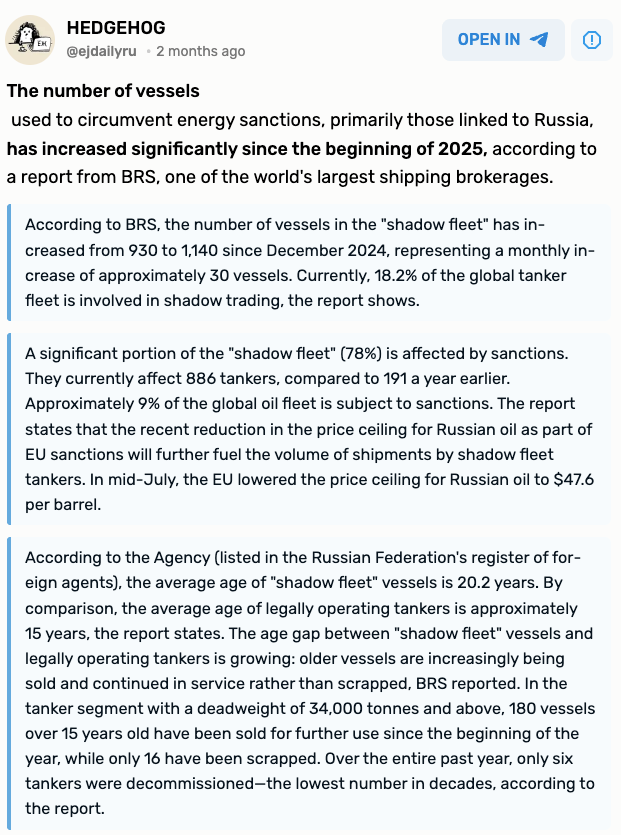
Telegram post on Russian Shadow Fleet
Russia’s shadow tanker fleet has become a fixed feature of the global oil market, not a temporary workaround. It has grown from 930 ships in late 2024 to 1,140 by mid-2025—roughly 18% of the world’s tanker capacity. Almost 80% of these vessels now face sanctions, a fourfold increase in a year. The EU’s price cap cut to $47.6 per barrel has pushed traders deeper into opaque networks that use reflagged and shell-owned ships to keep exports moving. The average shadow vessel is 20 years old, five years older than compliant ships. Owners are holding on to aging hulls instead of scrapping them: 180 have been repurposed this year, only 16 dismantled, and just six scrapped globally—the lowest count in a decade. The data show a durable system of evasion taking shape. Sanctions have not constrained trade; they have restructured it into a parallel, unregulated maritime economy built on concealment and profit.
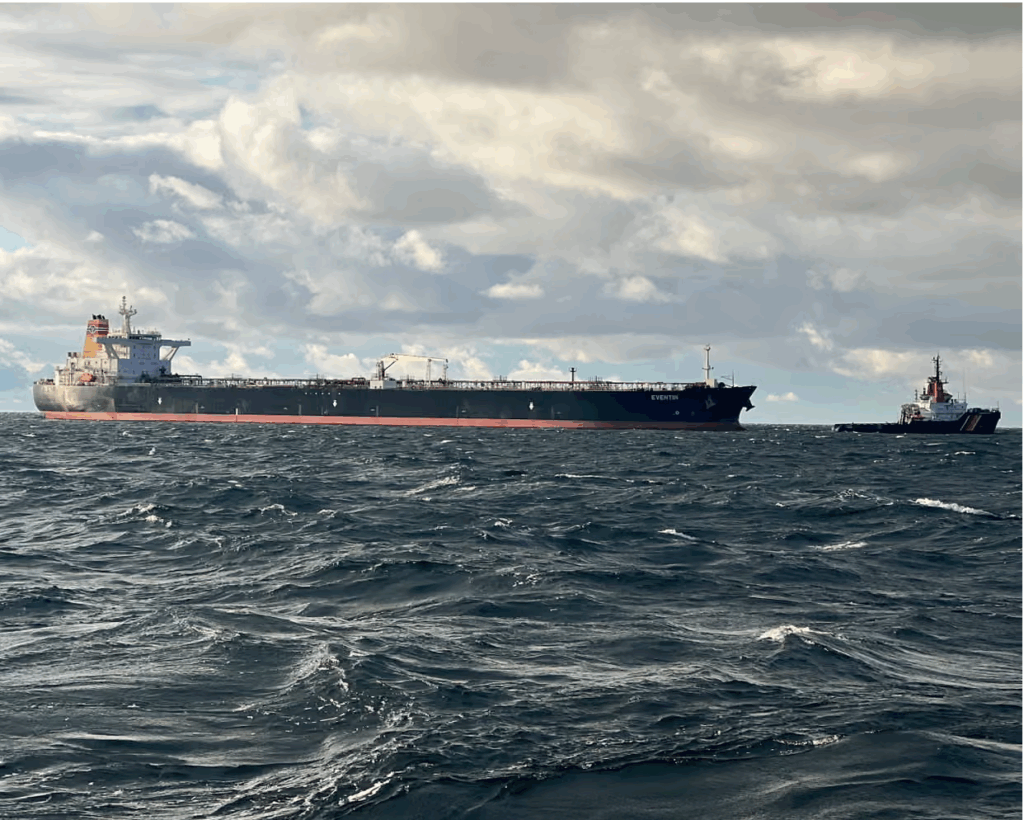
The Guardian image of Russian Shadow Fleet in German waters
The Guardian’s mid-January geolocation traced Russia’s Shadow Fleet operating inside German waters en route to Egypt. The fleet reportedly carries up to 85% of Russia’s oil exports, forming the core artery of Moscow’s sanction-evasion logistics. Operating across the Baltic Sea, these tankers sustain covert energy flows to the Middle East, bypassing Western trade controls. EU ministers have called for coordinated interdiction measures, warning that the fleet’s continued evasion of sanctions undermines European authority and maritime transparency.

Telegram post on Russia’s Shadow Fleet
Russia’s sanctioned oil fleet is now a maritime hazard as well as an economic one. A SourceMaterial investigation, reported by Politico, found multiple shadow tankers discharging oil into European waters while moving sanctioned crude. At least five incidents occurred in the past year, including two vessels already blacklisted by the UK. The spills left visible slicks along European coastlines and narrowly avoided large-scale environmental disaster. Latvian Energy Minister Kaspars Melnis called the pattern “a huge problem” that Europe “miraculously manages to avoid,” describing it as “Putin’s desperate and dangerous attempt to preserve oil revenues by polluting the seas.” British officials have issued similar warnings, citing the fleet’s poor maintenance and lack of safety compliance. The data point to systemic risk: aging, uninsured tankers operating under false flags are not just evading sanctions—they are eroding Europe’s maritime safety buffer and turning energy circumvention into an ecological threat.
Leveraging EdgeTheory's Global Cognitive Adversaries (GCA) module, this analysis traces the evolution of Russia’s shadow fleet. It began as a makeshift sanctions evasion tactic but has matured into a fortified maritime apparatus. The findings in this paper expose the fused dynamics at play: government-engineered supply chains and escalated disinformation maneuvers. By tracing 106 sources across 278 narrative items—spanning platforms like Twitter, Telegram, and Weibo—the module mapped the convergence of naval escorts with coordinated propaganda that reframes Western enforcement as piracy, exposing how these elements transform economic circumvention into a layered strategic apparatus.
| Putin has engineered a parallel, unregulated maritime infrastructure, sustained through state-enabled opacity, narrative amplification, and profit-motivated enablers. |
The GCA's image trace and sourcing analytics further illuminated the fleet's role in eroding maritime norms and diluting sanctions efficacy, with cross-referenced visuals linking fleet maneuvers to environmental hazards and sanction-evasion narratives. The module's tracking of amplification shifts—from Kyiv origins to Moscow hubs, then to global destinations like Paris, New Delhi, and Tehran—demonstrates a transnational network sustaining this ecosystem. This intelligence reveals a geopolitical dynamic where sanctions reshape rather than constrain trade: Putin has engineered a parallel, unregulated maritime infrastructure, sustained through state-enabled opacity, narrative amplification, and profit-motivated enablers, as evidenced by the fleet's expansion to over 1,100 vessels comprising 18% of global tanker capacity.
Lead Analyst: Connor Marr is an analyst at the EdgeTheory Lab. He is studying Strategic Intelligence in National Security at Patrick Henry College. He has participated in and led special projects for the college focusing on varied topics including: Cartels, Border Security, Anti-Human Trafficking, Debate of Cyber Strategy, and Chinese Infrastructural Projects in Africa.

