
Menu
This report tracks Russia’s deployment of coordinated propaganda around Moldova’s September 28 election. EdgeTheory’s Narrative Intelligence platform identified 57 global sources amplifying 214 narrative items that mirrored the Kremlin’s broader toolkit: ridicule, urgency escalation, narrative flooding, and projection. Geospatial data show narrative flows originating in Moscow and Kyiv before cascading into Chisinau from 18 origins across Europe, Asia, Africa, and the U.S., reflecting how Russia-linked messaging spreads through multi-vector channels. Engagement metrics highlight how anti-disinformation voices can counter and reframe these operations, while still revealing the scale of Russia’s investment—hundreds of millions of euros—in shaping Moldova’s political trajectory. The case illustrates how Moldova, though geographically small, has become a frontline in Russia’s perception war.

BBC article on Russian disinformation network to influence Moldovan elections
In recent days BBC exposed that Russia was actively trying to destabilize Moldova’s recent parliamentary election through one of their most aggressive interference campaigns to date. Authorities disclosed large-scale vote buying, disinformation operations, and plots for violent unrest tied to Moscow’s networks. The government framed the ballot as a decisive choice between a pro-European course anchored in EU accession or a return to Russian influence.
The contest illustrates Moldova’s fragile geopolitical position between Romania and Ukraine. Since Russia’s invasion of Ukraine, Chisinau has accelerated integration with the EU while Moscow has escalated hybrid tactics, AI social media operations, investing heavily in propaganda, and illicit financing. Opposition leaders, many openly aligned with Moscow, dismissed interference claims as political theater and threatened mass protests against any pro-EU victories in the Moldovan parliament. The stakes extended beyond Moldova’s borders: a Russia-leaning government could strengthen Moscow’s foothold in Europe, complicate Ukraine’s security, and undermine EU cohesion. The BBC’s article is the highest factual fidelity and source reliability in the infosphere surrounding the Moldovan elections. It counteracts the narratives stemming from Sputnik, RT, and TASS.
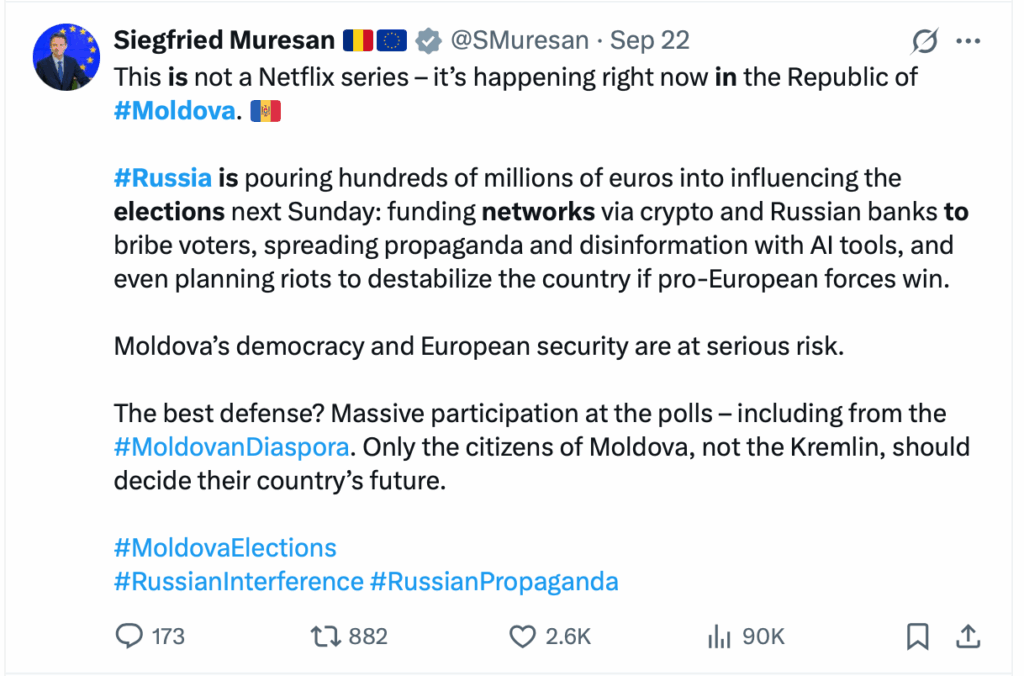
X post on destabilized Moldovan elections
This post amplifies the scale of Russian activity, framing it as coordinated and adaptive—mixing AI-driven influence, bribery pipelines, and destabilization plots. Engagement metrics show 882 reposts, 2.6K likes, 90K views, and 173 comments. Relative to Moldova’s small digital footprint, that volume signals outsized traction—anomalously high for a niche geopolitical thread. The post reframes Moldova from a local issue to a front in Europe’s cognitive defense perimeter. The resonance matches BBC framing that Moldova’s small size conceals its strategic gravity. Narrative uptake remains strong, indicating the message effectively translates localized instability into a European security storyline.
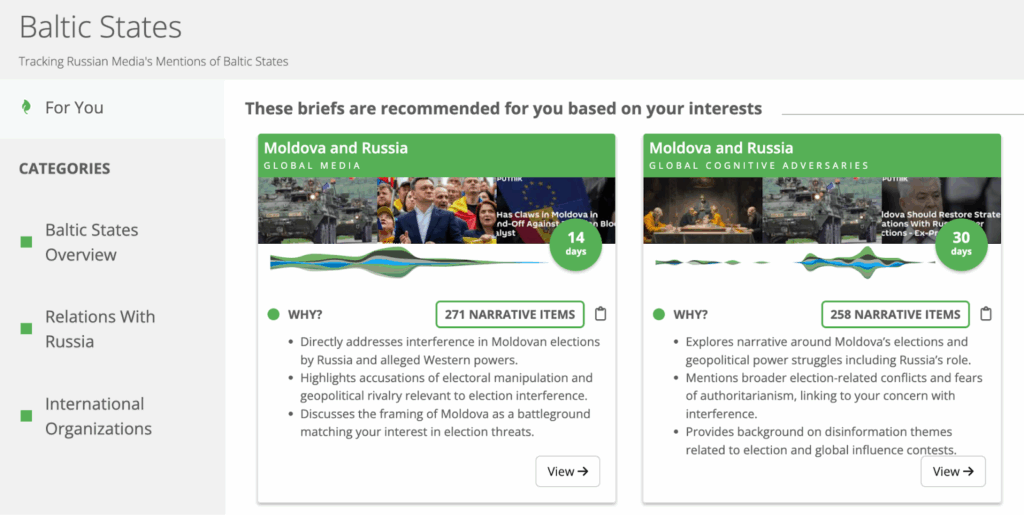
Viewpoint made for Moldova and Russia
The EdgeTheory Viewpoint system converts analyst intent into targeted intelligence briefs. Users submit a prompt that defines their operational or analytic need. The system interprets that input, maps it against relevant data streams, and automatically generates collections of briefs aligned to that specific mission context. Each brief functions as a narrative module within a larger ecosystem of insight. Together, they create a dynamic intelligence picture tailored to the team’s focus area. The Viewpoint model replaces static reporting with adaptive narrative mapping, giving analysts faster, mission-aligned situational awareness and precision control over framing and scope.
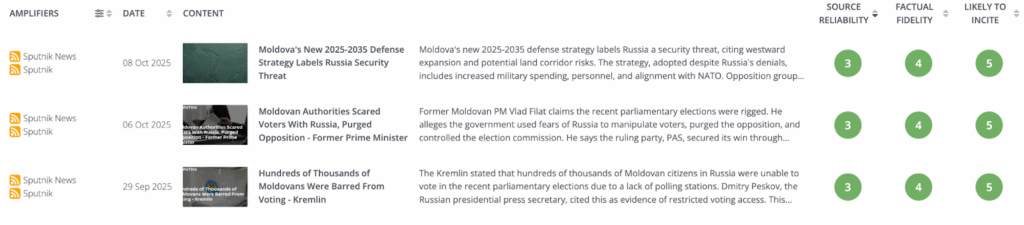
Factual Fidelity tracing via EdgeTheory briefs
EdgeTheory’s narrative tracking of source reliability, factual fidelity, and incitement rates track that the least reliable narratives stem from Sputnik News. Sputnik amplifies narratives that Moldova’s election was a failure due to violations of election statutes and falsified election results. These narratives also amplify Moldova’s position on increased European integration. The most reliable narratives are amplified by Al Arabiya English and Agence France-Presse which state that Russia failed to destabilize the Moldovan elections due to their resilience against cognitive warfare tactics.
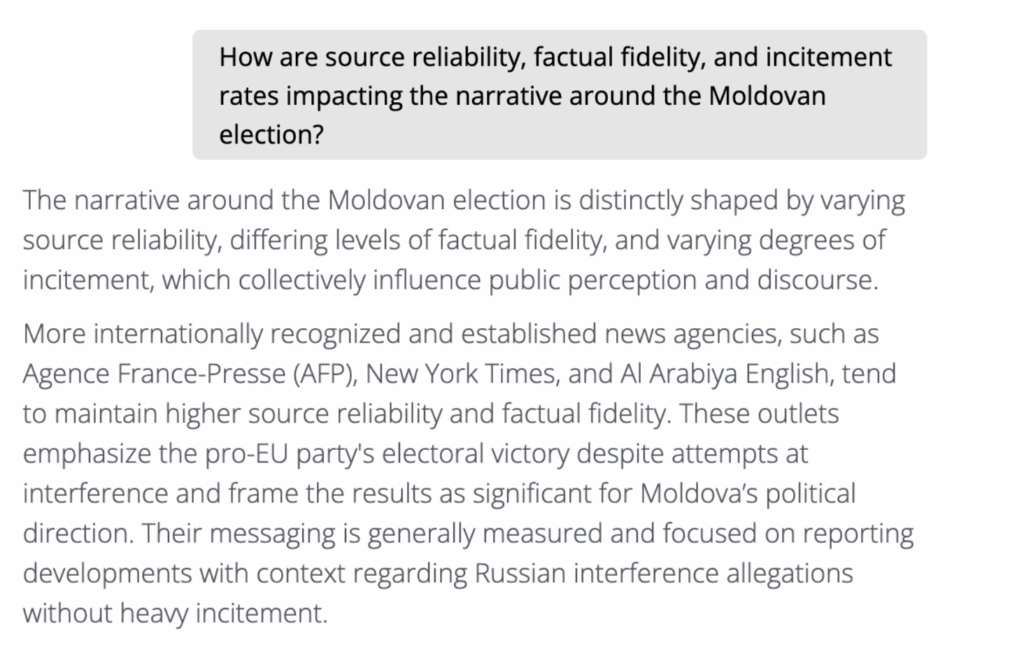
EdgeAgent UI on narrative warfare
When asked about the recent Moldovan elections, the EdgeAgent provided insight into: factual fidelity, source reliability, and the likelihood of incitement. The EdgeAgent stated: “The narrative surrounding the Moldovan elections is deeply influenced by a divide between high-reliability, fact-based reporting from established international media, which generally affirms the pro-EU party’s legitimate victory despite challenges, and more politically charged, lower-fidelity sources associated with Russian state media that emphasize allegations of government manipulation, opposition suppression, and provocations toward Russia. This latter framing often employs alarmist and inciting language that undermines trust in the electoral process and amplifies societal polarization. Together, these dynamics create a contested information environment where credible accounts coexist with synthetic or misleading narratives, complicating public understanding and heightening geopolitical tensions linked to Moldova’s democratic trajectory and regional security.”

The Guardian article on Moldovan election interference outcome
Moldova’s pro European Action and Solidarity party (PAS), led by President Maia Sanu, secured a parliamentary majority, winning about 50% of the vote and 55 of 101 seats, despite allegations of Russian interference, vote-buying, and cyber-attacks. The victory strengthened Sandu’s push for EU membership, a goal recently enshrined in Moldova’s constitution, and was welcomed by European leaders as a blow to Moscow’s efforts to regain influence in Moldova. Moldovans were hard to persuade in the recent elections because heightened awareness of the Russian threat, stronger institutional resilience, and a growing pro-European identity made traditional interference tactics like disinformation and vote-buying far less effective. This article falls under the most reliable sources due to its heightened factual fidelity on the Moldovan elections.

X post on Russian election interference in Moldova
This post highlights Russia’s use of multiple tools: from NGOs and oligarchs to crypto wallets and social media brigades, to shape Moldova’s election and influence the EU. The attached image utilizes ridicule as a cognitive tactic, framing Russia’s supporters as gullible and manipulated. The post itself mirrors the strategies it critiques: it simplifies complex networks into a digestible narrative, aiming to inoculate audiences against Kremlin narratives by associating them with absurdity. Analytics-wise, the post shows modest amplification (87 likes, 33 reposts, 1.2K views). While not viral, its targeted audience, followers interested in European security and hybrid warfare, extends the reach of the BBC’s revelations by reframing them as part of a larger war for perception and legitimacy.

X post claiming Russian investment 300M euros in Moldovan election
This account amplifies Moldova’s ambassador’s warning that Russia has committed €300M to sway the September 28 election. The post weaponizes detail, overwhelming the audience with evidence to cement belief in a “total hybrid war.” This style of messaging leverages information overload to shape perception: the more numerous the tactics, the more plausible the sense of existential siege. Analytics show strong resonance: 7.8K likes, 263 reposts, and nearly 20K impressions, suggesting broad reach beyond Moldova specialists. This reflects the BBC’s observation that networks operate across multiple spectrums (TikTok, Telegram, NGOs), with amplification designed to erode trust in institutions and redefine the mental battlespace itself.

Telegram post from Moldova Now on Moldovan elections
This post from Moldova Now reframes Moldova as the next strategic fault line in Russia’s influence network, merging electoral fragility with Transnistrian escalation to build a perception of impending crisis. It positions President Maia Sandu as politically vulnerable, amplifying narratives of Western disunity and “proxy fatigue.” Engagement levels—123K views with sustained repost and comment activity—show strong algorithmic lift and high resonance within geopolitical discourse clusters. The traction suggests effective narrative design: framing Moldova’s elections not as a domestic issue but as an inflection point in Europe’s containment strategy. The post functions as both analysis and amplification, feeding the wider information ecosystem that Russia exploits to cast doubt on Moldova’s stability and to legitimize interference under the guise of regional recalibration.

Telegram post from Causeni.News on Moldovan elections
This post from Causeni.News operationalizes a Russian tactic for cognitive warfare—identity erosion—framed through Maria Zakharova’s claim that Moldovans would become “NATO servants” if they vote for EU accession. It links national identity loss to Western alignment, reinforcing fear of cultural displacement and NATO encirclement. Engagement indicators—visible multilingual formatting, emoji signaling, and cross-language repetition—show targeting toward both Moldovan and international audiences to maximize algorithmic circulation. The content syncs with Russia’s broader interference playbook: framing Western integration as betrayal, amplifying opposition narratives, and eroding confidence in democratic legitimacy before ballots are cast

X post on Moldova “weathering” Kremlin election interference
This X post from Brian P. Williams pushes a high-impact narrative on Kremlin-financed election interference in Moldova, quantified through alleged bribes of 50 euros per vote and 300,000 voters bought. The framing fuses corruption and sovereignty violation tropes to escalate urgency and weaken pro-Russian legitimacy. The embedded YouTube link and promotional overlay reveal cross-platform narrative blending, where interference discourse doubles as a funnel to external content monetization. Hashtags (#Moldova, #Kremlin, #ctpolitics, #propagnada) attempt to drive visibility across geopolitical and domestic political streams, though reach data indicates the message remained siloed within a narrow audience.

X post on Russian hybrid warfare against Moldova
This post frames Russia’s hybrid war against Moldova as escalating, citing statements from both Maria Zakharova and a pro-Russian Romanian candidate to highlight how Moscow is pushing the narrative that Moldova is becoming a NATO launchpad. With 31.7K views, 667 likes, and 160 reposts, the post has significant amplification, showing how anti-disinformation voices can spread counter-narratives quickly. This reflects the information battlefield uncovered in the BBC investigation, where Russian-funded networks weaponize social media with propaganda.

X post reporting Russian bot networks are active
The Stratcom Centre post, amplified by George Foulkes, pushes a red-alert framing that Russia is preparing to use Moldova as a springboard against Ukraine’s Odessa region. With 75.2K views, 2.1K likes, 1K reposts, and over 100 comments, this post has significant reach showing how official institutions and influencers can harness amplification power to counter Moscow’s strategy of disinformation, bribery, and intimidation.
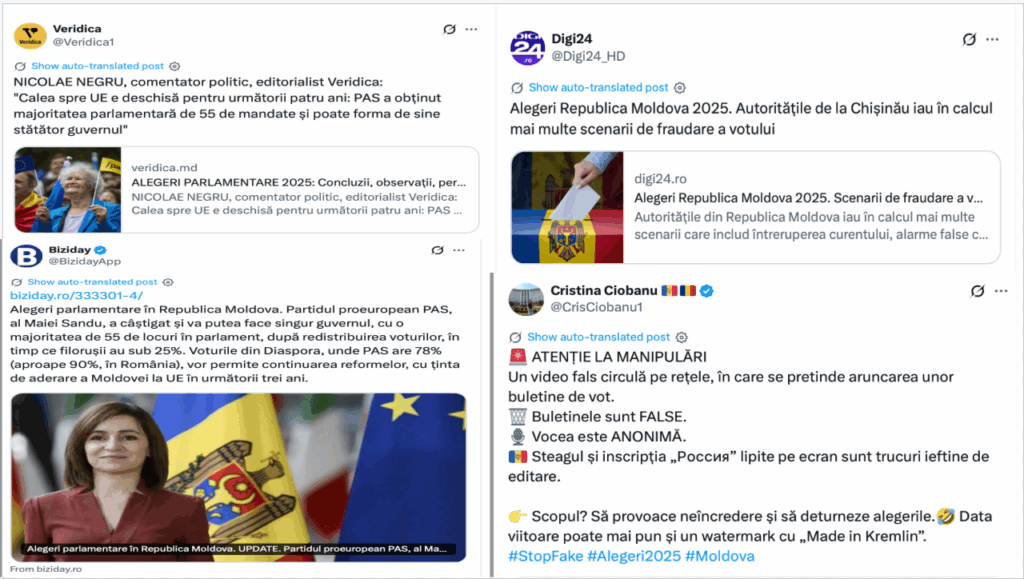
Multilingual analysis of pro & anti Russian narratives for Moldovan election
Posts from accounts like @Veridica1 and @BizidayApp celebrate pro-EU candidates as a clear path toward EU integration, emphasizing high voter turnout in the diaspora. However, posts from @Digi24_HD discuss authorities in Chișinău preparing for multiple fraud scenarios, such as disruptions to the voting process or false alarms. They also highlight vulnerabilities, as similar tactics could influence future elections in Europe, positioning Moldova as a “testing ground” for hybrid warfare.
Moldova’s strategic value lies less in geography than in its role as a proving ground. By testing disinformation tactics in a small, high-stakes arena, Russia develops narrative weapons for export to other European theaters, from the Baltics to the Balkans. Counter-messaging in Moldova thus offers lessons for resilience across the EU.
Ultimately, the struggle underscores the new reality of hybrid warfare: legitimacy is the terrain. Russia seeks to hollow out institutions, delegitimize elections, and discredit alliances. Yet its attempts in Moldova were less successful because the narratives failed to match local sentiment. Recycled Soviet nostalgia and anti-Western tropes lacked traction among younger, digitally aware citizens. Independent journalists and civil society groups quickly exposed fake networks, turning disinformation into evidence of foreign interference. Western and Moldovan analysts also coordinated real-time monitoring, linking online activity to Kremlin assets and eroding public trust in manipulated outlets.
Success for counter-narratives does not come from silencing Moscow but from reframing its claims as absurd, recycled, or self-incriminating. Moldova reveals both the persistence of Kremlin disinformation and the growing sophistication of those resisting it—pointing to a future where perception warfare, not firepower, defines Europe’s security architecture.
Lead Analyst:
Connor Marr is an analyst at the EdgeTheory Lab. He is studying Strategic Intelligence in National Security at Patrick Henry College. He has participated in and led special projects for the college focusing on varied topics including: Cartels, Border Security, Anti-Human Trafficking, Debate of Cyber Strategy, and Chinese Infrastructural Projects in Africa.

