
Menu
Growing U.S.–Philippines defense cooperation, expanding multilateral naval drills, and China’s increasingly assertive military posture have heightened tensions across the South China Sea. The establishment of Task Force-Philippines, combined with joint maritime and air exercises involving the United States, Japan, Australia, and other regional partners, signals a deepening effort to counter Beijing’s territorial claims and projection of force. China has responded by showcasing rapid naval modernization and high-visibility bomber patrols, framing its actions as defensive and legitimate while condemning foreign presence near disputed waters. Edgetheory’s AI analytics indicate a discernible escalation of cognitive confrontation about the South China Sea.
Simultaneously, narratives surrounding Taiwan, Japan’s evolving defense posture, and demographic trends across Asia further intensify the narrative confrontation of the region. e. As actors leverage social media, expert commentary, and coordinated online amplification, the South China Sea has become both a physical and informational theater of conflict. This report outlines how these narratives spread, who amplifies them, and how EdgeTheory’s tools surface both adversarial networks and allied messaging that can support stability and cooperation in the region.
1. Distinct Narrative Networks Are Driving Escalation in the South China Sea
Chinese-aligned Telegram channels, geopolitical aggregators, and RedNote commentary are amplifying narratives portraying PLA patrols and exercises as lawful, defensive responses to foreign “provocations,” often highlighting U.S. aircraft incidents and joint drills to depict Washington as destabilizing. In contrast, Philippine, U.S., and Japanese sources stress alliance cooperation, freedom of navigation, and the need to counter coercive behavior. These parallel networks reflect an increasingly polarized information environment shaping perceptions of escalation in the South China Sea.
2. China’s Military Modernization Is a Central Driver of Narrative Volume and Threat Signaling
The deployment of China’s Fujian aircraft carrier and bomber formation patrols serve as both operational moves and communication tools aimed at asserting sovereignty claims. PLA media uses these activities to demonstrate readiness, reinforce domestic legitimacy, and discredit multilateral drills as destabilizing. These narratives dominated Chinese amplifiers and circulated heavily across Beijing-origin nodes.
3. Malign Actors Are Transregionally Networked Across Geospatial and Social Dimensions
Pro-China narratives move through a transregional network of state media, economic partners, political actors, and digital influencers; The Philippine Daily Inquirer—by consistently advancing pro-US, Quad, and AUKUS-aligned frames—cuts into this ecosystem by disrupting message cohesion and weakening the effects that sustain adversarial influence.
4. EdgeTheory Can Identify Friendly Networks and Amplify Stabilizing Narratives
Just as the platform detects adversarial coordination, it also surfaces partner actors who consistently promote aligned, transparent, and cooperative messages. Edgetheory’s network analytics show that sources such as The Philippine Daily Inquirer propagate narratives of U.S.–Philippines–Japan exercise coverage, regional security statements, and pro-rules-based-order narratives form a distinct cluster of friendly messaging.
EdgeTheory’s tools can elevate these networks to strengthen deterrence, reinforce shared values, and support strategic communication objectives in the Pacific.
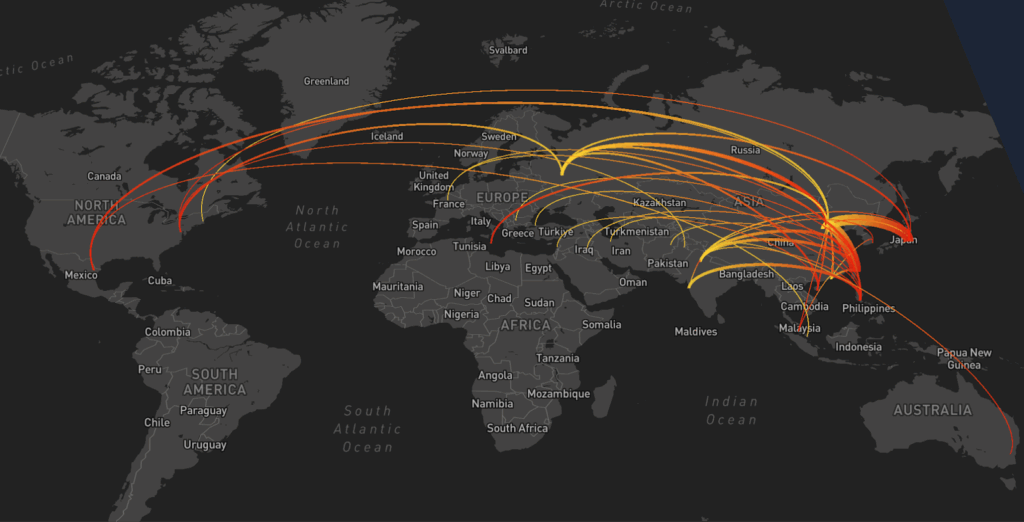
Geospatial Narrative sources (yellow) and targets (red)
Narratives surrounding naval drills in the South China Sea initially emerged from Hong Kong, headed for Taipei. As it spread, the most frequent origin shifted to Beijing, and the most frequent destination shifted to Beijing. There are a total of 17 points of origin, and 17 destinations. EdgeTheory’s Narrative Intelligence platform tracked narratives stemming from websites, social media actors, and RSS feeds. Individual posters on social media are amplifying items around the narrative of escalating military and geopolitical tensions in the South China Sea. These individual posters include World News South China Morning Post DD GeoPolitics CNA The Informant ASIAMTI and KSG India.Their posts frequently focus on key developments such as the creation of Task Force–Philippines, expanding joint naval and air exercises involving the U.S., Japan, Australia, and regional partners, and China’s PLA Navy live-fire drills and bomber patrols.
Many of the insights originate from the People’s Liberation Army Navy, Dai Xu, a Senior Colonel and military commentator, Zhang Zhaozhong, retired PLA Navy Admiral, and state/media outlets. These accounts form a top-tier “origin network” for messaging: state media, PLA official accounts, and prominent commentators set framing and themes. They are amplified downstream by nationalist pundits, social-media “enthusiast” accounts, and regional proxies which help distribute and embed the narrative among broader audiences.
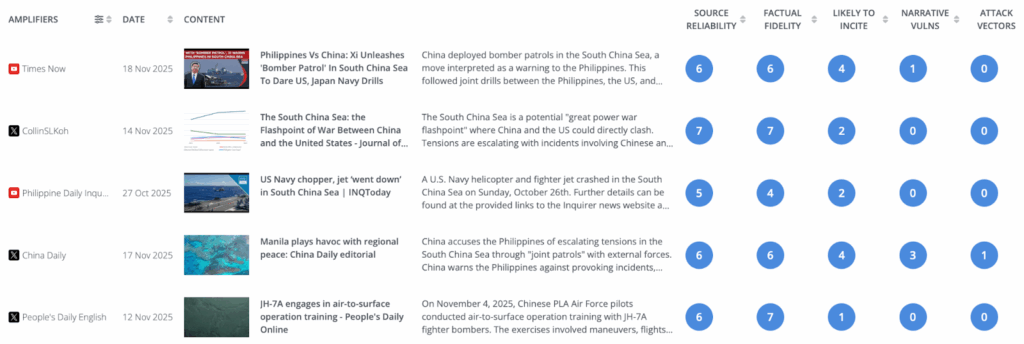
EdgeTheory GCA Social Media Narrative Classifier
The primary sources amplifying this narrative are predominantly Chinese-aligned. The narratives score moderately high on reliability and accuracy, generally ranging from 5 to 8, with most falling between 6 and 7. This indicates a fair degree of trustworthiness and factual soundness. Incitement levels are mostly low to moderate, typically between 1 and 4, suggesting that while some content may stir tensions, most aim to inform rather than provoke. Times Now’s framing of PLA “bomber patrols” as a direct warning to the Philippines scores a 4 on likelihood to incite, leveraging confrontational language that can heighten perceptions of imminent conflict. Similarly, the Philippine Daily Inquirer’s coverage of the U.S. Navy helicopter crash, which scores a 5 on narrative vulnerability, is repeatedly repurposed by foreign actors to suggest U.S. military weakness in the South China Sea. China Daily’s narrative accusing Manila of provoking tensions receives one of the highest incitement-adjacent scores, reflecting its potential to inflame bilateral distrust and reinforce adversarial threat perceptions. Detecting these high-impact narratives early is essential because they can quickly increase tension, fuel misunderstandings about military activity, and undermine trust in U.S. and partner operations in the region.
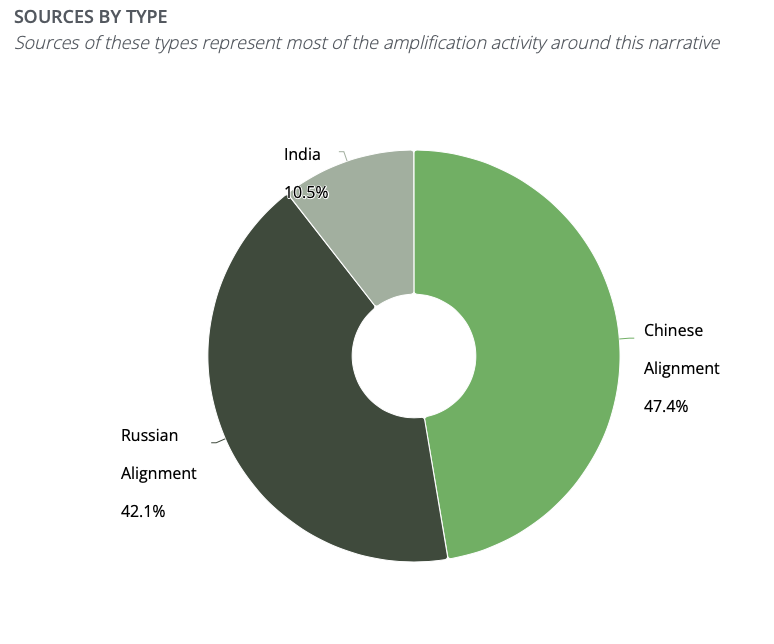
EdgeTheory NARINT sources tracing amplification activity
Manila’s growing alignment with the United States, Australia, and Japan has accelerated joint maritime and air exercises, strengthening deterrence but also generating narratives portraying heightened foreign influence and sovereignty risks.

EdgeTheory NARINT sources tracing Chinese aligned amplifiers
The South China Sea remains a key flashpoint as China’s expanding military activity drives intensified security cooperation among regional partners—most notably the Philippines, whose strategic location, young population, and ongoing military modernization make it central to Indo-Pacific stability. Manila’s growing alignment with the United States, Australia, and Japan has accelerated joint maritime and air exercises, strengthening deterrence but also generating narratives portraying heightened foreign influence and sovereignty risks. At the same time, Chinese bomber patrols, naval deployments, and simulated strike activities in contested waters fuel competing storylines that depict Beijing as either an aggressor or a besieged power. These dynamics intersect with information operations across the region; in Singapore alone, 35 sources are amplifying 80 narrative items tied to South China Sea military activity, creating openings for malign actors to exploit alliance cooperation, Chinese assertiveness, and U.S. support to shape political perceptions and influence electoral environments in neighboring states.
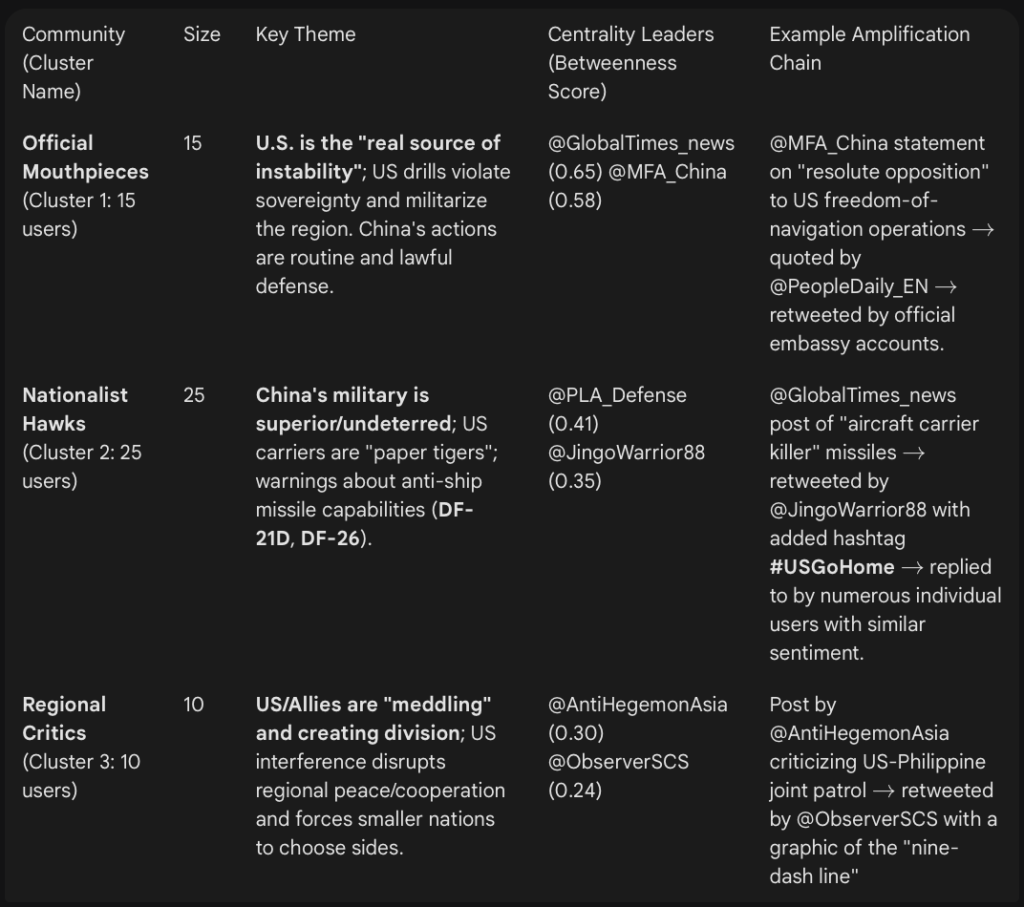
Grok table of Chinese twitter network amplifying anti-U.S. narratives

EdgeAgent on Chinese Bomber Patrols in South China Sea
Experts quoted or featured, such as Zhuo Hua and Song Zhongping, reinforce this messaging by emphasizing China’s readiness and condemning the Philippines for provocative cooperation with the US and Japan. Channels like TFI Global also contribute by providing in-depth analysis supporting Beijing’s stance, framing the incidents as deliberate geopolitical signals rather than accidents or escalations.
When asked about surfacing networks of friendly actors and networks and amplify aligned messages in the Pacific region via the GCA Social Media Module the EdgeAgent stated: “The pro-China narrative network prominently features state-backed sources like Global Times, China Daily, Xinhua News, CCTV, and the State Council Information Office of China. These outlets consistently amplify messages portraying China’s bomber patrols in the South China Sea as lawful, defensive actions aimed at safeguarding sovereignty and regional stability. Experts quoted or featured, such as Zhuo Hua and Song Zhongping, reinforce this messaging by emphasizing China’s readiness and condemning the Philippines for provocative cooperation with the US and Japan. Channels like TFI Global also contribute by providing in-depth analysis supporting Beijing’s stance, framing the incidents as deliberate geopolitical signals rather than accidents or escalations.
When asked about surfacing networks of friendly actors and networks and amplify aligned messages in the Pacific region via the GCA Social Media Module the EdgeAgent stated: “The pro-China narrative network prominently features state-backed sources like Global Times, China Daily, Xinhua News, CCTV, and the State Council Information Office of China. These outlets consistently amplify messages portraying China’s bomber patrols in the South China Sea as lawful, defensive actions aimed at safeguarding sovereignty and regional stability. Experts quoted or featured, such as Zhuo Hua and Song Zhongping, reinforce this messaging by emphasizing China’s readiness and condemning the Philippines for provocative cooperation with the US and Japan. Channels like TFI Global also contribute by providing in-depth analysis supporting Beijing’s stance, framing the incidents as deliberate geopolitical signals rather than accidents or escalations.

Example Weibo posts by Zhongping Song (宋忠平)
Conversely, voices aligned against China’s approach often come from Western and regional actors who highlight the risks of militarization and challenge China’s expansive claims. While specific individual posters from these networks are less prominent in this brief, regional governments and allied media criticize China’s aggressive posturing and warn about destabilization. These friendly networks include the Philippine Daily Inquirer, which regularly frames joint U.S.–Philippines–Japan exercises as necessary for maintaining stability and deterring coercion; AMTI, which consistently documents allied maritime cooperation and PLA assertiveness; and defense-focused social accounts such as Japan Defense Brief and Defense Intelligence, which emphasize freedom of navigation and underscore the value of interoperable allied forces. Regional outlets like CNA, KSG India, and The Informant also contribute by spotlighting PLA naval maneuvers and highlighting the strategic importance of multilateral drills. The Philippines’ joint exercises with the US and Japan, for example, are portrayed by opponents as necessary for maintaining a rules-based order and counterbalancing China. Thus, the pro-China network features coordinated amplification by Chinese state media and analysts, while the anti-China network is marked by official and allied voices advocating caution and partnership to resist assertive Chinese actions in the South China Sea.”
Conversely, voices aligned against China’s approach often come from Western and regional actors who highlight the risks of militarization and challenge China’s expansive claims. While specific individual posters from these networks are less prominent in this brief, regional governments and allied media criticize China’s aggressive posturing and warn about destabilization. These friendly networks include the Philippine Daily Inquirer, which regularly frames joint U.S.–Philippines–Japan exercises as necessary for maintaining stability and deterring coercion; AMTI, which consistently documents allied maritime cooperation and PLA assertiveness; and defense-focused social accounts such as Japan Defense Brief and Defense Intelligence, which emphasize freedom of navigation and underscore the value of interoperable allied forces. Regional outlets like CNA, KSG India, and The Informant also contribute by spotlighting PLA naval maneuvers and highlighting the strategic importance of multilateral drills. The Philippines’ joint exercises with the US and Japan, for example, are portrayed by opponents as necessary for maintaining a rules-based order and counterbalancing China.
Thus, the pro-China network features coordinated amplification by Chinese state media and analysts, while the anti-China network is marked by official and allied voices advocating caution and partnership to resist assertive Chinese actions in the South China Sea.”
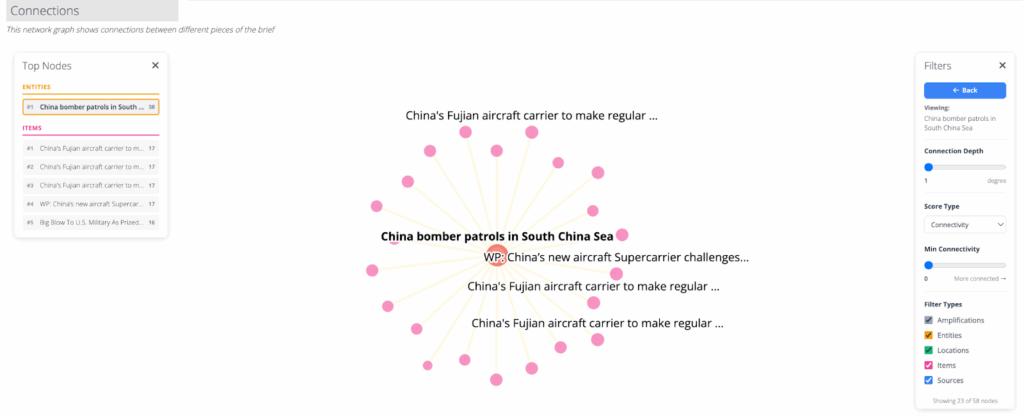
EdgeTheory connections entity-graph
Selectors

Full Node Network

Node: China Bomber Patrols

EdgeTheory network analytics by connection density
The analytic story of this visual begins by selecting Chinese bomber patrols as the central theme. Once anchored, the entity-relationship graph shows how a single military action spreads outward into a network of first-degree connections—state-sponsored outlets, aligned amplifiers, regional observers, and security-focused sources. What appears to be an isolated event becomes a mapped narrative ecosystem, revealing who engages with the story and how quickly it propagates. By centering the graph on this theme, the tool converts narrative noise into a structured intelligence picture, exposing amplification pathways, geopolitical alignments, and the early architecture of influence operations.
When layered with the additional maps, the most influential malign sources become unambiguous. CGTN, Global Times, Xinhua, and a constellation of high-volume pro-PRC social feeds surface repeatedly as the earliest injectors and most persistent amplifiers of the bomber-patrol narrative. These nodes form the primary distribution spine, driving the story into secondary ecosystems that then echo and normalize PRC framing. Identifying these specific sources provides a clear target set for disruption—through counter-messaging, throttling their reach, or focusing on downstream amplifiers that reliably replicate and reinforce their narratives.

Chinese Malign Sourcing Network
This image from EdgeTheory’s platform exposes a network of Chinese sources amplifying narratives of Chinese bomber patrols over the South China Sea. The largest amplifications come from CCTV, Global Times, XHNews, and the State Council Information Office of China. The connections tool auto-generates networks of information including sources, locations, and entities allowing for analysts to unearth connections between networks.
EdgeTheory’s Narrative Intelligence reflected key themes from narratives centered on U.S.–China security competition in the South China Sea, China’s rapid military buildup and regional power projection, and escalating Taiwan-related tensions and risk of regional miscalculation. These dynamics were evident in U.S.-led initiatives like Task Force-Philippines and expanding naval drills meant to counter Beijing’s assertiveness, in China’s deployment of the new Fujian carrier and steady PLA exercises that signal growing confidence, and in rising friction over Taiwan as Japan increases its defense posture and China reacts sharply.
Wider regional trends reinforce these tensions. The Philippines is becoming more strategically important as a young, trade-dependent country that sees cooperation with the United States as essential in pushing back against China’s territorial pressure. At the same time, China’s modernizing navy and frequent patrols complicate U.S. influence and add to uncertainty across the region. The situation around Taiwan remains especially sensitive, with political divisions on the island shaping its approach to Beijing and Washington. China’s commitment to eventual reunification keeps pressure high, drawing in both the United States and Japan.
Malign actors in the Indo-Pacific are increasingly networked across borders, not only through shared geography but through overlapping political, economic, and informational ties that extend far beyond a single region. China’s ability to coordinate military signaling in the South China Sea while simultaneously shaping narratives through state media illustrates how these networks operate on multiple levels. Regional actors who align with or depend on China economically, politically, or through digital information channels often reinforce its messaging, creating a layered ecosystem that amplifies Beijing’s influence. This transregional connectivity allows malign behavior to spread more easily, as military actions, diplomatic pressure, and information operations are linked together and echoed across platforms and partners.

Global TImes post on Chinese military drills in the South China Sea
This statement from the PLA’s Southern Theater Command publicly confirming a bomber patrol reinforces China’s effort to frame its actions as routine and defensive, even as it clearly responds to the joint maritime drills conducted by the Philippines, the United States, Japan, Australia, and New Zealand. By broadcasting this patrol, China is asserting its presence, challenging the legitimacy of these multilateral exercises, and reminding regional states that it intends to counter any moves it sees as threatening its territorial claims.

AMTI post on Philippines-U.S.-Japan joint naval exercises in the South China Sea
This post from AMTI focuses on the growing militarization and intensifying power competition in the South China Sea. The joint naval exercises involving the Philippines, the United States, and Japan highlight how regional partners are expanding coordination to counter China’s assertive behavior and protect freedom of navigation. This kind of public demonstration reinforces the message that multiple states are willing to operate together in contested waters, which directly feeds into the article’s theme that China’s bomber patrol was not an isolated move but part of a larger cycle of action and counteraction shaping the regional security environment.

Global Times post on PLA bomber patrols in the South China Sea
This Global Times post directly reinforces the article’s point about China using high-profile military patrols to push back against growing regional cooperation among the Philippines, the United States, and Japan. By publicly announcing a bomber formation patrol and framing it as a response to “joint patrols” with “external forces,” China is signaling both deterrence and dissatisfaction.
China’s bomber patrol was not an isolated move but part of a larger cycle of action and counteraction shaping the regional security environment.
Post in EdgeTheory Narrative Brief

Same Post on RedNote
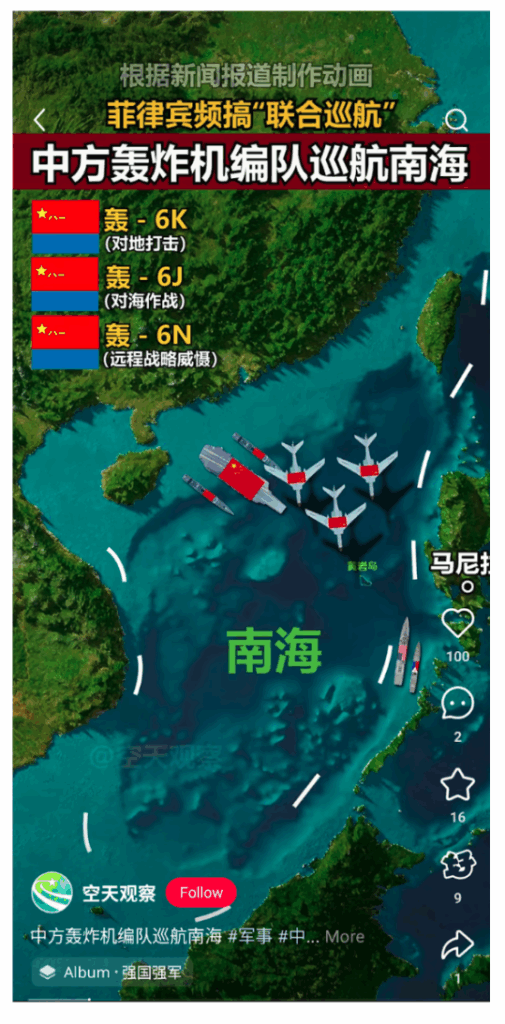
RedNote post on PLA bomber patrols in the South China Sea
This RedNote poster 空天观察 demonstrates an amplified narrative, providing subtle support for the article’s content.
The South China Sea has become a tightly linked operational and informational battlespace where military actions, diplomatic signaling, demographic pressures, and narrative campaigns all converge. China’s coordinated state messaging works to shape perception, defend its patrols, and undermine regional cooperation, while U.S., Philippine, and Japanese communications highlight alliance strength and support for a rules-based order. EdgeTheory’s tools reveal how these competing narratives spread across geographies and social networks, mapping both adversarial amplification and clusters of friendly actors. In particular, the network visualizations and metrics provide the real-time means to choke adversarial influence at its infrastructural level as opposed to just identifying key nodes. In addition, they also provide quantitative means to identify friendly networks and communities to support and perhaps enable for positive influence. As these visualizations and metrics update in real time with new data and narratives, users can quickly adjust courses of action to undermine hostile influence and scale friendly influence. Similarly, identifying key network pathways represented with quantified metrics can provide key targeting insight. This capability provides policymakers and regional partners with actionable insight into how influence is built and contested. As tensions continue to rise, the ability to detect and shape strategic narratives remains essential for maintaining stability and strengthening alliances in the Indo-Pacific.
Lead Analyst:
Ellie Munshi is an analyst at the EdgeTheory Lab. She is studying Strategic Intelligence in National Security and Economics at Patrick Henry College. She has led special projects for the college focused on Anti-Human Trafficking, Chinese influence in Africa, AI influence on policymakers, and is also an intelligence analyst intern at the Department of War.

