
Menu
The Iran war has reshaped Iraqi politics by bringing key powerful militias that were pragmatically aligned with the Iraqi state into direct confrontation with the Iraqi government. Iraqi militias have targeted Iraqi government forces in federal Iraq and in the Kurdistan Region on multiple occasions in the past month.
The global competition surrounding advanced battery technologies—and the companies that produce them—is increasingly shaped not only by industrial capacity and innovation, but by the narratives that define how those capabilities are perceived. Contemporary market dynamics unfold in an information environment in which state-aligned actors actively promote, defend, and
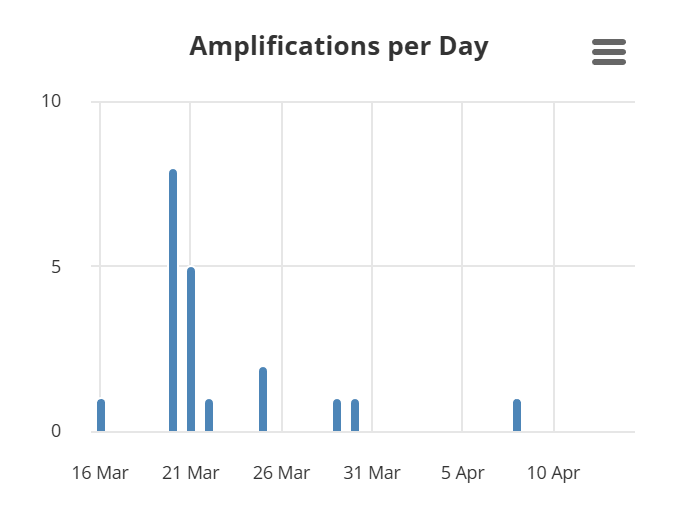
Iraq Sources’ amplifications of narratives discussing a 12 March likely militia attack on the Iraqi National Intelligence Service in Baghdad. Narratives associated with the spike included government figures’ condemnations of the attack, highlighted that the attack killed an intelligence officer, and called for the government to take action against “armed groups.”
Iran-backed militias have operated from within the Iraqi state since 2016, when then-Prime Minister Haider Al-Abadi confirmed their status as official government forces subordinate to the Popular Mobilization Commission (1). Several of the militias answer directly to Iran, rather than the Iraqi Prime Minister, despite their status as official government forces (2). This includes several of Iran’s most powerful militias in Iraq, notably Kata’ib Hezbollah, Harakat Hezbollah Al-Nujaba, and Kata’ib Sayyid Al-Shuhada - all of which have actively targeted US interests in Iraq and the region during the current war. These militias maintain brigades within the Popular Mobilization Forces, leaders in key security positions in the Iraqi state, and often have political wings active in parliament (3). These militias have previously engaged in sporadic confrontation with the Iraqi government as needed, but have generally avoided prolonged confrontation with the Iraqi government because prolonged confrontation would undermine their objective of furthering Iran’s strategic interests while enriching and entrenching themselves within the Iraqi state.
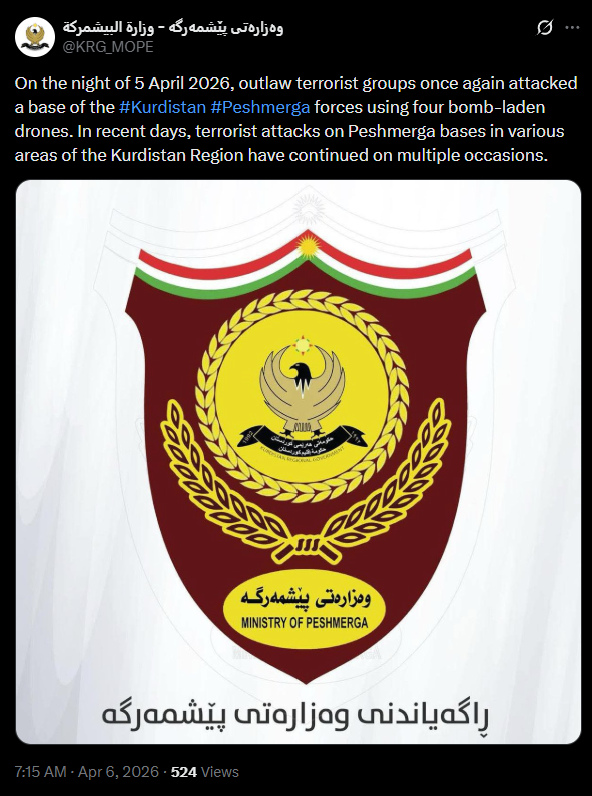
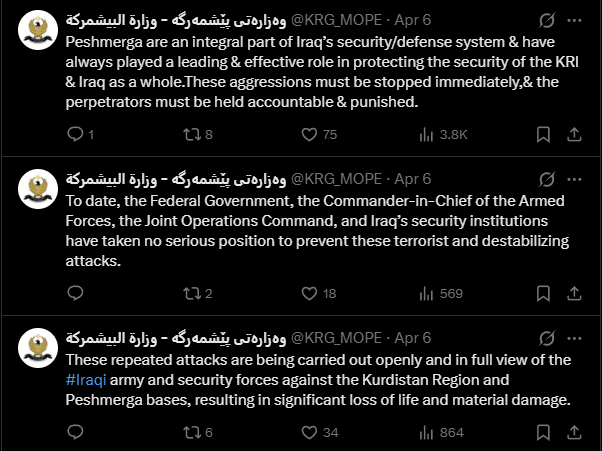
The Peshmerga Ministry’s response to 5 April militia attacks targeting the Peshmerga. The Ministry emphasized that the Peshmerga are official Iraqi government forces and accused the federal government of failing to prevent militia attacks targeting the Peshmerga.
The past month of the war has changed this. Iran-backed Iraqi militias have attacked Iraqi government security forces both in federal Iraq and in the Kurdistan Region, openly labeling them as US and Israeli agents.
Likely Iran-backed militias conducted a drone attack on the Iraqi National Intelligence Service (INIS) headquarters in Baghdad’s Al-Mansour neighborhood on 21 March, killing an Iraqi intelligence officer (4). Kata’ib Hezbollah - whose facade groups have claimed numerous attacks on US interests in Iraq and the region since the war began - implied they were not responsible, but characterized INIS as a legitimate target as “100% of Kurdish officers are linked to Mossad and the Americans,” and “70%” of INIS’ Sunni officers have “close working ties with” US, Jordanian, and Emirati intelligence (5).
(6) In some ways, this is not surprising; Iranian officials have repeatedly warned regional countries against permitting the US to launch attacks on Iran from their territories (7).
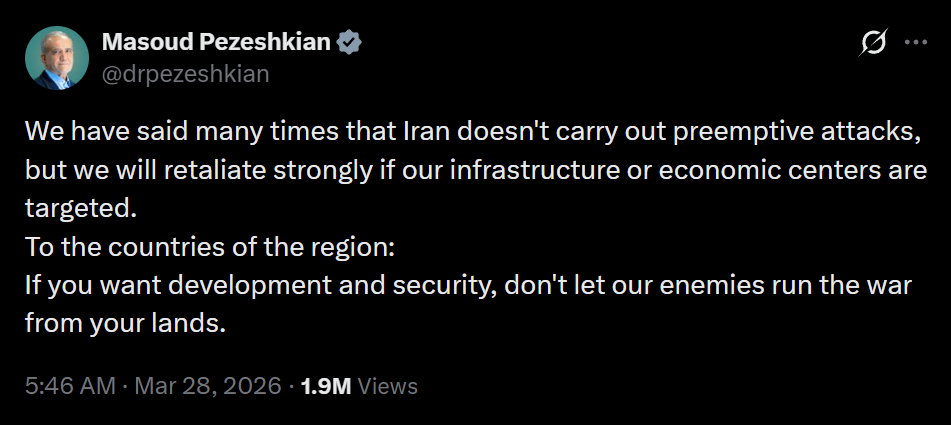
Iranian President Masoud Pezeshkian warned regional countries not to let the US and Israel “run the war from their lands” on 28 March.
Given this external pressure, it is likely no coincidence that mid-April reports of drone attacks on Erbil coincided with Kurdish leader Mustafa Hijiri’s denial of receiving weapons from the US to aid in the ongoing conflict against Iran.
This means that Kata’ib Hezbollah, which maintains three PMF Brigades (45th, 46th, and 47th), paid for by the Iraqi government, and whose commander Abdul Aziz Al-Mohammedawi is the PMF Chief of Staff, is openly labeling other components of Iraq’s security apparatus as foreign agents and therefore valid targets in the context of the Iran war.
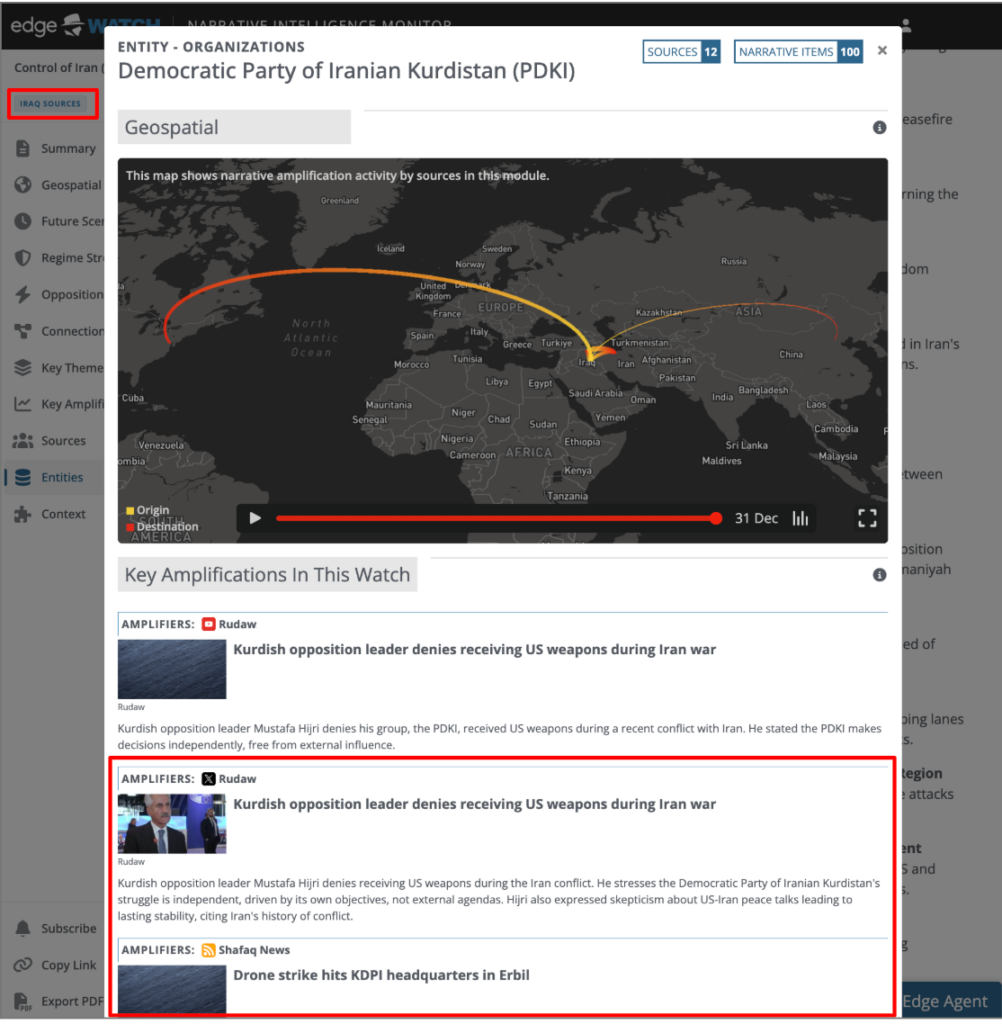
Narrative congruence surfaced by EdgeTheory indicating correlation between attacks and Kurdish public statements.
Kata’ib Hezbollah’s 31 March kidnapping of US journalist Shelly Kittleston also highlights Kata’ib Hezbollah’s increasing willingness to come into direct conflict with the Iraqi government (8). Kata’ib Hezbollah reportedly engaged in a car chase and confrontation with Iraqi police in the course of Kittleston’s abduction. While Kata’ib Hezbollah ultimately released her after cutting a deal with the Iraqi government, this highlights how the war is bringing this militia - whose leader has reportedly had an unusually active role in government formation negotiations - into direct confrontation with the Iraqi government (9).
Likely Iran-backed militias conducted an unsuccessful drone attack on KRG president Nechirvan Barzani’s home on 28 March and similarly targeted Kurdistan Democratic Party (KDP) leader Masoud Barzani on 29 March. The Coordinating Framework condemned the strikes.
Iran-backed Iraqi militias have also attacked Kurdistan Regional Government officials and armed forces (10)(11).
The Coordinating Framework is the largest coalition in Parliament. It encompasses numerous Shi’a parties, including the political wings of Iran-backed militias. While it is unclear from publicly available data which militia was responsible for these attacks, Harakat Hezbollah Al-Nujaba military adviser Abdul Qadir Al-Karbala’i had previously threatened to target the “Zionist agent Barzani” on 5 March (12). Even as it directly threatens members of Iraq’s government, Harakat Hezbollah Al-Nujaba leadership has participated in Coordinating Framework meetings and controls the Iraqi government forces of the 12th PMF Brigade (13). Meanwhile, the militia’s leadership threatens - and targets - Iraqi government officials on the pretext that they are “Zionist agents.”
But those limited attacks sought to achieve discrete domestic political gains for just one militia, while the current ones are designed to advance Iran’s strategic wartime goals.
The militias have also reportedly attacked KRG security forces. The Peshmerga Ministry claimed Iran and “outlawed armed groups in Iraq,” likely referring to Iran-backed militias, conducted two attacks targeting Peshmerga personnel on 5 and 7 April (14). The Peshmerga Ministry characterized the attacks as a “pattern of hostility” against Kurdish security personnel and called on Prime Minister Mohammed Shia’ Al-Sudani to limit such attacks. The Peshmerga are the official internal security forces of Iraq’s Kurdistan Region.
Iraqi militias have conducted attacks prior to the war that superficially resemble those outlined above.
Unknown attackers assassinated two INIS officers in March and June 2021 (15). In July and October 2021, an Iran-backed militia conducted rocket attacks targeting INIS’ Mansour neighborhood headquarters. Likely Iran-backed militias then attempted to assassinate then-Prime Minister and acting INIS head Mustafa Al-Kadhimi in November 2021 (16). Asa’ib Ahl Al-Haq (AAH), a militia that controls the 41st, 42nd and 43rd PMF Brigades with multiple members in Parliament, was most likely responsible for the rocket attacks and assassinations (17). The attackers reportedly launched the rockets from an AAH-controlled area of Baghdad, with the July attack possibly intended to coincide with Al-Kadhimi’s perceived failure to achieve full withdrawal of US combat troops from Iraq during a strategic dialogue with Washington. The officer assassinations followed Al-Kadhimi’s reported decision to transfer numerous AAH-affiliated officers out of INIS to remote posts. An AAH facade group accused Al-Kahdimi of catering to US and British interests by removing the officers (18). The assassination attempt against Al-Kadhimi himself occurred two days after Iran-backed militia supporters staged deadly protests in Baghdad decrying the October 2021 election results, in which militia-affiliated parties (especially AAH) performed poorly (19). Iran-backed militias attacking INIS, targeting Iraqi federal government leaders, and framing Iraqi leaders and institutions as beholden to the US is therefore not new. However, the primary goal of these attacks was to achieve AAH’s domestic objectives, with Iran’s regional goals taking a back seat (then-IRGC-QF commander Esmail Qaani even reportedly encouraged the militias to restrain their operations in October) (20).
The attacks of the past month stand in contrast to this precedent. They constitute direct support of Iran’s wartime objective of using force to compel regional countries to stop US and Israeli forces striking Iran from their territories. It was problematic in 2021 for a militia with brigades in Iraq’s security forces and members in Parliament to threaten INIS and the Prime Minister for its own ends. But it is far more dangerous for these militias, deeply entrenched in Iraq’s state, to treat Iraqi government institutions themselves as combatants in the war because it risks prolonged confrontation between different elements of the Iraqi government. The longer the war continues, the higher the risk of civil war.
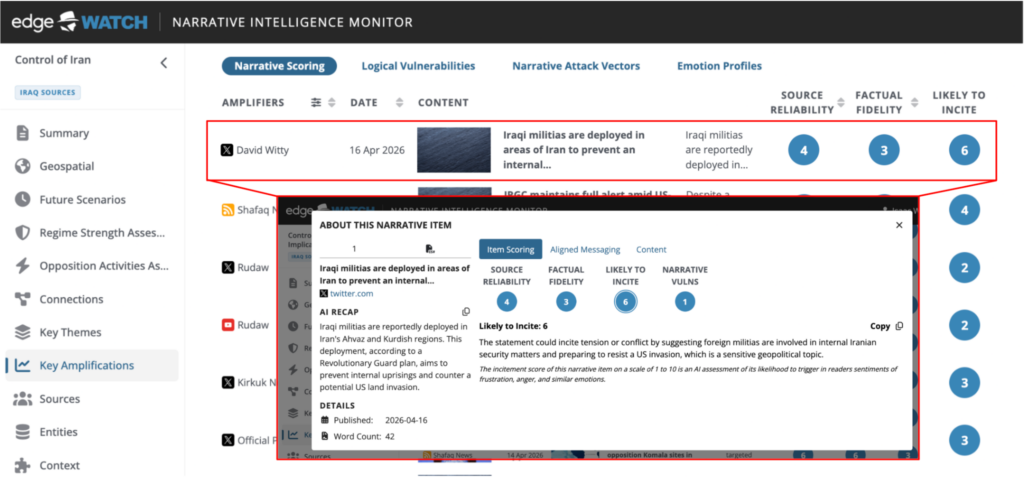
Reported Iran-directed deployment of Iraqi militias surfaced by EdgeTheory narrative intelligence monitor. Iraqi militias may be deploying in areas where Iran has previously confronted domestic unrest (see below).
Beyond their attacks on Iraqi government forces and institutions, the militias have aggressively advanced Iran’s interests while undermining Iraqi government policy in the region. Iranian opposition media and some international outlets have claimed Iraqi militias have deployed in southwestern Iran. This follows previous claims that Iraqi militias deployed to help Iran suppress the December 2025-January 2026 protests (21). US and Israeli strikes have extensively targeted Iranian internal security forces including the Basij and Law Enforcement Forces (22). If such a deployment has occurred, it could serve to backfill Iranian domestic law enforcement and to maintain security continuity. Furthermore, while such a deployment would not constitute direct confrontation with the Iraqi government (as the above examples do) it highlights the extent to which the militias are willing to oppose and undermine the Iraqi government’s stated aim of avoiding involvement in the war (23). The divided media environment in Iraq and persistent internet blackout in Iran further complicate efforts to determine the accuracy of such reports. Iran-backed militias’ strikes on Gulf targets also illustrate this. Kata’ib Hezbollah supporters reportedly stormed the Kuwaiti Consulate in Basra on 7 April (24). Kuwait, Saudi Arabia, and Bahrain have all reportedly summoned Iraqi diplomats within the past week over Iran-backed militias’ strikes on Gulf targets (see below) (25).
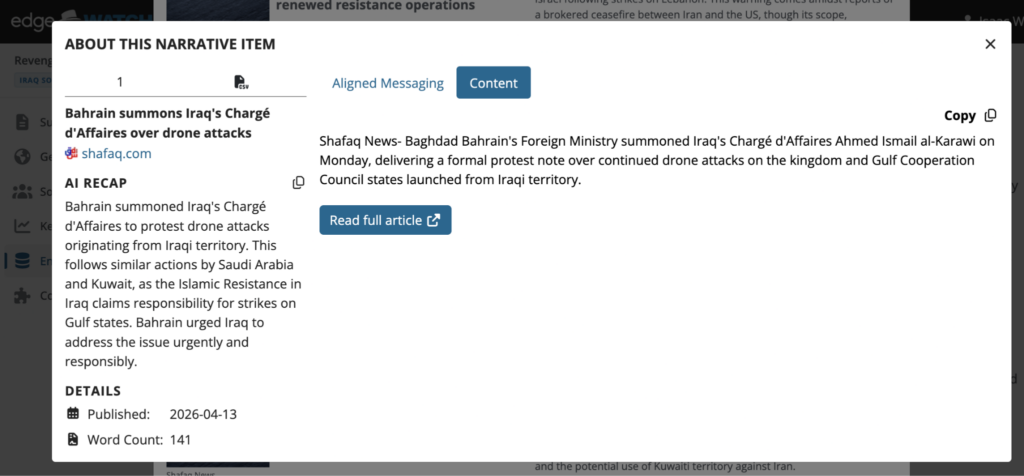
Edge-Theory-surfaced narrative highlighting Bahrain’s decision to summon Iraq’s Charge d’Affaires. Facade groups likely tied to Iran-backed militias have conducted numerous drone strikes on Gulf targets since the war began.
Even the Islamic Resistance in Iraq’s 8 April declaration of a 2-week ceasefire in accordance
with the US-Iran ceasefire highlights the extent to which the militias are at odds with Iraqi government policy (26). The Islamic Resistance in Iraq is a coalition of Iraq’s most powerful Iran-backed militias.
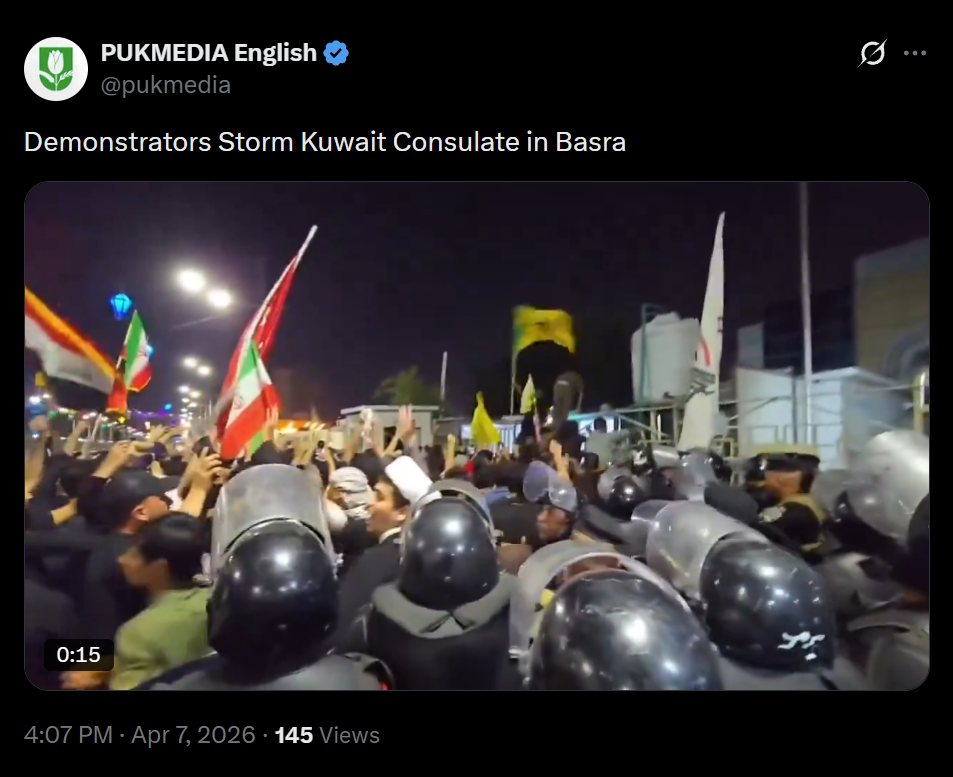
Footage surfaced by EdgeTheory of demonstrators storming the Kuwaiti Consulate. Demonstrators are holding the Iraqi flag (far left), Iranian flag (second to left), the Kata’ib Hezbollah flag (yellow, center), and the PMC flag (white, right).
The Iran war, and the militias’ participation, has divided the Coordinating Framework. The Framework appears to have reached a temporary truce, however. The Coordinating Framework has reportedly been internally divided regarding militias’ participation in the war (27). The Coordinating Framework reportedly authorized Badr Organization leader and key Coordinating Framework leader Hadi Al-Ameri to negotiate a “truce” with the militias intended to halt militias’ attacks on US interests on 5 April (28). The truce reportedly specifically sought to reign in Kata’ib Hezbollah and Harakat Hezbollah Al-Nujaba. A Coordinating Framework member claimed on 12 April that Al-Ameri successfully reached a truce in which the militias would halt attacks on the US in exchange for the US’ and Israel’s commitment to stop striking PMF bases in Iraq (29).
It is unclear whether the truce will alleviate stalled government formation negotiations, particularly regarding the premiership. Iraq has still not formed a government since its federal elections in November. Parliament has made some progress: it elected Patriotic Union of Kurdistan member Nizar Amedi president on 11 April (30). Amedi’s election marks welcome progress in stalled government formations; narrative items discussing “fear” spiked in the lead-up to the 11 April session in which Amedi was elected, likely reflecting concern that Parliament would again postpone the vote. The constitutional deadline for Parliament to elect a President expired in late January, but Iraq’s constitution provides no mechanism to enforce the deadline. It is therefore common in government formation for political parties to essentially hold constitutionally mandated government formation procedures hostage until they reach a political deal. This has historically frustrated the public and angered other political stakeholders.
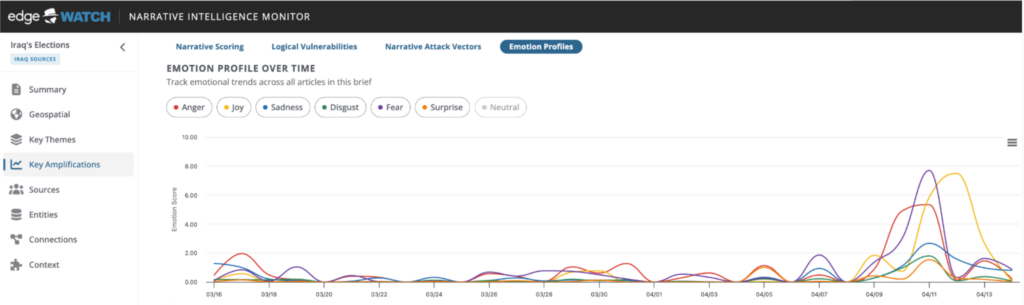
Emotion profiles over time of Iraq Source narrative items discussing elections, civil peace, and state confidence. “Fear” spiked in the lead up to the critical 11 April Parliament session that led to President Amedi’s election, possibly reflecting fears that Parliament would again fail to elect a president. The ensuing “joy” spike could reflect relief following his election.
Amedi’s election does not mean the parties are in agreement regarding next steps. Several parties including the KDP, former Prime Minister Nouri Al-Maliki’s State of Law Coalition, and others reportedly boycotted the session in which Amedi was elected, possibly due to both opposition to Amedi himself and due to broader lack of consensus regarding the premiership (31).
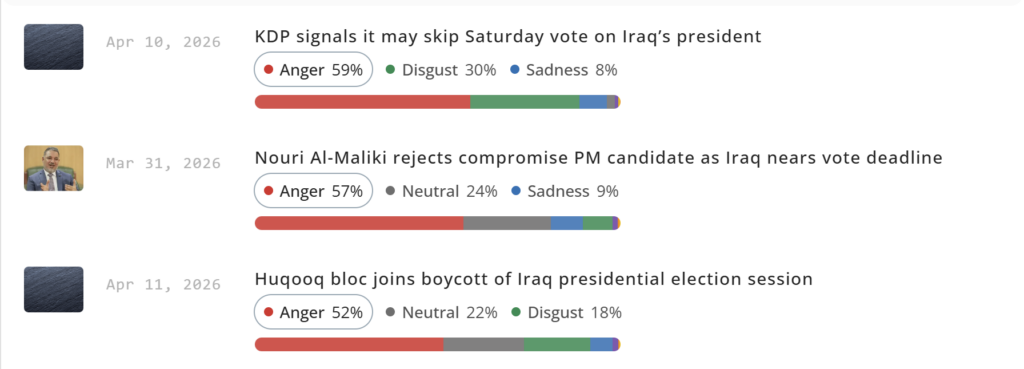
Among Iraq Sources EdgeTheory monitors, narratives discussing parties’ decision to boycott the presidential vote and disagreement regarding a compromise premier candidate extensively leveraged rhetoric evoking anger. This likely reflects anger towards parties’ attempts to stymie government formation in pursuit of their own interests.
The Coordinating Framework has been divided for months over the premiership. Specifically, powerful Framework leaders including Asa’ib Ahl Al-Haq leader Qais Al-Khazali, Wisdom Trend leader Ammar Al-Hakim, former Prime Minister Haider Al-Abadi, and Labor and Social Affairs Minister Ahmad Al-Asadi reportedly opposed former Prime Minister Maliki’s candidacy (32). The Framework nominated him for a third term on 24 January (33). Meanwhile, incumbent Prime Minister Mohammed Shia’ Al-Sudani’s Reconstruction and Development Party, which won the most seats in the November elections, have continued to support a second Al-Sudani term (34). Speaker of Parliament Haibat Al-Halbousi reportedly gave the Coordinating Framework 15 days to name its candidate for prime minister on 12 April, now that the president has been elected (35).

Narratives on government formation disputes have continued to spike, including beyond President Amedi’s 11 April election.
Over the past week, Coordinating Framework members have claimed Al-Maliki has agreed to withdraw in favor of alternate Basim Al-Badri and stated the Framework will decide between Al-Badri and incumbent Prime Minister Al-Sudani on 18 April. (36) Al-Maliki’s State of Law Coalition denied reports of his withdrawal (37).
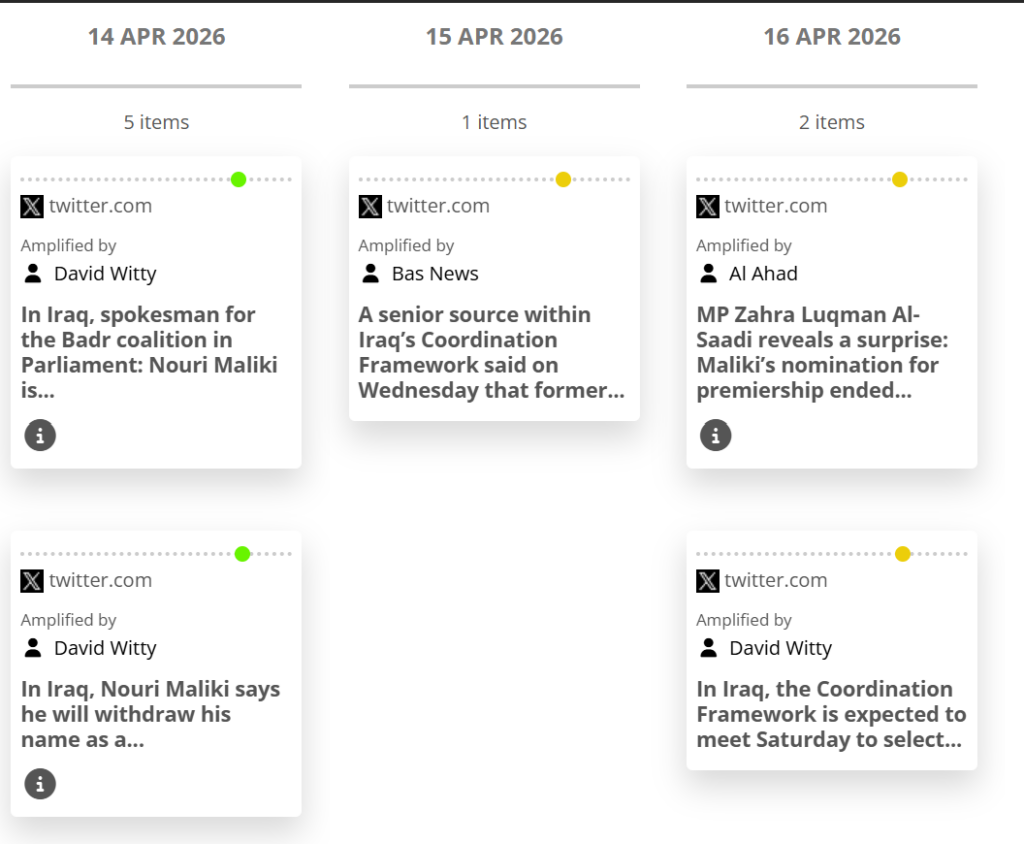
Narrative items surfaced by EdgeTheory highlighting multiple Coordinating Framework allegations of Al-Maliki’s withdrawal. The Badr Organization (discussed in the top left narrative) is part of the Coordinating Framework.
Several issues have contributed to disagreement over Al-Maliki’s candidacy. First, President Trump publicly rejected Al-Maliki’s candidacy in January, prompting some elements of the Coordinating Framework to suggest finding an alternative (38). The US generally perceives Al-Maliki as too amenable to Iranian interests, and looks skeptically on his history of pursuing sectarian policies and consolidating his own personal power within the Iraqi state, as we discussed in our February analysis. Al-Maliki is also viewed as responsible for losing a third of Iraq’s territory to ISIS. Despite this, then-Supreme Leader Ali Khamenei reportedly offered his blessing for Al-Maliki’s candidacy (39). New Supreme Leader Mojtaba Khamenei later reportedly reiterated to Al-Maliki that he is Iran’s preferred candidate via a delegation including Islamic Supreme Council of Iraq leader Humam Hammoudi, PMF Chief of Staff and Kata’ib Hezbollah leader Abu Fadak Al-Mohammedawi, and Iranian Ambassador to Iraq Eraj Masjedi (40). This places both Iran and at least one militia actively engaged in targeting US interests in Iraq at odds with other elements of the Coordinating Framework regarding both the militias’ activities in the context of the war and the nomination of an Iran-friendly premier. The war has only served to raise the stakes around Al-Maliki’s potential nomination.
Iraq does not have a monopoly on the use of force within its own borders, and can not meaningfully disrupt the militias’ activities. It is therefore imperative that the US continues to push back against the militias in the context of the Iran war.
Even if the Coordinating Framework agrees on a compromise candidate, he is likely to be politically weak and ill-equipped to limit the militias’ influence. The US must therefore continue to aggressively combat them. If the Coordinating Framework agrees to compromise on a premier candidate, even if the candidate is incumbent Prime Minister Al-Sudani, the chosen premier will inherit a Coordinating Framework that is divided over the Iran war. Any future premier will contend with the same issues Al-Sudani is currently experiencing; namely, that
The US struck and killed Kata’ib Hezbollah security chief Abu Ali Al-Askari in Baghdad on 16 March (41). Kata’ib Hezbollah then immediately announced a five-day pause on attacks against the US Embassy in Baghdad on 18 March, and demanded the US and Israel stop targeting Hezbollah in Lebanon and cease striking civilian areas of Baghdad (42). This five-day attack pause, which Kata’ib Hezbollah then extended multiple times (see above), reportedly laid the groundwork for the Al-Ameri-led truce. The US State Department reportedly announced a $10 million reward for information on Kata’ib Hezbollah leader Ahmad Al-Hamidawi on April 14 (43).
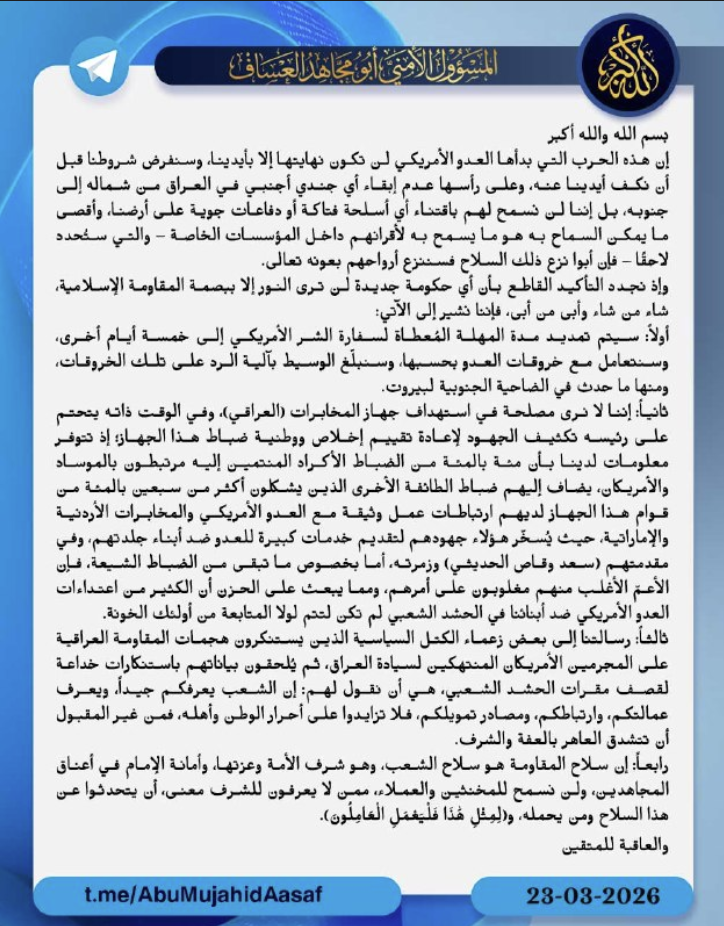
Kata’ib Hezbollah security official Abu Mujahid Al-Assaf statement extending a five-day pause on attacks against the US Embassy. The statement (released days after the drone attack on INIS) accuses Kurdish officers of being linked to Mossad and the US. It similarly claims that most Sunni officers are beholden to the US, Jordanian and Emirati intelligence services.
This is not a stable long-term strategy to permanently reduce the militias’ influence in Iraq, however. The US can not solve the militia problem through decapitation strikes alone while a politically weak Iraqi government potentially led by a compromise candidate struggles to contain their political and military influence, while simultaneously decrying US strikes as violations of Iraqi sovereignty. Beyond strikes, the US must invest long-term in addressing the underlying mechanisms that allow Iran-backed militias to entrench themselves in the Iraqi state. This includes seeking to limit militias’ influence in the judiciary, and supporting the overturn of electoral amendments that privilege large, well-financed legacy political parties. These steps may help ensure that the Iraqi government is a capable and independent partner, and can deny Iran-backed militias the institutional resources and cover they use to threaten the US-and Iraq’s-interests.
Lead Analyst
Samantha Leathley is a Middle East analyst supporting EdgeTheory lab. She is an American University graduate with over four years of professional experience analyzing Iraqi politics and security issues. Prior to EdgeTheory, she authored analysis for Department of Defense clients while working on the ground in the Kurdistan Region of Iraq.
Cover Design
Shia Militia: Fars Media Corporation, CC BY 4.0 via Wikimedia Commons
The image has been cropped and AI-enhanced for composition purposes.

