This report examines the evolving cross-strait relationship following the high-level engagement between Xi Jinping and Cheng Li-wun, leader of the Kuomintang. It focuses on how political engagement, economic inducements, and coercive signaling interact to influence Taiwan’s public opinion. Drawing on open-source intelligence and AI analytics, the report evaluates how Beijing combines episodic coercion and sustained political warfare conducted through parallel channels of influence in Taiwan's political system.
Beijing's influence operations are designed to deepen political division within Taiwan — eroding support for defense investment, complicating U.S.-Taiwan alignment, and empowering opposition channels that favor accommodation. Taiwan's internal cohesion, not its military capability, is the center of gravity in China's near-term strategy.
President Xi Jinping’s meeting with Kuomintang (KMT) chair Cheng Li-wun marks a rare resumption of high-level party-to-party engagement across the Taiwan Strait and reflects Beijing’s renewed emphasis on using Taiwan’s opposition as a parallel channel to the DPP-led government. By elevating the KMT as a primary interlocutor, Beijing reinforces its preference for political actors that do not reject the “one China” framework while bypassing formal state-to-state engagement. The meeting occurred amid heightened cross-strait tensions, including increased Chinese military activity, expanding U.S.–Taiwan defense cooperation, and domestic debate in Taiwan over defense spending. Substantively, the engagement emphasized opposition to Taiwanese independence, resistance to external involvement, and expanded dialogue framed around shared identity and economic ties, alongside signals of resumed trade and targeted economic exchanges to rebuild influence with key constituencies. Taken together, the interaction reflects a dual-track strategy that combines political outreach and economic inducements with sustained military and diplomatic pressure to shape Taiwan’s internal decision-making environment. Beijing is not pursuing a single pathway to unification but is instead creating conditions across political, economic, and military domains that advance three reinforcing trajectories: erosion of Taiwanese sovereignty, fragmentation of domestic political consensus, and continued preparation for coercive escalation. The central issue is not whether pressure will be applied, but how effectively Beijing can reshape Taiwan’s internal structures to achieve political accommodation without resorting to force.
1. Beijing is increasingly waging political warfare as a primary instrument of coercion
China is leveraging party-to-party engagement — particularly with the Kuomintang — alongside economic incentives and narrative shaping to influence Taiwan's political landscape. Rather than relying on military force, Beijing is normalizing cross-strait engagement at the elite level to build pro-integration constituencies and shift public cost-benefit calculations over time.
2. Fragmenting Taiwan's domestic consensus is the strategic objective
Beijing's influence operations are designed to deepen political division within Taiwan — eroding support for defense investment, complicating U.S.-Taiwan alignment, and empowering opposition channels that favor accommodation. Taiwan's internal cohesion, not its military capability, is the center of gravity in China's near-term strategy.
3. The most likely trajectory is gradual absorption, not rapid conflict
China is pursuing a dual-track approach: sustained military pressure to constrain Taiwan's options, paired with long-term political and economic integration as the preferred path to unification. Absent a significant provocation or shift in U.S. posture, the greater near-term risk is incremental sovereignty erosion rather than open confrontation.



Edge Theory Key Amplifiers
The amplified environment surrounding the Xi–Cheng meeting reinforces the same strategic framing present in the engagement itself: normalization of opposition-led dialogue and reduced emphasis on confrontation. The sources identified exhibit moderate-to-high reliability and factual fidelity, indicating that the core event is being transmitted accurately. However, the consistency in framing, focusing on the significance of dialogue, the legitimacy of the KMT’s role, and the importance of engagement, suggests convergence around a narrative that aligns with Beijing’s preference for political accommodation over deterrence.
Notably, the low incitement scores across these sources indicate that amplification is calibrated to avoid escalation. Rather than framing the meeting as controversial or destabilizing, the content presents it as pragmatic and stabilizing, reinforcing the perception that cross-strait tensions can be managed through dialogue and cooperation. This complements Beijing’s broader dual-track approach by shaping the information environment to reduce perceived urgency around military preparedness and defense spending debates inTaiwan.
This Rednote source with a history of accurate reporting is pushing the clear and forceful claim that the Xi-Cheng meeting was designed by the CCP to promote national absorption of Taiwan
At the same time, the presence of adjacent geopolitical reporting, including references to broader conflict environments, situates the Taiwan issue within a wider context of instability. This indirectly elevates the appeal of stability-focused narratives tied to engagement with Beijing. The result is a layered amplification effect: accurate reporting combined with selective emphasis that reinforces legitimacy, lowers perceived risk, and subtly shifts the policy conversation toward accommodation.
Taken together, these sources do not introduce disinformation but function as narrative multipliers. They extend the strategic impact of the Xi–Cheng meeting beyond the diplomatic interaction itself by shaping how key audiences interpret its significance, reinforcing Beijing’s objective of influencing Taiwan’s internal political and public opinion landscape.Amplification of the Xi–Cheng Li-wun meeting on RedNote reflects a coordinated narrative framing that prioritizes ideological signaling over event-specific detail. Content consistently anchors the engagement within the “great rejuvenation of the Chinese nation,” reframing a discrete political interaction as evidence of an irreversible historical trajectory toward cross-strait integration.

EdgeWatch Narrative Classifier on RedNote amplification framing the Xi–Cheng meeting within the “national rejuvenation” narrative, signaling a shift from event-based reporting to long-term perception shaping that normalizes cross-strait integration as inevitable.
RedNote amplification of the Xi–Cheng meeting consistently frames the engagement within the “great rejuvenation of the Chinese nation,” shifting focus away from discrete policy outcomes toward ideological signaling. The narrative reframes a routine political interaction as evidence of an irreversible historical trajectory toward cross-strait integration.
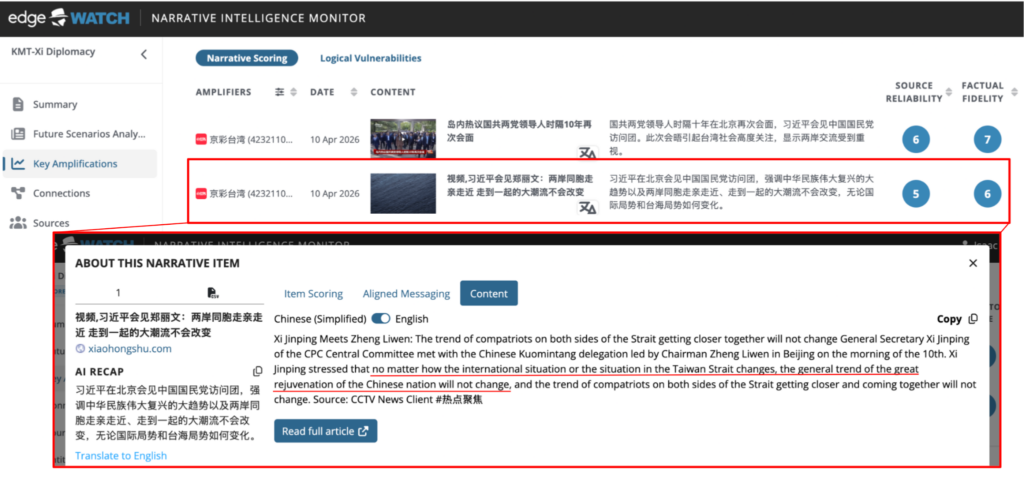
This Rednote source with a history of accurate reporting is pushing the clear and forceful claim that the Xi-Cheng meeting was designed by the CCP to promote national absorption of Taiwan
Notably, this framing is not confined to low-credibility or fringe accounts. Sources with a history of accurate reporting are advancing explicit claims that the Xi–Cheng engagement reflects deliberate CCP strategy to advance Taiwan’s absorption. The use of credible intermediaries increases the narrative’s persuasive potential by reducing perceived bias, allowing ideological messaging to be received as analytical assessment rather than state-directed propaganda.
| EdgeTheory identified this source (京彩台湾 (4232110808) from the previous graphic) as a central influence hub on Rednote. | EdgeWatch surfacing a central Rednote node of influence promoting the narrative that the Xi-Cheng summit aligns with long-term CCP absorption of Taiwan. |
Network analysis identifies the account 京彩台湾 (4232110808) as a central amplification hub within the RedNote ecosystem. Its high connectivity across narrative clusters indicates a coordinating role in distributing and reinforcing key messaging. The presence of a centralized node suggests that amplification is structured, enabling consistent narrative reinforcement across otherwise distinct content streams.
Network analysis identifies the account 京彩台湾 (4232110808) as a central amplification hub within the RedNote ecosystem. Its high connectivity across narrative clusters indicates a coordinating role in distributing and reinforcing key messaging. The presence of a centralized node suggests that amplification is structured, enabling consistent narrative reinforcement across otherwise distinct content streams.
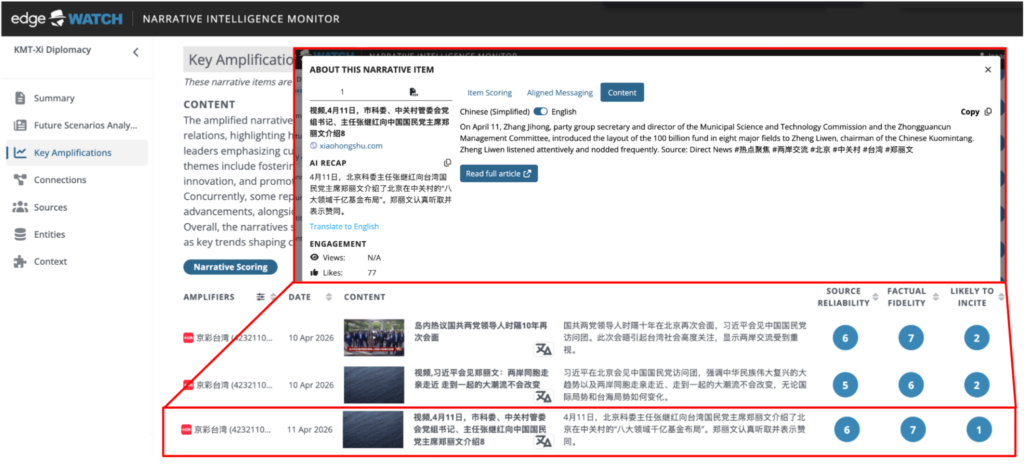
Rednote influencers [京彩台湾 (4232110808)] framing Cheng as in agreement with scientific and investments advancements and priorities accomplished by the CCP. The convergence of scientific authority with policy proposals frames Cheng’s assent as rational, supporting additional CCP-KMT cooperation over Taiwan, and reducing the appeal of Taiwanese independence sentiment.
Across key RedNote influencers, messaging converges around portraying cross-strait engagement as rational, forward-looking, and materially beneficial. The Xi–Cheng meeting is framed alongside themes of scientific progress, economic cooperation, and policy alignment, positioning engagement with the CCP as both pragmatic and inevitable. This convergence suggests coordination or strong narrative alignment, reinforcing the perception that integration is not only desirable, but consistent with broader modernization goals.
Taken together, these dynamics reflect a deliberate shift from persuasion through argument to conditioning through repetition and normalization. The absence of substantive policy discussion, combined with reliance on identity-based and inevitability framing, indicates that the objective is to reshape baseline assumptions about cross-strait relations. Over time, this reduces the perceived legitimacy of alternative futures and incrementally aligns public perception with Beijing’s long-term unification objectives.
Beijing is leveraging renewed party-to-party engagement with Taiwan’s opposition to weaken deterrence, fragment Taiwan’s domestic consensus, and intensify military preparation through coercive diplomacy, creating near-term risks to Taiwan’s defense posture and longer-term risks to US strategic positioning in the Indo-Pacific.
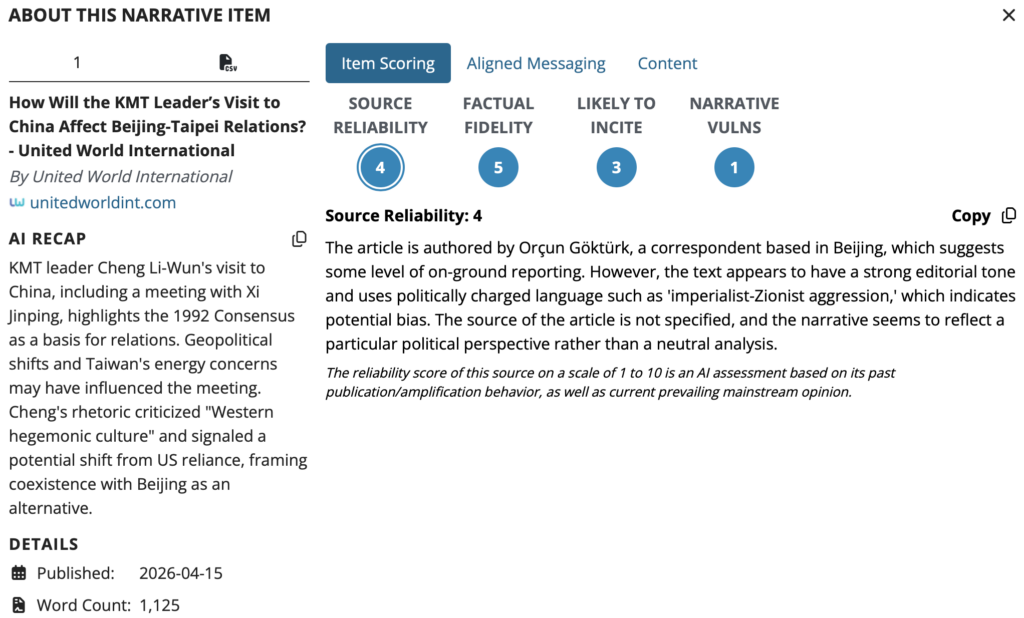
EdgeTheory’s Narrative Classifier assessment of reporting on the Xi–Cheng meeting shows high factual reliability and low incitement, indicating that the information environment is grounded in accurate reporting but consistently framed to emphasize stability and dialogue. This reinforces the assessment that Beijing’s strategy relies not on disinformation, but on selective amplification that normalizes engagement and reduces perceived urgency around deterrence and defense investment.
The meeting between Xi Jinping and Cheng Li-wun demonstrates Beijing’s shift toward political warfare through elite engagement rather than reliance on formal state-to-state diplomacy. By elevating ties with the Kuomintang, China is testing parallel channels of influence that threaten to erode support for the democratically elected Taiwanese government. This approach increases the likelihood of internal political fragmentation in Taiwan, which Beijing can exploit to slow or block defense initiatives.
Beijing is leveraging renewed party-to-party engagement with Taiwan’s opposition to weaken deterrence, fragment Taiwan’s domestic consensus
Xi’s elevation of “opposition to independence and foreign interference” as the foundation for cross-strait relations carries direct implications for US involvement. By implicitly targeting US arms sales and defense cooperation, Beijing is signaling that future engagement with Taiwanese political actors will be conditioned on reduced alignment with the United States. This creates pressure points within Taiwan’s political system, where opposition leaders may gain political capital by advocating de-escalation and economic engagement over defense investment. Over time, this dynamic risks shifting Taiwan’s policy baseline away from deterrence and toward accommodation, weakening the credibility of US security guarantees.
Beijing’s strategy relies not on disinformation, but on selective amplification that normalizes engagement and reduces perceived urgency around deterrence and defense investment.
Beijing’s use of economic incentives alongside political engagement reflects a calibrated “carrot and stick” strategy. Su Tzu-yun, a defence analyst, said such tactics are intended to weaken Taiwan's resolve while projecting engagement as a viable pathway. Meanwhile, academic Hung Pu-chao emphasised that China's military posture around Taiwan is not reactionary but part of a consistent long-term strategy. He noted that Beijing views political dialogue and military pressure as complementary tools, rather than mutually exclusive approaches, as highlighted by The Taipei Times. The timing of the military escalation serves as a clear demonstration of Beijing's coercive diplomacy.
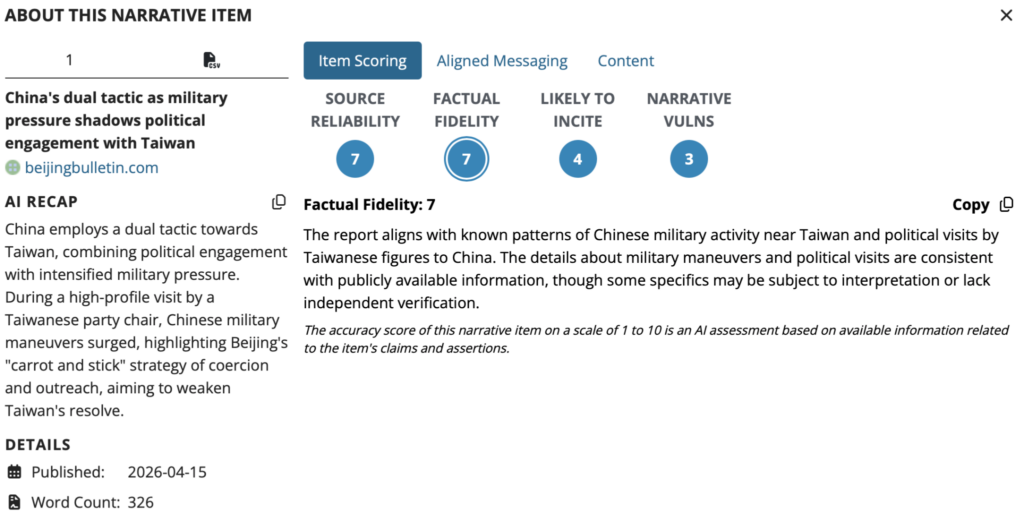
Edge Theory Factual Fidelity Classifier highlights that narratives surrounding China’s engagement strategy are supported by verifiable developments, including targeted trade and economic incentives. This supports the assessment that Beijing is shaping Taiwan’s internal decision-making environment through material benefits and credible policy signals, enabling influence without immediate coercion.
The meeting between Xi Jinping and Cheng Li-wun demonstrates how Beijing is operationalizing political warfare through elite engagement, using opposition channels to reshape Taiwan’s internal decision-making environment rather than relying on formal state-to-state pressure. By elevating ties with the Kuomintang, China is not just signaling preference, but actively creating alternative pathways of influence that can bypass governing authorities and introduce friction into policy formation. The emphasis on opposition to independence and foreign involvement functions as a conditional framework for engagement, implicitly linking economic and political cooperation to reduced alignment with the United States. This dynamic creates exploitable pressure points within Taiwan’s political system, where opposition actors can accrue political capital by advocating de-escalation and engagement. Over time, the effect is not immediate policy reversal, but a gradual shift in Taiwan’s cost-benefit calculus, where accommodation becomes more politically viable and deterrence more difficult to sustain.
Beijing is shaping Taiwan’s internal decision-making environment through material benefits and credible policy signals, enabling influence without immediate coercion.
Edge Theory’s EdgeWatches identifies three distinct but overlapping trajectories emerging from this engagement:

The scenario matrix visualizes three overlapping trajectories emerging from the Xi–Cheng engagement, with erosion of Taiwanese sovereignty identified as the most likely outcome.
1. Erosion of Taiwanese Sovereignty (Most Likely)
Beijing institutionalizes party-to-party diplomacy with the KMT to expand influence in Taiwan’s political system. Economic incentives, cultural exchanges, and political alignment around the 1992 Consensus are used to fragment domestic consensus and normalize integration pathways. The KMT functions as a conduit for Beijing’s influence, particularly by opposing defense spending and promoting cross-strait engagement. The net effect is gradual erosion of resistance to unification through internal political and economic alignment rather than coercion. This pathway most directly advances Beijing’s long-term objective of absorption while minimizing immediate costs and risks.
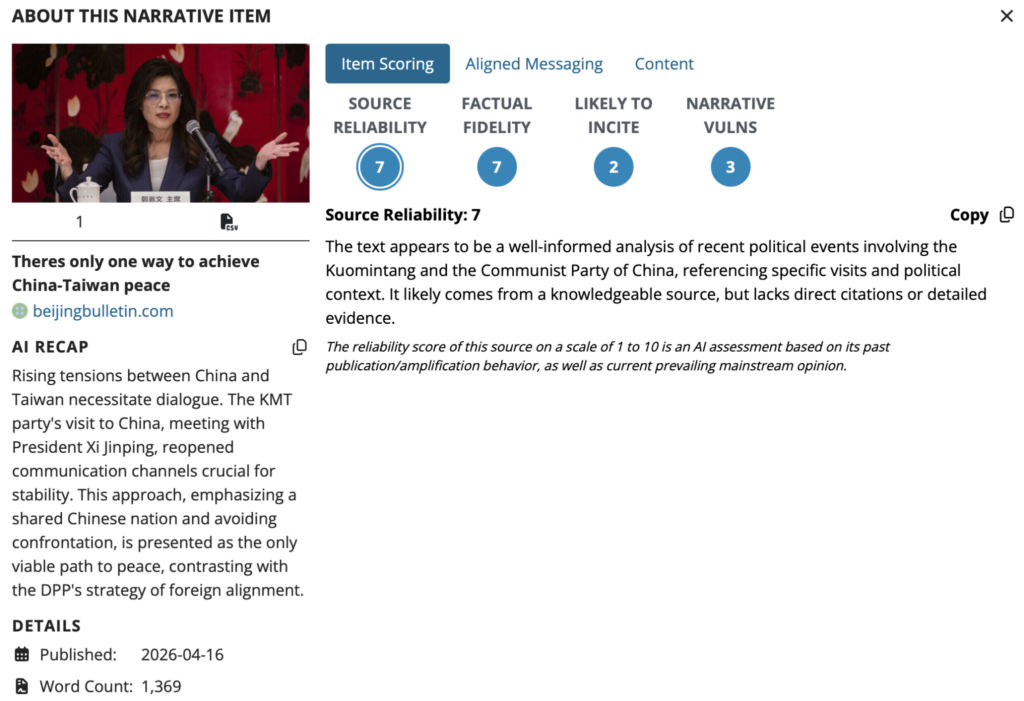
EdgeTheory Factual Fidelity Narrative Classifier
This type of narrative operates by embedding political preferences within seemingly pragmatic analysis, allowing influence to scale without triggering resistance typically associated with propaganda. By presenting cross-strait cooperation as both rational and stabilizing, these narratives reinforce constituencies that benefit from engagement while indirectly delegitimizing policies centered on deterrence or alignment with the United States.
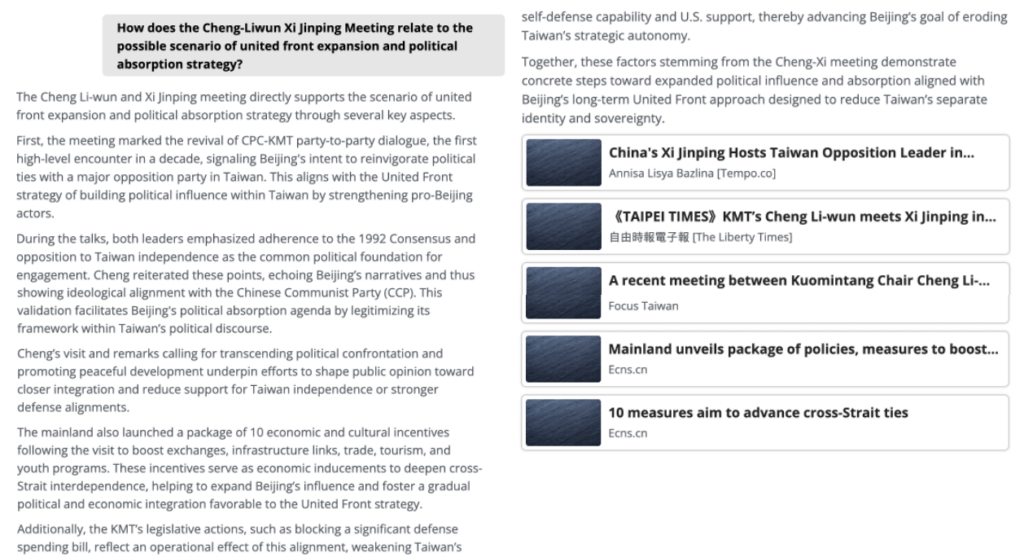
The aggregation of aligned reporting and narrative scoring demonstrates convergence across sources, where multiple outlets reinforce similar framing around cross-strait engagement and stability. This supports the assessment that Beijing’s influence is amplified through distributed narrative alignment, extending the impact of individual engagements into broader perception-shaping effects across the information environment.
The erosion of Taiwanese sovereignty ranks highest due to the comprehensive political, economic, and cultural initiatives launched by Beijing following the Xi-Cheng meeting, the strategic use of the KMT as a political vehicle, and the clear intent to reshape Taiwan’s domestic consensus toward Beijing’s framework.

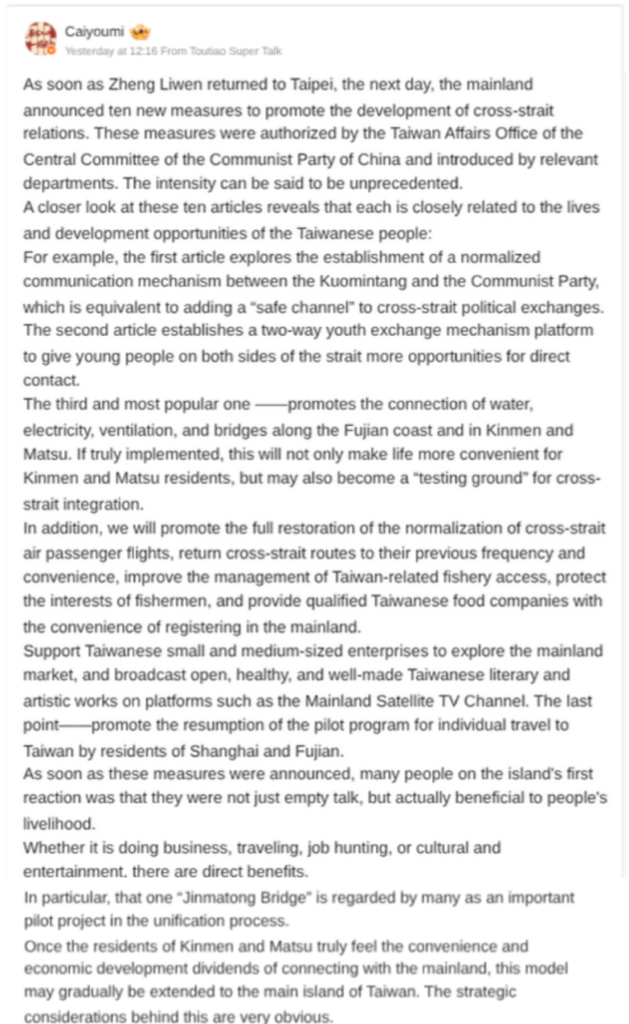
Weibo post by Caiyoumi emphasizes economic cooperation, infrastructure connectivity, and expanded exchanges, framing integration as materially beneficial and politically viable.
Social media amplification supports an assessment that Beijing is successfully operationalizing a political warfare approach centered on access, normalization, and elite capture rather than coercion. The key intelligence signal is the routinization of cross-strait engagement channels—particularly at the party, local, and civil society levels—which indicates these mechanisms are no longer episodic or symbolic, but embedded and scalable.
The emphasis on subnational exchanges, youth programs, and sector-specific cooperation points to a deliberate effort to diffuse influence horizontally across Taiwanese society, reducing reliance on any single political actor while still leveraging aligned intermediaries. China’s 10 measures aim to improve cross-strait ties by resuming individual travel by residents of Shanghai to Taiwan, establishing closer infrastructure links, easier access for Taiwanese products to the Chinese market, regular communication between the two parties, and bilateral youth exchanges.
Additionally, the framing of economic interdependence and social connectivity as stabilizing forces reflects measurable progress in shaping the decision-making environment inside Taiwan. The intelligence value lies in the implied shift in cost-benefit calculations among segments of the population and political class—where engagement is increasingly viewed as materially advantageous and politically defensible.This dynamic fractures Taiwan’s domestic consensus, particularly on defense priorities and long-term alignment.
Taken together, these indicators reinforce the assessment that Beijing’s most effective pathway remains gradual political absorption: building conditions in which resistance erodes internally as integration becomes structurally embedded, lowering the need for overt pressure while preserving strategic momentum toward unification.
The erosion of Taiwanese sovereignty ranks highest due to the comprehensive political, economic, and cultural initiatives launched by Beijing following the Xi-Cheng meeting, the strategic use of the KMT as a political vehicle, and the clear intent to reshape Taiwan’s domestic consensus toward Beijing’s framework.
2. Fragmentation of Taiwan’s Political Consensus
Beijing leverages opposition channels to stabilize cross-strait tensions while maintaining leverage. Limited dialogue, economic concessions, and people-to-people exchanges reduce immediate risk of escalation but remain conditional on political compliance. This creates a controlled environment in which Beijing can shape Taiwan’s policy direction incrementally while avoiding crisis-level confrontation. The meeting between Xi and Cheng was framed around themes of “shared homeland,” “one family,” and “peace,” with both leaders calling for peaceful development and opposing Taiwan independence. The mainland’s goodwill gestures, such as waiving fees for Taiwan residents’ travel permits and expanding permit-issuing ports, along with the promotion of youth exchanges and cultural cooperation, serve as pressure valves to ease tensions. Fragmentation of Taiwan’s political consensus is closely linked but functions more as providing a controlled easing of tensions without resolving sovereignty disputes.
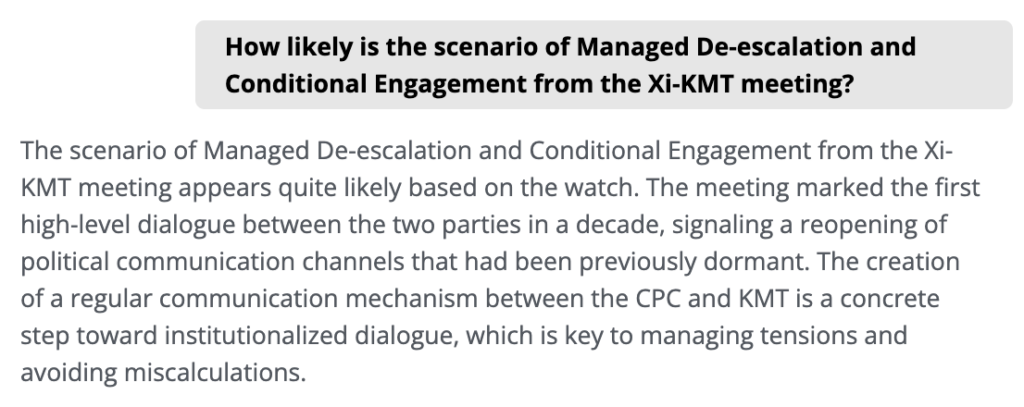
As the EdgeWatch Agent notes:
“The creation of a regular communication mechanism between the CCP and KMT is a concrete step toward institutionalized dialogue…Overall, the combination of resumed dialogue channels, agreed political principles, and concrete cooperative measures indicate a high likelihood that this scenario will unfold, with managed de-escalation and conditional engagement guiding cross-Strait relations in the near term.”
This points to a shift from ad hoc engagement to structured interaction, allowing Beijing to regulate the pace and scope of cross-strait exchanges while minimizing escalation risk. The mechanism itself becomes a tool of control—stabilizing the environment without requiring substantive political concessions.
At the same time, the identified constraints—DPP resistance and public skepticism—reinforce that this approach operates within limits, relying on selective alignment rather than broad consensus. By anchoring engagement in perceived benefits of stability and risk reduction, Beijing can incrementally shape decision-making conditions inside Taiwan while preserving leverage. The outcome is a controlled equilibrium where tensions are managed, but underlying strategic competition remains unresolved.
The post provides indicators of a calibrated influence framework designed to regulate cross-strait tensions through controlled distribution of material benefits.

Edge Theory Narrative Attack Vector messaging tied to economic prosperity, social welfare, and stability illustrates how benefits are explicitly linked to political alignment, reinforcing compliance through perceived gains rather than coercion.
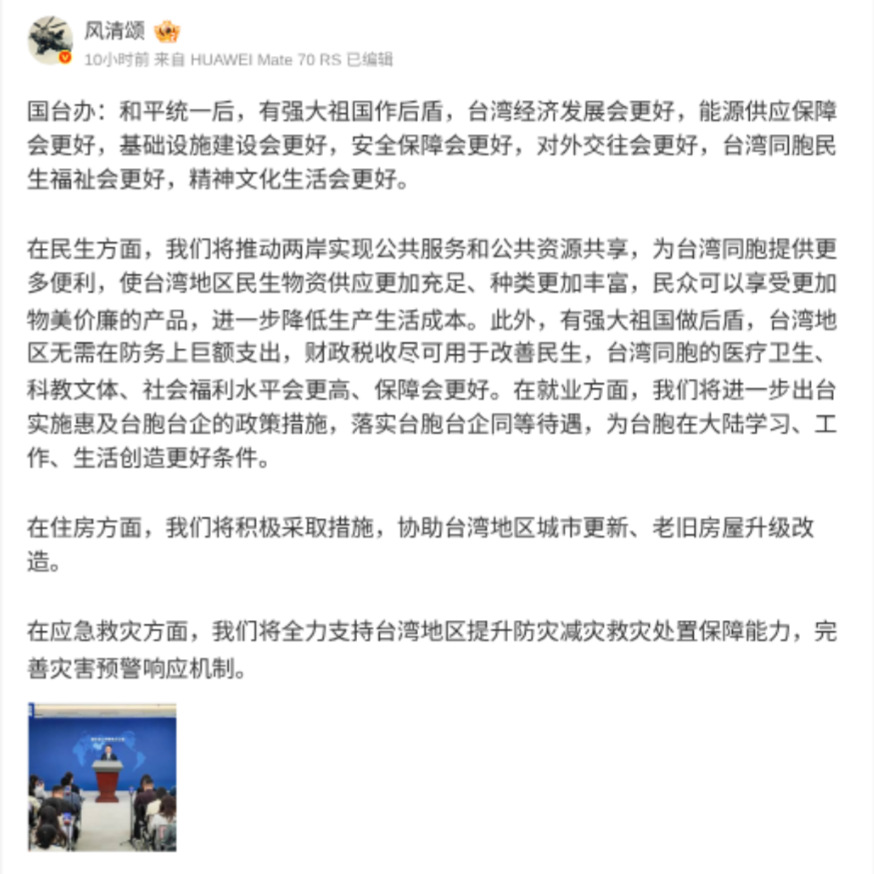
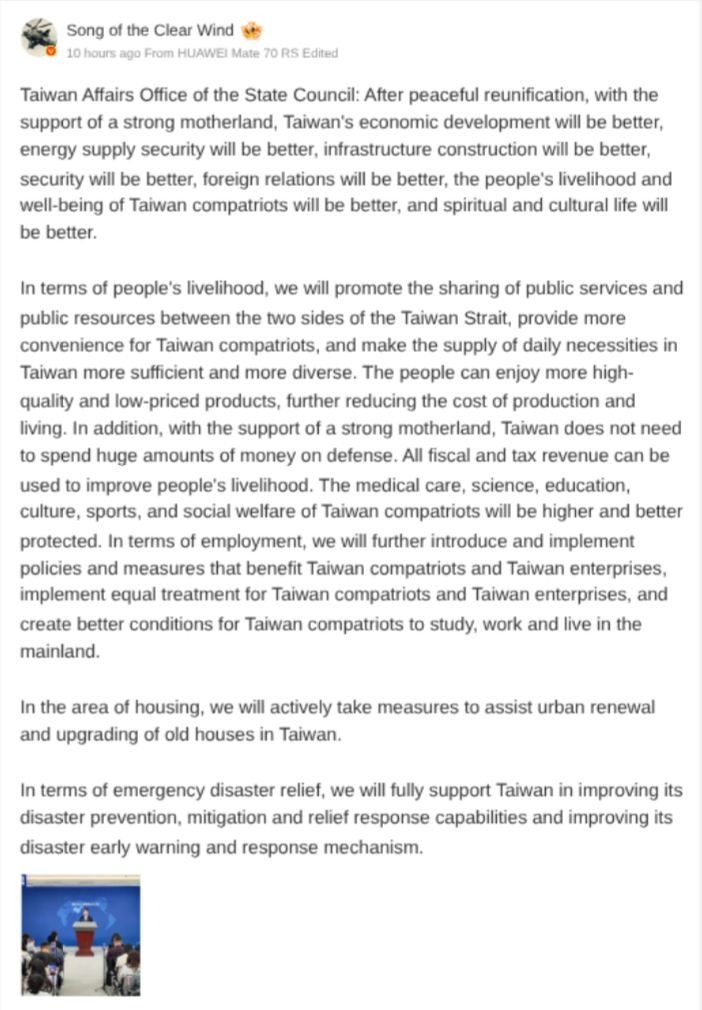
Weibo post by Song of the Clear Wind
The post provides indicators of a calibrated influence framework designed to regulate cross-strait tensions through controlled distribution of material benefits. The primary signal is the explicit linkage between improved economic conditions, social welfare access, and overall stability outcomes. This suggests an intent to condition segments of the target population to associate reduced tension with continued engagement, creating a feedback loop that reinforces compliance without overt enforcement. The breadth of sectors referenced—livelihoods, infrastructure, public services, and disaster response—indicates a whole-of-system approach, enabling multiple points of entry for influence while increasing the cost of disengagement.
Additionally, the structure of the messaging implies retained escalation control. Benefits are presented as expandable and contingent, rather than fixed, which preserves flexibility to adjust pressure based on political behavior.
This reflects a managed environment where baseline stability is maintained, but access to economic and social advantages can be modulated to incentivize alignment or signal disapproval. The intelligence value lies in the implied shift from reactive crisis management to proactive environment shaping: tensions are not resolved but bounded, with engagement mechanisms functioning as both stabilizers and levers of control.
3. Intensified Military Preparation through Coercive Diplomacy (Least Likely, but Present)
Despite engagement, Beijing sustains military pressure, influence operations, and coercive signaling. PLA activity, cyber operations, and narrative framing continue to condition the environment for potential escalation scenarios. This dual-track approach preserves optionality, allowing Beijing to transition from shaping to coercion if political pathways stall. While not indicative of imminent conflict, this trajectory ensures Beijing retains escalation dominance and preparedness. For the United States, the center of gravity is shifting from external deterrence to internal Taiwanese cohesion. As Beijing competes within Taiwan’s political and economic systems, U.S strategy that focuses primarily on military support risks misalignment with on-island political realities. Sustaining deterrence will require reinforcing both Taiwan’s defense capabilities and its domestic consensus around resisting coercion. The Xi–Cheng meeting does not signal immediate escalation; it signals a more sophisticated phase of competition in which Beijing seeks to win without fighting by reshaping Taiwan from within. The most likely outcome is not rapid unification, but incremental absorption through political fragmentation, economic dependence, and narrative convergence.
Weibo post by Fengyun Society Chen Jing emphasizes stability, gradual engagement, and long-term cooperation, reflecting a controlled narrative environment rather than reactive escalation. This reinforces the assessment that Beijing’s approach functions as continuous background conditioning, preserving escalation options while prioritizing long-term political and economic shaping of Taiwan’s internal landscape.
Intensified military preparation through coercive diplomacy, while present in the form of ongoing military activities and strategic signaling, remains secondary to the current emphasis on political and economic integration efforts, with no immediate signs of escalation to open conflict.
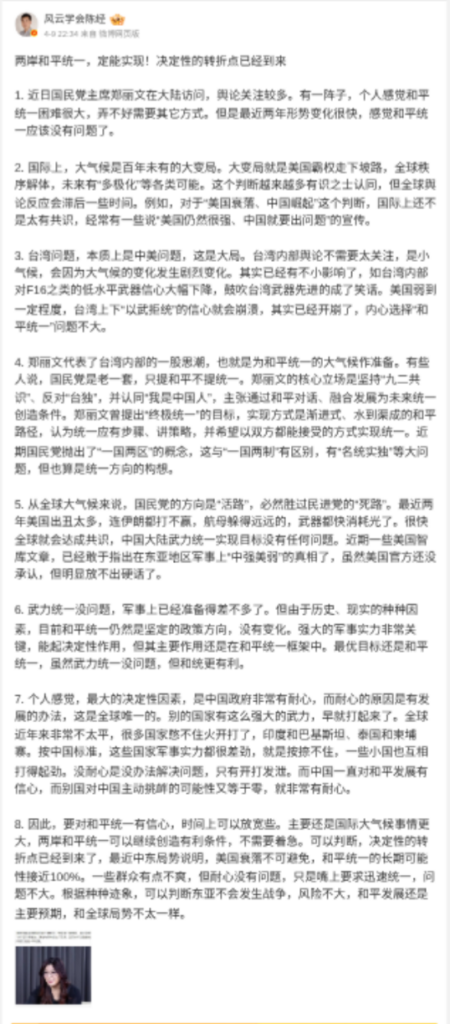
Weibo post by Fengyun Society Chen Jing emphasizes stability, gradual engagement, and long-term cooperation, reflecting a controlled narrative environment rather than reactive escalation. This reinforces the assessment that Beijing’s approach functions as continuous background conditioning, preserving escalation options while prioritizing long-term political and economic shaping of Taiwan’s internal landscape.
Beijing is maintaining steady military pressure, influence operations, and coercive signaling, but these function primarily as background conditioning rather than indicators of imminent escalation. This dual-track approach preserves optionality—keeping escalation pathways viable while prioritizing non-kinetic methods to shape the operating environment. This strategy enables China to engage politically and gain influence over internal Taiwanese politics without
The center of gravity continues to shift inward, toward Taiwan’s domestic cohesion and political alignment. As competition increasingly plays out within Taiwan’s economic systems, media space, and electoral dynamics, strategies focused predominantly on external deterrence risk misalignment. The more decisive variable is the resilience of internal consensus against incremental coercion. Current indicators point toward a prolonged phase of competition aimed at achieving outcomes without fighting—leveraging political fragmentation, economic dependence, and narrative convergence. Pre-conflict shaping remains present, but secondary, reinforcing a trajectory defined by gradual absorption rather than near-term escalation.
The Xi–Cheng engagement shows that Beijing’s primary pathway is not coercive unification, but sustained internal shaping, using political co-option, economic inducements, and calibrated pressure to erode Taiwan’s domestic cohesion and strategic autonomy over time. The central dynamic is a shifting center of gravity from external deterrence to internal resilience: outcomes will depend less on military balance and more on whether Taiwan can maintain political consensus in the face of persistent, multi-domain influence.