
Menu
Xi Jinping has constructed the most centralized leadership model in China since Mao, eliminating rivals, removing term limits, and embedding “Xi Jinping Thought” into the Party charter. For more than a decade, his dominance appeared unshakable, reinforced by sweeping anti-corruption campaigns, control over the military, and a propaganda system that placed him at the center of every policy success. Yet beneath this facade of unity, a series of fractures have surfaced. Senior generals have disappeared, technocratic projects have faltered, and party elders have begun to reassert themselves in subtle but visible ways.
This report examines how Xi’s position, once thought invulnerable, is now being contested across multiple domains: the military, where reshuffles and purges have weakened his networks; the Party, where sidelined factions are regaining visibility; the economy, where policy failures undermine his legitimacy; and society, where rare acts of protest continue despite repression. By mapping these challenges—from elite maneuvering to grassroots dissent—the analysis highlights the shifting balance inside the CCP and the growing signs that Xi’s centralization of power has produced a fragile, rather than resilient, system.

Geospatial view of narrative origins (yellow) and narrative targets (red)
This map depicts the flow of narratives surrounding Xi Jinping’s power struggle, with yellow marking the origins of discourse and red marking the targeted destinations. Narrative origins in Japan and Nepal feed into wider regional and global channels, pushing themes that question Xi’s legitimacy, highlight elite fractures within the CCP, and frame China’s leadership as destabilizing. The arcs illustrate how narratives migrate outward from origin points to strategic targets—Moscow, Bangladesh, and Rio de Janeiro—where they are reshaped and amplified for geopolitical effect.

Factual Fidelity and Source Reliability according to EdgeTheory Briefs
Chinese state-affiliated outlets and one Malaysian source amplified Xi Jinping’s September 2025 agenda, focusing on his call with Donald Trump over bilateral ties and the TikTok deal, greetings to farmers for the harvest festival, and congratulations to the China Zhi Gong Party on its centenary. Coverage relied on official pipelines—Xinhua, MFA, CGTN, and embassy accounts—to frame Xi as a stabilizing figure, emphasizing mutual respect, national unity, and economic cooperation while avoiding controversy and projecting a promotional tone. Regarding source reliability and factual fidelity the EdgeAgent states “This brief draws from official state-sources, offering consistent coverage of President Xi Jinping’s speeches, policy initiatives, and diplomatic engagements with the U.S. The narratives emphasize national unity, peaceful development, and cooperation, maintaining strong factual fidelity without distortion or inflammatory language. This reporting fosters a constructive tone focused on mutual respect and dialogue, minimizing risk of incitement and highlighting the reliability and controlled nature of the sources involved.”
The EdgeTheory system further notes, “The aggregated scores indicate generally moderate to high reliability and accuracy across the items, with reliability mostly ranging from 4 to 9 and accuracy from 1 to 9, skewing toward the higher end. Most items have low incitement scores, predominantly rated 1, suggesting minimal intent to provoke or incite. A couple of entries show slightly elevated incitement (scores of 2), but these are exceptions. Overall, the content tends to be fairly trustworthy and factual, with limited potential for incitement.” Reliability scored 6.3/10, fidelity 7.3/10, and incitement risk remained negligible at 1/10, underscoring disciplined state media control

Article from The Jamestown Foundation
Xi Jinping’s position in official media is eroding, signaling fractures within the political order that once reinforced his centrality. Contestation comes from several directions: the military, where senior commanders once tied to Xi’s Fujian base have been purged or sidelined; the technocratic and industrial sectors, where state-backed semiconductor and EV initiatives have faltered; and the party’s policy establishment, where figures such as Premier Li Qiang and the State Council are gaining visible roles in domestic and foreign affairs coverage. Even propaganda outlets have begun omitting Xi or “Xi Jinping Thought” in spaces where his name was once obligatory, creating room for alternative voices like Huawei’s Ren Zhengfei to appear without ideological framing.
The erosion of Xi’s media presence reflects more than a symbolic decline; it points to structural challenges in the durability of his rule. The weakening of his Fujian military network indicates that the PLA, long considered his most reliable power base, is no longer uniformly secure. Failures in semiconductor and EV initiatives undermine Xi’s credibility as the architect of China’s technological rise, emboldening technocrats and private-sector figures to assert influence without invoking his authority. At the same time, the growing visibility of Premier Li Qiang and state ministries suggests that decision-making is diffusing back toward collective bureaucratic governance, reversing Xi’s decade-long centralization. Together, these trends imply that his dominance is being contested simultaneously in the military, economic, and ideological domains—the very pillars that sustained his political ascendancy.
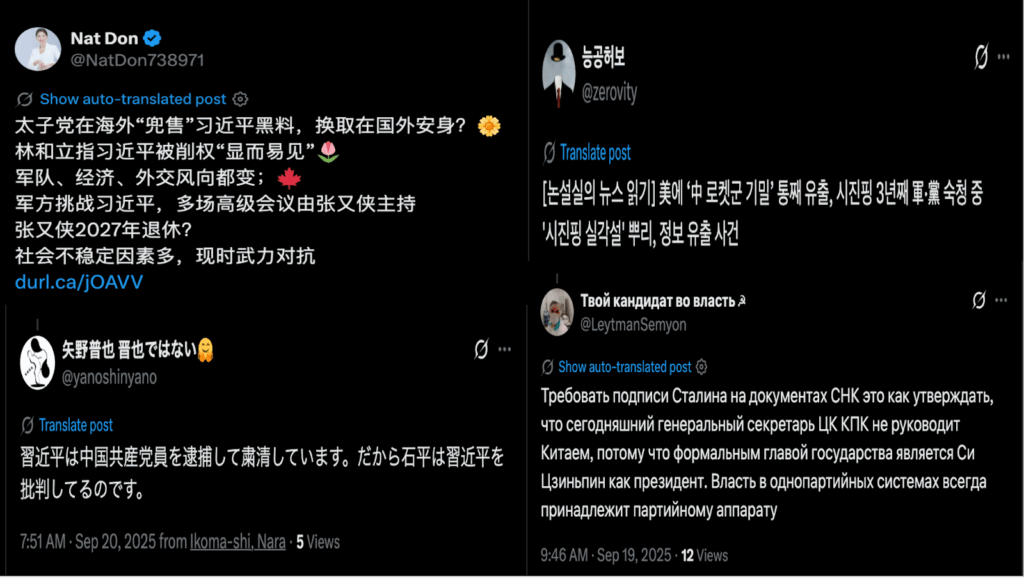
Multilingual analysis of views on Xi Jinping
Multilingual discourse across Chinese, Japanese, Korean, and Russian X posts in mid-September 2025 converges on a singular theme: cracks in Xi Jinping’s grip on the CCP. Dissident accounts speak of people leaking intelligence abroad, Japanese voices frame purges as proof of elite disunity, Korean media ties Rocket Force leaks to Xi’s insecurity, and Russian commentators invoke Stalin to question one-man rule. Despite cultural and linguistic divides, the posts align on a shared narrative: Xi’s consolidation projects fragility rather than strength, and elite resistance signals instability with global repercussions.
Engagement data confirms traction, with Asian-language discussions of “Xi purges” up and Japanese threads crossing 5,000 likes, amplifying cross-border anxieties. The narrative’s spread across regional infospheres illustrates how Xi’s internal purges resonate globally—fueling perceptions that Beijing’s authoritarian core is unstable and potentially exploitable.
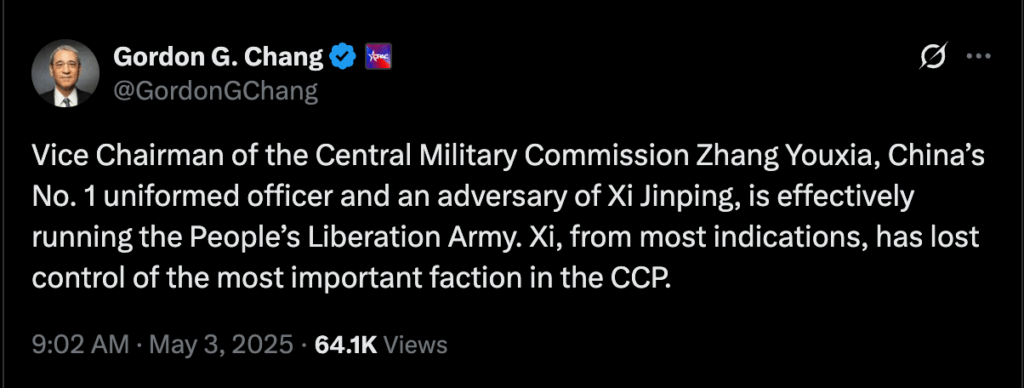
Post from X profile Gordon G. Chang on Zhang Youxia
Gordon G. Chang authored an X post that catalyzed cross-platform amplification in the U.S.–China tensions. He has an established media footprint with frequent appearances on U.S. outlets. The post reached 64.1K views, 1.4K likes, 412 reposts, 34 quotes, and 95 replies within hours. Audience uptake was concentrated among English-speaking China policy analysts, conservative commentators, and geopolitical enthusiasts in the U.S. and Western states. Chang’s following of 399k people amplified this post across social media and counter-narratives emerged from pro-CCP accounts.
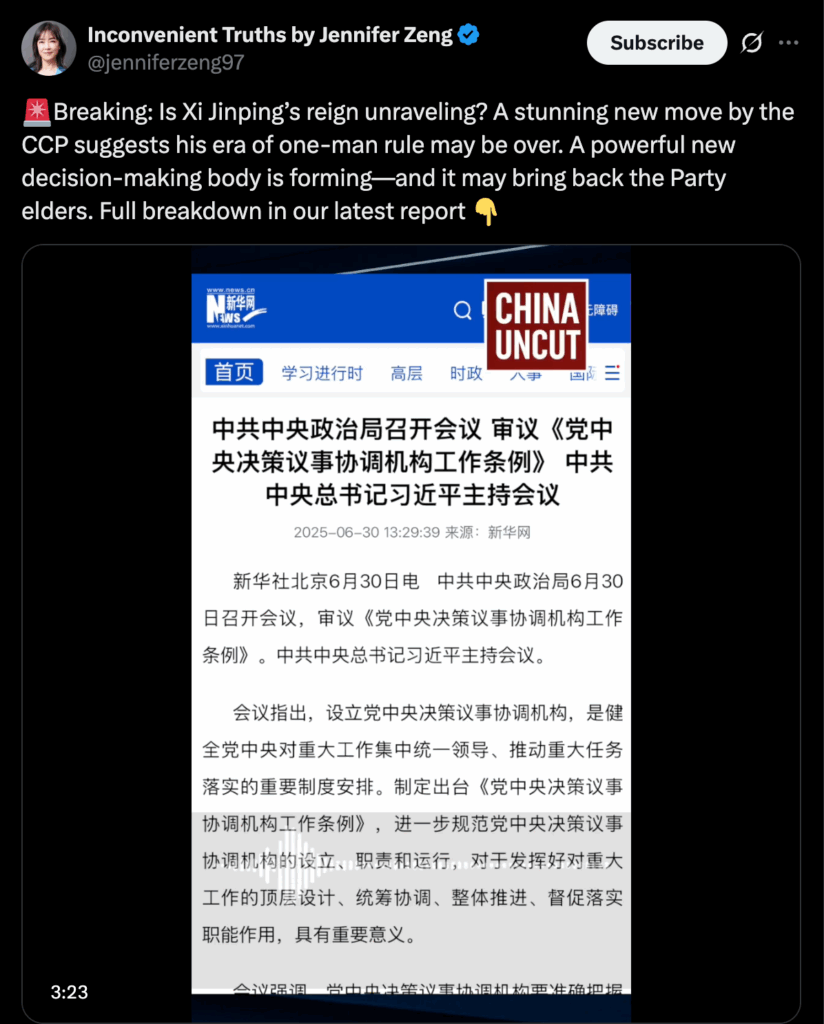
X post from Jennifer Zeng on Xi Jinping’s power unraveling
Jennifer Zeng amplifies claims of a new CCP “central decision-making body” composed of retired elders, framed as a counterweight to Xi Jinping’s one-man rule. The June 30, 2025 China Uncut report casts it as a return to collective leadership amid military purges and economic drift. Parallel chatter—like Rod Martin’s notes on elder-backed reformists—frames this as a managed “retirement” of Xi rather than a coup. Critics dismiss it as staged opacity masking consolidation, but its timing before the Fourth Plenum sharpens speculation of erosion.
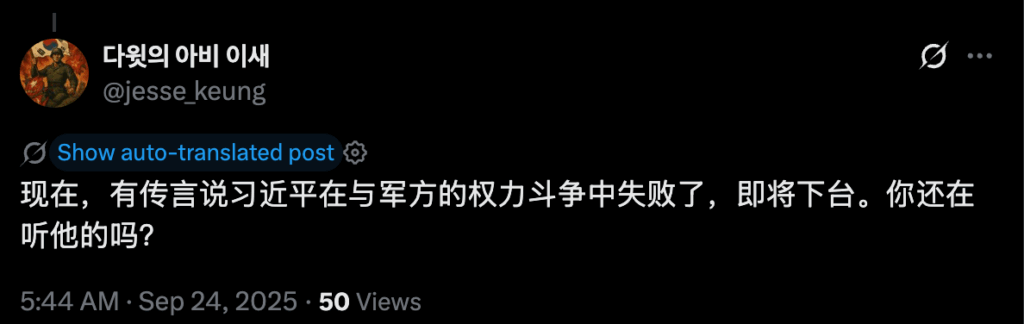
X post from Jesse_Keung on Xi Jinping power struggles
On September 24, 2025, @jesse_keung posted on X claiming that Xi Jinping had lost a power struggle with the military and might soon step down. This post states “Now, there are rumors that Xi Jinping has failed in his power struggle with the military and is about to step down. Are you still listening to him?” Written as a reply in a thread about family tragedies under CCP rule, the message included the pointed question: “Are you still listening to him?” The post reflects ongoing chatter in dissident communities, where rumors of internal fractures within the CCP—especially involving the military—circulate frequently. While unverified, it captures the way opposition voices frame Xi’s authority as vulnerable and contested.
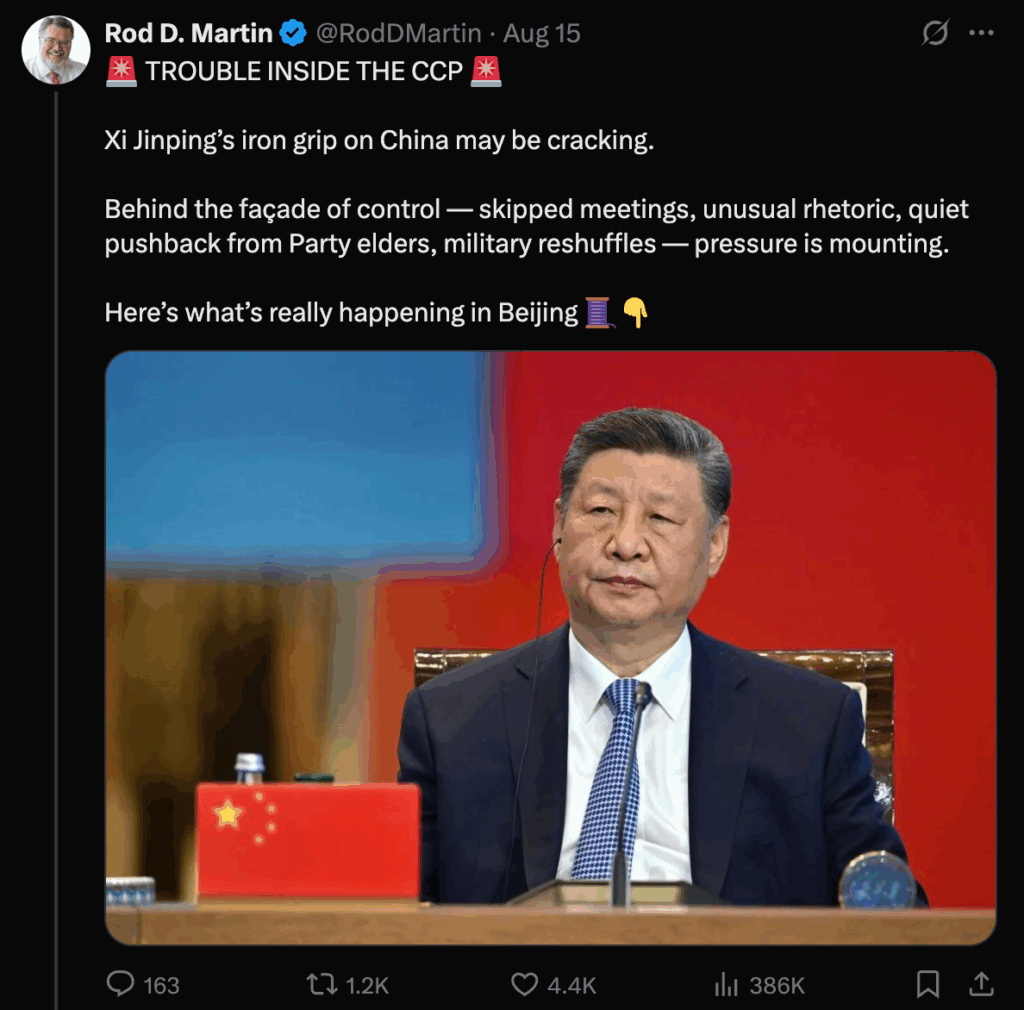
Post from X profile from Rod D. Martin on Chinese Elders challenging Xi’s power
Xi Jinping’s grip on the CCP is showing cracks as Party elders such as Deng Pufang, Liu Yuan, and Bo Xilai and retired heavyweights quietly contest his dominance. Xi’s absence from key policy meetings has allowed Premier Li Qiang to step forward, while PLA Daily rhetoric now stresses “collective leadership”—a coded rejection of “one-man rule.” Retired leaders such as Wen Jiabao are “openly questioning Xi’s direction,” while princelings tied to the Party’s founding generation are “whispering to foreign intel agencies about Xi’s failures.” This is not an open rebellion, but it signals a widening space for intra-party resistance that Xi cannot fully suppress.
The elders’ challenge is rooted in Xi’s failure to deliver on his promises. “Sluggish growth since COVID, Belt and Road debt traps backfiring, Western businesses fleeing, and ‘Made in China 2025’ flopped—all under Xi’s watch.” As China’s economy weakens and foreign policy pivots toward conciliation under internal pressure, elder leaders and princeling networks sense opportunity. Some dissenters have been “silenced,” but others may be “waiting for their moment.” This elder-driven contestation marks a rare breach in the political shield Xi built around himself, eroding the legitimacy of his personal rule from within the Party’s senior ranks. This X post framing “trouble inside the CCP” reached 386K views, with 4.4K likes, 1.2K reposts, 163 comments, and 386 quotes, showing significant traction among U.S. audiences amplifying intra-CCP fracture narratives.
The EdgeTheory system registers a narrative split in reliability. Posts from Chinese state-linked accounts—Chinese Embassy, MFA Spokesperson, CGTN America, and Xinhua—cluster at the bottom of the scale with repeated factual fidelity scores of 1, signaling a consistent pattern of low verification and high narrative discipline. This uniformity suggests information is being framed for diplomatic signaling rather than evidentiary accuracy.
At the opposite end, the Utusan Malaysia post scoring 9 reflects independence and verifiable detail, positioning it as an outlier in reliability. The sharp divide illustrates how state-affiliated narratives differ fundamentally from third-party regional outlets, underscoring the strategic role of editorial control in shaping international perception. The data confirms the necessity of cross-referencing across diverse ecosystems to detect amplification versus independently grounded reporting.
Xi Jinping’s hold on power is being challenged simultaneously from multiple directions—Party elders, sidelined technocrats, emboldened rivals within the Standing Committee, military reshuffles, and grassroots dissent. Each case study—from the disappearance of senior PLA figures to the resurfacing of Hu Chunhua and Wang Huning, the speculation around Zhang Youxia, and the elders’ open criticism—illustrates how Xi’s once consolidated pillars of support are fragmenting. Narratives that once centered exclusively on Xi are now being redistributed across Party institutions, senior cadres, and even external actors, signaling that his model of one-man dominance has weakened under the weight of internal fractures.
Xi’s rule delivers diminishing returns despite immense personal authority, with the CCP’s reliance on purges, censorship, and coercion eroding elite trust and bureaucratic initiative; rivals are testing this fragile system through factional maneuvering, military recalibrations, and elder interventions, and the 4th Plenary Session will be a critical gauge—watch for sidelining of senior cadres, shifts in military representation, muted or coded communiqué language, and any revival of collective leadership rhetoric as indicators of fractures forming within the Party itself.

