
Menu
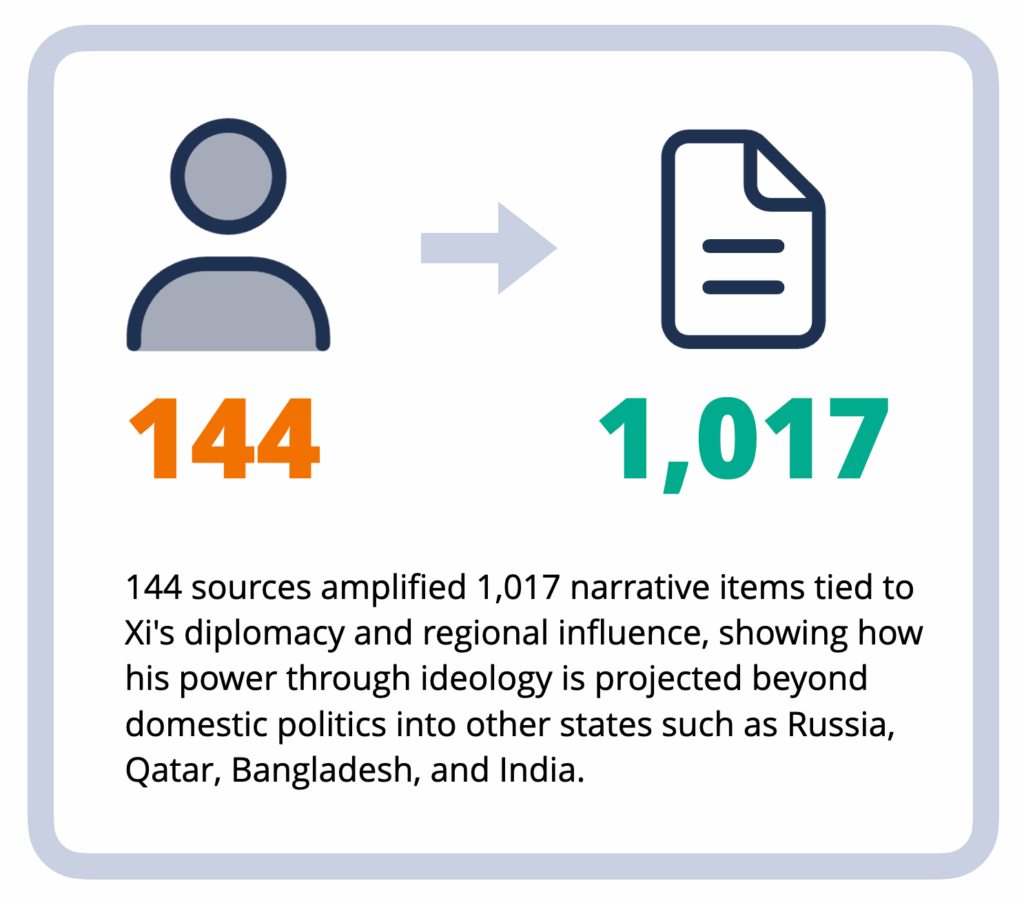
Xi Jinping’s power rests on the doctrine of “socialism with Chinese characteristics for a new era,” declared in his 2017 speech. Xi presented this philosophy as the foundation of China’s national identity and his lasting legacy, asserting that China’s prosperity will come through party discipline, national rejuvenation, and economic development. The strength of this message is reinforced externally: 144 sources amplified 1,017 narrative items tied to China’s diplomacy and regional influence, showing how his power through ideology is projected beyond domestic politics into other states such as Russia, Qatar, Bangladesh, and India.
Zhang Youxia, Vice Chairman of the Central Military Commission and a longtime ally of Xi, plays a central role in extending Xi’s power into the civilian side of the PLA (People’s Liberation Army). His position allows him to project Xi’s will while also holding influence that could counterbalance it. The 82nd Group Army, a core reserve force for Beijing, demonstrates Xi’s reliance on political reshuffling and loyalty campaigns to eliminate rival networks. Displays such as the Victory Day parade reinforce this control, where the placement of commanders and units signals alignment with Xi and the CCP. Lastly, Beidaihe, the annual gathering of party elders, retired military generals, and CCP party members remains a venue where Xi’s visibility functions as a measure of elite consensus or dissent.
Externally, Xi’s authority and power is further demonstrated through diplomacy and multilateral platforms. The 2025 Shanghai Cooperation Organisation summit in Tianjin, chaired by Xi, was the largest in the group’s history, drawing leaders from more than 20 countries and 10 international organizations. The summit underscored China’s role in achieving its dream of hegemony through economic cooperation, while bilateral meetings with the UN Secretary-General and regional partners reinforced Beijing’s external projection of leadership. Together, ideology, domestic control, and external amplification define the mechanisms sustaining Xi’s power.
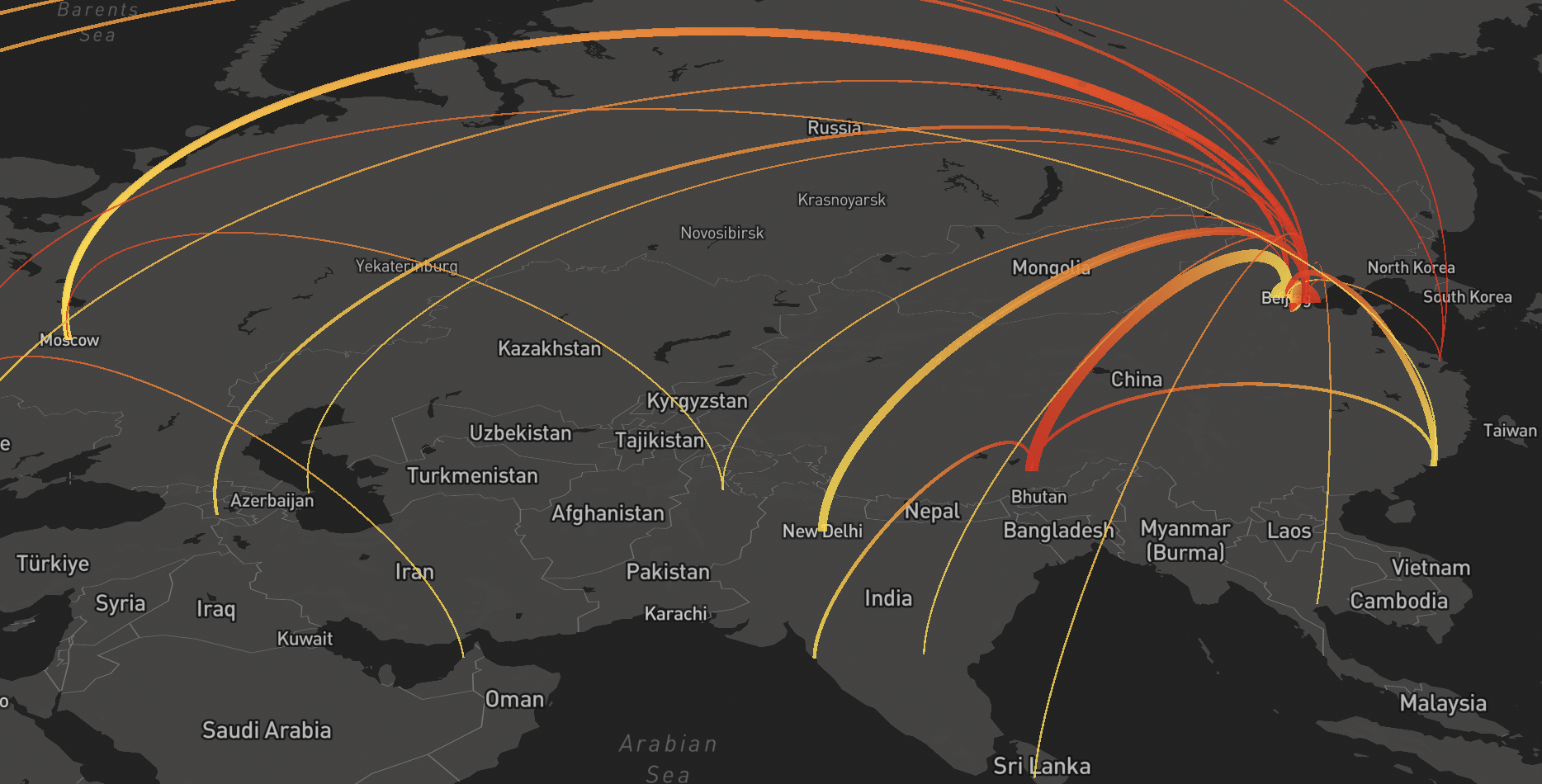
Imagery of source targets (yellow) & source origins (red) about Xi Jinping’s power
These narrative sources and targets form a dense web converging on Xi Jinping’s power. Narratives originate from Tianjin and Lhasa while targets include New Delhi, Moscow, and Beijing. The most reliable narratives originate from sources such as Ecns.cn and China Xinhua News, while the most unreliable narratives originate from fringe sources such as Alexander Dugin and China’s embassy in Poland. The heaviest traffic originates from proximate actors like Chinese embassies, communist-affiliated accounts, and aligned regional voices. The clustering underscores Xi’s portrayal as strategically indispensable, whether framed through economic leadership, political influence, or cultural alignment. These narratives are not about objective assessment, rather they are more about constructing Xi as the symbolic center of an emerging multipolar system. The above visual represents the contested narrative battlespace about Xi’s power originating and targeting China.

Narrative Classifiers of Sources on Xi Jinping
In EdgeTheory briefs, narrative incitement, source reliability, and factual fidelity are measured via amplifications across each topic and theme. According to the EdgeAgent, “Incitement rates measure how much the content encourages strong emotional reactions or prompts people to engage, such as sharing or commenting. Reliability reflects how credible and trustworthy the sources amplifying the content are—higher reliability means the source is seen as authoritative and factual. Factual fidelity assesses the accuracy and truthfulness of the narrative itself.” In this brief, articles with high incitement and reliability focus on President Xi Jinping’s recent activities, including his attendance at the 60th anniversary of the Xizang Autonomous Region, preparations for the Shanghai Cooperation Organization (SCO) Summit 2025, and meetings with world leaders like the UN Secretary-General.” These narratives are anchored in official state media outlets that score high on reliability and factual fidelity.
The EdgeAgent explains that “their combination of credible sourcing and emotionally resonant themes helps these narratives spread widely and shape public understanding effectively.” This pairing demonstrates how Xi’s leadership messaging is deliberately structured: factual grounding ensures trust, while incitement creates engagement. Together, they extend his ideological framework beyond domestic audiences, amplifying Xi’s role in domestic and international politics.

Narrative classifiers of least reliable Xi Jinping narratives
These narratives fall into the lowest tier of EdgeTheory’s system, classified as the most unreliable and un-factual. The claims originate from fringe ideologues, propaganda outlets, and state-aligned accounts. Within EdgeTheory’s assessment model, such content ranks at the bottom for reliability, factual fidelity, and credibility. The emphasis is on constructing emotionally charged storylines around Xi Jinping’s global role rather than presenting balanced or evidence-based reporting. This places the narratives firmly in the category of unreliable influence operations designed to amplify state interests rather than inform.
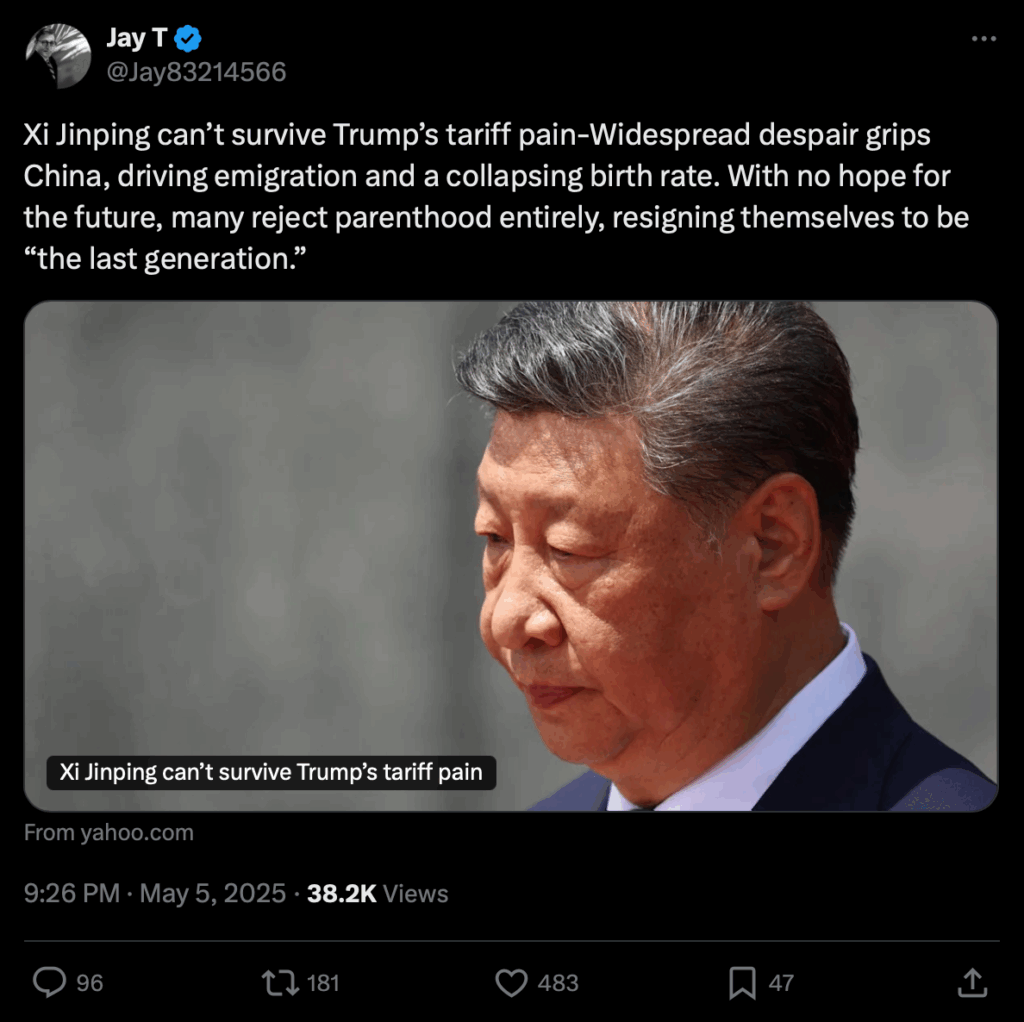
Post from X profile Jay T on Xi’s declining power
An article posted on 5 May 2025 by X user Jay T amplifies a narrative of widening instability inside China following Trump’s tariffs. The content highlights rising frustration among younger generations tied to economic stagnation, falling birth rates, and a deepening sense of futility with government control, symbolized through the slogan “last generation.” The framing positions demographic and economic decline as converging pressures on the CCP and Xi’s legitimacy.
The post further asserts that Xi Jinping has lost control of the military to General Zhang Youxia, introducing a storyline of fractured command within the PLA. This claim intensifies perceptions of elite division and instability in China’s leadership, suggesting a weakening grip by Xi over both political, civilian, and military structures.

Post from TikTok Profile warumdarum218 claiming Zhang Youxia’s Control over PLA
The post above from @warumdarum218 claims that Zhang Youxia is rumored to be building his own faction inside the PLA to challenge Xi Jinping’s authority. It frames Zhang as a key figure , shaping a counter-Xi coalition, leveraging unrest among both citizens and disaffected elites. Due to Xi’s consistent reshuffling of elites, many influential figures are seeking to disrupt Xi’s power and create a new power structure in China.
Narrative monitoring indicates that Zhang’s influence is tied to his dual role as vice chairman of the Central Military Commission and overseer of the civilian arm of the PLA. That civilian apparatus is closely linked to the Victory Day Parade, a stage-managed event in Beijing designed to showcase loyalty, discipline, and unity under the Party. Control over this symbolic display of power amplifies Zhang’s image as a stabilizing counterweight within a fractured system. The Vision Times states that the Beidaihe summit, a meeting place for the elites to discuss new policy and leadership decisions, is speculated to speak on finding a new leader.

YouTube Post from China Insider on Xi’s weakening power
This video from China Insider casts the 2025 Beidaihe Conference as a turning point for Xi Jinping’s grip on power. While state media portrays it as a routine “working vacation,” for the average citizen, insider accounts claim leadership lists for the 21st Party Congress are being finalized, determining whether Xi remains or steps aside. Signals of elite uncertainty are highlighted: Cai Qi’s shift in tone, an unusually tense Army Day, and the reemergence of sidelined figures like Liu He—all feed speculation that Xi’s control is slipping. The strongest narrative centers on reports that Zhang Youxia’s 82nd Group Army has moved into Beidaihe, fortifying the site of deliberations. This positioning underscores the idea that military power, once Xi’s key source of authority, may now be shifting under Zhang’s influence.

Weibo Post from 紫光阁 profile on Victory Day Parade
The Victory Day parade scheduled for September 3, 2025, in Beijing’s Tiananmen Square, marking the 80th anniversary of Japan’s WWII surrender, is a calculated display of military might and diplomatic clout designed to reinforce Xi Jinping’s power amid domestic and international pressures. The image is translated to say “Victory Day Parade Rehearsal Completed. Grand Parade: People's Army 70 Minutes, Conducted in Two Steps.” With over 10,000 troops, 100+ aircraft, and advanced weaponry like hypersonic missiles and drones, the parade showcases the PLA’s modernization under Xi’s reforms, projecting strength to deter external threats and rally domestic support through nationalism. The parade also bolsters Xi’s power through strategic diplomacy and domestic messaging. The attendance of 26 foreign leaders, including Russia’s Putin and North Korea’s Kim Jong Un, signals a counter-U.S. “Axis of Upheaval,” enhancing Xi’s global stature as he navigates the international order.
Adding to the resonance, commentary around recent Victory Day parade deployments suggests that troop compositions are factionally mixed, raising speculation that Zhang is safeguarding against mutiny while consolidating influence. Reports on PLA factionalism show that Xi’s previous purges eroded trust within the military, creating openings for Zhang’s faction to emerge as a credible alternative pole of power.
Xi Jinping’s authority in 2025 is both reinforced and contested. Ideological messaging, elite gatherings, and high-profile military displays continue to project an image of centralized control and national strength. However, emerging narratives point to fractures within the CCP and PLA, demographic pressures, and economic stagnation that challenge the perception of unassailable power. Key figures, particularly Zhang Youxia, are increasingly positioned as alternative centers of influence, signaling potential shifts in loyalty and authority that could reshape internal power dynamics.
The interplay between projection and perception defines Xi’s current position. Outward displays of strength through summits, parades, and diplomatic engagement obscure underlying tensions, creating a dual narrative of dominance and vulnerability. Monitoring elite movements, factional alignments, and public sentiment will remain critical to understanding the durability of Xi’s control, where symbolic events serve as both instruments of power consolidation and indicators of emerging instability.

