
Menu
Menu
This report examines the evolving information environment surrounding the election in Hungary, integrating open-source intelligence, cross-platform narrative analysis, and network mapping to assess how malign actors are shaping perception, sentiment, and electoral legitimacy. Leveraging EdgeWatch analysis, the report traces how influence is constructed through interconnected narratives rather than isolated messaging, with particular attention to how key actors such as Viktor Orbán, NATO, and the European Union are framed within broader geopolitical tensions. By combining EdgeTheory’s agentic analysts, narrative classifiers, and source classifiers, the report evaluates both the structure and impact of narrative ecosystems, including emotional drivers, amplification pathways, and cross-platform convergence. It focuses on how election-related narratives frequently translate discrete events, such as political statements or campaign developments, into broader claims about sovereignty, foreign interference, and domestic instability. Using these analytic tools, the report illustrates how EdgeTheory’s analytics generate real-time insights into narrative evolution, sentiment spikes, and influence operations shaping the pre-election environment.
The Hungarian election represents a convergence of domestic manipulation and external influence. Malign actors frame the election as a binary outcome with disproportionate strategic consequences: a vote for Viktor Orbán stresses sovereignty, stability, and peace, while opposition alignment is framed as submission to external control, economic decline, and conflict escalation. This binary is not organically derived. It is constructed through the deliberate convergence of narratives linking Hungary’s domestic politics to broader geopolitical tensions involving the European Union and NATO. Across platforms, malign actors amplify narratives that converge around three central themes: Orbán as a defender of national sovereignty, the European Union as coercive and intrusive, and NATO as a driver of escalation. These narratives are reinforced through emotional and temporal dynamics, where stable messaging builds legitimacy while more volatile content activates fear, anger, and distrust.
Across platforms, messaging consistently links Viktor Orbán with sovereignty, stability, and peace, while portraying opposition figures as proxies of foreign control aligned with the European Union and NATO. These narratives are deliberately interconnected, transforming routine campaign developments into broader claims about war, external coercion, and national survival. This convergence reduces complex political competition into a simplified, high-stakes dichotomy that amplifies perceived consequences of electoral outcomes.
Malign influence operations reframe the Hungarian election as a binary geopolitical choice rather than a domestic political process.
Pro-Orbán narratives demonstrate higher volume and greater emotional consistency, functioning as a stabilizing legitimacy anchor that reinforces inevitability and continuity. In contrast, anti-opposition messaging is more sporadic but significantly more emotionally charged, relying on fear-based and conspiratorial claims that link opposition figures to terrorism, foreign interference, and geopolitical escalation. This imbalance suggests malign actors are focusing more on strengthening favorable perceptions of Orbán than undermining opponents directly, while still deploying targeted emotional spikes around key events to heighten voter anxiety and polarization.
Russian-aligned sources and affiliated networks extend election narratives beyond Hungary by linking them to global actors, conflicts, and ideological divides, including U.S. politics and Middle Eastern dynamics. Telegram functions as an experimental staging ground where diverse narratives are tested and then amplified through secondary outlets and international commentators. Network mapping highlights a hub-and-spoke structure, where major state-aligned outlets are supported by smaller amplifiers, enabling narratives to transition from overtly state-linked origins to more diffuse, third-party validation. This ecosystem reinforces distrust in Western institutions and recasts the election as part of a wider struggle over global order and sovereignty.
The election in Hungary has become a focal point for coordinated narrative shaping by malign actors, who are exploiting geopolitical tensions surrounding Viktor Orbán, NATO, and the European Union to influence perception and legitimacy outcomes.
Across social media platforms, coordinated narratives cluster around three themes: Orban as a sovereignty defender, EU as coercive and illegitimate, and NATO as an escalation driver. These narratives are not isolated; they are deliberately converged to construct a binary: Orbán equals peace and sovereignty, while opposition alignment equals war and foreign control.

X post by Anne Applebaum
There is a distinct emotional framing difference between pro-Orban and anti-Magyar narratives. By tracking all the narratives, we can identify a spike on April 7th in items discussing Magyar and Orban. However, the pro-Orban narratives spike to 70 while the anti-Magyar narratives spike only to 19. This may indicate that pro-Russian sources are focusing more on supporting Orban than trying to attack his opponent Magyar. This analysis becomes more likely as we investigate the most amplified items in both sparklines:
...the pro-Orban narratives spike to 70 while the anti-Magyar narratives spike only to 19. This may indicate that pro-Russian sources are focusing more on supporting Orban than trying to attack his opponent Magyar.

EdgeWatch Narrative Intelligence Monitor
The relative emotional stability of pro-Orbán narratives functions as a legitimacy anchor. By maintaining consistent, less emotionally volatile messaging around Viktor Orbán, malign actors push inevitability and normalcy. This aligns with the broader theme of sovereignty framing, where Orbán is positioned not as a reactive political actor but as a steady defender of national continuity against external pressure from the European Union and NATO.
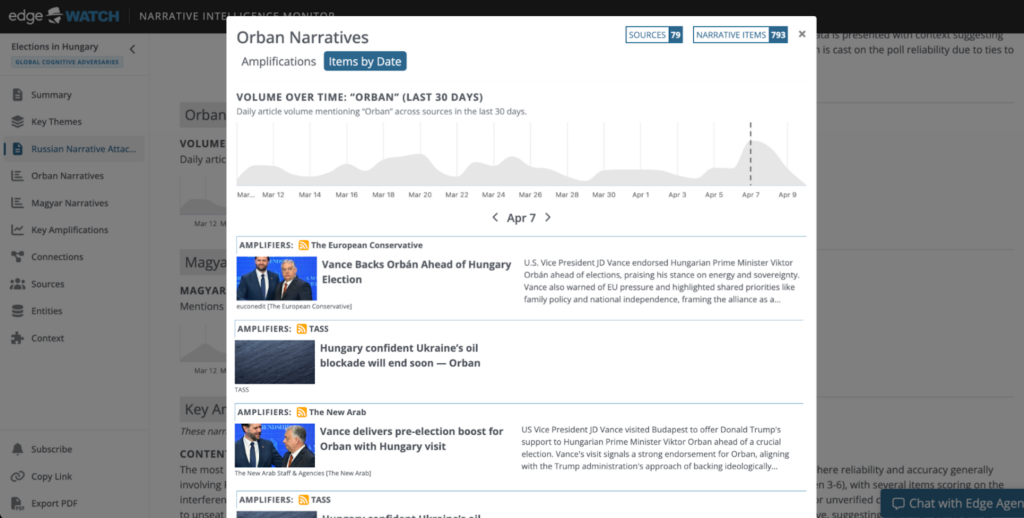
EdgeWatch on Orban Narrative Amplifications
While the anti-Magyar items use significantly more charged language and leverage divisive topics, such as claiming Ukraine is using terror to support Magyar, leveraging fear and VP Vance to claim surrounding countries want to control Hungary, and suggesting that Hungary has made significant progress that will be undone with an Orban defeat:
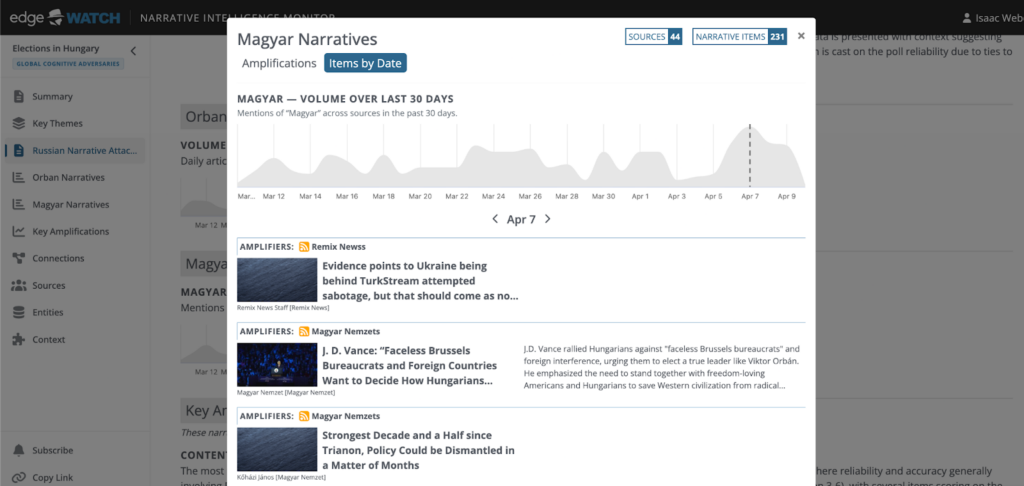
EdgeWatch on Magyar Narrative Amplification
The anti-Magyar spike, particularly around April 7th, demonstrates clear alignment with key attack vectors. By tying Magyar support to Ukraine and terrorism, narratives exploit war fatigue and fear of escalation. This directly connects domestic voting behavior to external conflict risk. The portrayal of Magyar as aligned with foreign interests intensifies internal polarization, reframing political competition as existential betrayal rather than policy disagreement.
By tying Magyar support to Ukraine and terrorism, narratives exploit war fatigue and fear of escalation.
Russian sources are similarly appealing to US audiences by framing support of Orban as a pro-Trump policy.
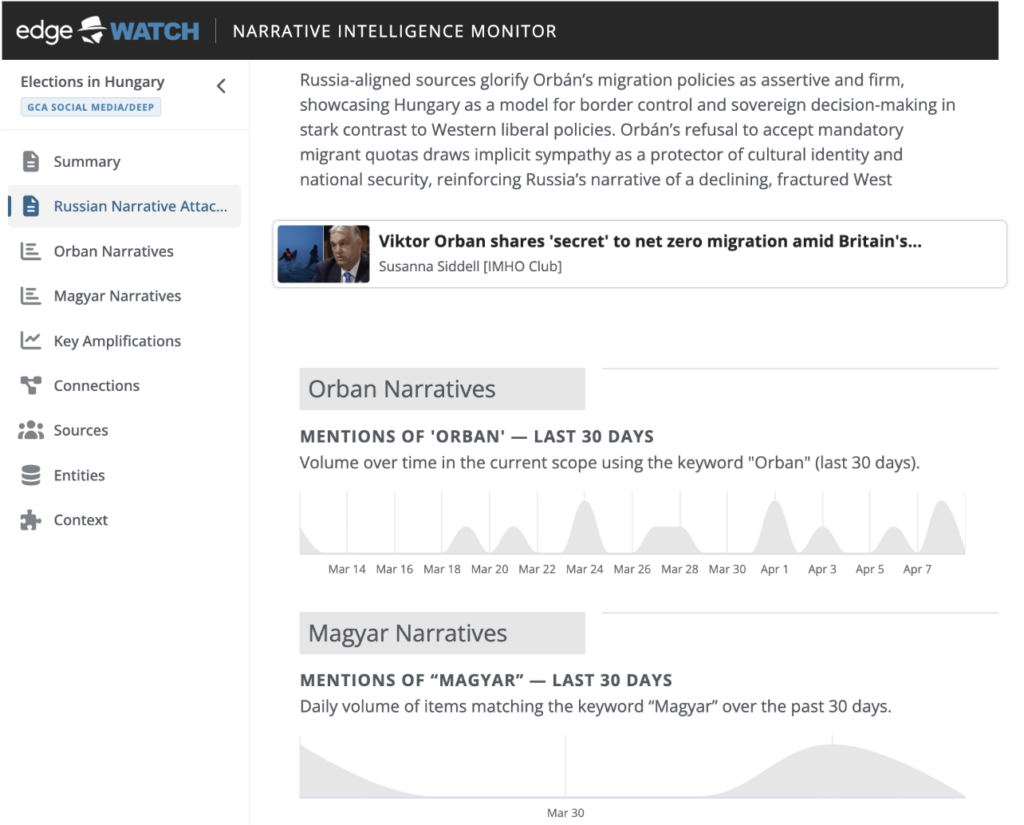
EdgeWatch Narrative Intelligence Monitor
This source effectively merges an attack vector of “Aversion to Foreign influence” to appeal to both domestic Hungarian and conservative American audiences, drawing a connection that seeks to increase international support for Orban, and by doing so incidentally also includes a withdrawal of support for Ukraine in line with Orban’s position on the Russia-Ukraine War.
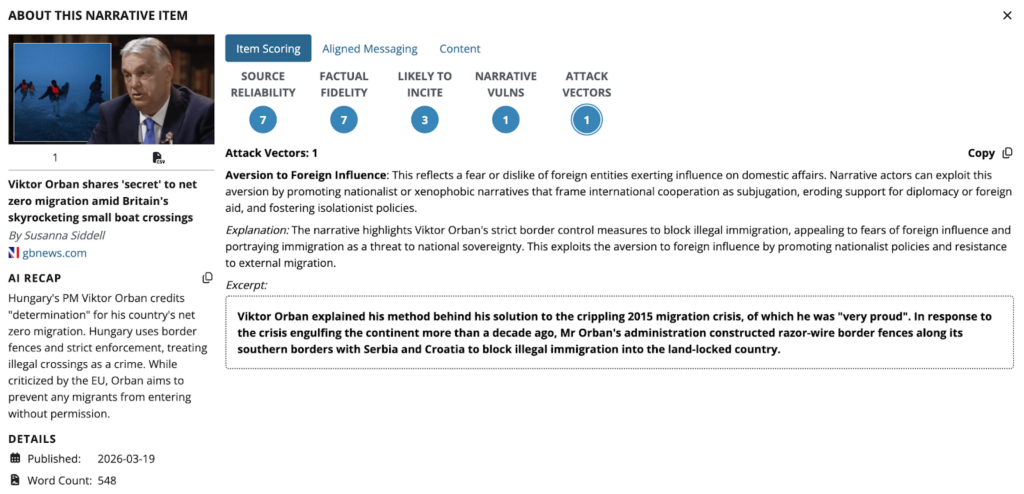
EdgeWatch Narrative Attack Vector Classifier
Russia has actively been influencing the Hungarian election by embedding it within broader geopolitical narratives, amplifying perceptions of foreign interference, and reinforcing distrust in Western institutions to shape voter sentiment.

X post by Michael Weiss
This post connects multiple theaters and actors in a single narrative chain: Russia, Hungary, Iran, the Middle East, and figures like Benjamin Netanyahu and Donald Trump. The Hungarian election is framed as part of a larger global alignment battle, Orbán is positioned within a network of “non-Western” or “anti-liberal” actors, and Western alliances are portrayed as fragmented or contradictory.This aligns with a known Russian objective: erode the coherence of Western political identity by presenting alliances as unstable and opportunistic.
The variety of attack vectors highlights a persistent Russian strategy of using Telegram as a staging zone to promote a variety of emotional and logical tactics, then see which narratives are promoted in international audiences by local pundits.
The variety of attack vectors highlights a persistent Russian strategy of using Telegram as a staging zone to promote a variety of emotional and logical tactics, then see which narratives are promoted in international audiences by local pundits. For example, the highlighted attack vectors can appeal to US audiences similarly seeking a more isolationist stance, conspiratorial sentiments, or distrust of government.

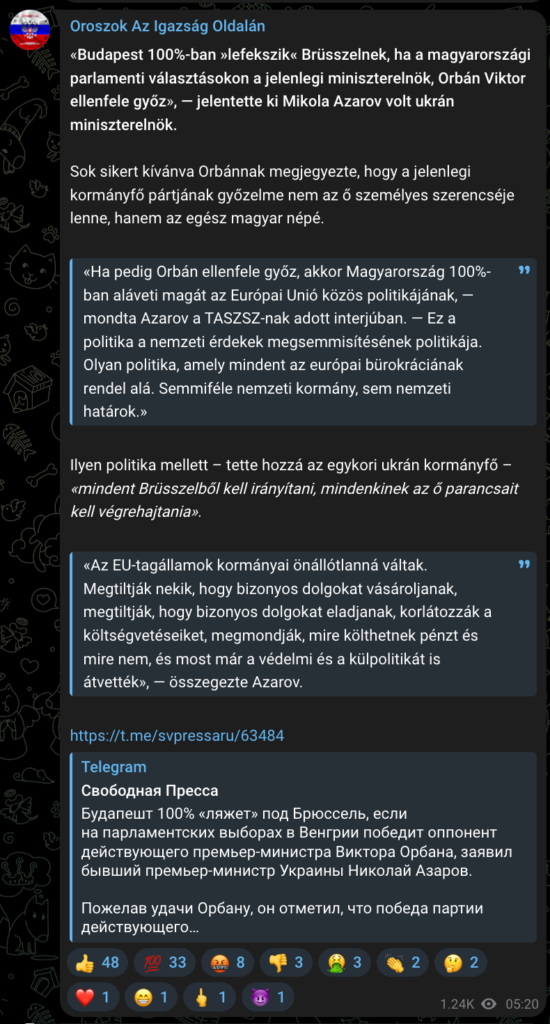
Telegram post by Russians on the Side of Truth
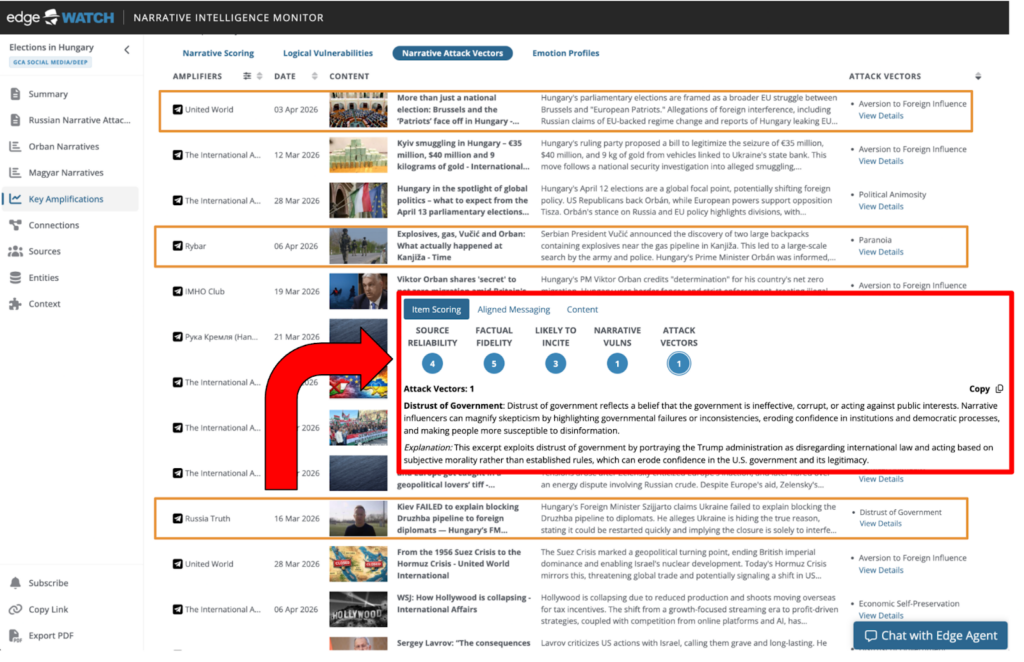
EdgeWatch Narrative Attack Vector Classifier
Analyzing the key nodes and ties of this information network, entities, and geographic locations reveals how influence flows and reinforces coordinated messaging. EdgeTheory’s connections reveal a set of hubs, mostly from Telegram or X. But there are also many smaller outlets orbiting these larger hubs, promoting similar materials. By identifying London in the top locations list, we can see sources connected to it, revealing London acts as a significant hub for narratives shifting from clearly State-owned and Russia-aligned to third party amplifications.

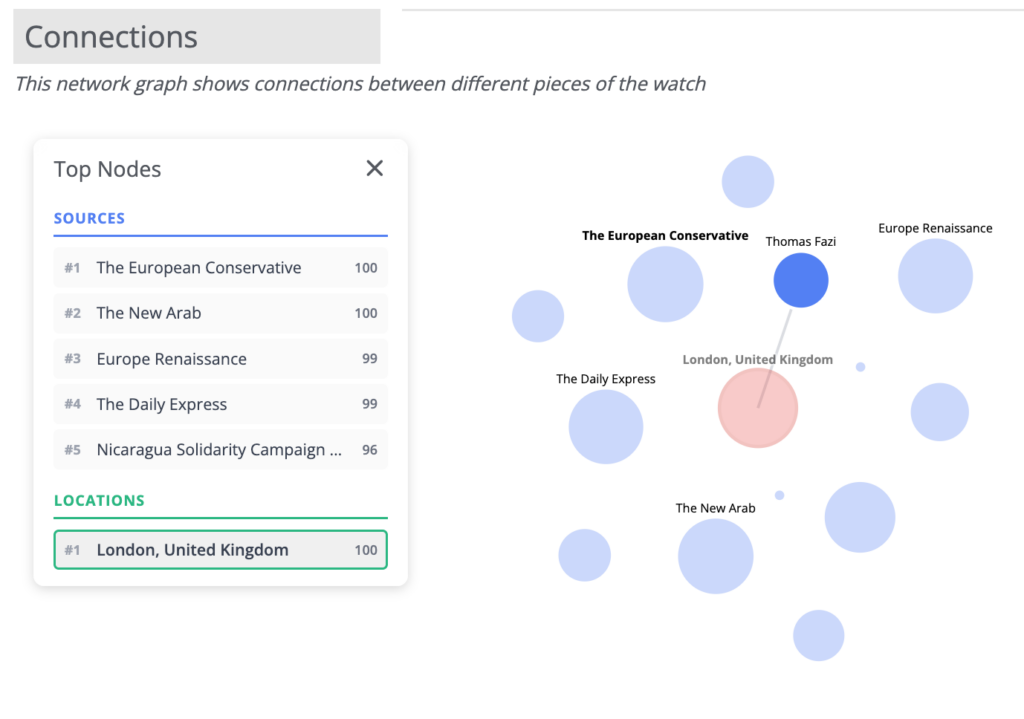
EdgeTheory Connection Amplifications
Other sources like Europe Renaissance amplify items portraying NATO as an offensive rather than defensive alliance, attempting to dominate Hungary.
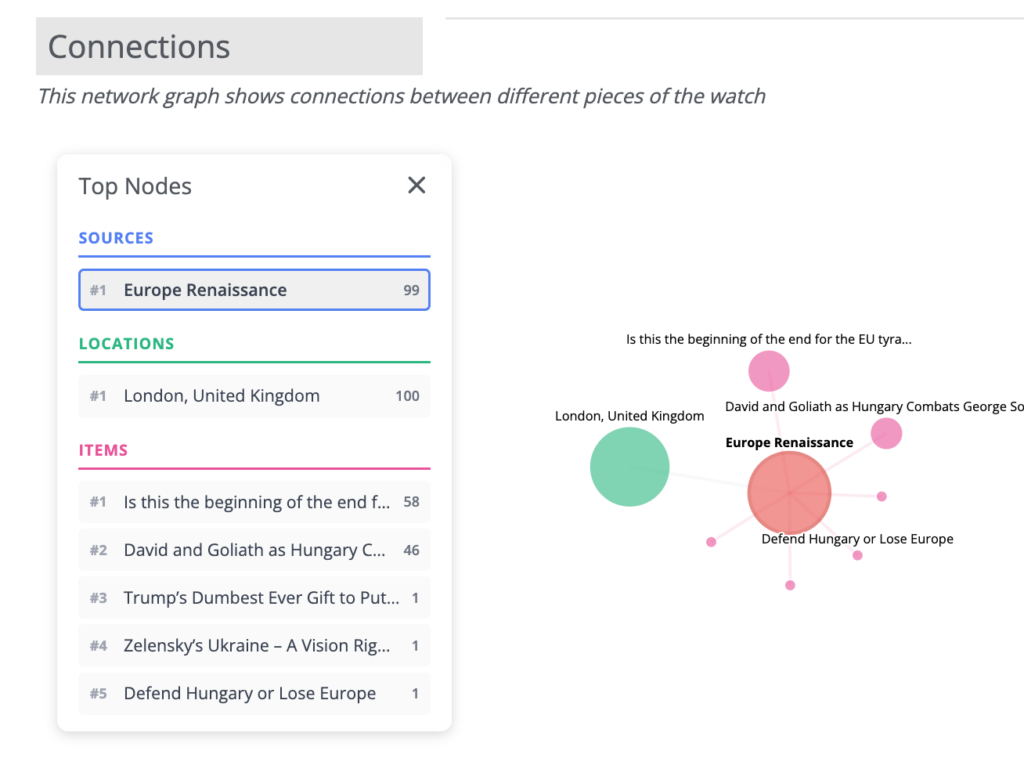
Edge Theory Connection Amplification
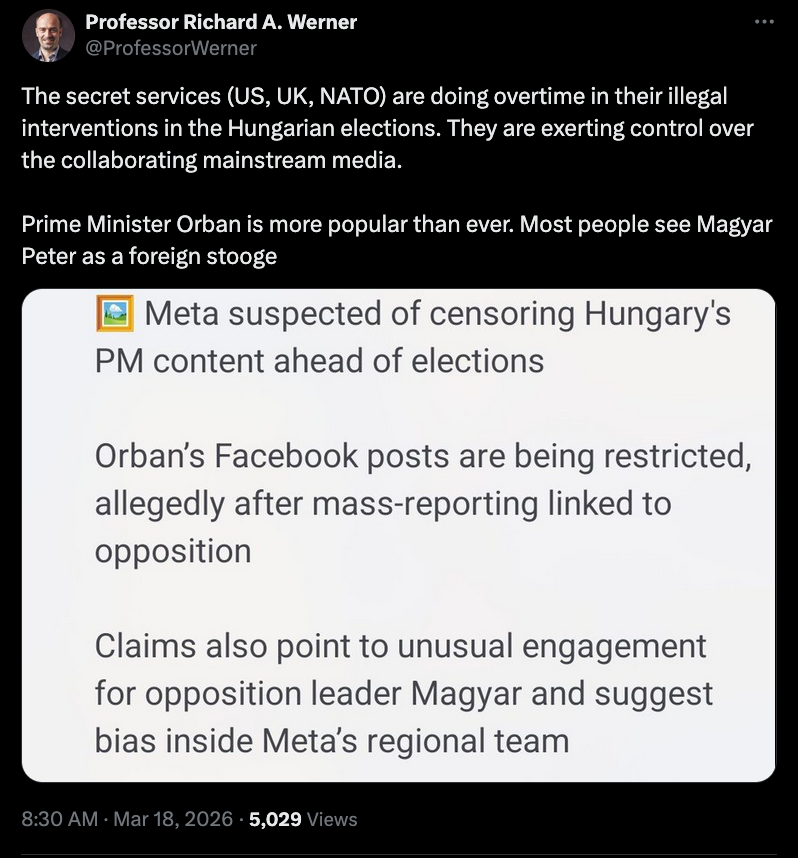
X post by Professor Richard A. Werner
The claim that U.S., UK, and NATO intelligence services are “illegally intervening” in the Hungarian election mirrors broader messaging that frames Western institutions as actively working to dominate Hungary’s political system. By linking alleged media control, platform censorship (via Meta), and opposition support to Western actors, this narrative extends beyond simple criticism and instead constructs a coordinated external threat. This aligns with recurring malign framing that positions NATO not as a security guarantor, but as a coercive actor undermining national sovereignty, thereby reinforcing pro-Orbán themes of resistance and justifying distrust toward Western alliances.
...pro-Russian attempts to sow fear across multiple dimensions, including prompting Orban as a calm and fatherly leader, directing efforts to bring justice, and outsourcing blame and inputting nefarious intentions to the EU.
Building on these interconnected narratives, examining emotion profiles and time-series trends reveals how specific sentiments intensify and spike in the lead-up to the election, highlighting when and how these messages have the greatest impact on audience perception.While other emotions remain relatively steady, fear and anger tend to spike with political events, indicating the pro-Russian attempts to seize on recent events to promote an emotional response from voting populations. Note the spike on and around April 07, correlating to VP Vance’s visit and comments.

EdgeTheory Emotion Profile Classifier
Filtering for Fear, we get a more complete picture of pro-Russian attempts to sow fear across multiple dimensions, including prompting Orban as a calm and fatherly leader, directing efforts to bring justice, and outsourcing blame and inputting nefarious intentions to the EU:
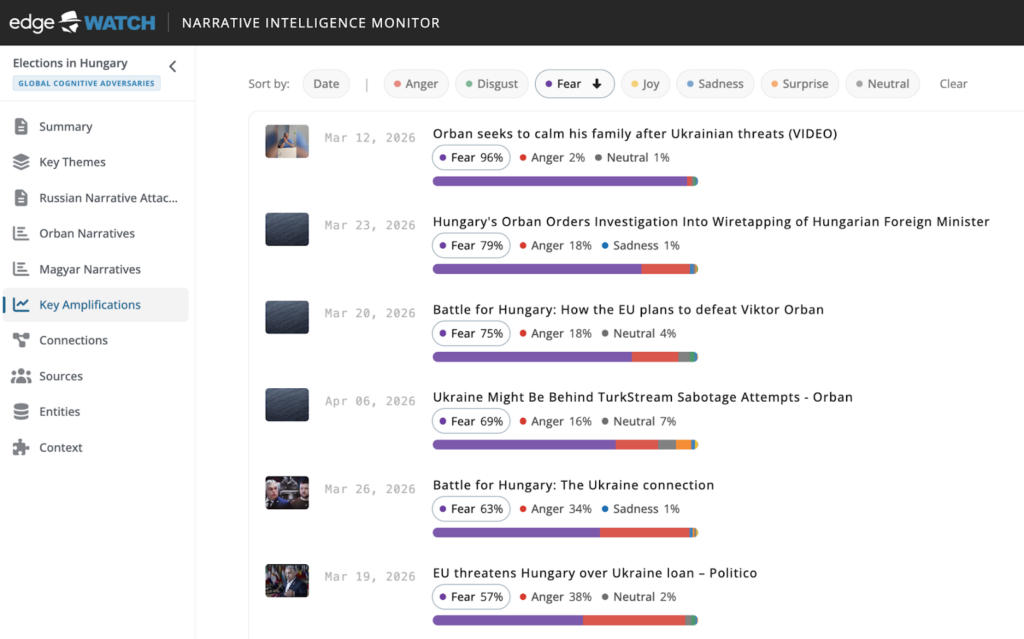
EdgeTheory Emotion Profile Classifier
Péter Magyar’s campaign overcame Viktor Orbán’s 16-year rule by utilizing a "populist against populist" strategy, turning the ruling party's own tactics against them. By focusing on rampant corruption, economic disparity, and elite cronyism, Magyar mobilized frustrated voters, capitalizing on voter fatigue and a sex abuse pardon scandal to break Fidesz's hold.

X post by Crunchupdates
According to the Guardian, “Magyar catapulted into the limelight in 2024 after it emerged that Orbán’s government – which for years had built its brand on defending Christian families and protecting children – had pardoned a man convicted of helping to cover up a sex abuse scandal at a children’s home.”
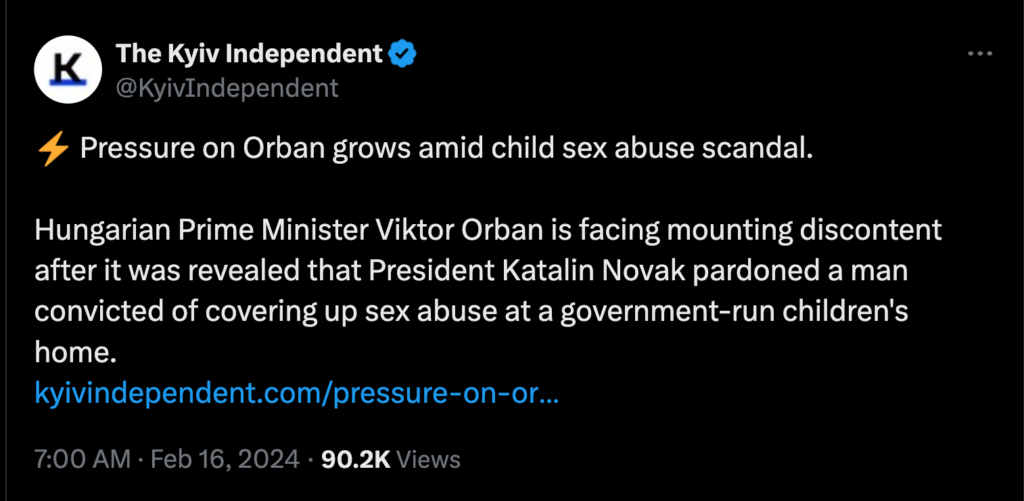
X post by The Kyiv Independent
Instead of focusing on ideological debates, Magyar highlighted the vast wealth of the Fidesz elite compared to the stagnating living standards of ordinary citizens, directly challenging the narrative of national prosperity. While Orbán’s campaign often relied on fear-mongering and external threats, Magyar's theme of "fear no more" offered a proactive, optimistic alternative that resonated with a populace tired of negative campaigning.
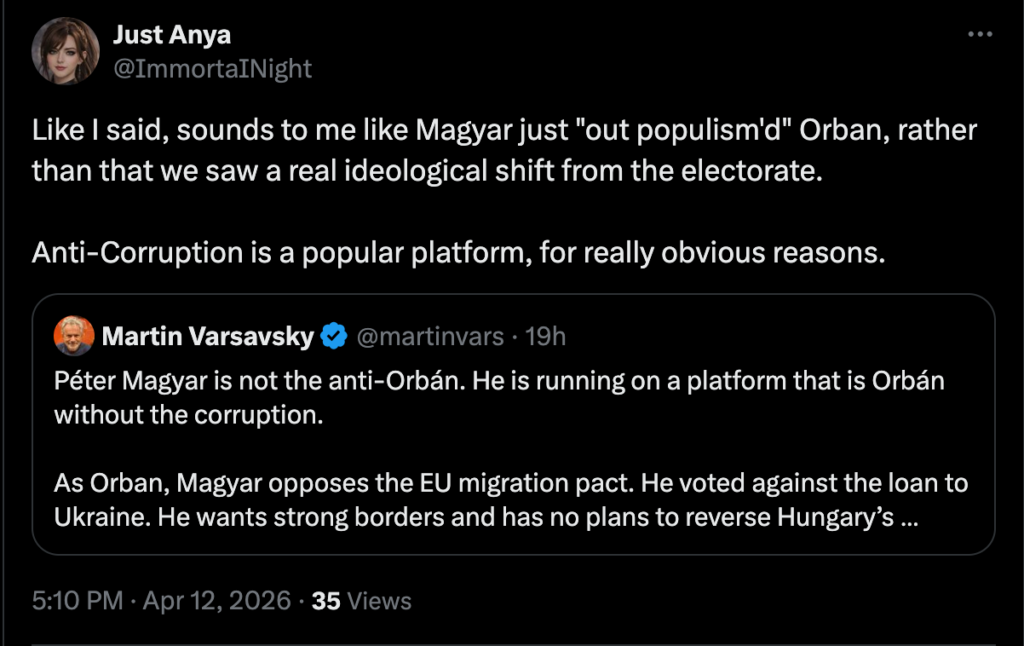
X post by JustAnya
This outcome was historically significant for several reasons. First, it demonstrated that even a deeply entrenched political system can be challenged when voter mobilization reaches a critical threshold. Second, it showed that Hungary’s electorate was willing to move beyond a dominant leadership structure that had defined the country’s politics for more than a decade and a half.
Magyar’s campaign was competitive because it aligned strong, broad-based sentiment with an effective alternative network structure. On the sentiment side, he was able to generate positive momentum across normally divided groups by focusing on anti-corruption and criticism of the NER system, rather than strict ideology. This allowed him to pull support from urban voters, disaffected conservatives, and fragmented opposition groups at the same time. Negative sentiment was also more focused and effective, targeting the ruling network in a way that was easy to repeat and mobilize around.
On the network side, Magyar did not rely on traditional party or media channels. Instead, he built a parallel, grassroots-driven network that operated across local communities and digital platforms. This made his campaign more flexible and less dependent on centralized media, allowing messages to spread quickly through loosely connected but active groups.
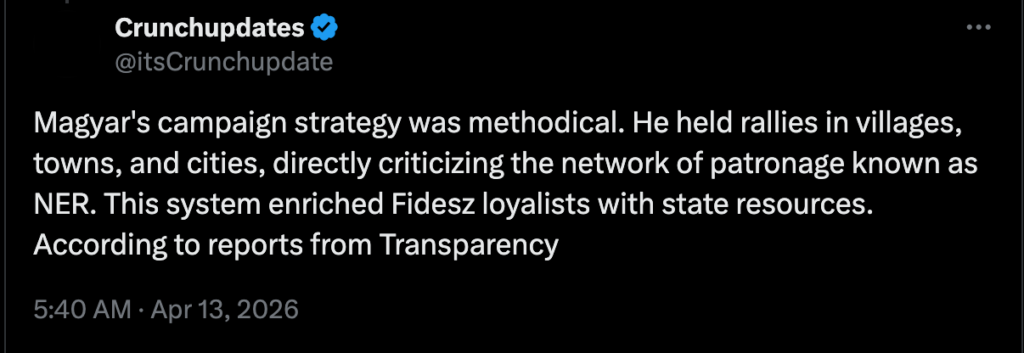
X post by Crunchupdates
The Hungarian election information environment reflects a coordinated influence architecture in which narrative, emotion, and network structure are deliberately aligned. Malign actors do not rely on singular messages or isolated campaigns. Instead, they construct an integrated system in which stable narratives establish baseline legitimacy while high-intensity content drives emotional activation at critical moments. This dual-track approach enables sustained influence over both how voters interpret information and how they respond to it.
Network analysis further demonstrates that influence is not centralized but distributed across interconnected hubs, where state-aligned sources, fringe outlets, and mainstream amplifiers collectively reinforce shared narratives. This creates a feedback loop in which messaging gains credibility through repetition across seemingly independent actors. At the same time, emotional analysis shows that fear and anger are selectively intensified in response to political events, indicating that narrative deployment is both reactive and strategically timed.
Critically, the election is consistently reframed as part of a broader geopolitical contest involving NATO and the European Union, elevating its perceived stakes beyond national governance. This reframing serves a dual purpose: it reinforces sovereignty-based support for Viktor Orbán while simultaneously undermining trust in external institutions and domestic opposition.
Photo Credits
Viktor Orbán: EU2017EE Estonian Presidency
Image has been cropped for composition purposes.
Peter Magyar: Norbert Bánhalmi
Image has been cropped for composition purposes.
Vladimir Putin: TASS News Agency
Image has been cropped for composition purposes.
Hungarian Parliament Building: Suicasmo
Image has been cropped for composition purposes.
Kremlin: Tuner tom
Image has been cropped for composition purposes.

