
Menu
This report examines the evolving conflict environment in Iran, integrating open-source intelligence, cross-platform narrative analysis, and structural assessment to evaluate how sustained pressure is shaping regime durability and potential pathways to change. Leveraging EdgeTheory’s agentic analysis, the report traces how pressure accumulates across interconnected domains rather than producing immediate outcomes. Particular attention is given to how conflict conditions are interpreted and framed within the information environment, including narratives on leadership attrition, succession uncertainty, and the role of the Islamic Revolutionary Guard Corps (IRGC) as the regime’s central stabilizing force.
By combining EdgeTheory’s agentic analysts, narrative classifiers, and source classifiers, the report assesses both the perceptions and ground truths of instability, population sentiments, and regime durability.
By combining EdgeTheory’s agentic analysts, narrative classifiers, and source classifiers, the report assesses both the perceptions and ground truths of instability, population sentiments, and regime durability. It focuses on how conflict-driven narratives frequently translate incremental developments, such as targeted strikes or economic disruption, into broader claims about regime collapse, consolidation, or long-term erosion. Using these analytic tools, this report illustrates how EdgeTheory’s analytic agents generate real-time scenarios and projections for analysts to track the level of objective progression.
Introduction
The conflict in Iran represents a sustained geopolitical and economic crisis rather than a decisive confrontation. External strikes, proxy warfare, and instability in key economic sectors, particularly energy flows, generate continuous strain, while internal repression and security enforcement preserve centralized authority. At the same time, the conflict is unfolding within an active information environment that shapes how these dynamics are not only interpreted but also played out on the ground. Social media and open-source data frequently amplify discrete events, such as leadership targeting, protest activity, or economic disruption, into broader narratives of imminent collapse or decisive transformation. These narratives often overstate the immediate impact of pressure while underestimating the regime’s capacity to absorb shocks through coercive control, institutional redundancy, and adaptive strategies.
The current conflict in Iran is defined by sustained pressure across military, economic, and political domains rather than a clear, decisive war. External strikes, internal strain, and market disruption are interacting in ways that weaken state capacity over time without forcing immediate collapse.
Externally, the conflict has settled into a continuous exchange. U.S. and Israeli operations target Iranian military assets and leadership, while Iran responds through missile and drone strikes and by relying on proxy groups across the region. These include Hezbollah and other militias that allow Tehran to project force without direct escalation at home. This pattern produces ongoing attrition, but not a decisive shift in control. The regime retains enough capability and coordination to continue operating under pressure.
Economic strain compounds these dynamics. Instability around the Strait of Hormuz has disrupted energy flows and contributed to price volatility, while sanctions and infrastructure damage constrain exports and state revenue. These factors increase domestic costs and reduce flexibility in responding to crises, even as the government prioritizes security spending and conflict-related operations.Inside the country, control is intact but requires constant enforcement. Protests and public dissatisfaction continue to surface, but they remain localized and are quickly contained through arrests, surveillance, and restrictions on communication. The IRGC and internal security forces maintain a strong presence, preventing opposition activity from building into a coordinated challenge.
The result is a steady level of unrest that does not yet threaten central authority.
At the leadership level, pressure is accumulating. Targeted killings of senior figures and the contested succession of Mojtaba Khamenei introduce uncertainty around decision-making and authority. The system has so far compensated through quick replacements and overlapping chains of command, but repeated disruptions increase the risk of misalignment within the elite.
Taken together, the conflict is best understood as a slow strain on the regime rather than a breaking point. It limits resources, tests internal alignment, and keeps the state under constant pressure, but it has not yet produced the conditions for immediate collapse. This environment sets the baseline for how regime change, if it occurs, is likely to unfold.
Scenario 1: IRGC-Dominated Regime Consolidation (Most Likely)
The most likely trajectory for Iran is regime transformation into a more explicitly militarized system in which the Islamic Revolutionary Guard Corps (IRGC) governs behind nominal clerical authority. Mojtaba Khamenei’s contested elevation reflects this shift, widely attributed to IRGC pressure and executed through a rushed Assembly of Experts process marked by coercion and clerical dissent.
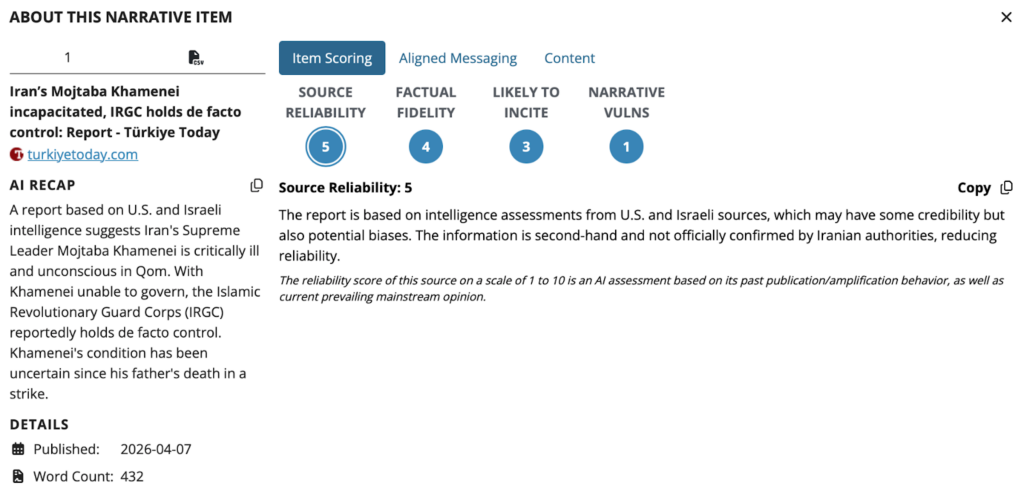
Edge Theory Factual Fidelity Classifier
His reported incapacitation, as reflected in U.S. and Israeli intelligence assessments, reinforces a dynamic in which the IRGC exercises de facto control. Within this context, his profile as a relatively low-ranking cleric with limited traditional religious legitimacy, yet closely tied to IRGC-aligned economic and political networks, suggests he operates less as an independent supreme authority and more as a gatekeeping figurehead facilitating military dominance.
Analysis from EdgeTheory’s watch monitoring Iran updates, consolidating all relevant information to judge likely future scenarios.
Operational behavior further reinforces this trajectory. Continued missile and drone activity across the Persian Gulf, along with sustained proxy operations, demonstrates the IRGC’s central role in both external projection and internal legitimacy-building. Israeli targeting of IRGC and Basij leadership underscores their position as the regime’s coercive core, yet rapid replacement of senior figures highlights institutional resilience rather than fragmentation. U.S. intelligence assessments indicating that security forces are tightening control despite leadership attrition further support the conclusion that the regime is under strain but not nearing collapse.
The first section of Narrative Intelligence assessment from an edgeWatch measuring day to day shifts in Iran’s regime strength.
At the same time, Mojtaba Khamenei’s limited public visibility, whether due to security concerns or injury, correlates with governance increasingly exercised through IRGC-linked intermediaries. Rebels and moderates remain sidelined, opposition movements are fragmented and externally dependent, and state efforts to control media narratives, alongside orchestrated pro-regime demonstrations, reinforce the perception of stability. Across diverse reporting streams, there is consistent alignment around a core pattern: militarization of political authority paired with the preservation of clerical symbolism.
This outcome is enabled by several structural realities: the IRGC’s control over key economic sectors and coercive institutions, the regime’s ability to absorb leadership losses without disrupting command continuity, and the absence of a unified or internally embedded opposition capable of exploiting instability. The result is not the fall of the Islamic Republic, but its evolution into a more centralized, security-dominated system where ideological legitimacy is secondary to coercive control.
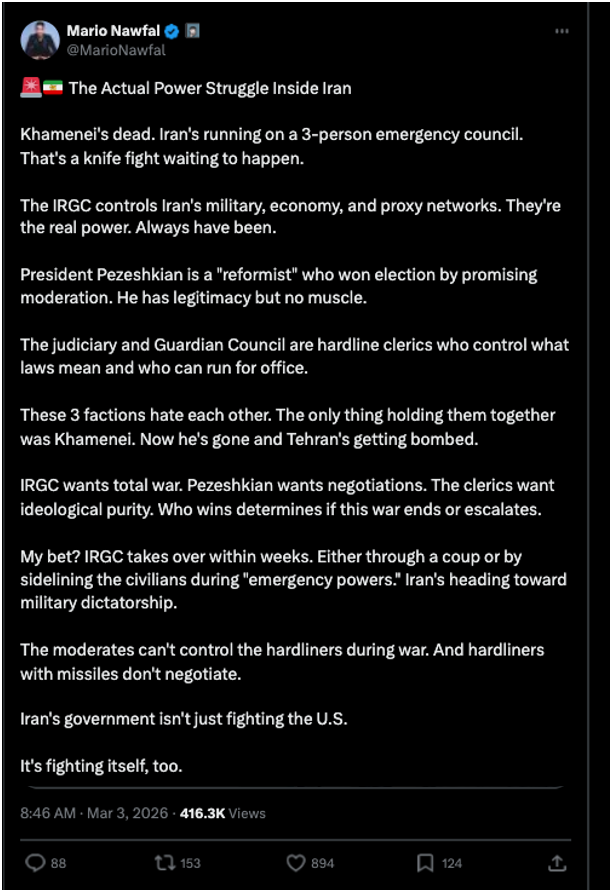
X post by Mario Newfal
This post presents a stark, conflict-driven portrayal of elite politics in Iran, emphasizing fragmentation between military, clerical, and civilian actors. Its core mission is to reduce the system to competing factions—particularly highlighting the dominance of the Islamic Revolutionary Guard Corps as the decisive force. While the tone is alarmist, this framing reflects a real structural feature of the Iranian system: power is not evenly distributed across formal institutions, but heavily concentrated in security networks that span the military, intelligence, and economy. @MarioNeawful’s claim that elected or moderate figures lack “muscle” aligns with evidence that the IRGC operates as a parallel authority with deep political and economic entrenchment, often eclipsing civilian governance.
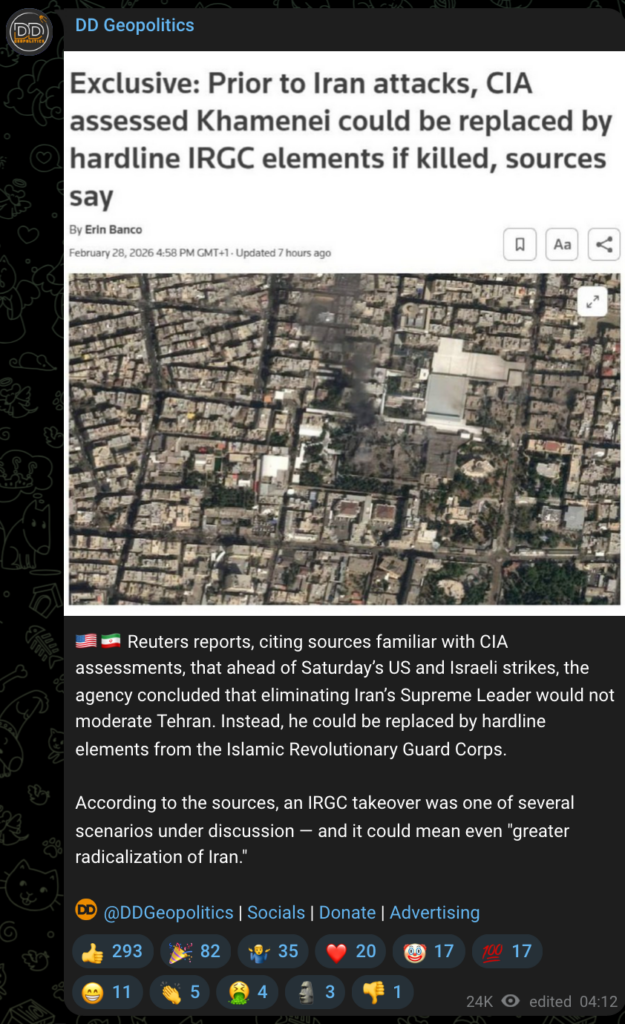
Telegram post by DD Geopolitics
The key analytical insight is that power in Iran is not strictly tied to the supreme leader as a person, but embedded within security and military structures.
DD Geopolitics frames potential leadership decapitation in Iran not as a pathway to moderation or regime collapse, but as a trigger for hardline consolidation—specifically by elements of the Islamic Revolutionary Guard Corps. The key analytical insight is that power in Iran is not strictly tied to the supreme leader as a person, but embedded within security and military structures. By emphasizing that even the removal of the supreme leader would not fundamentally alter Iran’s trajectory, the post reinforces the idea that the regime’s ideological and operational direction is structurally anchored, not personality-dependent. This challenges common external assumptions that leadership change would produce moderation, instead suggesting continuity or even intensification of hardline policies.
At the same time, the narrative implicitly elevates the IRGC as the most coherent and capable actor in a crisis scenario. The suggestion that they could step in to fill a leadership vacuum reflects their organizational cohesion, control over force, and entrenched role in both domestic governance and regional operations. Overall, it aligns with a broader interpretation of Iran’s political evolution: that in moments of instability, authority is likely to consolidate around actors with coercive capacity rather than diffuse across weaker civilian or clerical institutions.
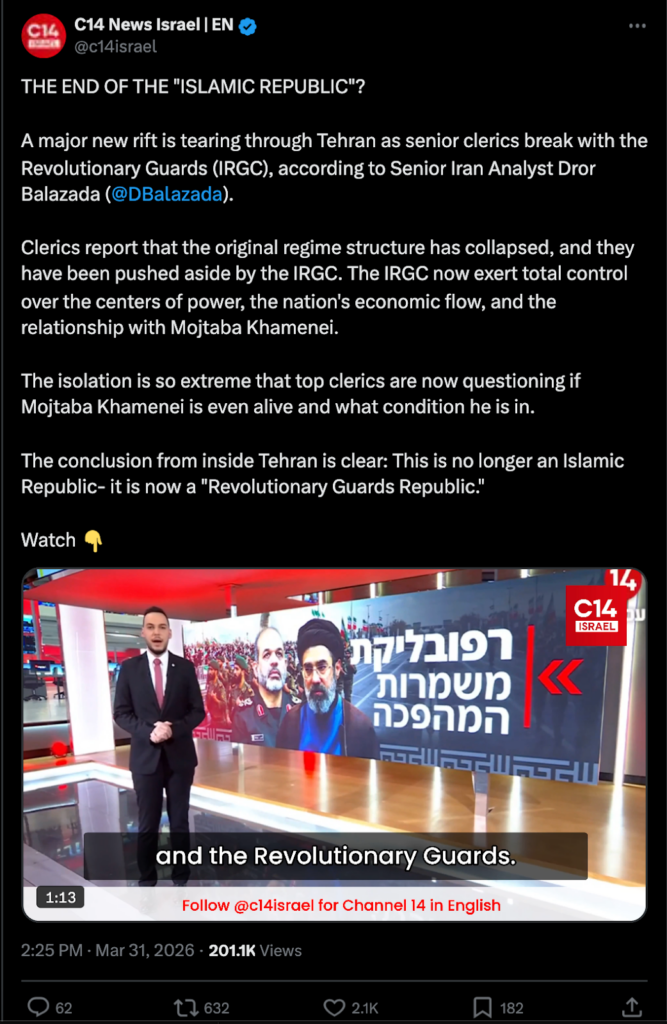
X post by C14 News Israel
This post constructs a high-impact regime-collapse narrative by framing internal elite fragmentation within Islamic Revolutionary Guard Corps and the clerical establishment as both sudden and decisive. The language (“end of the Islamic Republic,” “total control,” “collapsed”) signals a shift from incremental internal tension to systemic breakdown, encouraging audiences to interpret opaque power dynamics in Iran as already resolved in favor of the IRGC. By invoking uncertainty around Mojtaba Khamenei, the narrative further amplifies perceptions of instability at the core of succession politics, a known ambiguity within Iran’s political system. Structurally, the post moves from insider claims and institutional displacement to leadership uncertainty and definitive regime reclassification, guiding readers toward the conclusion that the IRGC regime will stabilize.
Scenario 2: Protracted Conflict Leading to Gradual State Erosion (Highly Likely)
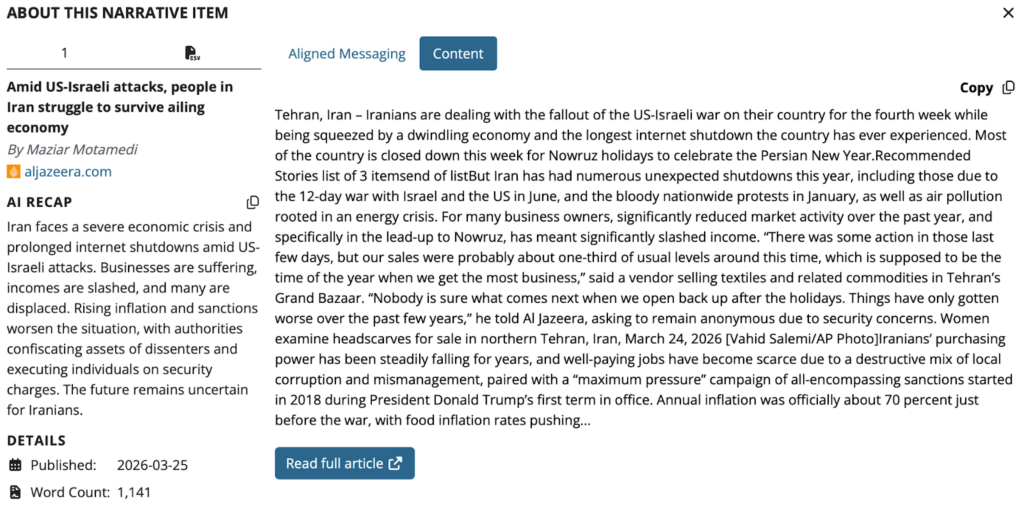
The second likely scenario is slow degradation under sustained conflict conditions. Continued external pressure from U.S. and Israeli operations, combined with internal economic strain and disruption to oil exports, produces a long-term weakening of Iranian state capacity without triggering immediate overthrow.

Edge Theory Factual Fidelity Classifier
In this scenario, regime change is not event-driven but cumulative, emerging gradually as the system absorbs repeated shocks over time.
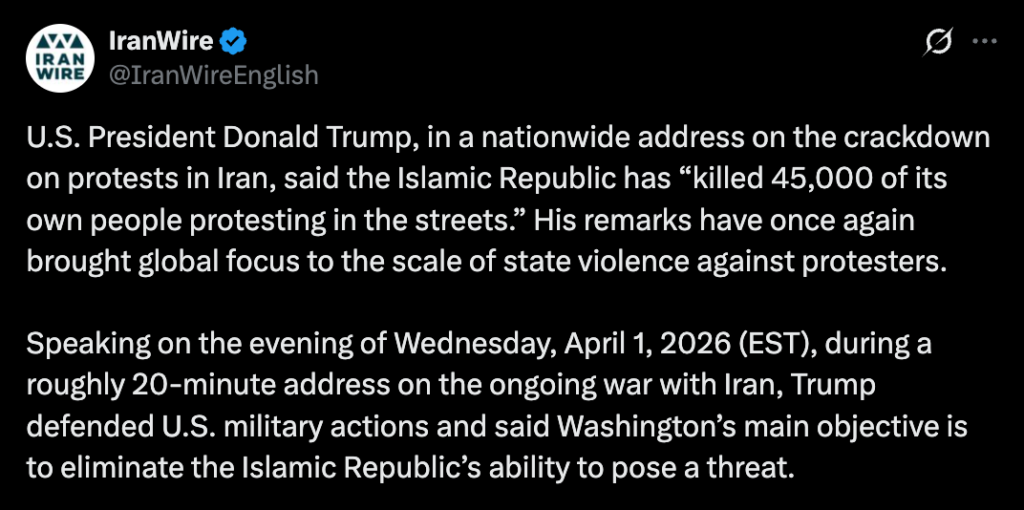
Updating reporting identified in our edgeWatch that influences the likelihood of a protracted conflict and gradual state erosion scenario. Evidence is categorized and classified in EdgeTheory’s system to quickly identify what geopolitical events support certain likely outcomes.
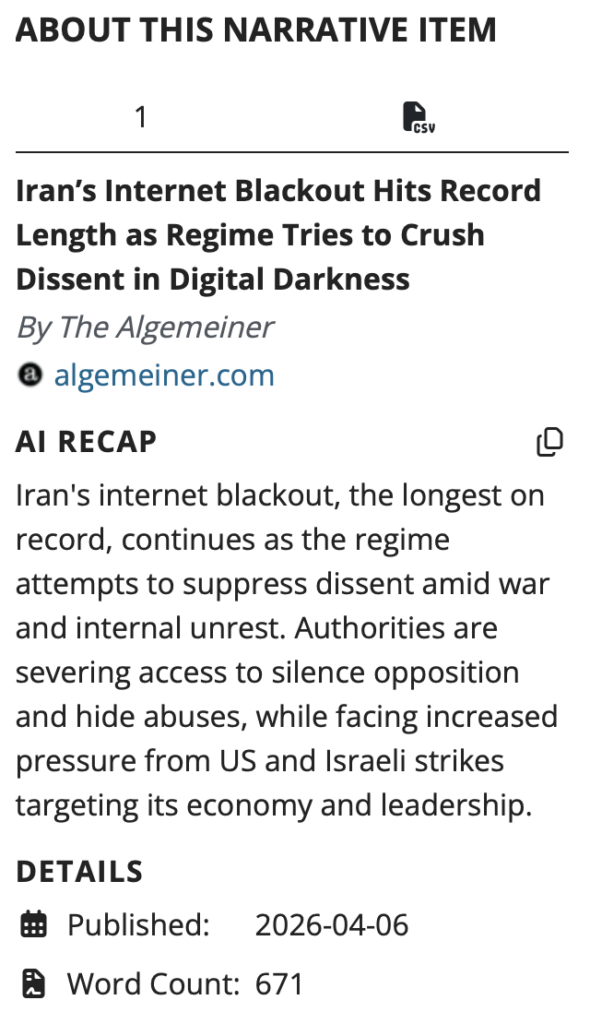
The operational environment reflects a persistent, unresolved conflict. Military exchanges continue beyond initial strikes with no decisive outcome, as Iran sustains asymmetric warfare through proxies such as Hezbollah, Houthi forces, and Iraqi militias, alongside ongoing missile and drone operations. At the same time, U.S. and Israeli actions degrade Iranian military capabilities and infrastructure but fail to dismantle the regime. The result is a strategic stalemate that prolongs instability across the region, including continued attacks affecting Gulf states and disruptions to critical maritime and energy infrastructure.

Analysis updating hourly showing factors resulting in this scenario as the second most likely future for Iran
Economic pressures compound these dynamics. Disruptions to oil exports, price volatility, and sanctions-driven isolation intensify domestic hardship while amplifying global energy instability. Humanitarian conditions deteriorate as infrastructure damage accumulates and displacement increases, reinforcing long-term societal stress. At the same time, external actors acknowledge both the scale of disruption and the absence of a near-term resolution, with U.S. leadership signaling cautious expectations of a prolonged and costly engagement rather than a rapid strategic breakthrough.
Within this environment, regime change, if it occurs, is delayed and indirect. The state becomes progressively less capable of effective governance, increasing the likelihood of eventual elite fracture, localized breakdowns in control, or opportunistic challenges from internal or peripheral actors. However, in the near term, the regime persists through coercion, adaptation, and reliance on proxy warfare, producing a condition best understood as erosion without collapse.
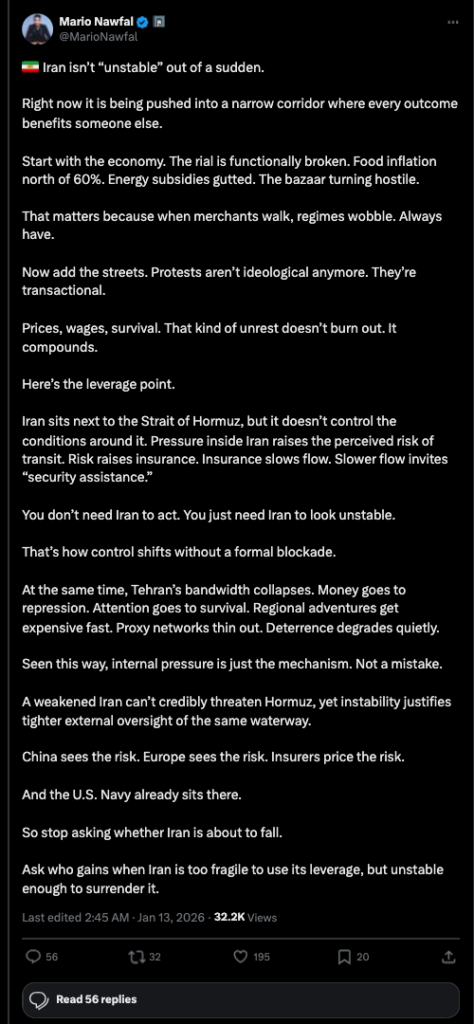
X post by Mario Nawfal
The post frames Iran’s instability as an externally shaped condition—where economic decline, inflation, and social unrest are not isolated shocks but reinforcing pressures that gradually constrain state capacity. This interpretation is consistent with a protracted conflict environment in which sanctions, disrupted oil flows, and persistent military pressure steadily weaken the regime’s ability to govern effectively. Notably, the emphasis on “transactional” protests and merchant dissatisfaction reflects a shift from ideological dissent to survival-driven unrest, reinforcing the idea that internal strain compounds over time without necessarily triggering immediate regime failure.
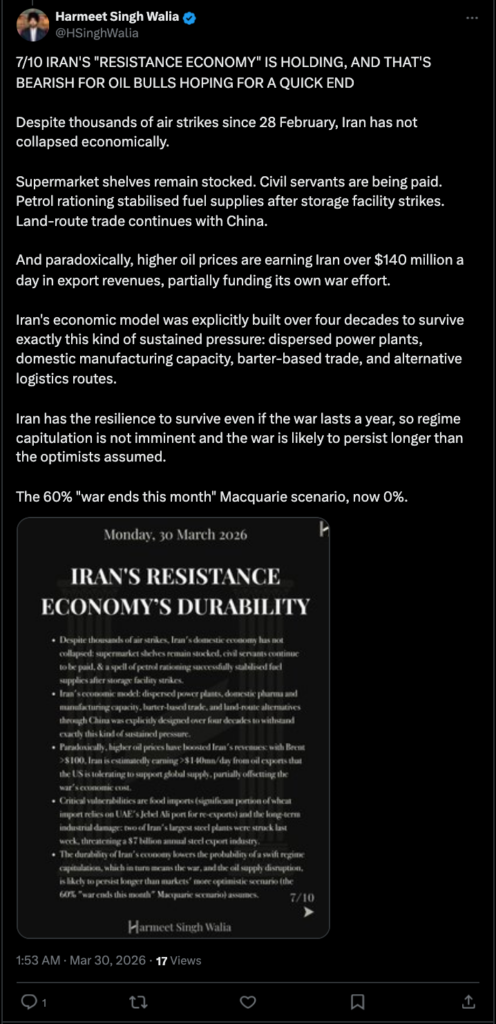
X post by Harmeet Singh Walia
@HSinghWalia’s post emphasizes resilience—stockpiled goods, continued trade with China, and sustained oil revenues—as evidence that Iran can absorb ongoing military pressure without immediate economic collapse. This framing reinforces the early phase of a protracted conflict scenario: a system designed to endure shocks can prolong confrontation by preventing rapid breakdown. The emphasis on adaptive mechanisms—rationing, alternative logistics, and state-managed distribution—suggests a capacity to stabilize in the short term, which in turn enables the continuation of military and proxy activities without forcing a decisive outcome. This aligns with a conflict environment that persists not because pressures are ineffective, but because they are incrementally absorbed.
At the same time, the very need to highlight these resilience mechanisms hints at underlying strain. A “resistance economy” implies sustained external pressure and constrained normal functioning, where stability depends on constant adjustment rather than organic growth. Over time, such conditions are consistent with gradual erosion: institutions remain operational but are increasingly burdened, economic activity narrows, and dependence on workarounds deepens. The absence of imminent collapse, as noted in the post, does not preclude long-term degradation; instead, it suggests a trajectory where endurance delays—but does not eliminate—the cumulative weakening of state capacity characteristic of a prolonged, unresolved conflict
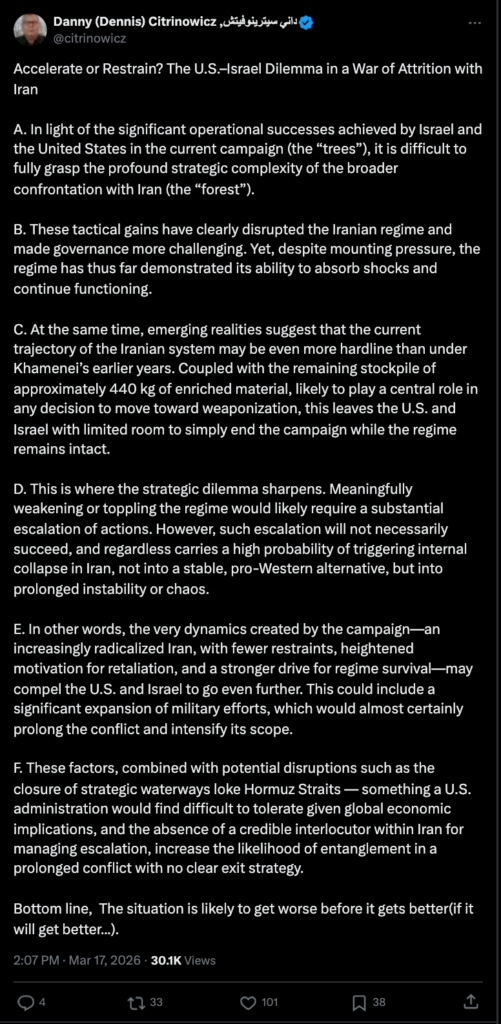
X post by Danny Citrinowciz
This narrative frames the conflict as a strategic dilemma rather than a pathway to decisive resolution, emphasizing that tactical successes have not translated into systemic collapse. The acknowledgment that Iranian governance has been disrupted—but remains functional—mirrors the core dynamic of a protracted erosion scenario: the state absorbs repeated shocks while preserving enough coherence to continue operating. The reference to hardened positions, stockpiled enriched material, and the persistence of centralized control suggests that pressure may be reinforcing regime durability in the near term, even as it incrementally degrades institutional capacity. In this sense, the “trees versus forest” analogy captures how visible battlefield gains can obscure the slower, cumulative trajectory of state resilience under strain.
At the same time, the dilemma described—escalate and risk chaos, or restrain and accept endurance—aligns with the logic of gradual degradation without immediate collapse. The expectation that intensified efforts could prolong the conflict and expand its scope, coupled with risks to critical infrastructure and regional stability, reflects an environment where no actor achieves a decisive breakthrough. Instead, the system trends toward extended instability, where internal cohesion is maintained through pressure and adaptation, even as underlying capacity erodes. The conclusion that conditions are likely to worsen before improving reinforces the idea that change, if it comes, will emerge cumulatively over time rather than through a single event.
Scenario 3: Internal Fragmentation and Competing Power Centers (Moderately Likely)
...regime change does not emerge from mass mobilization but from intra-elite conflict.
A more volatile and less stable pathway involves the gradual fragmentation of Iran’s ruling system, driven by deepening divisions among clerical institutions, political elites, and the Islamic Revolutionary Guard Corps (IRGC). While not yet dominant, indicators suggest that regime cohesion is under increasing strain. The contested succession of Mojtaba Khamenei, marked by reported boycotts and procedural disputes within the Assembly of Experts, reflects weakening clerical consensus and growing tension between ideological legitimacy and coercive power. His limited qualifications and ambiguous health status, combined with the emergence of an interim governing structure involving figures such as Pezehskian, Aarafi, and Mohseni-Ejei, point toward a diffusion of authority rather than a clear consolidation.
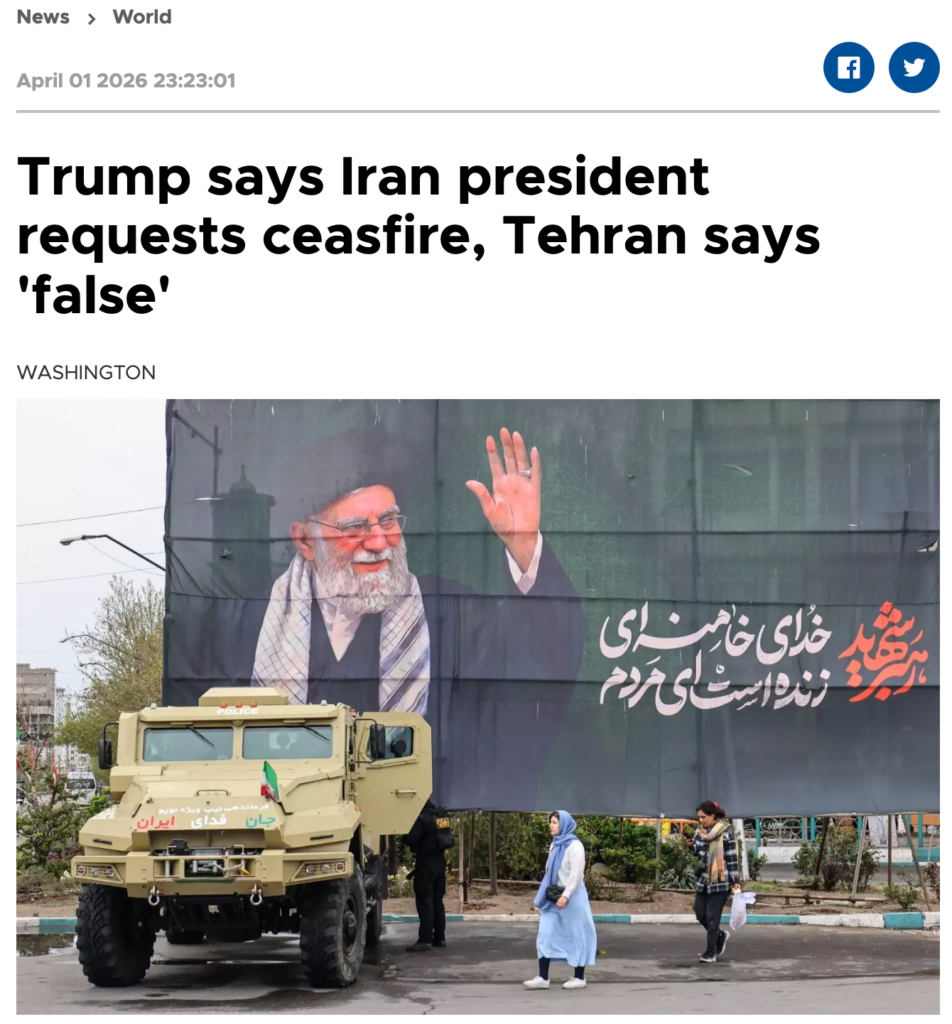
Command, control, and communications fragmentation identified by edgeWatch from Hurriyet Daily News.
Further support for this scenario is constantly monitored, such as reports of Iran's new supreme leader, Mojtaba Khamenei, falling unconscious and receiving treatment.
In this scenario, regime change does not emerge from mass mobilization but from intra-elite conflict. Persistent factionalism between hardliners, reformists, military actors, and clerical leadership begins to manifest more openly, eroding the regime’s traditionally centralized control.
Edge Theory Factual Fidelity Classifier
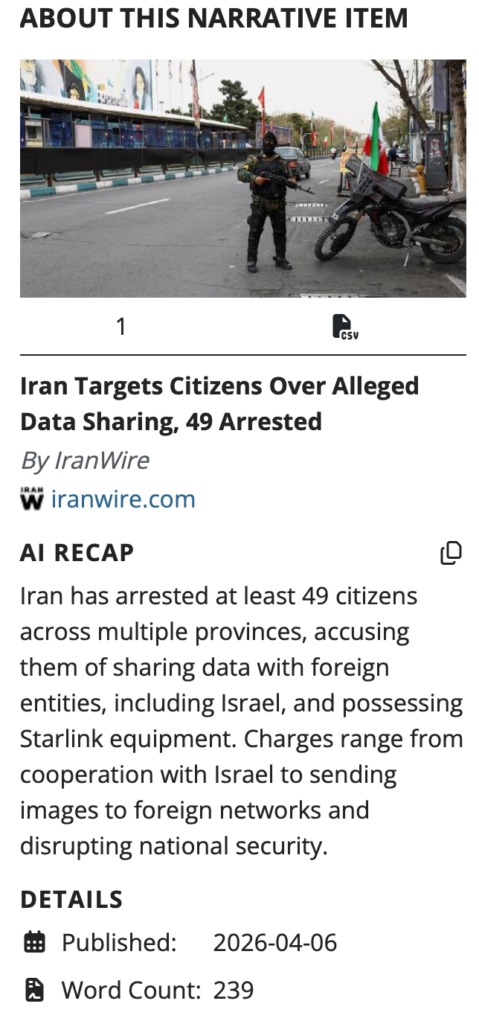
Reports of defections, including elements within Iranian security services signaling dissent, and the rapid succession of targeted killings of high-profile figures, further degrade leadership continuity and trust within the system. At the same time, evidence of local IRGC commanders exercising independent authority in provincial areas, particularly in Kurdish and Balochi regions, suggests that command-and-control structures are becoming uneven and contested.This decentralization of authority carries significant risk: as centralized control over coercive force weakens, the regime’s ability to uniformly suppress dissent diminishes. Under such conditions, localized uprisings, insurgent activity, or external pressures could have disproportionate and destabilizing effects.
Example of items supporting the claim of regional Iranian military independence, updated hourly in edgeWatch
This scenario represents the most unpredictable pathway. While current indicators do not yet suggest imminent systemic collapse, they highlight a trajectory in which cohesion gives way to competition, and the regime’s greatest vulnerability shifts from external pressure to internal division.
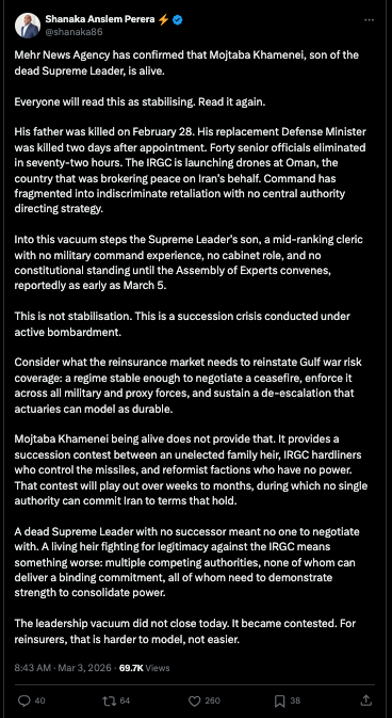
X post by Shanaka Anslem Perera
The post constructs a deliberately counterintuitive narrative: that the survival of Mojtaba Khamenei does not resolve uncertainty but reframes it into a more complex and unstable form. By urging the reader to “read it again,” the author signals that surface-level continuity masks a deeper rupture—specifically, the transformation of a leadership vacuum into a contested succession arena. The emphasis on Mojtaba’s limited credentials and lack of formal authority brings the widening gap between inherited influence and institutional legitimacy, particularly within the Assembly of Experts, into the spotlight.
...compensatory behaviors in a system struggling to reassert control, suggesting that apparent stability may mask intensifying internal competition.
The post suggests that military responses are proceeding without “central authority directing strategy” implies that coercive power is no longer tightly coupled to political decision-making. The security apparatus appears to be acting in a more decentralized and reactive manner. The overall framing is less about imminent collapse than about a system entering a phase where authority is diffuse, coordination is uneven, and multiple actors are incentivized to assert influence simultaneously—conditions under which localized actions and elite rivalries can begin to shape the broader trajectory in unpredictable ways.
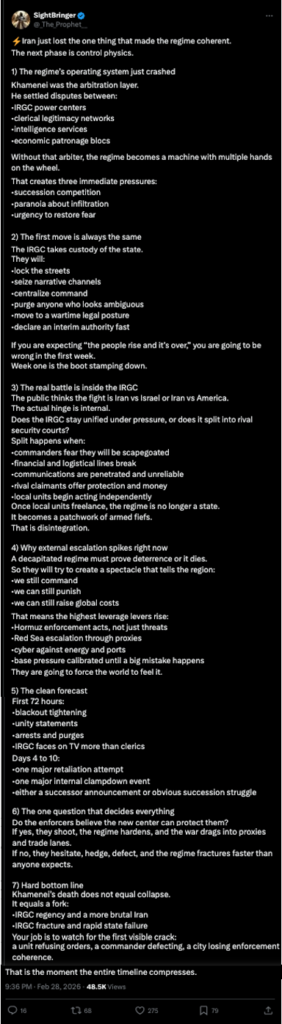
X post by SightBringer
...a system entering a phase where elite actors are simultaneously signaling strength and hedging against one another. This creates conditions in which fragmentation emerges not abruptly but through the cumulative effects of mistrust, parallel decision-making, and increasingly autonomous centers of power.
This post frames the moment as a systemic shock to regime coherence following the death of Ali Khamenei. Its central narrative is that the Supreme Leader functioned as the sole integrative layer binding together otherwise competing power centers—particularly the Islamic Revolutionary Guard Corps, clerical institutions, and intelligence networks. His removal is thus framed as triggering a breakdown in coordination rather than a clean transfer of authority. The emphasis on the regime becoming “a machine with multiple hands on the wheel” captures a shift from hierarchical control to uncoordinated decision-making, where different factions act preemptively to secure their position. This framing recasts early signals—purges, arrests, unity messaging—as compensatory behaviors in a system struggling to reassert control, suggesting that apparent stability may mask intensifying internal competition.
The post’s focus on the IRGC as both the regime’s backbone and its primary fault line is particularly telling. By portraying the “real battle” as internal to the IRGC—between cohesion under pressure and fragmentation into rival sectors—it points to a scenario where coercive power itself becomes contested. References to compromised communications, freelance local units, and the risk of commanders acting independently imply an erosion of centralized command-and-control, where authority is no longer reliably transmitted or enforced. This narrative suggests a system entering a phase where elite actors are simultaneously signaling strength and hedging against one another. This creates conditions in which fragmentation emerges not abruptly but through the cumulative effects of mistrust, parallel decision-making, and increasingly autonomous centers of power.
...a system entering a phase where elite actors are simultaneously signaling strength and hedging against one another. This creates conditions in which fragmentation emerges not abruptly but through the cumulative effects of mistrust, parallel decision-making, and increasingly autonomous centers of power.
Scenario 4: Negotiated Transition or Reform-Oriented Shift (Least Likely)
A final, lower-probability pathway involves pragmatic retrenchment, in which elements of the Iranian regime pursue negotiation to stabilize the system under mounting internal and external pressure. In this scenario, regime change would not take the form of collapse or elite rupture, but rather a managed, incremental transition, potentially involving limited concessions, ceasefire arrangements, or partial reintegration into diplomatic frameworks. The objective would be preservation of the regime’s core structures while selectively adapting policy to reduce immediate threats to regime survival.
Current indicators, however, suggest that the conditions required for such a shift remain weak. Diplomatic efforts mediated by regional actors such as Oman, Egypt, and Qatar have been limited and largely unsuccessful, while Iranian officials continue to reject ceasefire proposals absent the cessation of U.S.-Israeli strikes and demands for compensation. This posture reflects the continued dominance of hardline factions, for whom external pressure reinforces resistance rather than incentivizing compromise.
At the same time, underlying indicators of regime weakness create the theoretical foundation for a negotiated shift. The cumulative loss of senior leadership figures, including key military and political actors, highlights sustained attrition within the regime’s upper ranks and raises concerns about leadership continuity. The contested elevation of Mojtaba Khamenei, reportedly shaped by IRGC pressure and marked by clerical dissent, further undermines traditional sources of legitimacy. His limited religious credentials, low public visibility, and reported health concerns compound these vulnerabilities, while indications of latent opposition within elite circles suggest that consensus at the top is not absolute.
Despite these pressures, the prevailing trajectory remains resistant to reform. Legitimacy concerns, factional competition, and the central role of hardline security actors incentivize repression over accommodation, limiting the likelihood of meaningful negotiation in the near term. As a result, any negotiated transition or reform-oriented shift would likely be reactive, constrained, and incremental, emerging only if internal instability or external pressure reaches a threshold where compromise becomes less costly than continued resistance.
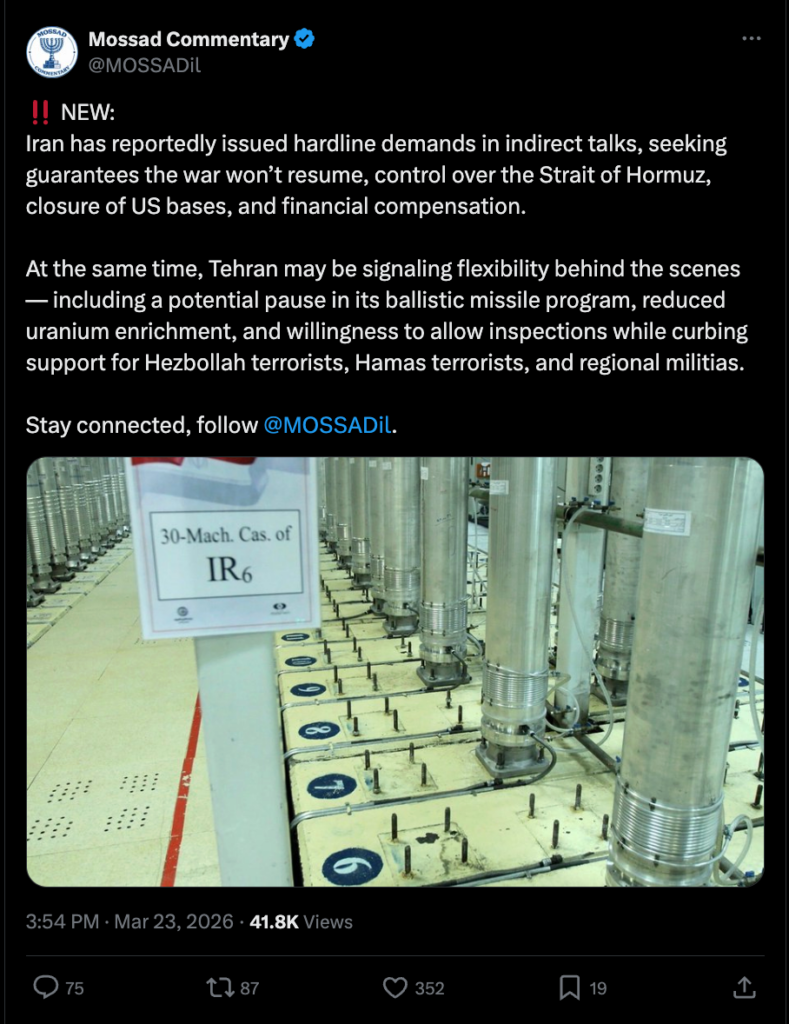
X post by Mossad Commentary
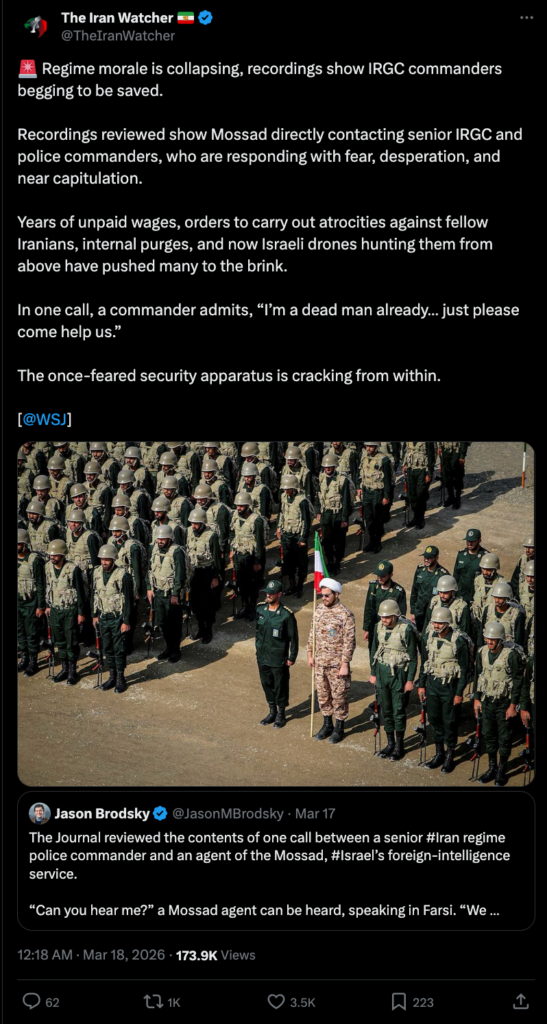
X post by Iran Watcher
This post constructs a collapse narrative centered on internal security fracture. It claims that IRGC and police commanders are fearful, potentially communicating with foreign intelligence, and approaching capitulation. The language is intentionally emotive and absolute. Phrases like “begging to be saved,” “dead man already,” and “cracking from within” are not neutral descriptors but psychological cues designed to signal inevitability. The inclusion of alleged intercepted communications and reference to external intelligence services attempts to simulate credibility, even though the claims are not independently verifiable in the post itself. The accompanying military formation image reinforces a contrast between outward strength and alleged internal breakdown, which amplifies the perception of hidden instability.
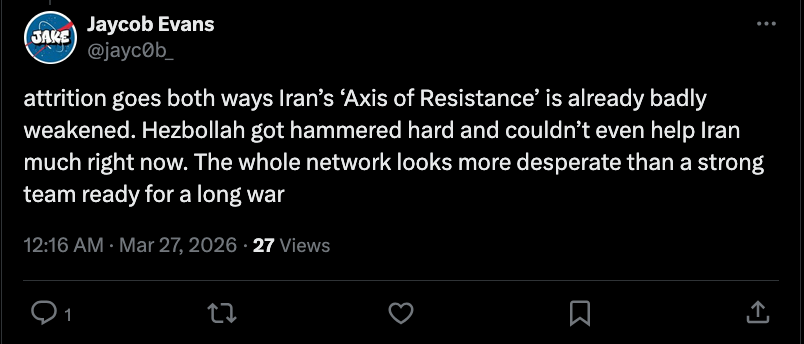
X post by Jaycob Evans
This post is more restrained in tone but complements the same trajectory by expanding the frame from internal collapse to regional network degradation. Instead of focusing on individual fear or defection, it emphasizes attrition across Iran’s “Axis of Resistance,” particularly Hezbollah. The key move here is shifting from anecdotal claims to a broader strategic assessment: the network is “weakened,” unable to support Iran effectively, and no longer positioned for sustained conflict. This framing trades emotional intensity for plausibility, making it more likely to be perceived as analytical rather than propagandistic.
Iran is operating under sustained pressure, but not at a breaking point. The system remains intact because coercive institutions are functioning and elite alignment, while strained, is holding.
This produces a clear trajectory. The most likely outcomes are internal: either consolidation around security actors or gradual erosion that increases the probability of fragmentation over time. Rapid collapse or externally driven change remains unlikely under current conditions.
The decisive variable going forward is not how much pressure the regime faces, but whether that pressure begins to disrupt coordination within its core power structures. Until that happens, the system persists.

