
Menu
The Strait of Hormuz crisis represents both a material disruption to global energy flows and a narrative battleground shaping perceptions of economic and geopolitical stability. As one of the world’s most critical maritime chokepoints, even limited disruption to transit generates disproportionate effects on oil and liquefied natural gas markets, exacerbating speculative behavior, supply risks , and trade flows. However, the crisis is not only unfolding in physical space but also across the information environment, where social media and coordinated messaging expand localized events into broader claims about global instability, de-dollarization, and shifting power balances. This report examines how these narratives emerge, propagate, and influence both market behavior and geopolitical interpretation, integrating open-source intelligence, geospatial analysis, and cross-platform narrative tracking.
The crisis is increasingly framed by some actors as a successful application of economic pressure against the United States, rather than simply a disruption to global energy flows. Messaging highlights how limited maritime threats and instability in the Strait of Hormuz can generate outsized economic effects, portraying this as evidence that U.S. vulnerabilities can be exploited without direct confrontation. In this framing, rising oil prices, shipping disruptions, and insurance costs are not just consequences of conflict, but indicators of effective coercion.
This narrative shifts the interpretation of the crisis from instability to leverage. By emphasizing the asymmetric impact of relatively low-cost actions on global markets, these actors present the situation as proof that economic pressure can constrain U.S. decision-making and impose broader costs on Western economies. As this framing circulates, it reinforces the idea that control over key chokepoints can be used strategically to shape outcomes, elevating the perceived effectiveness of economic warfare in the current environment.
A network of aligned actors is converging on a shared line that frames energy market disruption as an opening to advance alternative payment mechanisms outside U.S. control. Rather than focusing on price volatility or supply risk alone, messaging emphasizes the feasibility and growing use of non-dollar transactions, particularly in energy trade. Select examples, such as isolated yuan-denominated payments or bilateral agreements, are elevated and repeatedly circulated to signal momentum toward parallel financial channels.
This convergence is reinforced across interconnected accounts that amplify and legitimize each other’s framing, giving the impression of coordinated validation rather than isolated commentary. The effect is to normalize the idea that alternative payment systems are not only emerging, but already operational at scale. In this context, the Hormuz crisis is used less as an energy story and more as a proof point, supporting a broader narrative that U.S.-centered financial infrastructure can be bypassed and replaced under conditions of sustained pressure.
Amplified content leverages themes of inflation, shortages, and cost-of-living pressures to heighten uncertainty and distrust. These narratives often extend beyond energy markets to suggest cascading economic and societal consequences, including financial system instability. By framing the crisis through fear-based and worst-case scenarios, coordinated messaging increases polarization and primes audiences to accept geopolitical interpretations that align with specific strategic interests.

Geospatial Narrative Sources (yellow) and targets (red)
The narrative map above illustrates a coordinated information operation with clear directional intent — arcs originating predominantly from Eastern Europe, particularly Sofia, radiate outward toward Western capitals, Middle Eastern hubs, and East Asian nodes, before converging heavily on Tehran as the primary destination. This pattern suggests a deliberate amplification network designed to shape how the Strait of Hormuz crisis is perceived across allied and partner nations. The narrative architecture appears structured to establish initial credibility before redirecting influence. Early-stage dissemination mimics Western-origin discourse to build trust, followed by a concentrated shift in messaging volume toward Tehran, where the narrative’s strategic impact is ultimately consolidated. Amplified content surrounding the Strait of Hormuz crisis focuses on portraying the conflict as a sustained threat to global energy stability, emphasizing volatility in oil and gas markets to heighten fears of shortages and economic disruption. At the same time, synthetic and coordinated messaging amplifies concerns about inflation and insecurity, framing the crisis in ways that can deepen distrust, polarize audiences, and increase susceptibility to influence during politically sensitive periods.
Narratives frequently highlight shifting energy dependencies, particularly Russia’s role as an alternative supplier, to legitimize geopolitical realignments and influence public perception.
At the same time, synthetic and coordinated messaging amplifies concerns about inflation and insecurity, framing the crisis in ways that can deepen distrust, polarize audiences, and increase susceptibility to influence during politically sensitive periods.
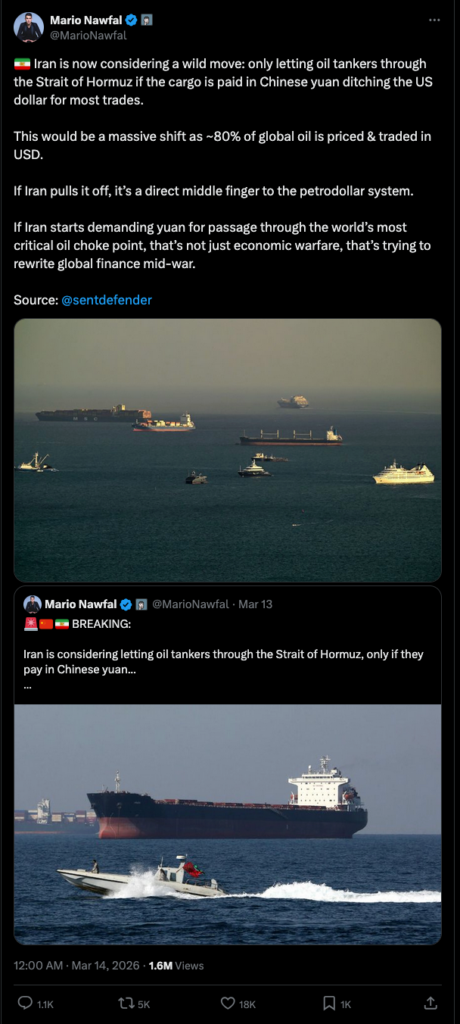
This post shares a high-performing geopolitical narrative that converts a reported or proposed operational constraint into a systemic economic threat through a clear escalation structure. It begins with the claim that Iran could restrict Hormuz transit based on yuan-denominated payments, reinforced by a credibility anchor (“~80% of global oil is priced in USD”). The framing quickly shifts from a conditional policy move to a broader challenge to the petrodollar system, using simplified and emotionally charged language to recast a technical issue of payment mechanisms into a symbolic confrontation over global financial power.
It begins with the claim that Iran could restrict Hormuz transit based on yuan-denominated payments, reinforced by a credibility anchor.
The argument expands further by highlighting that remaining shipments are moving on Chinese vessels and being transacted in yuan, implying that the disruption could accelerate a shift away from the U.S. dollar in global energy trade. Structurally, the post moves from operational disruption to macroeconomic consequences, encouraging readers to interpret the crisis as a systemic threat to both the global economy and U.S. financial influence. It culminates by framing the scenario as “rewriting global finance mid-war,” reinforcing a sense of inevitability and strategic coordination.
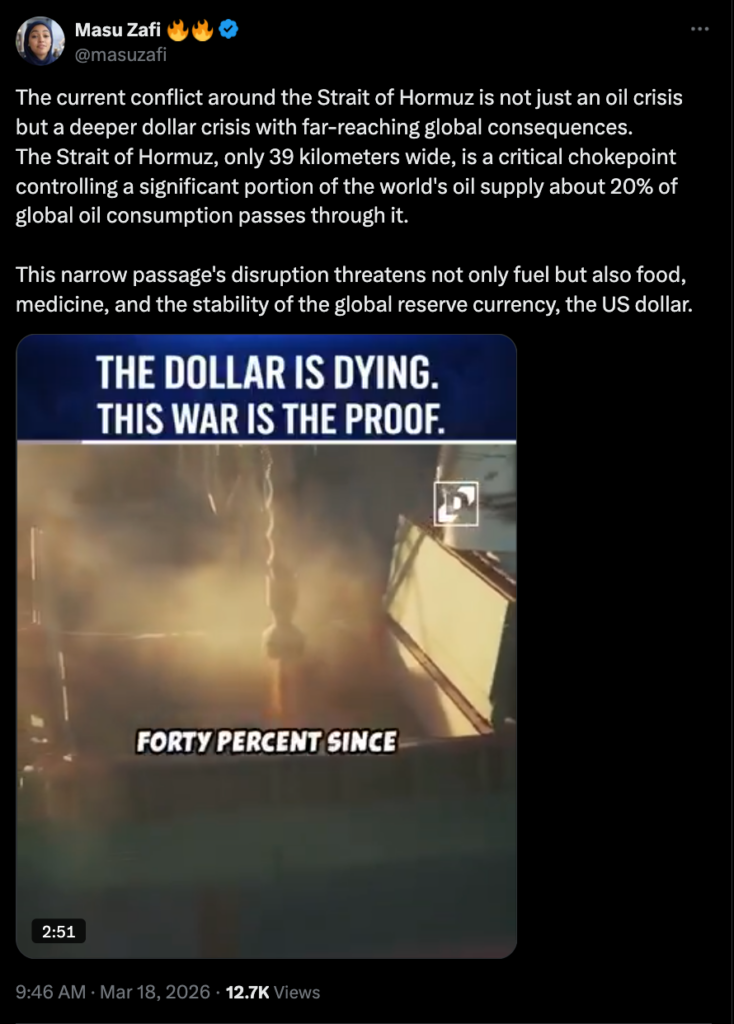
X post by Masu Zafi
This post frames tensions around the Strait of Hormuz as evidence of a broader systemic collapse rather than a localized geopolitical or energy-security issue. While the text begins with factual context—that roughly one-fifth of global oil consumption passes through the strait—it quickly reframes the chokepoint as the trigger for a global financial breakdown. The key narrative pivot occurs when the disruption of oil shipping is linked not only to fuel shortages but also to cascading failures in food, medicine, and ultimately the stability of the United States dollar. By tying logistical disruption to monetary collapse, the post expands a regional maritime security issue into a narrative about the collapse of the global financial system.
The attached video and headline—“THE DOLLAR IS DYING. THIS WAR IS THE PROOF.”—reinforce a common geopolitical narrative that U.S. financial dominance is collapsing due to global conflict and shifting energy trade dynamics. This framing echoes broader “de-dollarization” narratives frequently circulated in online geopolitical discourse, where disruptions to oil flows or conflicts in strategic chokepoints are interpreted as catalysts for the end of the dollar-based global financial system. The post therefore functions less as analysis of the maritime situation and more as narrative amplification: it uses the Hormuz chokepoint as symbolic evidence for a predetermined conclusion about U.S. economic decline, leveraging crisis imagery and statistics about oil transit to lend credibility to that broader claim.
Viewed in the context of @masuzafi’s broader activity, this content aligns with a consistent pattern of reframing discrete events to support a fixed narrative line. The account operates within Nigerian and overseas Twitter networks where domestic politics and global developments are routinely merged, allowing geopolitical events to be repurposed for broader interpretive use. Rather than evaluating the Hormuz incident on its own merits, the post uses it as a vehicle to advance claims about weakening U.S. influence and instability.
This behavior reflects a hybrid amplification model. Real-world events function as initial triggers, but are quickly abstracted into generalized claims about institutional weakness and shifting power dynamics. Within this context, the Hormuz post functions as narrative alignment. A specific event is incorporated into an existing interpretive framework, guiding the audience toward a predetermined conclusion. The post’s primary value is not analytical insight into the event itself, but its role in sustaining and reinforcing a broader narrative of decline.
,,,remaining shipments are moving on Chinese vessels and being transacted in yuan, implying that the disruption could accelerate a shift away from the U.S. dollar in global energy trade.
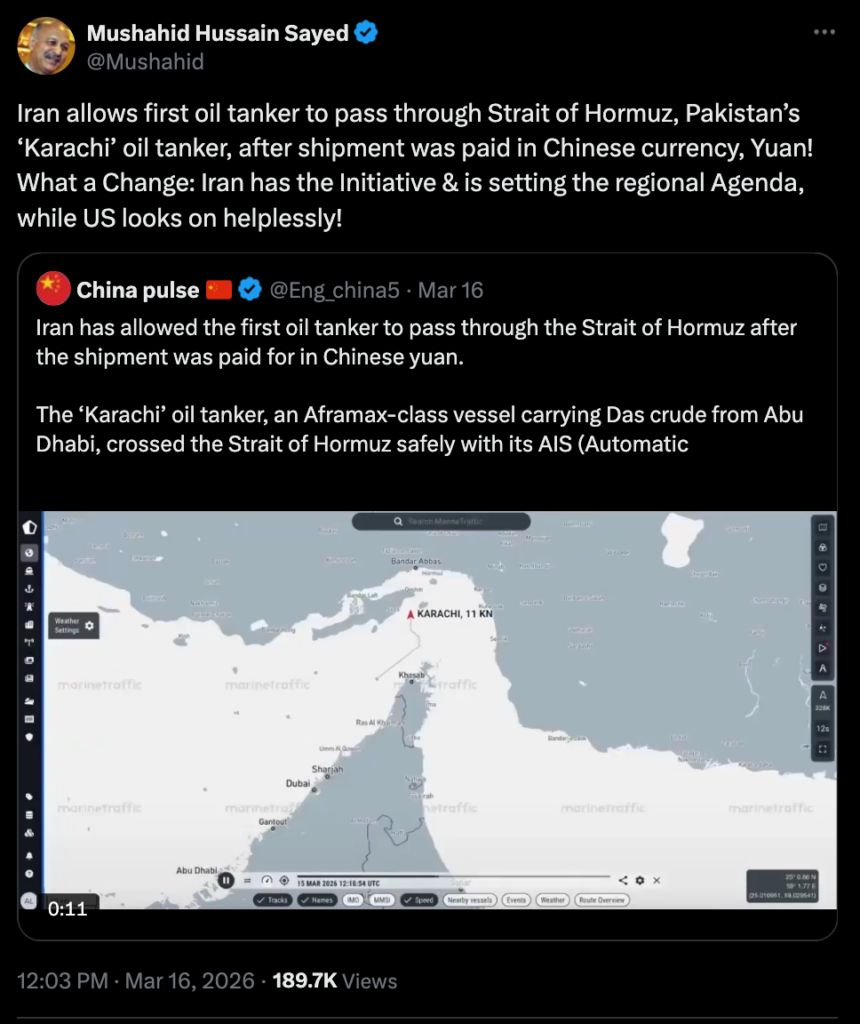
X post by Mushahid Hussain Sayed
This post signals developments in the Strait of Hormuz through a geopolitical narrative emphasizing the decline of U.S. influence and the rise of alternative economic alignments. By highlighting that the tanker transit was allegedly permitted after payment in Chinese yuan, the post suggests a shift away from the dollar-denominated oil trade system that has historically underpinned U.S. financial influence. The accompanying commentary amplifies this interpretation by portraying Iran as “setting the regional agenda” while the United States “looks on helplessly,” reinforcing a broader narrative of declining Western leverage in Middle Eastern energy security. The emphasis on yuan-denominated payment also implicitly elevates China as a growing economic power capable of reshaping regional trade dynamics, aligning the event with wider online narratives about de-dollarization and the emergence of alternative financial systems tied to Chinese influence. By presenting a single tanker transit as evidence of a structural shift in global energy trade, the post transforms a discrete event into symbolic proof of a broader geopolitical realignment.
The emphasis on yuan-denominated payment also implicitly elevates China as a growing economic power capable of reshaping regional trade dynamics, aligning the event with wider online narratives about de-dollarization and the emergence of alternative financial systems tied to Chinese influence.
When situated within the behavior of the account that shared it (@Mushahid), this framing reflects elite-level narrative positioning. As a prominent Pakistani political figure embedded in policy, diplomatic, and media networks, the account functions as a bridge between institutional geopolitical discourse and broader online narratives. Its content consistently advances a multipolar worldview in which U.S. dominance is eroding and alternative centers of power—particularly China—are gaining influence. Thus, the Hormuz post functions as strategic framing: a specific event is elevated to signal broader global transition. Rather than relying on overt dramatization typical of lower-tier amplification accounts, this account applies an authoritative tone and geopolitical context, which increases the perceived credibility of the claim and supports its spread across both elite and general audiences. The result is narrative alignment in which a localized maritime development is presented as evidence of wider economic realignment, consistently tied to themes of de-dollarization, Western decline, and shifting power balances.
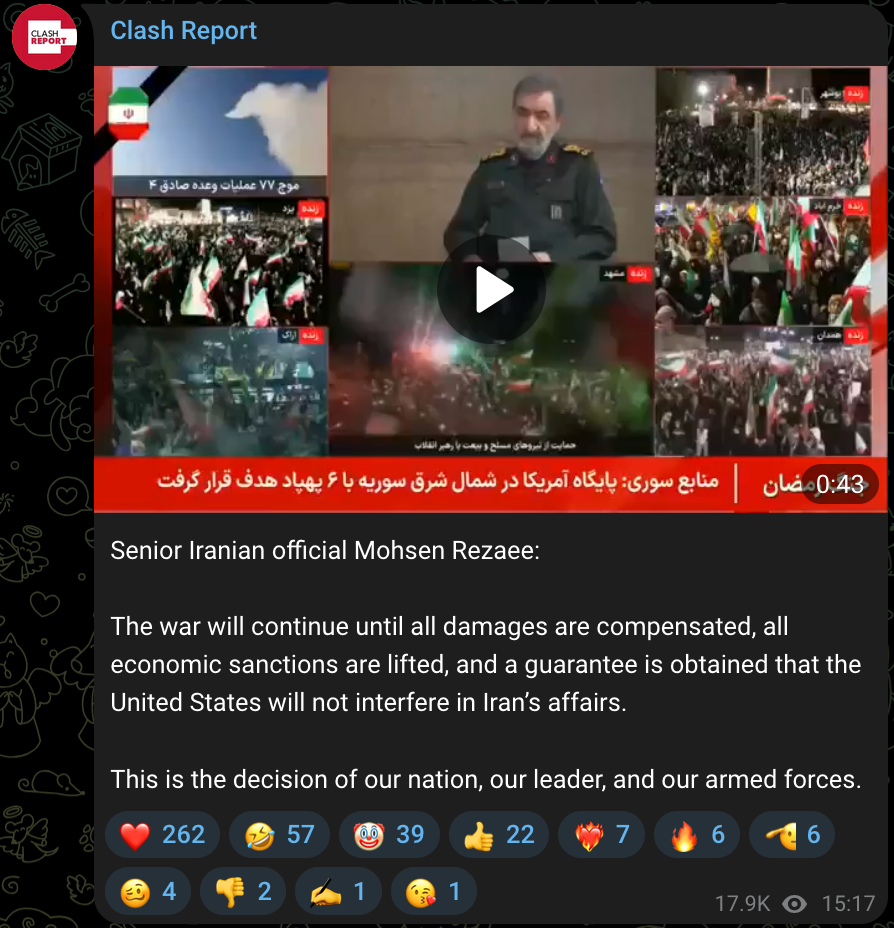
Telegram post by Clash Report
This Clash Report post emphasizes resilience, sovereignty, and defiance in the face of external pressure—particularly from the United States. By highlighting a senior Iranian official’s statement that the war will continue until damages are compensated and sanctions lifted, the messaging frames the conflict as both justified and ongoing, rather than temporary or reactive. This positions Iran as a rational but uncompromising actor, reinforcing a narrative of legitimacy and endurance.
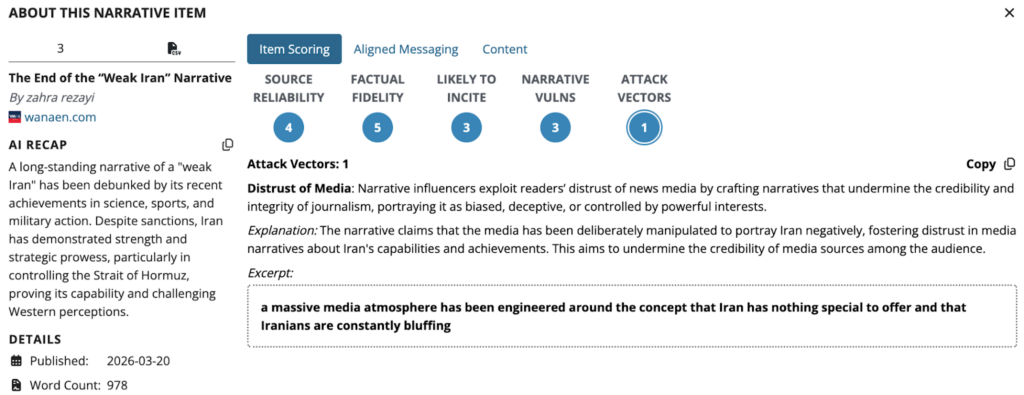
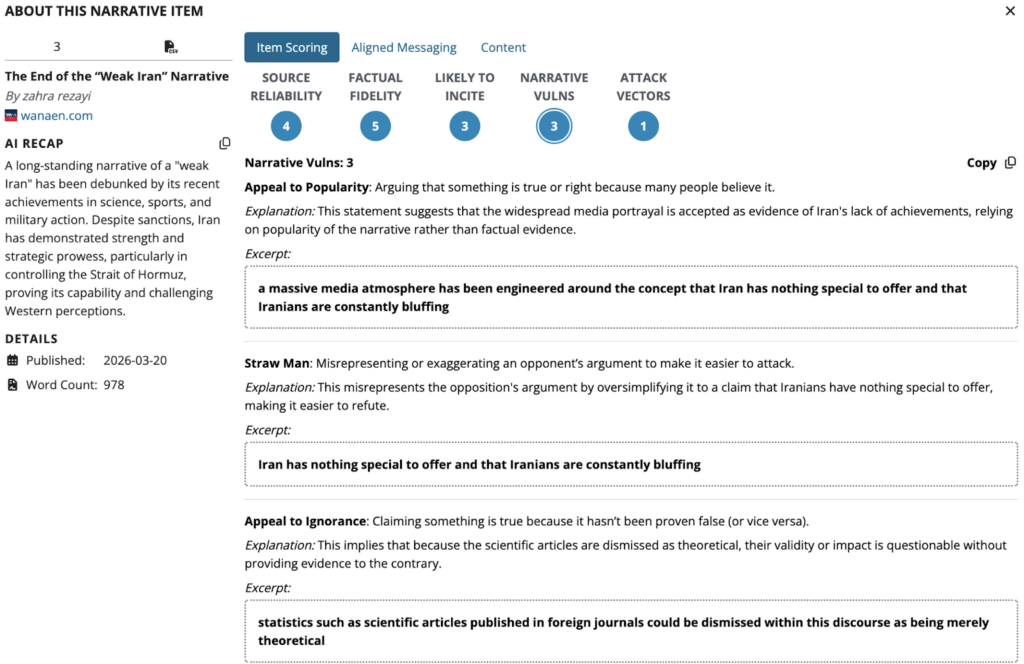
Edge Theory Narrative Attack Vector Classifier and Attack Vulnerabilities
The narrative frames Iran as a capable, deliberate actor while relying on rhetorical shortcuts that reinforce credibility but weaken analytical rigor.
The image supports the portrayal of Iran as a rational but uncompromising actor by reframing past perceptions of weakness as manufactured rather than real, positioning Iran as deliberately underestimated and strategically consistent. By emphasizing resilience and capability, particularly in contexts like Hormuz, the narrative reinforces legitimacy and endurance under pressure. However, this framing relies on identifiable vulnerabilities: an appeal to popularity dismisses the “weak Iran” view as widely believed rather than empirically assessed; a straw man reduces opposing arguments to the claim that Iran has “nothing to offer,” making them easier to refute; and an appeal to ignorance discounts contrary evidence as incomplete or irrelevant. Together, these mechanisms strengthen the narrative’s persuasive effect while limiting substantive engagement with competing analysis.
Even without a full closure of the strait, the credibility of disruption risk alone is enough to alter trader behavior, shipping routes, and insurance costs.
The inclusion of mass protest imagery further amplifies this by visually suggesting popular support, thereby strengthening the perception that the state’s stance reflects national will rather than elite decision-making.
At the same time, the narrative functions as strategic messaging aimed at both domestic and external audiences. Domestically, it reinforces unity and long-term commitment by tying the conflict to national dignity and economic justice. Internationally, it signals deterrence and refusal to concede to foreign interference, framing any continued pressure as prolonging instability rather than resolving it. Overall, the messaging aligns with a broader psychological endurance narrative—prioritizing persistence, legitimacy, and collective resolve over immediate military outcomes.
The Strait of Hormuz crisis represents a high-risk disruption to one of the world’s most critical energy transit chokepoints, through which a significant share of global oil and liquefied natural gas flows. Escalating U.S.–Iran tensions, including missile strikes and threats to Gulf infrastructure, have heightened the perceived and real risk of maritime disruption. Social media and open-source narratives across Telegram, Weibo, VK, RedNote, and X consistently frame the situation as a prolonged instability scenario rather than a short-term shock, reinforcing market expectations of sustained disruption. Even without a full closure of the strait, the credibility of disruption risk alone is enough to alter trader behavior, shipping routes, and insurance costs.


Edge Theory Narrative Scoring
This narrative cluster expands the Hormuz crisis beyond energy markets, linking disruption to broader regional instability and economic strain. Messaging emphasizing impacts on exports, labor markets, and energy access in South and Southeast Asia reinforces the idea that the crisis will produce system-wide energy and economic effects. This broader framing contributes to market sensitivity, as energy disruptions are interpreted not in isolation but as part of a wider geopolitical and economic shock. Markets have responded to the Strait of Hormuz crisis not only through actual supply disruptions.
Following initial U.S.–Israel strikes on Iran, oil prices surged nearly 20% in a single trading session and rose over 50% in subsequent weeks, even before full supply losses materialized. Discrete escalation signals, such as tanker attacks or threats to close the Strait, triggered immediate price spikes, while partial de-escalation led to rapid declines, showing how markets price anticipated instability rather than realized shortages. This pattern demonstrates that energy markets interpret disruptions as part of a wider systemic shock, amplifying volatility through narrative-driven expectations of prolonged conflict and global economic strain.
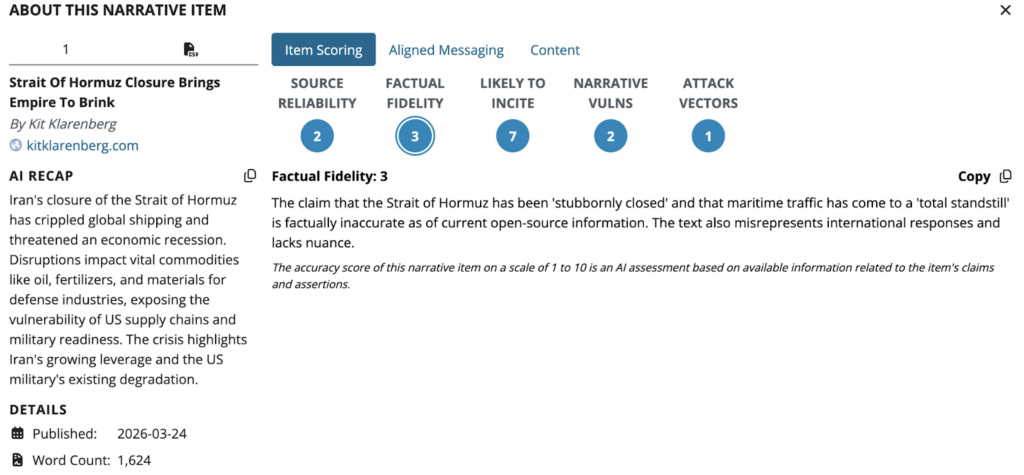
Edge Theory Factual Fidelity Classifier
This narrative item uses the Strait of Hormuz crisis to reinforce claims of U.S. vulnerability and decline, prioritizing amplification over factual accuracy. The item frames a potential Hormuz disruption as both an immediate economic shock and a broader strategic failure, linking maritime instability to supply chain breakdowns, military readiness concerns, and global recession risk. While the Strait is a legitimate energy chokepoint, the claim that it has been effectively “closed” and traffic reduced to a standstill is overstated, lowering factual fidelity while increasing narrative impact. This reflects a broader pattern in which real-world events are scaled into generalized claims about U.S. weakness, connecting multiple domains into a single storyline of declining resilience. The framing aligns with recurring narratives that emphasize Western vulnerability, particularly in relation to critical infrastructure and global trade.

Edge Theory Factual Fidelity Classifier
This narrative item reflects a largely accurate, event-driven assessment of rising oil prices, but still carries secondary relevance as a reinforcing signal for broader energy insecurity narratives tied to the Hormuz crisis. The item tracks a measurable increase in crude oil prices and attributes it to escalating tensions in the Middle East, including attacks on tankers and disruptions near the Strait of Hormuz. Unlike more distorted narratives, the claims here generally align with observable market behavior and known geopolitical developments, resulting in higher factual fidelity. The linkage between maritime risk and energy price volatility is well established, and the inclusion of factors such as sanctions dynamics and supply constraints reflects a grounded interpretation of current conditions. As a result, the content functions primarily as reporting rather than narrative manipulation. While this item does not itself exaggerate or misrepresent events, it operates within an information environment where such developments are quickly integrated into larger narratives about uncertainty, competition, and realignment in global energy systems.
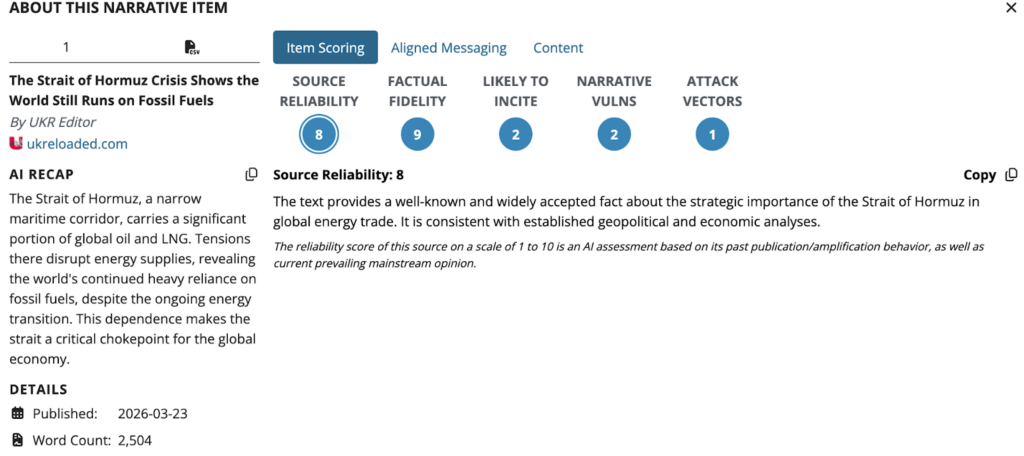
Edge Theory Factual Fidelity Classifiers
The contrast between these narratives reflects a clear divide between structural analysis and exaggeration. High-fidelity accounts accurately frame the Strait of Hormuz as a persistent chokepoint within a fossil fuel–dependent system, emphasizing vulnerability without overstating disruption. The reporting on a ~17% oil price increase by hejazi similarly aligns with observable market behavior, linking price movement to escalation signals and uncertainty rather than definitive supply loss. In contrast, the lowest-fidelity narrative claims a “total standstill” in maritime traffic. Overall, credible narratives preserve nuance and scale effects appropriately, while low-fidelity narratives rely on worst-case framing that distorts risk perception.
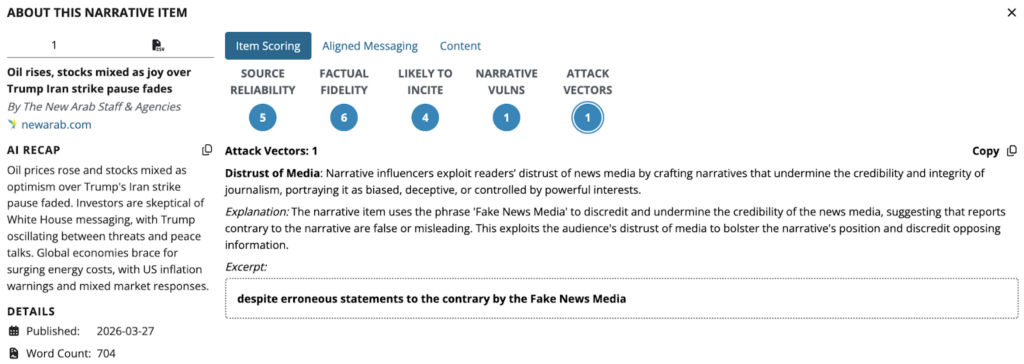
Edge Theory Narrative Attack Vector Classifier
This narrative leverages a “distrust of media” attack vector to shape audience perception by discrediting competing information sources rather than engaging with their claims. The use of terms like “Fake News Media” reframes disagreement as bias or deception, allowing the narrative to assert credibility without substantiating its position. This shifts evaluation from evidence-based assessment to source-based dismissal.
This narrative leverages a “distrust of media” attack vector to shape audience perception by discrediting competing information sources rather than engaging with their claims.
By narrowing the set of perceived credible sources, the narrative reinforces confirmation bias and reduces the likelihood that audiences will incorporate corrective information. In a crisis context like the Strait of Hormuz, this fragmentation of trust can amplify uncertainty, as market and policy responses become increasingly driven by contested narratives rather than verifiable developments.
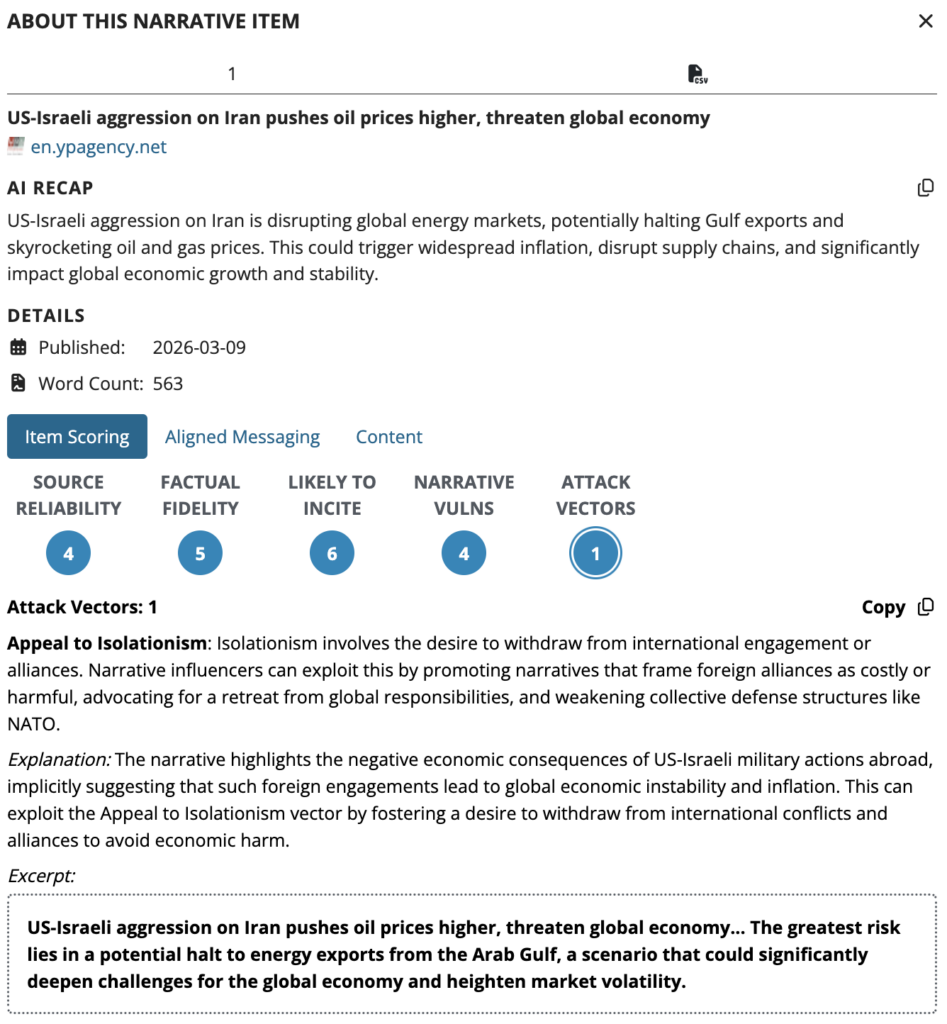
Edge Theory Narrative Attack Vector Classifier
This narrative reflects how the Strait of Hormuz crisis is being framed as an immediate shock to global energy markets, with particular emphasis on rapid oil price increases following U.S.–Iran escalation. Coverage highlighting double-digit price surges reinforces perceptions of acute supply vulnerability, even in the absence of a full disruption. The result is that perceived instability alone is driving market movement, altering pricing behavior and reinforcing short-term spikes in oil markets.
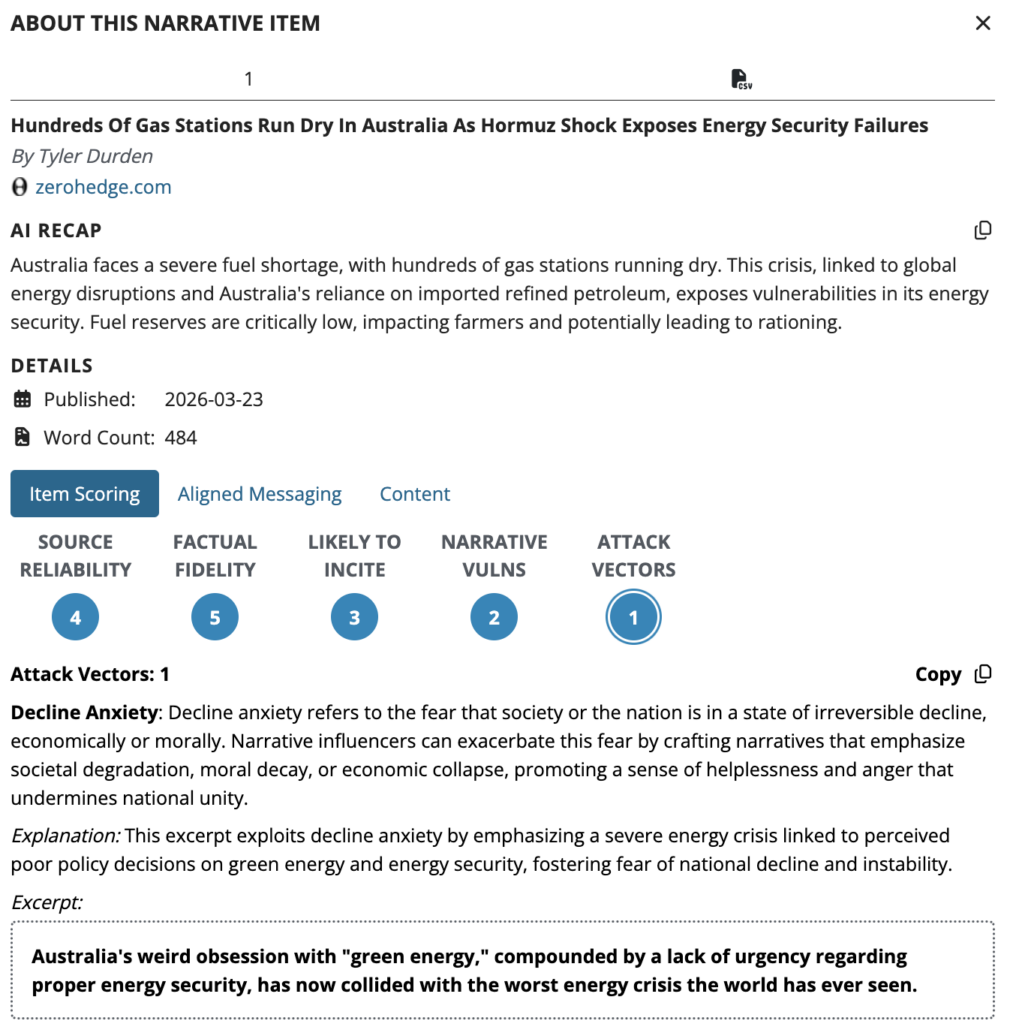

Edge Theory Narrative Attack Vector Classifier; Al Mayadeen Telegram Post
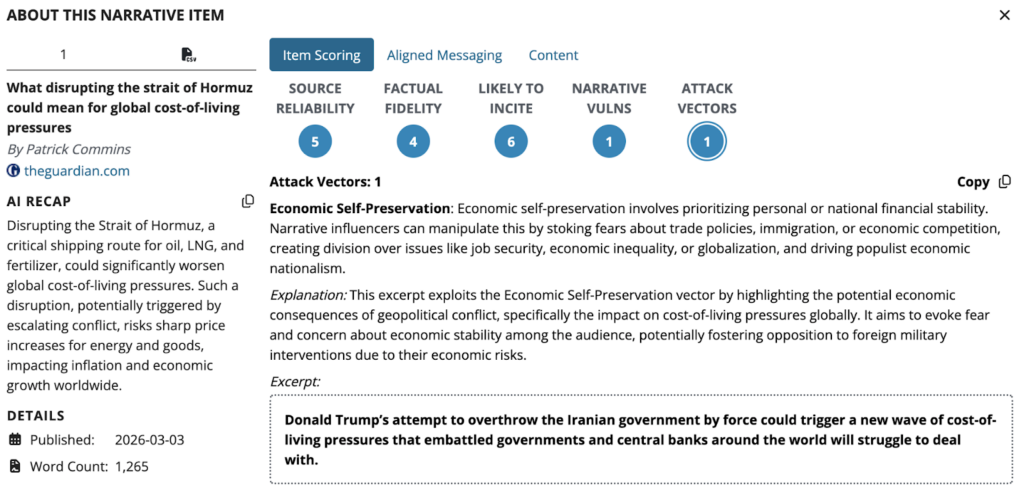
EdgeTheory Narrative Attack Vector Classifier
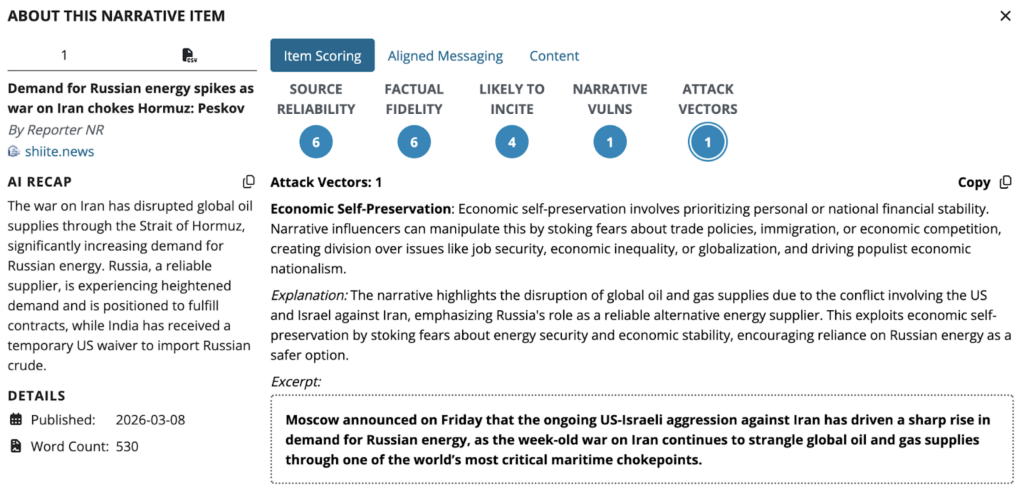
This narrative item highlights how the Hormuz crisis is being interpreted through an economic security lens, directly linking energy disruption to global inflation and cost-of-living pressures. By emphasizing downstream economic consequences, these narratives reinforce the perception of long-term disruption rather than a temporary shock. This expectation is itself shaping market behavior, increasing risk premiums, influencing trade flows, and heightening sensitivity to further escalation in the region.
Following Iranian missile strikes on Qatar’s Ras Laffan LNG facility and ongoing instability, Qatar has suspended all LNG production temporarily, significantly exacerbating supply shocks in Singapore and the wider region. Imports from countries such as Malaysia, Indonesia, and Australia offer some relief. However, production and export capacities from these neighbors are relatively limited compared to Gulf suppliers. Malaysia and Indonesia face their own operational constraints, while Australia’s LNG supplies are largely committed and face logistical limits for quick expansion due to shipping lane congestion and increasing freight costs. Singapore-based firms and regional refiners have been attempting to source LNG cargoes from spot markets in the US, West Africa, and Latin America. Nonetheless, longer shipping routes (often via the Cape of Good Hope)lead to a 14-day delivery delay and surge freight and war-risk insurance premiums by as much as 15-20%. This sharply increases landed costs and diminishes competitiveness. While these alternatives provide some buffering, the quantities available in the short term are insufficient to fully replace disrupted Gulf flows. Increased freight and insurance costs reduce profit margins and may force higher prices on end-users.
There are several short and long term impacts. In the short term, these dynamics are generating immediate price volatility, inflationary pressure, and supply insecurity. Strategic reserves and stockpiles are providing temporary buffers, but their capacity is uneven across regions, with Southeast Asian states particularly exposed due to more limited reserves. Refining constraints, especially dependence on Middle Eastern crude grades, further limit rapid substitution. As a result, energy-importing economies, particularly in Asia, face growing risks of fuel rationing, slowed industrial output, and broader economic strain. At the same time, demand is shifting toward alternative suppliers, including Russia, signaling early-stage realignment in global energy trade flows.
EdgeTheory Narrative Attack Vector Classifier
This narrative reinforces how energy disruptions are not only reshaping supply chains but also being leveraged to advance alternative geopolitical alignments. By emphasizing Russia as a “reliable supplier” amid Strait of Hormuz disruptions, the narrative promotes economic self-preservation logic that encourages states to shift toward non-Gulf, non-Western energy sources. This aligns with the structural shift where countries pursue diversification through overland routes, stockpiles, and alternative suppliers. The narrative functions as a soft influence mechanism that normalizes dependence on actors like Russia and, by extension, China-linked energy networks, which similarly offer diversification outside traditional chokepoints. This is particularly relevant for states like Singapore and ASEAN members, where such narratives could shape policy preferences toward China-connected supply chains under the guise of resilience, even when those shifts may carry longer-term strategic tradeoffs.

Map of oil and gas fields and pipelines around Hormuz
...ostensibly offering alternatives but also supporting Chinese strategic positioning, potentially at Singapore’s economic cost. Regional actors, particularly within ASEAN, are likely to pursue greater energy integration, including shared reserves and expanded LNG infrastructure, to reduce reliance on single chokepoints.
A potential ground invasion would further reinforce and accelerate these dynamics by transforming a primarily maritime disruption into a broader, multi-domain energy shock. Unlike chokepoint instability alone, ground conflict introduces direct risks to physical energy infrastructure—including pipelines, refineries, and storage facilities—while expanding uncertainty across both supply and production systems. This widens the geographic scope of disruption and intensifies market volatility, driving up insurance, transit costs, and precautionary stockpiling behavior. At the same time, heightened insecurity would likely push states toward more tightly controlled, bilateral, or bloc-based energy arrangements, deepening the shift away from open global markets toward securitized supply networks. In this environment, narratives promoting alternative suppliers such as Russia or China-linked systems gain additional traction, as resilience becomes increasingly defined by political alignment and infrastructure access rather than market efficiency, further embedding the structural realignment already underway.
Over the longer term, the crisis is accelerating structural changes in global energy systems and geopolitics. China is positioned to benefit strategically due to its diversified supply chains, including overland pipelines from Russia and Central Asia, as well as its ability to leverage stockpiles and alternative routing. Chinese energy stockpiles and diversified supply chains via pipelines (e.g., from Russia, Kazakhstan) offer Beijing leverage and enhance resilience against Gulf disruptions. Singapore’s relations with China may lead to narrative pressures advocating increased LNG trade with China or via China-connected supply chains. However, such moves could serve dual purposes: ostensibly offering alternatives but also supporting Chinese strategic positioning, potentially at Singapore’s economic cost. Regional actors, particularly within ASEAN, are likely to pursue greater energy integration, including shared reserves and expanded LNG infrastructure, to reduce reliance on single chokepoints. At the same time, the crisis reinforces the strategic vulnerability of fossil fuel dependence, increasing pressure for investment in renewables, decentralized energy systems, and alternative supply chains.
The Strait of Hormuz crisis demonstrates how physical disruptions and information operations interact to produce compounded strategic effects. While the material risk to global energy supply is significant, the narrative environment magnifies these effects by shaping expectations, influencing market behavior, and reframing geopolitical dynamics. Perception of instability is itself a driver of economic outcomes, contributing to price volatility, supply chain adjustments, and shifting trade alignments even in the absence of full disruption. Over time, these dynamics accelerate structural changes in global energy systems, benefiting actors with diversified supply networks and alternative financial mechanisms, particularly China. As a result, the crisis is not only a test of energy security but also a catalyst for longer-term geopolitical and economic realignment, where control over narratives becomes as consequential as control over physical infrastructure.

