
Menu
The U.S. military capture of Nicolás Maduro triggered not only an international diplomatic crisis but an immediate and coordinated battle of narratives across the global information environment. Within hours, Russian and Chinese state aligned actors, media outlets, and social media networks began reframing the operation as an act of imperial aggression, a violation of international law, and a resource driven intervention aimed at Venezuelan oil. These narratives spread rapidly across X, state media, and syndicated news platforms, exploiting existing sensitivities around sovereignty, interventionism, and U.S. influence in Latin America. Rather than contesting operational facts directly, adversarial actors emphasized emotional framing, legal rhetoric, and historical grievance to shift attention away from Maduro’s alleged crimes and toward the legitimacy of U.S. power. The resulting information environment is highly polarized, with Russia and China leveraging the incident to undermine the rules based order, fracture allied consensus, and normalize a sphere of influence model that favors coercive state action.
Amplified narratives overwhelmingly frame the U.S. action as a criminal abduction and breach of sovereignty rather than a targeted security operation. Geospatial analysis identifies 26 narrative points of origin and 11 primary destinations, with early amplification shifting from Western media commentary to sustained messaging from Russia, China, and aligned Latin American actors. Core themes include alleged violations of the UN Charter, accusations of neocolonial oil exploitation, and claims that the operation signals the collapse of international law. These narratives are reinforced through repetition across state media, diplomatic statements, and coordinated X posts, creating informational saturation that obscures legal nuance and operational context.
Adversarial actors systematically weaponize high arousal emotions to accelerate narrative uptake. Emotion profiling shows Anger dominating imperialism and resource war claims, while Fear peaks in narratives asserting the end of the rules based order. By portraying the operation as a precedent that places all states at risk of U.S. coercion, these narratives generate anxiety among non aligned states and U.S. partners. Emotional resonance outpaces verification, enabling rapid spread of synthetic content, including fabricated imagery and exaggerated claims of civilian harm, which complicates attribution and slows coordinated responses.
Moscow uses the Venezuela operation to advance three interlocking objectives. First, to legitimize its invasion of Ukraine by framing U.S. actions as equivalent great power behavior. Second, to weaken the universality of international law by promoting a spheres of influence model where power overrides norms. Third, to distract international attention from Russian battlefield and economic vulnerabilities by redirecting outrage toward U.S. actions. These narratives seek to lower the political cost of continued Russian coercion in Eastern Europe and the former Soviet space.
Beijing’s narrative campaign aims to portray the U.S. as an unpredictable and destabilizing actor while positioning China as the primary defender of sovereignty and stability. This serves four objectives: undermining U.S. influence in Latin America, reinforcing China’s Global Security Initiative messaging, increasing receptivity to Chinese diplomatic and economic engagement, and weakening normative resistance to Chinese coercive options in its own periphery. By arguing that the U.S. has abandoned the rules based order, Chinese commentators explicitly claim greater freedom of movement on Taiwan and regional security issues.

Geospatial Narrative sources (yellow) and targets (red)
The narrative initially emerged from Dayton Avenue, headed for Beijing. As it spread, the most frequent origin shifted to New Delhi, and the most frequent destination shifted to Caracas. There are a total of 26 points of origin, and 11 destinations. The three primary narratives being amplified are widespread condemnation of U.S. military actions in Venezuela, claims of U.S. resource control motives, and international responses emphasizing sovereignty and anti-interventionism. Adversarial actors, led by Russia and China, utilize these themes to frame U.S. posture as a violation of international law, thereby legitimizing their own geopolitical opposition and undermining Western influence. Claims regarding the control of Venezuelan oil resources are specifically weaponized through synthetic social media content to fuel accusations of neocolonialism and imperialism. International responses emphasizing sovereignty and anti-interventionism from Russia, China, and Latin American actors are being used to question Western influence and democratic processes, increasing vulnerability to the spread of overt disinformation. Primary sources include Svoboda, a critical Russian‑language write‑up on how the world and Russian audiences interpret the U.S. capture of Maduro; this source often represents more nuanced or critical views distinct from Kremlin state media. Sina news, a Chinese news portal citing China’s Foreign Ministry spokesperson condemning the U.S. military action, calling it an act of hegemonism that violates international law and threatens regional peace.
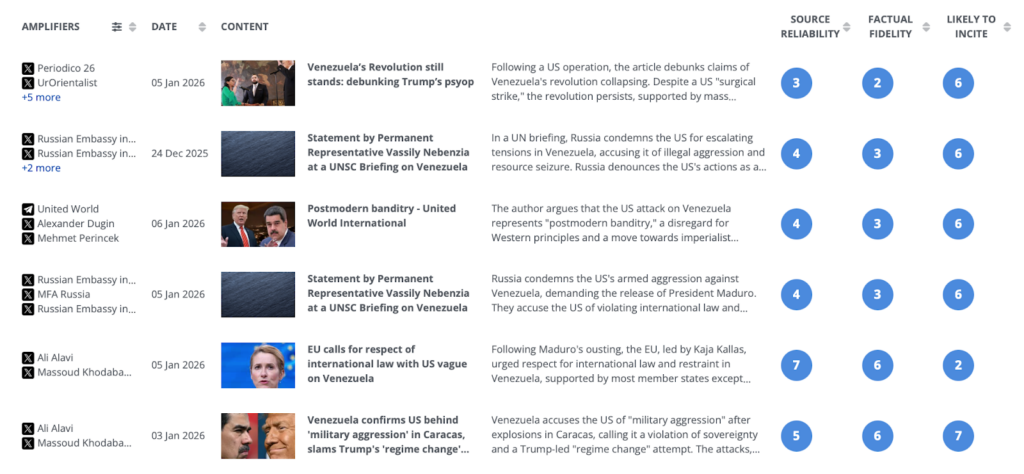
EdgeTheory Global Cognitive Adversaries (GCA) Narrative Classifier
The primary sources amplifying this narrative are predominantly Russian-aligned, followed by Chinese-alignment. Key vectors driving these narratives include Russian diplomatic channels (MFA Russia, Russian Embassy networks) and state-aligned proxy outlets (United World International, Sputnik), which systematically frame the operation as "illegal aggression" and "postmodern banditry.” Influential figures such as Alexander Dugin and Mehmet Perincek dominate this cognitive space, utilizing their platforms to portray the capture of Nicolás Maduro as a violation of sovereignty and a "resource-driven oil grab." These sources contrast Western "unilateralism" with a vision of a "multipolar world order," positioning Moscow and Beijing as defenders of international law and the UN Charter. By weaponizing high-arousal emotions such as anger and fear, this narrative network targets audiences in the Global South to erode U.S. moral authority and normalize a "spheres-of-influence" model of global security.
The three primary narratives being amplified by Russian accounts regarding the U.S. military operation in Venezuela are widespread condemnation of the "act of aggression," claims of U.S. resource control motives, and an emphasis on sovereignty to legitimize a global order based on spheres of influence. According to Meduza and Radio Free Europe, following the capture of Nicolás Maduro, the Kremlin has framed the incursion as a flagrant breach of international norms and a return to "great-power politics" where imperialistic states dominate their regional spheres with impunity. While officially calling for "de-escalation" and "diplomatic dialogue," Russian state-controlled media and diplomats leverage these narratives to portray the U.S. as a violator of the UN Charter, effectively using the intervention to justify their own actions in Ukraine as a parallel exercise in maintaining a regional sphere of dominance.
According to the Washington Post, Moscow is cautiously monitoring the U.S. effort to seize control in Caracas, viewing the operation through the lens of economic and strategic risk. The Kremlin perceives a successful U.S. intervention as a direct threat to its economy via a potential sustained drop in oil prices, while simultaneously weighing the "upside" of Washington becoming mired in a prolonged Latin American conflict. By framing the ousting of Maduro as a confirmation that the liberal order is ending, Russia seeks to distract from its own aggression in Ukraine and President Putin’s refusal to engage with Western peace initiatives. Ultimately, Moscow interprets the U.S. incursion as a validation of its own worldview: a global order defined by spheres of influence rather than international law, emboldening Putin to further assert dominance across the former Soviet bloc.
Chinese narratives focus on three themes: hegemonic behavior, the violation of international law, and strategic comparisons to the Taiwan issue.
EdgeTheory’s Narrative Intelligence indicates Chinese narratives focus on three themes: hegemonic behavior, the violation of international law, and strategic comparisons to the Taiwan issue. Chinese-aligned posts consistently use language regarding "hegemonic actions," "violation of international law," and "threats to regional peace" to distinguish China as a stabilizing force. Messaging underscores solidarity with Venezuela’s sovereignty and concern for the stability of Latin America, positioning Beijing as the defender of the UN Charter against a "world judge" and "unilateral bully." Ultimately, this narrative seeks to leverage the sense of anxiety across the Global South to seize the moral high ground, portraying the U.S. intervention as a "dark moment" that signals the "beginning of the end of Pax Americana" and a descent into the "law of the jungle."
Chinese scholars and netizens have coined the term “唐罗主义” (tángluó zhǔyì)—a wordplay on "Trump" (Tang-na-de) and the "Monroe Doctrine" (Mo-luo-zhuyi)—to frame the U.S. move. According to Xinhua and CNA, Beijing characterizes the military raid and capture of Nicolás Maduro as a testament to a scheme aimed at "running" and plundering South America’s resources. The argument posits that the U.S. is abandoning the "rules-based order" in favor of a "predatory order" and "resource imperialism," effectively dragging the world back to an era of colonial plunder to benefit U.S. oil interests.
Chinese scholars and netizens have coined the term “唐罗主义” (tángluó zhǔyì)—a wordplay on "Trump" (Tang-na-de) and the "Monroe Doctrine" (Mo-luo-zhuyi)—to frame the U.S. move.
While state media officially condemns the raid, academics such as Professor Shen Yi argue that the U.S. has provided a "perfect blueprint" or "template" for how Beijing could handle its own regional tensions. Shen argues that comparing Taiwan to Venezuela is "laughable" because Taiwan is not a sovereign state in China's eyes. He suggests that while China won't "arrest" leaders like the U.S. did, the U.S. action has fundamentally destroyed the "rules-based order," leaving China with more "freedom of movement" in its own region.
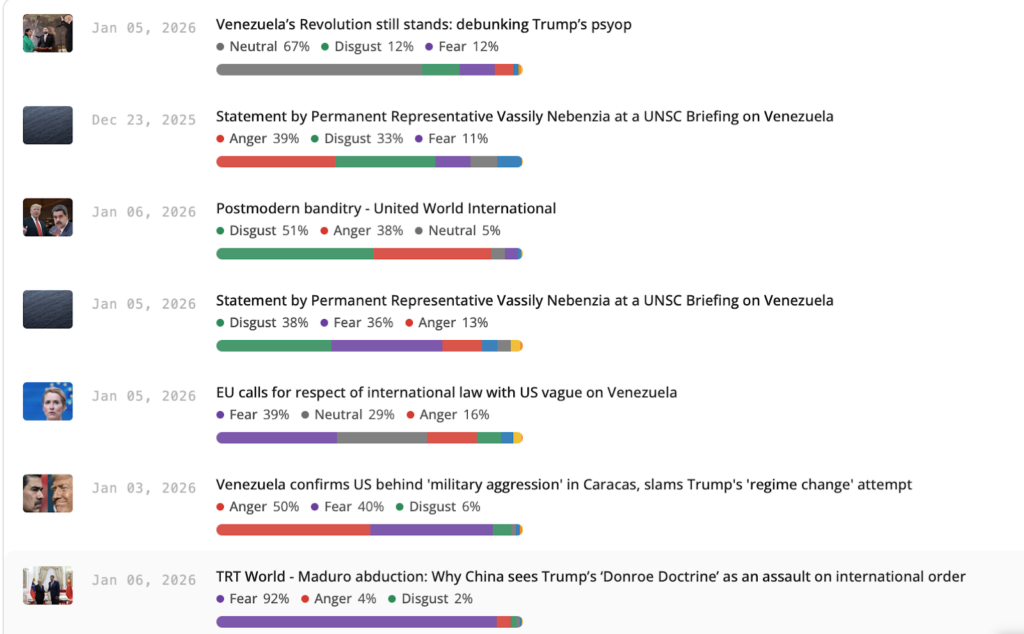
EdgeTheory Emotion Profile Classifier
Adversarial actors utilize high-arousal emotional triggers, specifically Fear and Anger, to mask strategic geopolitical goals with deceptive narratives. By weaponizing these emotions, they manipulate global perceptions of the U.S. operation in Venezuela through three primary deceptive themes:
Based on these themes, malign actors are utilizing the following attack vectors to distort operational perception and expand their influence:
Adversarial engagement and amplification strategies rely on "information laundering" through local media to make these emotional appeals appear organic. Russian state-directed outlets like RT and Sputnik use their significant Spanish-language footprint—millions of followers on X and Facebook—to intensify anti-U.S. sentiment. Meanwhile, pro-war Telegram channels and "influence-for-hire" firms coordinate to flood hashtags with automated bots and synthetic content, such as fictionalized AI images of Maduro's imprisonment. These tactics exploit existing societal divisions, creating an "Answer Economy" where emotional resonance outpaces verified facts, thereby making it harder for the U.S. to maintain a unified international response.
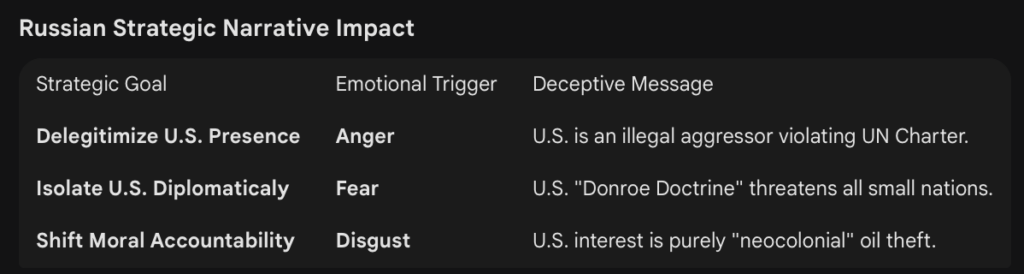
Gemini table of Russian Strategic Narrative Impact

China_Fact X post amplifying Chinese narratives
The X post from @China_Fact (China Perspective) functions as a coordinated bulletin of dissent, grouping the reactions of Russia, Iran, and Cuba to create a sense of a unified global front against U.S. "state terrorism." By quoting Evo Morales comparing the U.S. leadership to "Hitler," the post utilizes extreme emotional triggers of Anger and Disgust to characterize the incursion as a murderous assault driven by a "thirst for natural resources". This framing attempts to shift the international focus from Maduro’s alleged crimes to the perceived "barbarism" of the U.S. military, thereby isolating Washington from the Global South.
The X post from @China_Fact (China Perspective) functions as a coordinated bulletin of dissent, grouping the reactions of Russia, Iran, and Cuba to create a sense of a unified global front against U.S. "state terrorism."

Russian Ministry of Foreign Affairs X post
The X post from @mfa_russia (the Russian Ministry of Foreign Affairs) frames the U.S. operation as a criminal abduction by demanding the "release" of the "legitimately elected president" and his spouse. By emphasizing Maduro’s status as a sovereign leader, the post seeks to delegitimize U.S. law enforcement justifications and portray the United States as a lawless actor that ignores international protocols. This narrative is designed to rally international condemnation and position Russia as a defender of global legal norms and sovereignty against "imperialist" overreach.
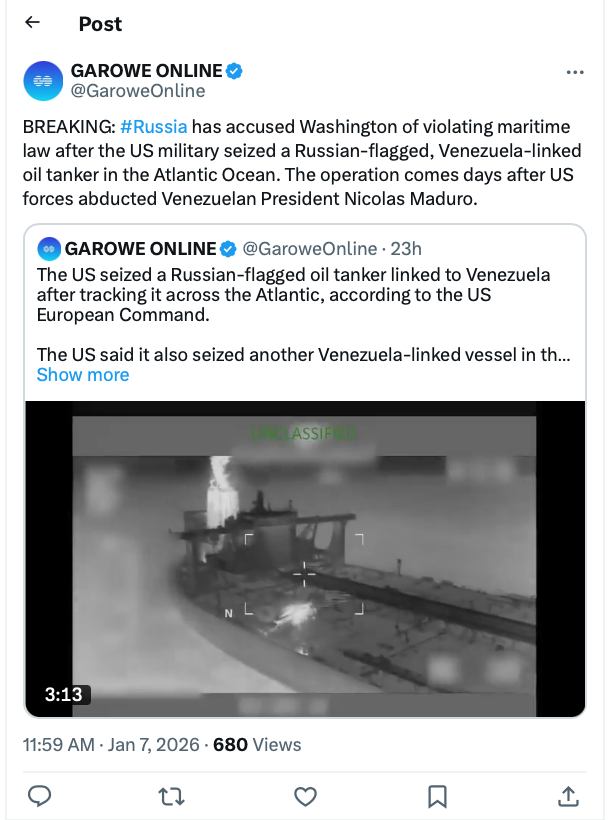
X post from Garowe Online
The X post from @GaroweOnline feeds into a broader Russian critique that the United States is abusing its power on the global stage by selectively invoking international law to justify coercive actions. Russia’s accusation that Washington violated international maritime law by seizing a Russian-flagged tanker carrying Venezuelan oil reframes the U.S. campaign against Caracas as more than a discrete military or law-enforcement operation, casting it instead as part of a wider geopolitical and legal confrontation. By labeling the seizure a violation of the 1982 U.N. Convention on the Law of the Sea and characterizing it as “outright piracy,” Russian actors seek to undermine the legitimacy of U.S. actions not only at sea but also on land, including military pressure against Venezuela. Crucially, this framing reinforces a recurring Russian narrative that U.S. involvement in Venezuela is driven less by democratic or security concerns and more by economic self-interest—specifically, control over energy resources—portraying American intervention as extractive “resource farming” disguised as rule-based enforcement. This narrative aims to erode U.S. moral authority while positioning Russia as a defender of sovereignty against predatory Western intervention.
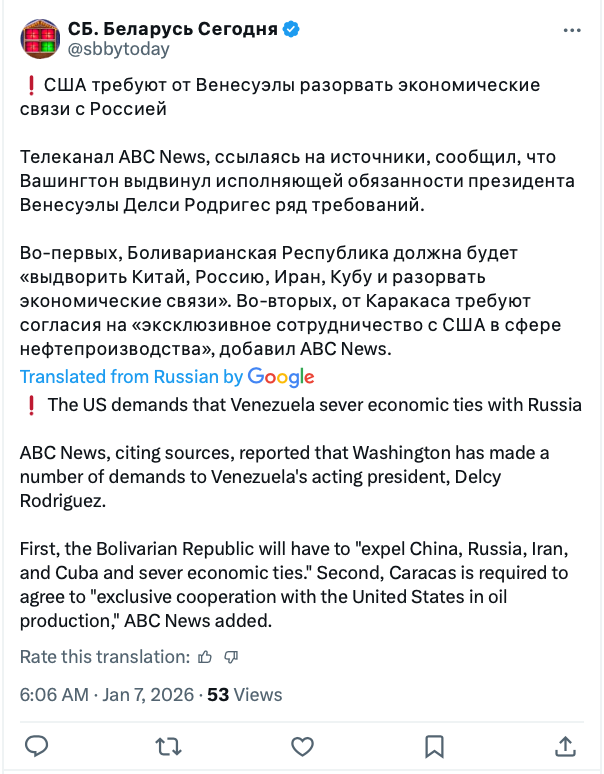
Belarus Today X post
The post by @sbbytoday (Belarus Today) serves the Russian strategic interest by focusing on the economic fallout and alleged U.S. "demands" for Venezuela to sever ties with Moscow. It frames the conflict not as a pursuit of justice, but as a calculated geopolitical move to force "exclusive cooperation" in oil production and purge Russian and Chinese influence from the hemisphere. This narrative effectively weaponizes the "Resource War" theme, using claims of economic blackmail to fuel anti-Western sentiment and justify the Kremlin's continued support for the Maduro regime.
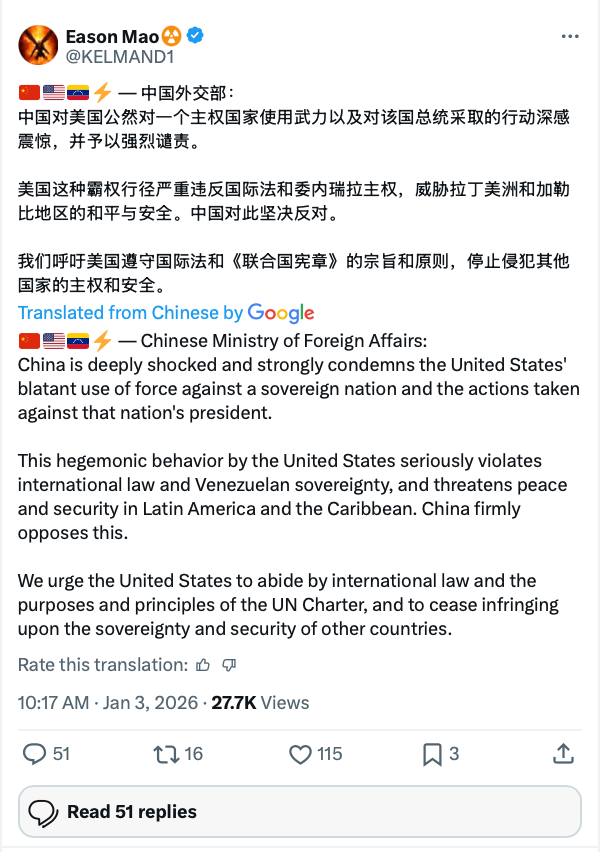
X post amplifying official Chinese condemnation of attack
The X post from @KELMAND1 (Eason Mao) amplifies the Chinese Ministry of Foreign Affairs' official condemnation, framing the strike as a "hegemonic act" that "seriously violates international law". It portrays China as a "shocked" and responsible global power calling for a return to the UN Charter, effectively contrasting Chinese "diplomacy" with American "blatant use of force". This narrative seeks to undermine U.S. leadership in Latin America by suggesting that American "bullying" threatens the peace and security of the entire Caribbean region, thereby positioning China as the more stable and respectful partner for sovereign nations.
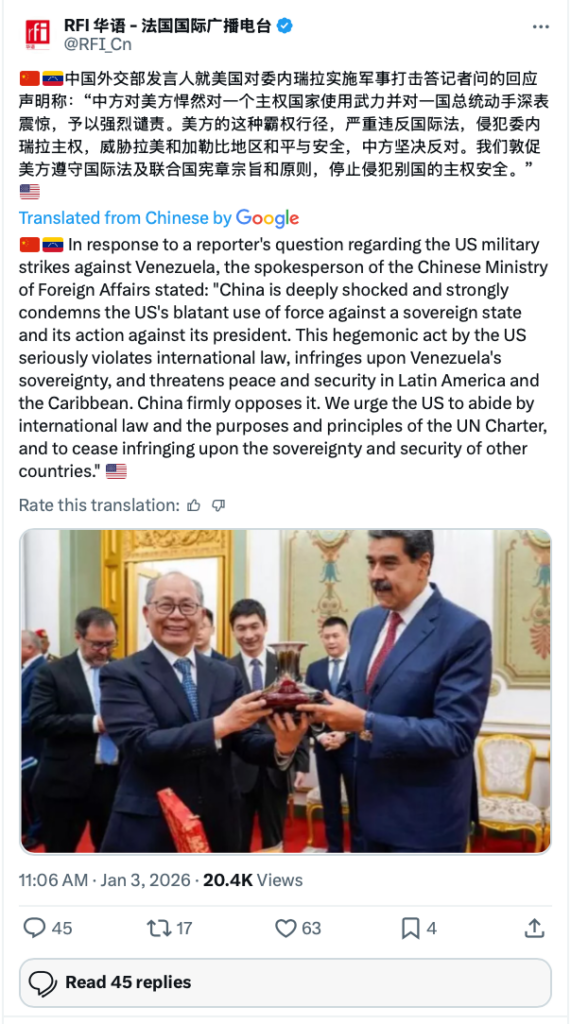
X post amplifying Russian narratives
The X post from @RFI_Cn (RFI Chinese) reinforces the "Assault on World Order" narrative by highlighting the specific timing of the attack—noting it occurred while Chinese officials were in Caracas. By pairing an image of diplomatic cooperation with text denouncing the "infringement upon sovereignty," the post suggests that the U.S. is intentionally disrupting peaceful international relations. This narrative is designed to generate fear regarding U.S. unpredictability, signaling to other nations that any state, regardless of its diplomatic ties, could be the next victim of a unilateral U.S. "abduction" or military strike.
Through the weaponization of high-arousal emotions like anger and fear, these malign actors create an "Answer Economy" where emotional resonance outpaces verified facts, effectively eroding U.S. moral authority and undermining the perceived legitimacy...
Adversarial nations have moved rapidly to delegitimize the U.S. operation by framing it as a lawless powergrab rather than a security or law enforcement action. On January 5, 2026, a "fierce clash" erupted at the UN where representatives of Moscow and Beijing delivered some of the "strongest criticism" regarding the U.S. operation in Venezuela. Characterizing the action as "armed aggression," they warned against the "normalisation of unilateral force" and stressed the "inviolability of head-of-State immunity under international law". Framing the situation as a test of whether "Charter principles apply equally to all States," they called for the "immediate release of President Maduro."
Adversarial actors are no longer merely reacting to global events; they are proactively engaged in a sophisticated effort to shape the perception and legitimacy of U.S. operations. Russia and China seek to seize the narrative initiative before operational facts can be fully established. This strategy relies on "information laundering,” the process of passing state-directed messaging through local media and influence-for-hire networks—to make these deceptive themes appear like organic global dissent. Through the weaponization of high-arousal emotions like anger and fear, these malign actors create an "Answer Economy" where emotional resonance outpaces verified facts, effectively eroding U.S. moral authority and undermining the perceived legitimacy of the rules-based international order. The information campaign following the U.S. capture of Nicolás Maduro is not reactive messaging but a deliberate strategic effort by Russia and China to reshape perceptions of power, law, and legitimacy. By reframing the operation as illegal aggression and resource imperialism, adversarial actors seek to erode U.S. moral authority, deter alignment with Washington, and weaken confidence in the rules based international order. Emotional manipulation and information laundering are used to accelerate narrative adoption, obscure attribution, and delay coordinated responses.
Russia leverages the incident to normalize spheres of influence and justify continued coercion in Ukraine and its near abroad. China uses the same event to portray the United States as destabilizing while positioning itself as a responsible guarantor of sovereignty, expanding diplomatic and strategic space in Latin America and beyond. The convergence of these narratives amplifies their impact and creates the appearance of broad international opposition to U.S. action.
Lead Analyst:
Ellie Munshi is an analyst at the EdgeTheory Lab. She is studying Strategic Intelligence in National Security and Economics at Patrick Henry College. She has led special projects for the college focused on Anti-Human Trafficking, Chinese influence in Africa, AI influence on policymakers, and is also an intelligence analyst intern at the Department of War.

