Unlike traditional state propaganda, which is often overtly political and easily identifiable, these videos embed ideological narratives within visually engaging, meme-driven content optimized for short-form social media platforms.
This report examines the emergence and rapid spread of Iranian regime-aligned AI-generated propaganda videos across Western and global social media ecosystems. Using Lego-style animation, AI-generated battle scenes, meme formatting, and short-form entertainment techniques, the campaign demonstrates how modern information operations are evolving beyond traditional state propaganda into algorithmically optimized cultural content. EdgeTheory's research uncovered specific mechanisms enabling these memetic information warfare techniques to achieve virality across ideologically diverse audiences.
EdgeTheory evaluates how these videos circulate through platforms such as Telegram, X, TikTok, Instagram, and YouTube, and how audience engagement varies between regime supporters, anti-establishment communities, meme culture participants, and politically disengaged users. Particular attention is given to the convergence of entertainment, emotional stimulation, and algorithmic amplification of purported ground truths, which collectively reduce audience resistance to geopolitical and propagandized messaging. The report also assesses how AI-generated propaganda differs from conventional information operations by prioritizing visibility, shareability, and emotional conditioning over direct persuasion, asserting an explicit factual claim, or providing a logical defense of actions. This assessment draws on open-source reporting, platform observations, narrative analysis tools, and engagement patterns to evaluate the strategic implications of AI-enabled propaganda campaigns in modern digital ecosystems.
This new wave of Iranian propaganda is an evolution in digital influence operations. The viral success of AI-generated Lego-style videos stems from their ability to merge geopolitical messaging with internet entertainment culture. Unlike traditional state propaganda, which is often overtly political and easily identifiable, these videos embed ideological narratives within visually engaging, meme-driven content optimized for short-form social media platforms. The result is a campaign capable of reaching audiences far beyond politically aligned or regime-supportive communities. EdgeTheory NARINT identified broad Target Audiences (TAs), including younger audiences in Western countries, politically independent adults, and anti-war European audiences. The diversity of these target audiences makes the content highly shareable and difficult to consistently mitigate or counter across fragmented social media ecosystems.
Iranian AI-generated Lego-style propaganda videos achieved mass circulation across X, TikTok, Instagram, Telegram, Facebook, and YouTube ecosystems, generating more than 145 million views in March alone. Engagement patterns indicate the campaign prioritizes rapid visibility and redistribution over direct persuasion, enabling Iranian narratives to spread through passive consumption and repeated exposure across mainstream digital spaces.
AI-Generated Meme Propaganda Achieved Significant Cross-Platform Reach Through Entertainment-Driven Engagement.
The campaign relies on different amplification models across platforms. Telegram and regime-linked outlets provide centralized seeding, while X enables decentralized ideological amplification through pro-Iran, anti-Western, and anti-interventionist networks. TikTok and Instagram amplify the content algorithmically through entertainment-focused formats optimized for watch time, resharing, and emotional engagement. Mixed audience reactions—including criticism and irony—further increase visibility rather than reduce reach.
By embedding geopolitical messaging within meme culture and short-form entertainment, the campaign reaches audiences beyond traditional regime supporters, including younger Western users, anti-establishment communities, and politically disengaged audiences. U.S. audience reactions remain polarized, but even non-ideological engagement through humor, satire, or aesthetic appreciation contributes to broader narrative diffusion and normalization across Western social media ecosystems.
Effective mitigation of Iranian propaganda campaigns is more likely to succeed when platforms and counter-messaging efforts employ in-kind tactics, techniques, and procedures that mirror the speed, format, and emotional appeal of the original content. Because Iranian influence operations promote geopolitical messaging through entertainment, humor, and meme-style visuals, traditional fact checking and reactive messaging alone are insufficient. More effective responses combine rapid cross-platform detection of coordinated synthetic media campaigns with equally engaging counter-content that leverages similar short-form formats while promoting media literacy, exposing manipulation tactics, and reducing passive audience consumption of propaganda disguised as entertainment.
The Iranian/pro-Iran AI Lego-style video campaign poses a significant information warfare threat because it has moved beyond niche propaganda into mass meme circulation. Public reporting indicates the influence operation has garnered 145M+ views across X, Facebook, Instagram, and TikTok in the second half of March, with additional amplification through Telegram, Iranian state-linked outlets, Russian state media, and Western anti-Trump communities.
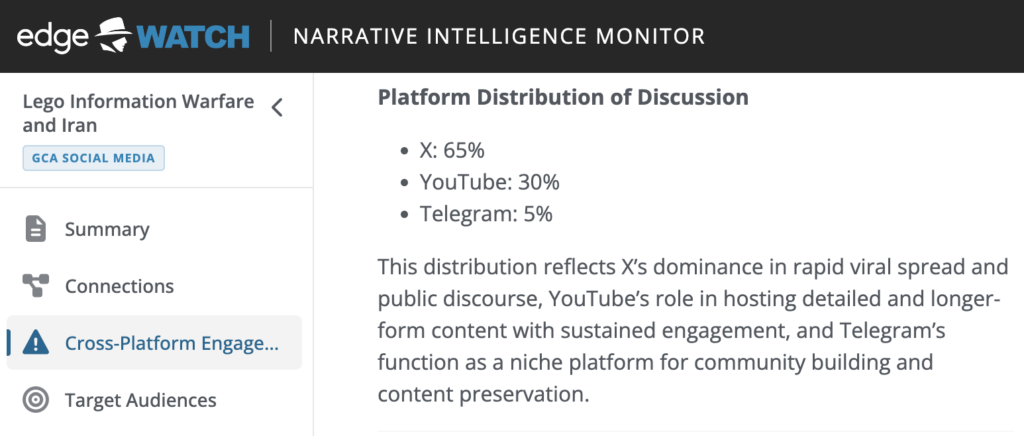
Edge Theory Narrative Intelligence Monitor tracking Platform Distribution of Discussion on Iranian propaganda. The majority of discourse occurs on X, followed by YouTube, and then Telegram.
The campaign is most active on X, Instagram, TikTok, and Telegram, while YouTube has become less reliable due to moderation actions against some affiliated channels. Reporting indicates that Iranian-linked media ecosystems, including IRGC-affiliated outlets such as Tasnim News, have amplified the content on Telegram and other regional networks. On Telegram, amplification appears more centralized and tied to regime-aligned media channels that redistribute the videos to established ideological audiences.
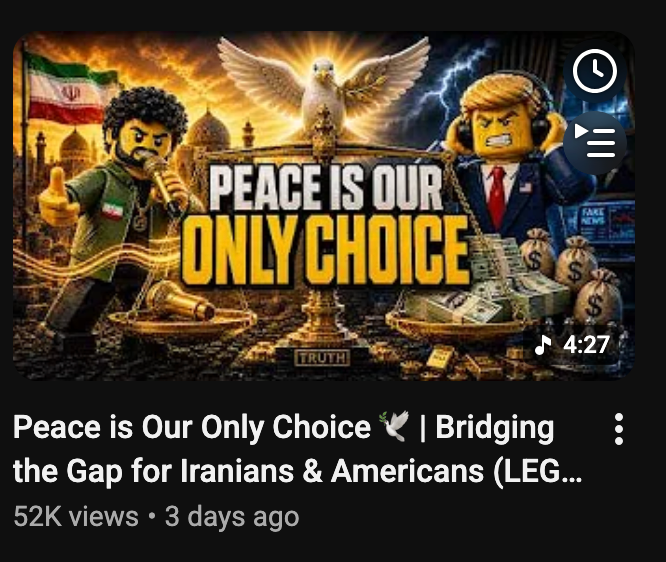
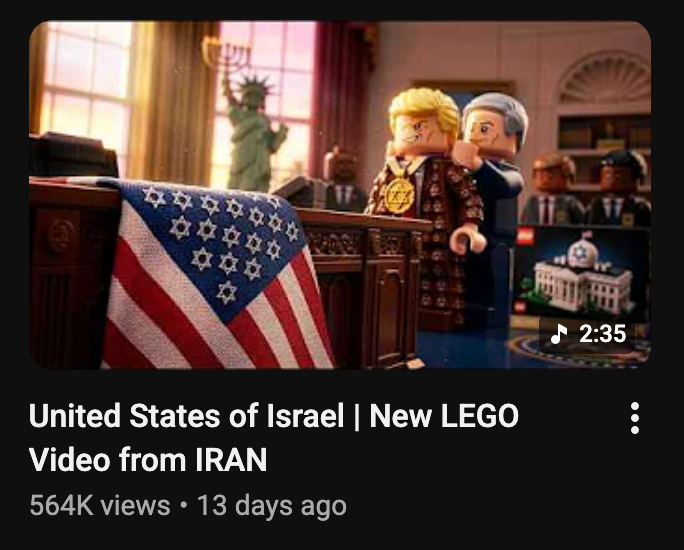
Brick Beat Battalion (Left) and AI Iran (Right) YouTube Meme Propaganda
On X, amplification appears more driven by incidental connections. Engagement comes from pro-Iran accounts, anti-Western commentators, Russian state-affiliated media ecosystems, and anti-Trump or anti-interventionist communities in the West. TikTok and Instagram operate differently: rather than depending on overt political networks, the content benefits from algorithmic amplification tied to short-form entertainment. The Lego visuals, fast-paced editing, AI-generated battle scenes, rap music, and meme formatting allow the videos to blend into entertainment feeds, lowering viewers’ political defenses and increasing shareability among users who may not otherwise engage with geopolitical content.
This diffusion pattern suggests the campaign is not targeting a single ideological audience, but instead using platform-specific audience analytics to tailor distribution pathways for different demographic and behavioral groups. On X, the campaign benefits from politically adjacent ecosystems already predisposed toward anti-Western, anti-interventionist, or adversarial narratives, allowing content to spread through existing grievance and geopolitical discourse networks. In contrast, TikTok and Instagram indicate a broader audience acquisition strategy focused less on ideology and more on behavioral engagement metrics such as watch time, replayability, humor, aesthetics, and meme participation.
X post by Explosive Media
@ExplosiveMediaa’s framing of rising Google search interest as a collective “win” confirms this campaign has transitioned into mass meme circulation, and success is measured by views rather than sophisticated messaging. The exponential increase in keyword appearances further signals such content is no longer passively consumed on social feeds but is actively sought out, ingested, and shared by organic user behavior, validating that the campaign has achieved cross-platform cultural traction. Many sources on YouTube post multiple new videos every day, with content quickly copied to other platforms.
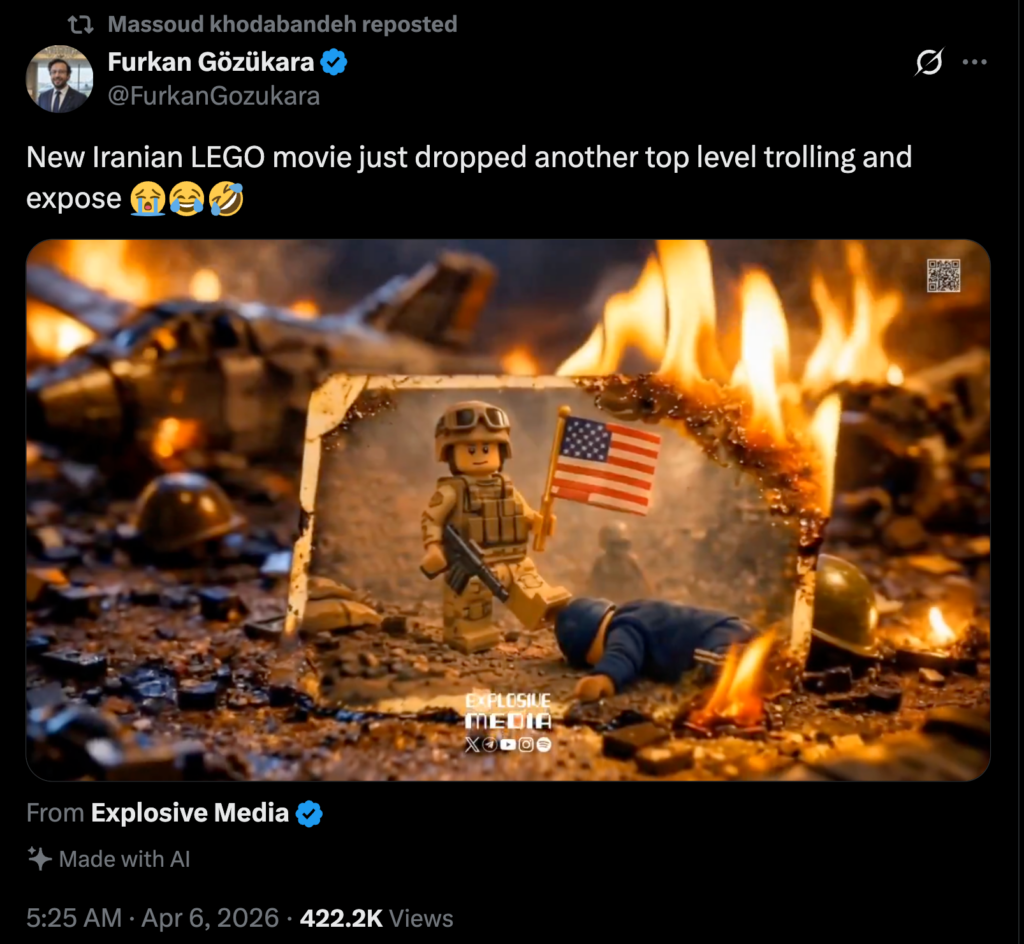

EdgeTheory source amplification metrics identifying a key influencer promoting content from Explosive Media when new videos are released. This content portrays the U.S. as an imperial aggressor during the mission to rescue the downed Weapon Systems Officer (WSO) in early April.
By highlighting search volume growth rather than just platform engagement, the post implicitly confirms a key dynamic: the campaign’s success is now driven by both decentralized network amplification (X, Telegram ecosystems) and algorithmic entertainment discovery (TikTok/Instagram). Search behavior reflects spillover from platform-driven exposure into deliberate user action. While search volume has increased, EdgeTheory’s Narrative Intelligence also identified several amplifiers on platforms such as X whose posting behavior closely aligned with the release of new propaganda content, producing visible spikes in the amplification trendline above. This suggests the campaign’s reach is not driven solely by organic engagement, but also by deliberate amplification techniques that accelerate exposure across networks. The pattern demonstrates how coordinated amplification and algorithmic discovery work together to sustain visibility, embed narratives into mainstream attention cycles, and expand the operation’s overall reach and influence.
Telegram Channels
These platforms show the pivot: early Persian content for domestic morale, then English + universal Lego/rap format for global reach.
This circulation is amplified by deliberate coordination from Iranian government staff, as identified by Iranian TTPs for targeting specific audiences.
Target audiences and Iranian TTPs for amplifying influence operations identified in EdgeWatch.
These tactics prominently rely on promoting Fear and Anger, but Joy also spikes in early May, with posts like these:
Emotion profiles of adversarial social media accounts promoting Iranian propaganda, compiled in EdgeWatch.
While the majority of sources promoting the Iranian Lego videos are Iran-aligned, some Russia-aligned sources similarly share in promoting “Joy” as an emotional tactic:
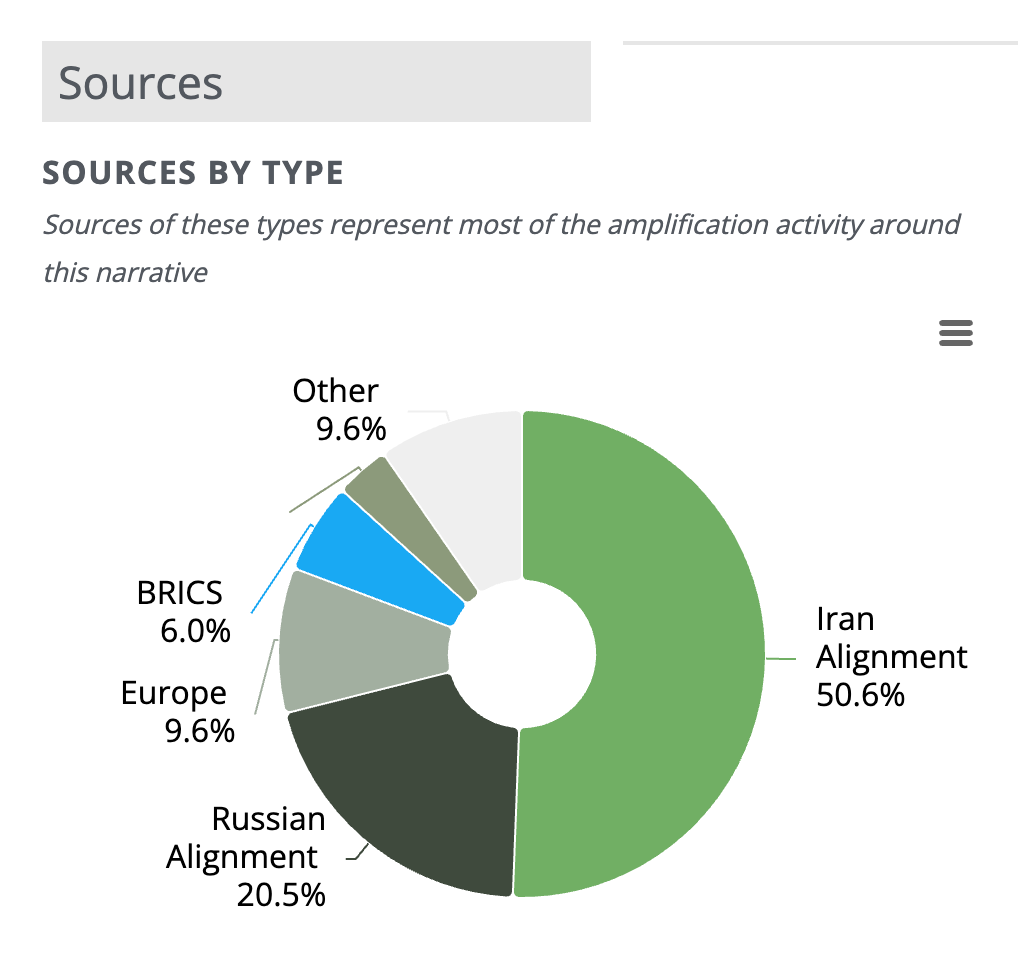
When filtering for only Iranian sources, the dominant emotion clearly emerges as Fear, indicating a strategic priority for messaging campaigns.
Emotion profile of Iran-aligned sources promoting Lego-style AI propaganda.
The scale and diversity of emotional engagement suggests the campaign is a legitimate information concern, particularly because the videos appear to resonate beyond explicitly pro-Iran audiences. Public reporting and platform observations indicate the videos receive high engagement through likes, reposts, humorous commentary, and meme participation rather than purely ideological discussion. Among regime supporters and anti-Western communities, the videos are often celebrated as demonstrations of Iranian strength and technological sophistication. Among younger Western audiences, engagement frequently takes the form of irony, humor, or aesthetic appreciation rather than explicit political endorsement.
This mixed reception is strategically advantageous for Iran because the campaign does not need universal approval to succeed; it only needs sustained circulation and emotional engagement.
However, even ironic engagement benefits the campaign by increasing visibility and normalizing Iranian narratives within broader online culture. This dynamic is strategically significant because Iran has historically operated as an international pariah state associated with sanctions, proxy violence, repression, and anti-Western militancy. By embedding its messaging within humor, aesthetics, and participatory internet culture, Iran reduces the psychological and reputational barriers that traditionally limited broader acceptance of its narratives. Over time, repeated exposure can soften perceptions of the regime, particularly among younger and politically impressionable audiences who may increasingly view Iranian messaging as culturally familiar, entertaining, or legitimate rather than overtly hostile propaganda. This mixed reception is strategically advantageous for Iran because the campaign does not need universal approval to succeed; it only needs sustained circulation and emotional engagement.
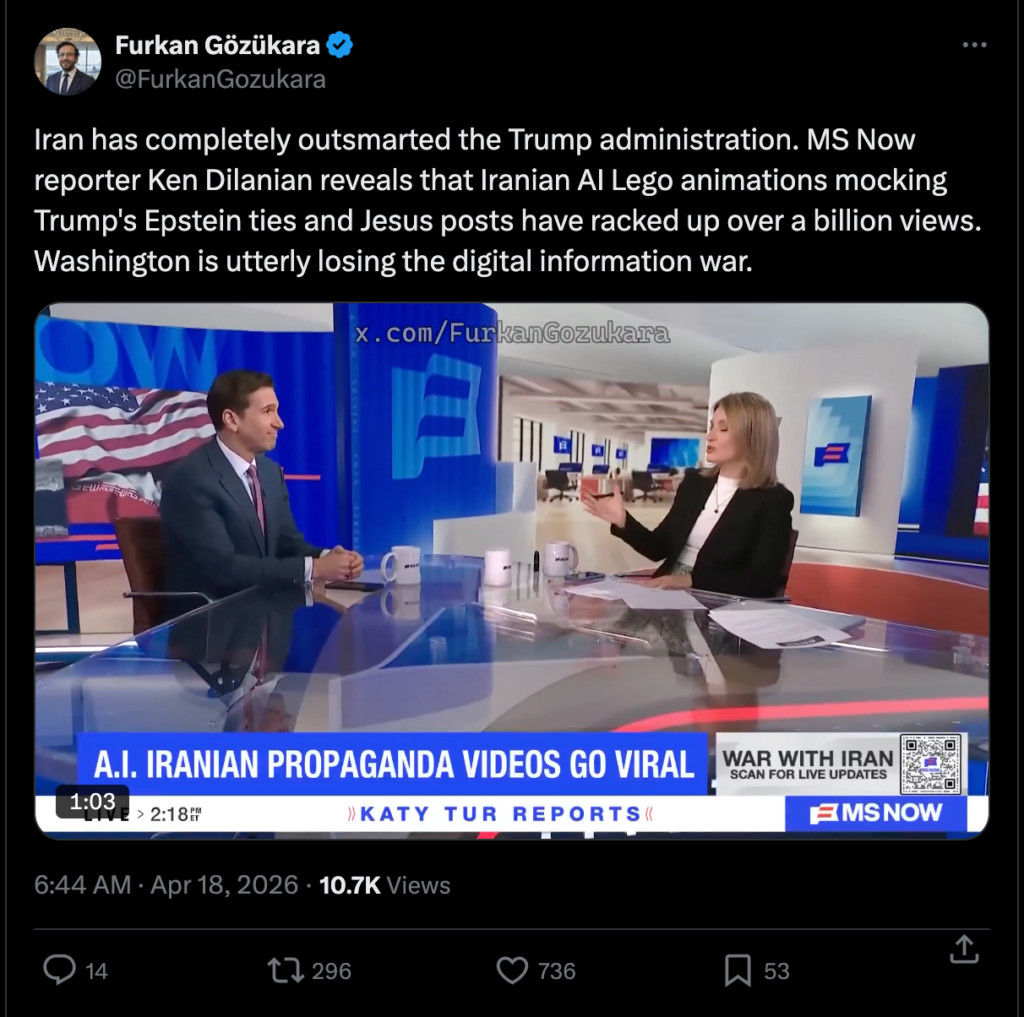
X post by Furkan Gözükara
Audiences interpret the campaign through sharply different lenses. Some view the videos as entertainment or meme content, while others treat them as evidence of Iranian strategic competence and Western information failure. Rather than limiting the campaign’s influence, these varied interpretations broaden its appeal across ideological and non-ideological audiences alike, increasing engagement and amplification beyond explicitly pro-Iran communities.
...portraying the videos as having “outsmarted” the U.S. and accumulated massive view counts. This framing resonates strongly within anti-Western and anti-establishment communities, where the videos are elevated as symbols of Iranian ingenuity and digital dominance.
The narrative here is not centered on the content itself but on its perceived effect: portraying the videos as having “outsmarted” the U.S. and accumulated massive view counts. This framing resonates strongly within anti-Western and anti-establishment communities, where the videos are elevated as symbols of Iranian ingenuity and digital dominance. At the same time, by citing mainstream media coverage (MSNBC), the post bridges into broader audiences, including those who may engage out of curiosity, skepticism, or concern rather than alignment. This dual-layered reception—celebration on one end, alarm or disbelief on the other—drives continued circulation. Even critical or incredulous engagement reinforces the core narrative of scale and effectiveness, ensuring the content remains visible across different networks.
The Lego aesthetic and gamified visuals make the content accessible and digestible to users who may otherwise avoid political media.
The target audiences of these videos appear layered and segmented. One primary audience is younger social media users in the West, particularly Gen Z audiences accustomed to meme-driven communication and AI-generated entertainment content. The Lego aesthetic and gamified visuals make the content accessible and digestible to users who may otherwise avoid political media. Another target audience includes anti-war, anti-U.S., anti-Israel, and anti-establishment communities in Europe and North America, where the videos tap into preexisting distrust of Western foreign policy. A third audience consists of regime supporters and regional sympathizers across the Middle East, where the videos function as morale-building and ideological reinforcement tools. The campaign also appears designed to target politically disengaged individuals globally by embedding geopolitical narratives within entertainment formats that encourage passive consumption and resharing rather than critical evaluation.

Edge Theory Narrative Attack Classifiers
This strategy earns many posts moderate to high incitement scores (such as the 6/10 above) in EdgeTheory’s NARINT watches monitoring Iranian information operations. In practice, this allows Iranian narratives to penetrate mainstream Western social media spaces more effectively than traditional state propaganda formats.
U.S. targeted audiences receive these videos in highly polarized ways. National security-focused communities and pro-Israel audiences tend to interpret the content as hostile propaganda and evidence of expanding Iranian information operations capabilities. However, portions of younger and politically disaffected audiences often engage with the videos as entertainment, satire, or anti-establishment humor rather than foreign propaganda. This distinction is critical because Iran’s information objective may not be direct persuasion but rather narrative diffusion and emotional conditioning. By packaging geopolitical messaging within humorous and visually compelling AI-generated content, the campaign reduces audience resistance and increases the likelihood that users will share or engage with the material regardless of ideological alignment. This strategy earns many posts moderate to high incitement scores (such as the 6/10 above) in EdgeTheory’s NARINT watches monitoring Iranian information operations. In practice, this allows Iranian narratives to penetrate mainstream Western social media spaces more effectively than traditional state propaganda formats.

Comments on Explosive Media X post indicating various audiences amplifying the post.
The Lego AI content simultaneously engages ideologically aligned users, casual entertainment consumers, and politically mixed Western audiences—showing that its effectiveness comes from appealing to different motivations rather than a single unified message.
In contrast, AI-generated meme propaganda disguises ideological content within entertainment, enabling broader reach and lower audience resistance.
The responses reflect a fragmented but complementary audience landscape. Some users engage at a purely entertainment level (“can’t get that tune out of my head”), indicating the content’s success as meme-driven media that bypasses political scrutiny. Others provide tactical feedback on video length and format, treating the content like optimized social media production rather than propaganda—evidence of participatory engagement that helps refine and extend the campaign. At the same time, explicitly ideological reactions (“thank you IRAN,” anti-Israel rhetoric) show resonance within aligned or sympathetic communities. Notably, these different modes of engagement coexist in the same thread, allowing the content to circulate across audiences with varying levels of political intent. This layered interaction environment increases shareability and persistence, as users can engage with the same material for entirely different reasons without disrupting its spread.
One of the most important analytical questions is whether AI-generated propaganda is more effective at engaging target audiences than traditional propaganda methods. Early indicators suggest the answer is likely yes, particularly in short-form social media environments. The success of these memes lies in their audience strategy. They do not target people actively seeking news. Instead, they mimic the language of everyday internet culture to reach those who are not following events in the Middle East at all. AI-generated propaganda offers several advantages: it is cheaper and faster to produce, visually novel, emotionally stimulating, and optimized for algorithmic engagement. The Lego-style videos specifically exploit the convergence of meme culture, gaming aesthetics, nostalgia, and AI spectacle. These characteristics increase watch time, resharing behavior, and emotional response, all of which improve algorithmic visibility on platforms such as TikTok and Instagram. Traditional propaganda often signals itself immediately as political messaging, causing audiences to disengage. In contrast, AI-generated meme propaganda disguises ideological content within entertainment, enabling broader reach and lower audience resistance.
X post by Explosive Media
This post’s high engagement metrics—over 100K views and thousands of interactions—indicate that stylized, meme-driven video content is achieving disproportionate reach relative to its informational value, suggesting strong resonance with passive, entertainment-oriented audiences rather than issue-aware consumers.
The distribution of engagement (106,575 views vs. 2,370 likes, 821 shares, and 62 comments) reflects a content profile optimized for rapid consumption and low-friction interaction. The relatively high share count compared to comments indicates that users are more inclined to pass the content along than critically engage with it, a pattern consistent with visually novel, emotionally stimulating media. This dynamic amplifies reach across networks without requiring deeper cognitive investment, enabling the content to circulate beyond politically engaged communities.
This performance suggests that format and delivery—short-form video, gamified framing, and meme language—are driving visibility more effectively than substantive messaging. By aligning with platform algorithms that reward watch time and resharing, this type of content can scale quickly, embedding itself in broader digital ecosystems where traditional, explicitly political messaging would likely see reduced engagement and faster audience drop-off.
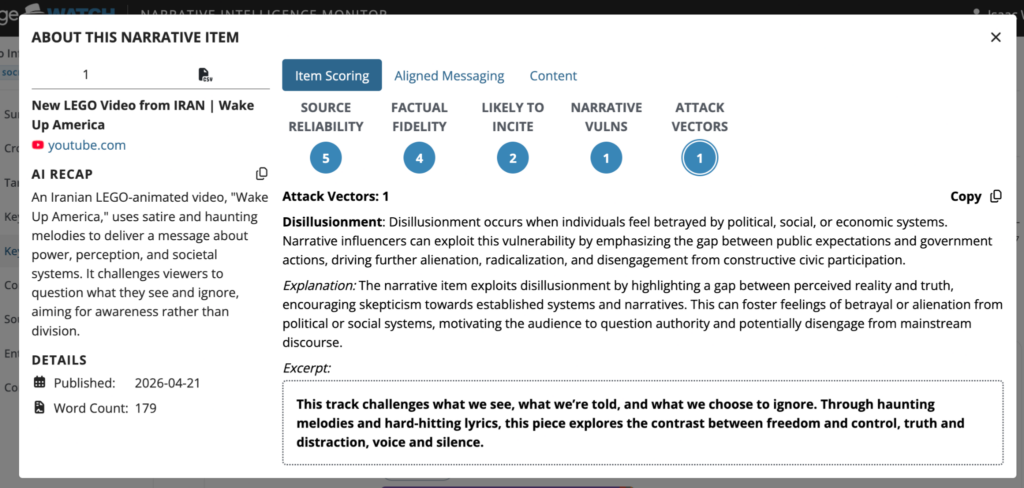
EdgeTheory watch measured Iranian persuasion tactics and identified Disillusionment as an attack vector to drive:
“further alienation, radicalization, and disengagement from constructive civic participation. The narrative item exploits disillusionment by highlighting a gap between perceived reality and truth, encouraging skepticism towards established systems and narratives. This can foster feelings of betrayal or alienation from political or social systems, motivating the audience to question authority and potentially disengage from mainstream discourse.
Excerpt:
This track challenges what we see, what we’re told, and what we choose to ignore. Through haunting melodies and hard-hitting lyrics, this piece explores the contrast between freedom and control, truth and distraction, voice and silence.”
The distribution of engagement (106,575 views vs. 2,370 likes, 821 shares, and 62 comments) reflects a content profile optimized for rapid consumption and low-friction interaction.
Detailed target audience analytics remain partially limited because public reporting lacks access to platform-level demographic data, but observable engagement patterns suggest the campaign performs especially well among younger users, meme communities, anti-establishment networks, and politically disengaged audiences who are more likely to form new political opinions from social media content. The campaign’s success demonstrates how AI-generated propaganda can exploit modern recommendation algorithms and online attention economies more effectively than conventional state media messaging. Rather than relying on persuasion alone, the strategy focuses on virality, emotional stimulation, and cultural integration, allowing Iranian narratives to circulate organically through Western digital ecosystems.
To guard against this widespread influence campaign, EdgeTheory watches identified key response and mitigation strategies to directly counter Iranian TTPs.
EdgeTheory analytics identifying key response strategies to directly counter Iranian TTPs.
Persistent Narrative Intelligence (NARINT) monitoring surfaces key strategic responses as the situation develops. This rapid analysis is critical to countering the Iranian regime's distributed and viral memetic warfare campaigns.
The Iranian AI Lego-style propaganda campaign demonstrates how AI-generated media is reshaping the modern threat landscape by blending entertainment, meme culture, and geopolitical narratives into a single highly shareable format. Its success does not rely on convincing audiences to adopt explicitly pro-Iran positions. Instead, the campaign leverages virality, emotional engagement, humor, and algorithmic amplification to normalize and circulate Iranian narratives across digital platforms.
AI-generated media is reshaping the modern threat landscape by blending entertainment, meme culture, and geopolitical narratives into a single highly shareable format.
As AI-generated content becomes cheaper, faster, and more sophisticated, similar campaigns are likely to proliferate across geopolitical competitors and non-state actors alike. This evolution presents a growing challenge for democratic societies because the line between propaganda, entertainment, and participatory internet culture is becoming increasingly blurred. The Iranian campaign illustrates how future information operations may succeed not through centralized messaging discipline alone, but through their ability to integrate seamlessly into the rhythms, aesthetics, and emotional dynamics of everyday online life.