This report analyzes how Iraq became an active front in the US Israeli war with Iran after US forces struck Iran backed militia Kata’ib Hezbollah on 28 February. The strike prompted retaliatory attacks while Iraq’s political parties remain unable to form a government.
EdgeTheory’s narrative intelligence detects escalation signals and rising narrative volume tied to militia retaliation and regional reactions following the strikes on Iran.
These indicators point to deepening instability that could further destabilize Iraq’s Shi’a dominated political system.
This report analyzes how Iraq became an active front in the US-Israeli war with Iran after US forces struck Iran-backed militia Kata’ib Hezbollah on 28 February, prompting retaliatory attacks as Iraq’s political parties remain unable to form a government. EdgeTheory’s narrative intelligence detects escalation signals and deepening instability linked to the strikes on Iran that could further destabilize Iraq’s Shi’a-dominated political system.
Iraq became an active front in the US-Israeli war with Iran on 28 February when US forces struck Iran-backed Iraqi militia Kata’ib Hezbollah (KH) in Jurf Al-Sakhar, a KH stronghold south of Baghdad (1). Since then, the US has struck additional militia sites, including on the Iraq-Syria border in Anbar province, and in Diyala, Muthanna, Ninewa, and Babil provinces (2). The militias have retaliated by striking various locations housing US personnel or US citizens (more below).
These attacks occur at a sensitive political moment for Iraq. The political parties that won seats in Iraq’s November 2025 parliamentary elections have still not formed a government, largely due to disagreements over who to select as the next prime minister.
The war in Iran will further stagnate Iraqi government formation and destabilize Iraq (especially the Kurdistan Region of Iraq) in the near term.
But it could also fundamentally destabilize Iraq’s current Shi’a-dominated political system, potentially opening the door for intra-Shi’a conflict and sectarian tension between Iraq’s Shi’a and Sunni communities.
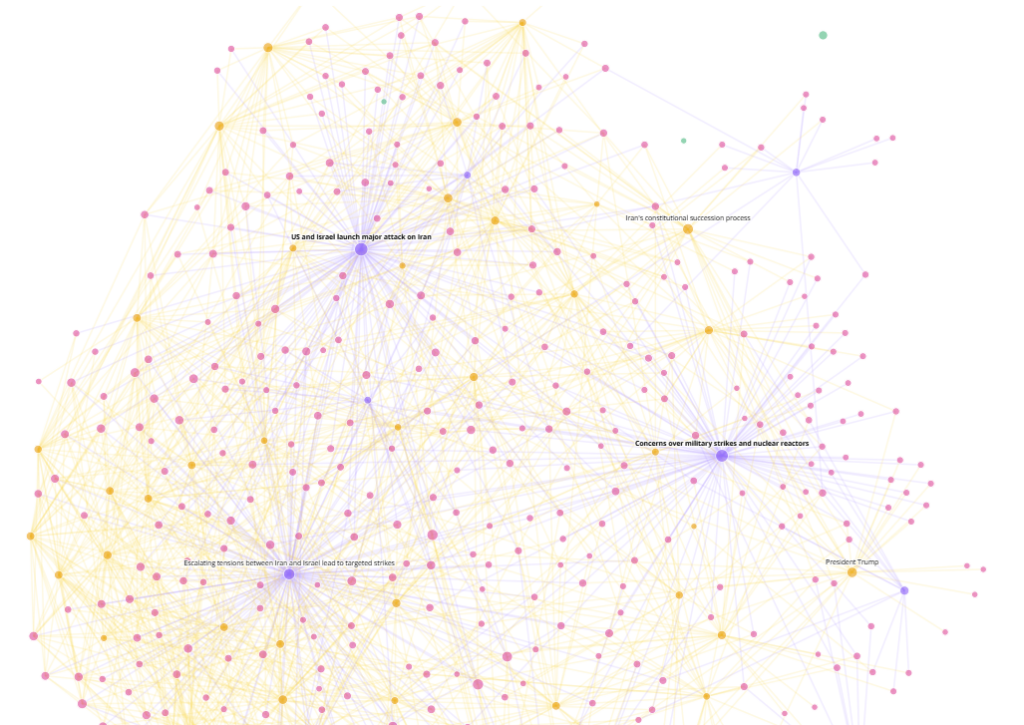

(Left) Sources monitored by EdgeTheory identified several narrative themes during the initial days of the war in Iran, including concerns over military strikes and nuclear reactors, and Iran’s constitutional succession process. One notable theme amidst the war coverage pertained to calls for inclusive government in Iraq (left). This likely reflects concerns that the war in Iran could negatively impact Iraqi government formation, further destabilizing the region. Iraqi Shi’a parties backed by Iran, which have played a prominent role in Iraq’s post-election negotiations, will likely be particularly affected.
The war in Iran will further stagnate Iraqi government formation. Government formation has stalled for two reasons. First, Iraq’s Kurdish parties failed to agree on a nominee for the presidency (a position traditionally held by a Kurd). The constitutional deadline for parliament to elect a president passed on January 28 (3). Second, parliamentary disagreement regarding the Coordinating Framework’s (CF’s) nomination of former Prime Minister Nouri Al-Maliki. Al-Maliki’s nomination generated backlash both within the CF and from Sunni parties. The CF is a coalition of Shi’a parties, some of which are backed by Iran. The US’s clear disapproval of Al-Maliki appears to have finally moved the needle. On 27 January, President Trump stated on Truth Social that the US would “no longer help” Iraq if Al-Maliki became the next premier:
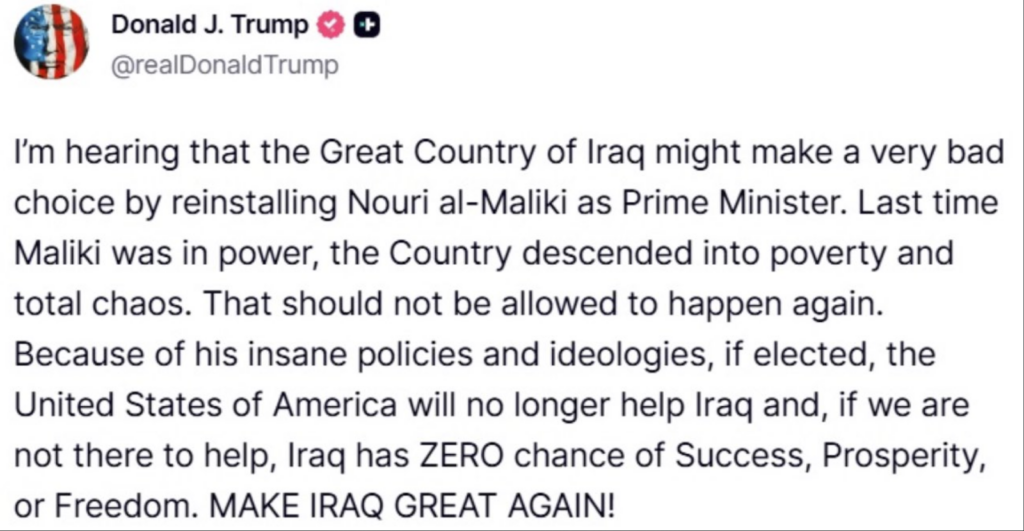
The CF later reportedly reached a “preliminary agreement” that Al-Maliki would withdraw his nomination on 3 March, during a meeting Al-Maliki did not attend (4). US-government-funded Al-Hurra news claimed on 3 March that the US had threatened Iraq with additional sanctions, urging Iraq to form a government and to select a premier other than Al-Maliki (5). Despite this, the CF does not appear to have agreed upon or put forth an alternative candidate. Powerful elements of the CF previously opposed incumbent Prime Minister Mohammed Shia’ Al-Sudani, the most obvious alternative.
Some of Iraq’s most powerful Iran-backed militias have attacked US personnel and locations. Kata’ib Hezbollah, Harakat Hezbollah Al-Nujaba, and Kata’ib Sayyid Al-Shuhada released statements calling for escalation against US and Israeli forces in response to the coalition’s killing of Supreme Leader Khamenei (6). Militia supporters clashed with Iraqi Security Forces near the Green Zone in an apparent attempt to reach the US Embassy (7).

Narrative volume pertaining to Khamenei’s death, and Iraqi protestors’ subsequent reactions, increased on 28 February (the date of his death) and remained escalated through 1 and 2 March. Iraqi protesters attempted to breach the Green Zone near the US Embassy first on the evening of 28 March, then gathered for 2 additional nights.
The Islamic Resistance in Iraq, an umbrella group encompassing Iraq’s most powerful Iran-backed militias, claimed over 20 drone attacks on targets in Iraq and the region on 1 March and claimed an additional 28 missile and drone attacks on 2 March (8). Facade groups such as Saraya Awliya Al-Dam claimed additional attacks on Al-Harir Base in Erbil, an Erbil hotel reportedly containing US personnel, and claimed drone swarm attacks on Baghdad and Erbil International airports (9). Unspecified Iraqi militias reportedly informed the Iraqi government and CF that halting operations against US and Israeli targets is “not on the table,” following reported Iraqi government and political parties’ efforts to contain the escalation. While it is not clear which militias communicated this, the CF contains multiple parties linked to Iran-backed militias, making it possible that there is intra-CF disagreement regarding the escalation. The Islamic Resistance of Iraq and Harakat Hezbollah Al-Nujaba also separately threatened to target European personnel if they join the US-Israeli fight against Iran (10).
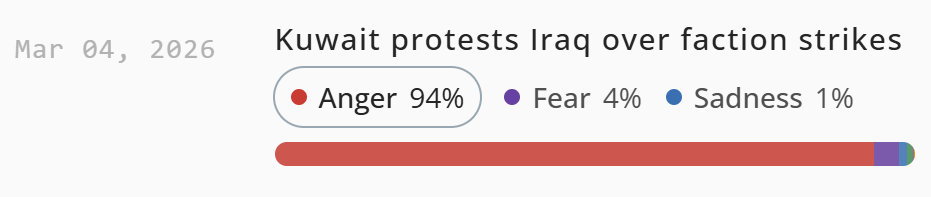

Among the Iraq-related narratives gathered by EdgeTheory, narratives covering the Iran-backed Iraqi factions’ escalation on Iran’s behalf following Khamenei’s death relied heavily on language evoking anger. This could reflect both anger at Khamenei’s death itself and regional anger in response to Iraqi factions’ escalation against Gulf countries.
US forces reportedly fully withdrew from federal Iraq on 18 January (11). US presence in Iraq is now concentrated in the Kurdistan Region, making the region a likely venue for continued escalation. Furthermore, the CIA is reportedly working to arm Kurdish separatist groups that have long operated in the Kurdistan Region of Iraq to foment a popular uprising in Iran (12). Iran has conducted missile strikes against the groups for years (13). Unverified reports allege the separatist groups have launched a “cross-border military operation” in Iran, though Iranian Kurdish officials affiliated with one separatist group reportedly denied this (14).
As government formation remains unresolved, some of Iraq’s Iran-backed Shi’a militias are escalating in retaliation for the strikes on Iran and for Khamenei’s death, with few opportunities for de-escalation in sight.
As government formation remains unresolved, some of Iraq’s Iran-backed Shi’a militias are escalating in retaliation for the strikes on Iran and for Khamenei’s death, with few opportunities for de-escalation in sight.
President Trump stated he would be “all for” a Kurdish offensive in Iran but declined to state whether the US would provide air support (15). The aim of the potential “Kurdish unrest” strategy appears to be to foment domestic unrest that could further stretch the already-weakened Iranian regime and to complement the US and Israeli bombing campaign that has targeted Iranian missile and drone infrastructure, air defense systems, nuclear infrastructure, regime leadership, and law enforcement personnel.
The war in Iran will shake this system. It has shown these Shi’a political actors that the regime (if it survives) will be weaker than ever before.
Notably, the joint bombing campaign has also targeted law enforcement personnel responsible for maintaining internal security in Iran’s Kurdistan province, which borders the Iraqi Kurdistan region (16). It is unclear whether such Kurdish separatist forces - if they became involved - could hope to succeed against the entrenched, well-armed (if battered) Islamic Revolutionary Guard Corps (IRGC), despite recent Israeli strikes that have focused on targeting the IRGC Ground Forces, Intelligence, Basij, and Quds Force in Tehran (17). What is clear, however, is that the separatist groups’ involvement would likely increase Iranian strikes in the region, and could prompt Iran-backed Iraqi militias to target Kurdish separatists or Kurdish figures perceived as assisting the US-Israeli campaign. On 5 March, Harakat Hezbollah Al-Nujaba (HHN) military adviser Abdul Qadir Al-Karbala’i reportedly threatened to target the “Zionist agent Barzani,” likely referring to either Kurdistan Regional Government (KRG) Prime Minister Masrour Barzani or KRG President Nechirvan Barzani. (18) The Barzani family is a powerful Kurdish family that dominates one of the region’s two most powerful political parties, the Kurdistan Democratic Party.
In the longer term, Iraq’s Shi’a-dominated political system could experience a reckoning, whether or not the Iranian regime (or some form of it) survives. It is unlikely that the US and Israeli bombing campaign alone - even if supplemented by some form of limited ground operation - will bring about decisive regime change. But the regime is nonetheless experiencing the biggest existential threat they have confronted since 1979. There are two broad possibilities:
Possibility 1: The US and Israel degrade Iran’s missile, drone, and nuclear capabilities, but the Islamic regime (while profoundly weakened) survives. When the US removed Saddam Hussein and dismantled the Ba’ath regime following the 2003 invasion, and failed to meaningfully involve Sunni parties in the construction of Iraq’s subsequent political system, it inadvertently created a Shi’a-dominated political order that enabled Iran to exert extensive influence in Iraq. Iran seized this opportunity. It funded Iraqi militias in the form of paramilitary “special groups” to fight the US occupation, used decades-old contacts with Shi’a political parties to shape Iraqi politics, exploited Iraq’s territory and economy to circumvent US sanctions, and eventually funded and exerted de-facto command over numerous Popular Mobilization Forces units (which had initially formed to fight for the Iraqi government against the Islamic State) (19).
Iran’s influence even expanded to Shi’a political actors it does not control, such as the Sadrist Movement (now known as the Shi’a National Movement) (20). These actors have long operated within a political system built on Iranian intervention, negotiation, and patronage.
It has been demonstrated that the regime is no longer a constant and cannot be relied upon to mediate and intercede in intra-Shi’a affairs in Iraq. Powerful Shi’a actors like populist Shi’a cleric and Shi’a National Movement leader Muqtada Al-Sadr, who issued a statement on X offering condolences for Khamenei on 1 March, could nonetheless seek to exploit this new reality by sidelining Iraq’s Iran-backed parties and militias, his longstanding rivals in Iraq (21). The absence of the Iranian regime as a stabilizing force within Iraq’s Shi’a sphere could lead to intra-Shi’a conflict in Iraq in the longer term.
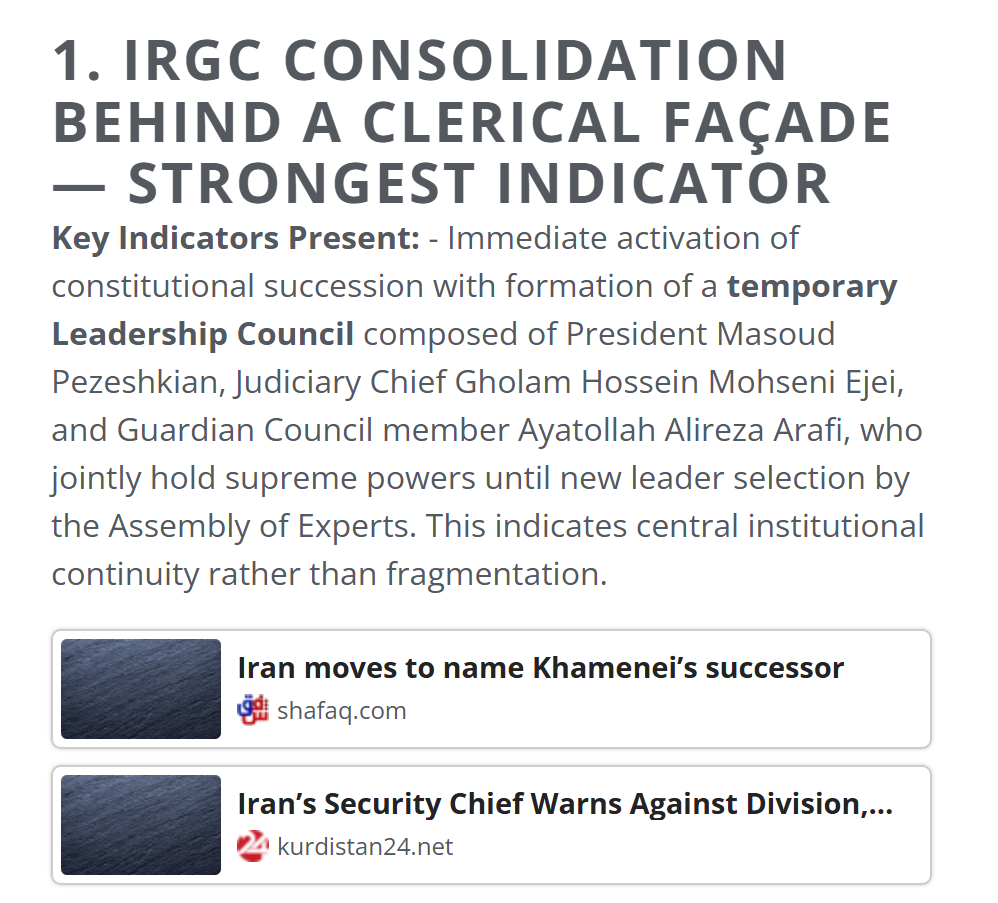

| (Left) EdgeTheory has identified that, among the sources it monitors, most indicators suggest enough Iranian regime personnel survive to adhere to the Iranian constitution’s requirements to appoint Khamenei’s successor. Iran’s president, judiciary chief, and one Guardian Council member hold executive power until the 88-member Assembly of Experts selects a new Supreme Leader. (Right) As the regime seeks to appoint a successor while withstanding US and Israeli strikes, a protracted regional conflict is likely. |
Iraqi Sunnis will also be profoundly affected. Weaknesses or instability within the current Shi’a-dominated system could open the door for Sunnis, many of whom have been politically sidelined due to de-Ba’athification measures and who have been relegated (at the federal level) to a handful of key positions (including Speaker of Parliament and Minister of Defense) to seek additional power (22). Sunnis have fared poorly in many regards under the Shi’a-dominated political system. Shi’a militias targeted them during the 2006-2008 sectarian war. They were impacted by sectarian policies during Al-Maliki’s tenure (23).
In the short term, the Kurdistan Region of Iraq is poised to become a flashpoint between the US, Iran, and the Iran-backed militias.
More recently, Iran-backed militias have forcibly removed Sunni civilians from strategically valuable zones, most notably Jurf Al-Sakhar, where they built a base that the US has subsequently struck (as mentioned above) (24). Given this history, Sunnis may see an opportunity to alter the status quo in Iraq now that the Iranian regime (and therefore the Shi’a-dominated Iraqi system) is weakened. Regional changes such as the rise of the Suni-dominated Ahmed Al-Sharaa government in Syria (after the fall of the Shi’a Alawite Bashar Al-Assad regime) could facilitate this.
Possibility 2: The US and Israel completely destroy the Iranian regime. Destruction of the Iranian regime could make the implications outlined in Possibility 1, such as intra-Shi’a conflict and/or sectarian conflict in Iraq, imminent. But it would also entail additional risks. Civil war could occur in Iran, driven by numerous potential factors. Iranian Kurdish and Baloch separatists may seek to establish autonomous regions if the regime is incapacitated. As discussed above, Kurdish separatists operating in northern Iraq may already become involved. Meanwhile, the Mobarizoun Popular Front (MPF), a coalition of Baloch groups operating in Iran’s Sistan and Baluchistan province, reportedly targeted an Iranian Law Enforcement Commander on March 3, marking the first time a separatist group has targeted the Iranian government since the war began (25). Any of these groups could become embroiled in conflict with surviving lower-level former regime personnel if the regime does not survive. Such personnel could also vie for internal control amongst themselves. Iraq’s Shi’a militias could become involved in any version of such a conflict. The militias have a history of direct action on Iran’s behalf, including inside Iran. The Badr Organization (previously known as the Badr Corps) was trained and financed by the IRGC and fought on Iran’s behalf in the Iran-Iraq war, for example. Iraqi militias may also have participated in quelling recent popular protests in Iran (26). It is therefore possible that some of Iraq’s militias would support regime remnants if a civil war were to occur.
The US failed to anticipate Iran’s involvement in Iraq, to grapple with the complexities of intra-Shi’a politics, and to appreciate the profound risks of sidelining Iraq’s Sunnis.
Iraq has already undergone one fraught sectarian transition at the US’s hands. In the wake of 2003, the US was not prepared for the implications of shifting Iraq’s political system from a Ba’athist, Sunni-dominated one to a Shi’a-dominated one.
While the current administration clearly does not intend to uproot Iraq’s current system, and indeed has sought to draw a sharp distinction between the current conflict and the Iraq war, it is poised to repeat the US’ fundamental error in Iraq: underestimating the cost of tinkering with the balance of power.
Lead Analyst:
Samantha Leathley is a Middle East analyst supporting EdgeTheory Lab. She is an American University graduate with over four years of professional experience analyzing Iraqi politics and security issues. Prior to EdgeTheory, she authored analyses for Department of Defense clients while working on the ground in the Kurdistan Region of Iraq.