This report synthesizes geospatial indicators, narrative attribution, and networked information flows related to Islamic State recruitment, propaganda dissemination, and operational signaling in the contemporary digital environment. Drawing on multi-platform collection streams—including Telegram channels, X posts, online newsletters, open-source media reporting, and extremist-affiliated publications—the analysis maps how jihadist narratives originate, adapt, and amplify across regions and audiences.
This EdgeTheory Narrative Intelligence report examines how the Islamic State has transformed from a territorial insurgency into an AI-enabled digital recruitment network—leveraging synthetic media, automated chat systems, and emotionally targeted propaganda to accelerate radicalization across global platforms.
Drawing on geospatial mapping, narrative attribution, attack-vector classification, and emotion profiling across Telegram, X, RSS feeds, and extremist publications, the analysis shows how AI-generated news anchors, deepfake imagery, and instructional chatbot manuals are altering recruitment pipelines. Messaging has shifted from territorial triumph to psychological endurance—framing patience, grievance, and identity as entry points for mobilization.
The report further traces the geographic reorientation of Islamic State activity toward Africa, where operational expansion and propaganda output now converge—demonstrating how decentralized affiliates sustain global relevance through narrative dominance rather than territorial control.
Rather than treating extremism as isolated acts of violence, this study shows how AI-assisted propaganda, emotional manipulation, and coordinated amplification are redefining recruitment in the modern information environment—shortening radicalization timelines and targeting increasingly younger audiences.
Propaganda has shifted from territorial triumph to psychological endurance and networked identity.
The Islamic State’s loss of territorial control in Iraq and Syria has not diminished its capacity to recruit, radicalize, or project influence. Instead, the organization has adapted by transforming its operational model—shifting from a centralized, territory-holding entity into a decentralized network that prioritizes digital engagement, narrative persistence, and geographically dispersed violence. Recruitment and mobilization now occur primarily online, where propaganda circulates rapidly. Central to this evolution is the growing use of artificial intelligence and data-driven engagement tools, enabling Islamic State recruiters to tailor messaging to individual psychological profiles. Synthetic media, automated accounts, and AI-assisted chat interfaces allow extremist narratives to be deployed continuously across platforms, lowering the barrier to entry for radicalization while increasing its intensity and personalization. These tools amplify longstanding recruitment themes—grievance, moral duty, heroism, and belonging—while masking organizational decline behind a façade of global reach and ideological momentum. Geographically, Africa has emerged as the organization’s primary operational and symbolic front. Affiliates across the Sahel, Central Africa, and the Horn of Africa now dominate Islamic State activity and propaganda output, benefiting from porous borders, weak governance, and persistent socioeconomic instability. This shift is reflected not only in attack patterns but also in narrative emphasis, as violence in African theaters is increasingly framed as evidence of momentum, divine favor, and global relevance.
Together, these developments illustrate a threat environment defined less by physical territory and more by information power, emotional manipulation, and networked connectivity.
The Islamic State has increasingly leveraged artificial intelligence to automate and personalize recruitment efforts across social media platforms. AI-enabled chatbots and synthetic content allow extremist groups to operate continuously, analyze user behavior, and tailor messaging to individual emotional and ideological vulnerabilities. Unlike traditional human recruiters, these systems can rapidly adapt narratives in real time, increasing both the speed and effectiveness of radicalization. This represents a qualitative shift in recruitment dynamics, transforming radicalization from an episodic process into a persistent, data-driven engagement strategy that is particularly effective against adolescents and first-time recruits.
This data-driven customization allows propaganda to be refined and deployed in real time, making AI-assisted radicalization far more effective than traditional recruitment methods.
Analysis of primary sources such as al-Naba, Amaq News Agency, and affiliated Telegram and X accounts reveals a deliberate shift in messaging. Rather than solely emphasizing battlefield victories or state-building, IS propaganda now focuses on themes of patience, steadfastness, sacrifice, and long-term struggle. This narrative recalibration reflects the organization’s transition from a centralized “caliphate” to a decentralized combat network. Weekly publications and consistent media output serve less to announce operational success and more to assert continuity, reinforce group identity, and sustain morale among dispersed supporters despite declining activity in Iraq and Syria.
The Islamic State’s operational center of gravity has increasingly shifted to Africa, which now accounts for the majority of its global activity. Affiliates across the Sahel, Central Africa, and the Horn of Africa benefit from porous borders, ungoverned spaces, corruption, and socioeconomic vulnerability. IS propaganda reflects this reality, highlighting attacks on Christian and Shiite communities and emphasizing campaigns such as “Burning Camps.” Interconnectivity among African provinces—facilitated by financial and logistical hubs like Somalia’s al-Karrar office—demonstrates that Africa is no longer a peripheral theater but a core pillar of the organization’s transnational infrastructure.

Geospatial Narrative Sources (yellow) and targets (red)
The narrative initially emerged from Dhaka, headed for New Delhi. The amplified narrative content focuses on synthetic AI-generated social media posts and overt fake news campaigns being increasingly used to manipulate public opinion. Artificial intelligence has significantly enhanced the ways terrorist organizations exploit social media for recruitment and radicalization. By analyzing patterns in user interaction and engagement, AI models enable extremists to identify vulnerabilities and adapt messaging to target potential recruits with greater precision. This data-driven customization allows propaganda to be refined and deployed in real time, making AI-assisted radicalization far more effective than traditional recruitment methods. The Islamic State has demonstrated awareness of this potential, publishing a guide in 2023 on “how to securely use generative AI.” Unlike human recruiters, AI-based chatbots can operate continuously across multiple platforms, sustaining interactions that convincingly mimic human conversation. These systems are designed to personalize radicalization pathways by identifying behavioral triggers and adjusting responses to align with an individual’s ideological leanings and emotional vulnerabilities, making the threat posed by passive, AI-enabled recruitment particularly severe.
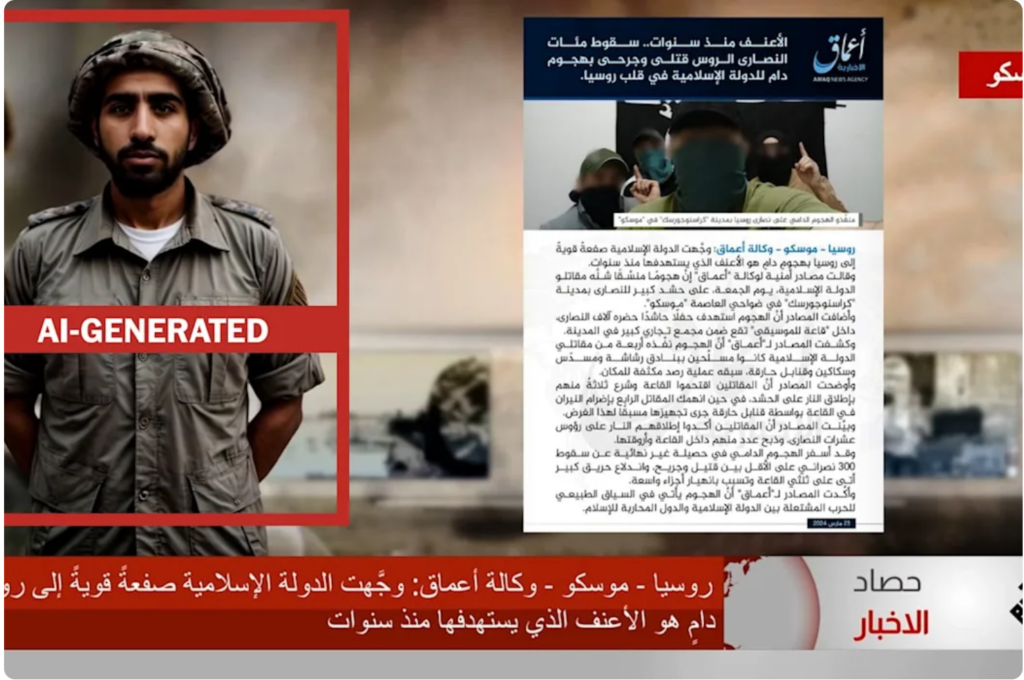
AI ISIS News Anchor
Four days after the Islamic State (ISIS) conducted an attack on a Moscow concert venue in March, ISIS-affiliated media channels circulated a 92-second video on a private platform linked to the group. The video featured a purported news anchor, dressed in military fatigues, asserting that the attack was not an act of terrorism but part of the “normal context of the raging war between the Islamic State and countries fighting Islam.”

Example of ISIS usage of AI propaganda
Hamas-affiliated media accounts circulated an AI-generated TikTok depicting Israeli Defense Forces soldiers wearing diapers, presenting them as infantile and dependent. The image appeared across encrypted messaging platforms and social media channels commonly used by the group and its supporters, where it was shared alongside captions mocking Israeli military strength and resolve. Rather than documenting a real-world event, the image relied on generative artificial intelligence to construct a deliberately exaggerated and demeaning portrayal of Israeli soldiers.
The image aligns with a broader Islamist recruitment narrative that seeks to erode the perceived authority and masculinity of enemy forces while reinforcing in-group solidarity.
The image aligns with a broader Islamist recruitment narrative that seeks to erode the perceived authority and masculinity of enemy forces while reinforcing in-group solidarity. By infantilizing armed soldiers, the visual reframes military power as weakness and ridicule, encouraging viewers to see the adversary as undeserving of fear or respect. Such content functions less as ideological instruction than as emotional conditioning, using humiliation and mockery to normalize hostility and lower psychological barriers to engagement. In this context, AI-generated imagery allows militant groups to rapidly produce viral, emotionally charged content that blends meme culture with propaganda, creating accessible entry points for recruitment and radicalization without relying on overt doctrinal messaging.

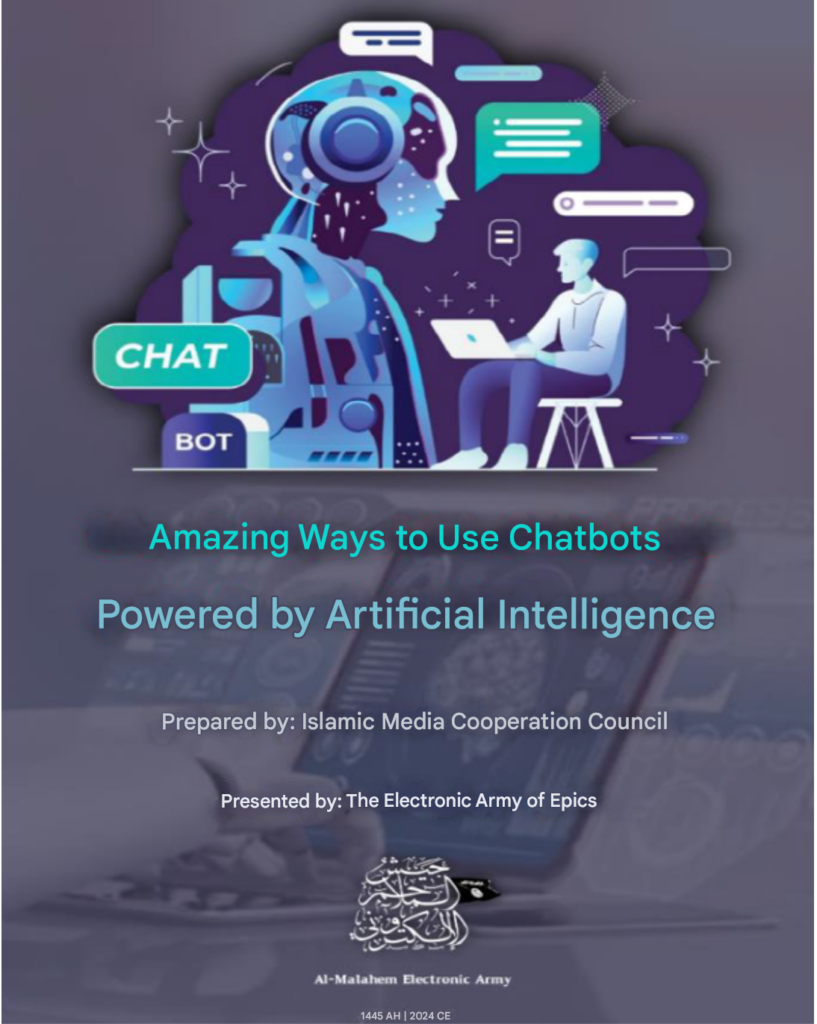
Islamic “Amazing Ways to use Chatbots” Guide
After announcing an online workshop focusing on the potential of AI, an al-Qaeda–affiliated media group quietly released a 50-page e-book titled Amazing Ways to Use AI-Powered Chatbots. Published in February 2024 under the name “Islamic Media Cooperation Council” (Electronic Army of Epics), the manual introduced readers to AI chatbots, explained how to access them, and outlined practical methods for their use. Written in a casual, instructional tone, the book framed the technology as an accessible resource rather than an advanced technical system, inviting sympathizers to experiment with it as part of the group’s broader media and outreach efforts. In fact, after defining AI, the first page ends with the line: “So let’s see what you can do with this tool, shall we?”
Experts warn that chatbots’ ability to simulate human conversation and tailor responses to individual users makes them particularly effective for influence and gradual radicalization. The publication appeared alongside a wider pattern of extremist engagement with artificial intelligence. Similar ISIS-aligned technical guides released in 2023 focused on privacy protection when using AI tools, advising users to disable chat histories, avoid sensitive disclosures, and employ anonymization techniques. Together with documented calls from pro-ISIS media channels seeking individuals with AI and digital skills, the e-book signals a shift toward more systematic experimentation with AI-driven, personalized propaganda and recruitment methods rather than one-off or ad hoc use of emerging technologies.
Primary sources disseminating information include Al-Naba News, Khilafah News, and Amaq News Agency. The Islamic State publishes its al-Naba magazine weekly, providing detailed insight into the group’s military, ideological, and propaganda activities across its provinces. The newsletter’s consistent release demonstrates the persistence of a minimal central media structure, though its primary purpose appears to be asserting symbolic presence rather than achieving tangible operational gains. Over time, the content reflects a gradual organizational shift from a centralized “territorial caliphate” toward a decentralized “combat network.” Propaganda increasingly emphasizes themes such as “steadfastness,” “patience,” and “trial,” signaling internal confidence challenges and efforts to sustain morale among supporters. Repeated newsletter releases also serve recruitment purposes and act as reminders to supporters that the group’s project “remains active,” maintaining a sense of continuity and relevance despite territorial losses. Al-Naba follows a consistent format, typically opening with an ideological introduction, followed by statistical summaries of operations, and concluding with a propaganda section. The newsletter emphasizes organizational continuity more than battlefield victories, often including images of fighters in remote areas to convey a perception of global reach. While operations in Iraq and Syria have declined, coverage increasingly highlights activity in Africa, reflecting a geographic and strategic shift. Its language stresses “patience and long-term jihad” over promises of rapid empowerment, illustrating a deliberate shift in internal messaging aimed at sustaining commitment and resilience among its supporters.
The content reflects a gradual organizational shift from a centralized “territorial caliphate” toward a decentralized “combat network.”

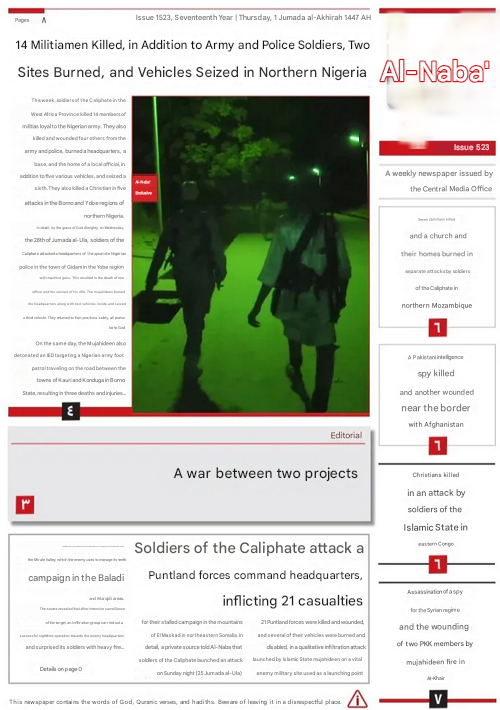
Image from Al Naba 523 Newsletter
The Amaq News Agency is a news outlet linked to the Islamic State and is often the first point of publication for claims of responsibility for terrorist attacks in Western countries. In March 2019, it was designated as a foreign terrorist organization by the US Department of State. Messaging is also disseminated through social media platforms such as X, Telegram, Kik, Reddit, Ebay, as well as through sermons, literature, pamphlets, and speeches. This outreach aims to validate the recruits’ decisions, emphasizing community support and shared beliefs.
Islamist extremist recruitment narratives frequently employ a range of logical fallacies and manipulative rhetorical techniques to persuade potential recruits.
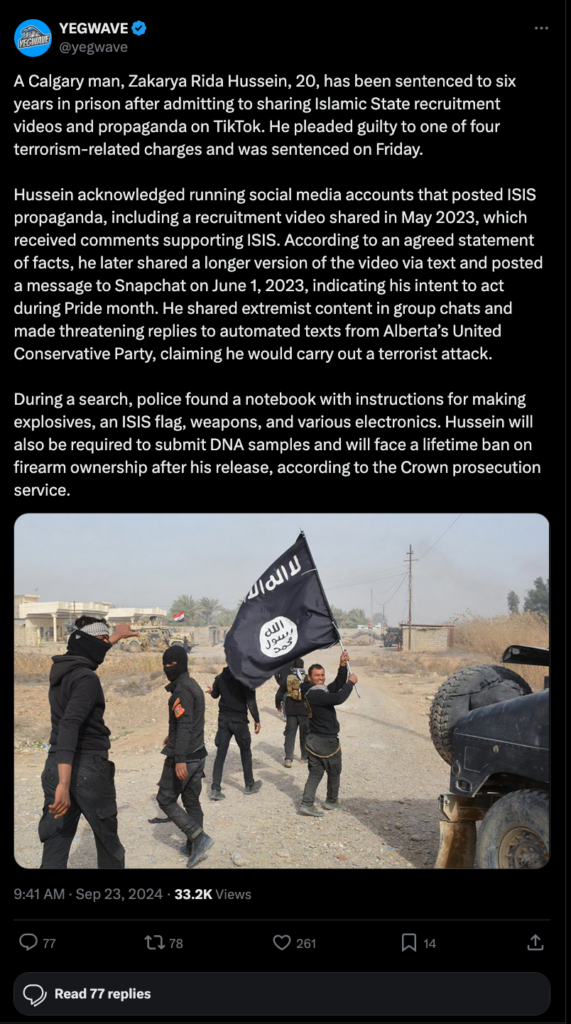
Telegram Post
Islamist extremist recruitment narratives frequently employ a range of logical fallacies and manipulative rhetorical techniques to persuade potential recruits.

Edge Theory Narrative Attack Vector Classifier
Piers Robinson's piece on the Douma 2018 chemical incident, amplified through platforms like X, employs appeal to authority via selective citation of OPCW whistleblowers while insinuating a grand conspiracy of staged evidence and institutional cover-up, constituting a post hoc ergo propter hoc fallacy that links alleged investigative irregularities directly to broader regime-change motives without substantiating causal links.

Edge Theory Narrative Attack Vector
Similarly, contributions from outlets such as Middle East Monitor, Alt-World, and Iran Wire frame Western media and governments as inherently biased propagators of disinformation—evident in warnings against foreign interference in Iranian protests and dismissals of interventionist arguments as power-driven hypocrisy—relying on straw man distortions of opposing views, ad hominem attacks on critics as "idiots" or regime apologists, and false dichotomy presentations that portray any support for external pressure as endorsement of catastrophic war. These pieces collectively exploit victimhood and demonization rhetoric, a hallmark of extremist discourse, by portraying Muslim-majority states as besieged by orchestrated Western/Israeli aggression while downplaying internal regime flaws or dissent.
These pieces collectively exploit victimhood and demonization rhetoric, a hallmark of extremist discourse, by portraying Muslim-majority states as besieged by orchestrated Western/Israeli aggression while downplaying internal regime flaws or dissent.

Edge Theory Emotion Profile Classifier
The Grayzone report alleging Mossad's use of Farsi-language recruitment advertisements—purchased through a U.S.-based comedian's LLC and disseminated on platforms like Google, X, and Telegram amid Iran's 2026 unrest—exemplifies how Islamist extremist recruitment narratives exploit perceived foreign interference to reinforce core manipulative themes. Amplification through anti-Western networks (tagged as Anti-Mek, Russian Alignment, or pro-Palestine) normalizes distrust of mainstream sources, mirroring jihadist tactics that dismiss counter-narratives as propaganda while promising recruits a heroic role in countering existential threats.
Recruiters employ utopian promises and generalities, portraying the so‑called “Caliphate” as a harmonious community of justice and prosperity, thereby leveraging idealized imagery to evoke hope and belonging.
A primary strategy is the appeal to grievance, which simplifies complex geopolitical events into a binary moral struggle, suggesting that Muslim oppression by Western powers or local governments inevitably justifies violent jihad. Complementing this, recruiters employ utopian promises and generalities, portraying the so‑called “Caliphate” as a harmonious community of justice and prosperity, thereby leveraging idealized imagery to evoke hope and belonging. These narratives also exploit heroic framing, presenting martyrdom and battlefield action as emotionally fulfilling journeys, appealing to recruits’ desire for honor and purpose while committing the false cause fallacy. Recruitment materials frequently rely on selective interpretation of religious texts, cherry‑picking Qur’anic verses and Hadith to legitimize violence while suppressing countervailing scriptural evidence. To further manipulate perception, recruiters construct straw man arguments and red herrings, portraying mainstream Muslim leaders as complicit with oppressive forces, and employ bandwagon appeals, exaggerating the number of foreign fighters to normalize participation and emphasizing the united group of believers.

Edge Theory Narrative Attack Vector
Finally, false dilemmas frame the choice as stark: either one joins the extremist cause or is complicit in the oppression of Muslims, omitting alternative peaceful or reformist options. Collectively, these fallacies function to bypass critical reasoning, exploit emotional vulnerabilities, and present violent extremism as both morally imperative and socially desirable.


Telegram Post Example of Appeal to Grievance and Utopian Promises
After mapping out the potential recruit’s social, psychological, and cultural level, the recruiter will begin to introduce the jihadist ideology in a tailored manner. There are seven common narratives used by jihadist recruiters that have been identified: the Search for a Better World Narrative, the “Mother Teresa” Narrative, the Savior Narrative, the Marriage Narrative, the “Lancelot” Narrative, and the “Zeus” Narrative. Recruitment narratives are carefully tailored to exploit different emotional vulnerabilities and personal aspirations, yet they ultimately converge toward the same ideological endpoint. For individuals disillusioned with society, recruiters advance the promise of a “better world,” depicting a utopian community defined by equality, brotherhood, and solidarity through videos of shared meals, communal childcare, and aid to the poor, all while framing total submission to divine law as the foundation of this ideal society. For those drawn to humanitarian service, the narrative shifts toward moral obligation: aspiring nurses, doctors, or social workers are exposed to graphic footage of civilian suffering in Syria, producing a profound moral shock that convinces them jihadism is the only meaningful way to alleviate human suffering. When recruits are instead coping with grief, the messaging becomes salvific, offering emotional comfort through images of paradise and promises of reunion with lost loved ones, often intensified by apocalyptic predictions that heighten urgency. For vulnerable young women, recruiters emphasize the prospect of marriage, portraying strict gender separation as protection from sexual harm and framing union with a heroic fighter as a source of safety, purpose, and dignity. Young men drawn to ideals of heroism and adventure are targeted through a chivalric “Lancelot” narrative that glorifies sacrifice, brotherhood, and martial valor, encouraging them to see themselves as defenders of the oppressed and agents of historical change in response to international inaction. Finally, for individuals driven by a desire for dominance or control, the “Zeus” narrative reframes jihadist ideology as a means of imposing divine authority on others, allowing recruits who habitually engage in risky behavior to channel their sense of omnipotence through violence justified in God’s name. Even those struggling with forbidden sexual obsessions are offered a final appeal through the “Fortress” narrative, which presents radical Islam as a path to purity and self-containment—a moral enclosure designed to protect them from their own impulses. Together, these narratives reveal a flexible recruitment strategy that adapts to personal psychology while consistently steering individuals toward radical submission and violent action.
Islamic State fighters follow two main strategies: “war of attrition,” and “economic warfare,” as well as other strategies aimed at targeting Christians and Shiites.
In Islamic military recruitment, propaganda and messaging serve as tools to shape perceptions and influence potential recruits. The strategic use of religious narratives and historical context promotes the idea of jihad as a noble cause, framing participation in military efforts as a spiritual duty. Groups like Kata'ib Hezbollah and Hamas emphasize militant resistance framed by religious duty, which can be exploited in synthetic content to sway opinions and deepen societal divides. In many of their newsletters, they relate their killings back to God saying “After killing one member and seizing his rifle, the mujahideen burned the headquarters… and returned to their positions safely, praise be to God…The mujahideen also inflicted approximately 30 casualties on the militias… in addition to 84 Christian homes… they seized three rifles and a number of primitive weapons and the mujahideen returned to their positions safely, praise be to God.” They declare the purpose of the Islamic state as “to fight tyranny and confront it at every turn, while their projects in all their diversity, appease and flatter tyranny at every opportunity. This is the crux of the matter, the heart of the issue for those who find the details confusing.” ISIS also effectively preys on intellectual confusion and crises of identity, especially among young people searching for purpose and belonging. Recent cases in Europe illustrate how the Islamic State exploits intellectual confusion and identity crises among young people who are searching for purpose and belonging. A notable increase in minors involved in IS-inspired plots underscores this trend, including a 14-year-old girl in Austria detained for planning an axe and knife attack in Graz, another 14-year-old arrested in early 2025 for plotting an attack on a Vienna train station, and a foiled 2024 plot against Taylor Swift concerts in Vienna involving teenagers aged 17 to 19. The extremely young age of these individuals—many of whom were highly active online yet previously unknown to counter-terrorism authorities—highlights how rapidly radicalization and mobilization to violence can occur. Taken together, these cases reflect a broader pattern in Europe: Islamic State radicalization now primarily unfolds online, accelerates at unprecedented speed, and increasingly targets adolescents whose unresolved identity struggles make them particularly vulnerable to extremist narratives.
Islamic State fighters follow two main strategies: “war of attrition,” and “economic warfare,” as well as other strategies aimed at targeting Christians and Shiites. In Al-Naba issue 523, it highlights seven Christians being killed and their homes burned in separate attacks by soldiers of the Caliphate in northern Mozambique. It also goes on to say 5 Christians were killed in an attack by the soldiers of the Islamic State in eastern Congo. Since 20 March, the Islamic State has embarked on a new military campaign, particularly in Africa (in the areas of Nigeria, Niger, Cameroon and Mozambique) called “Burning Camps.” Africa has become IS’s main operational front.

Chat with Edge Agent
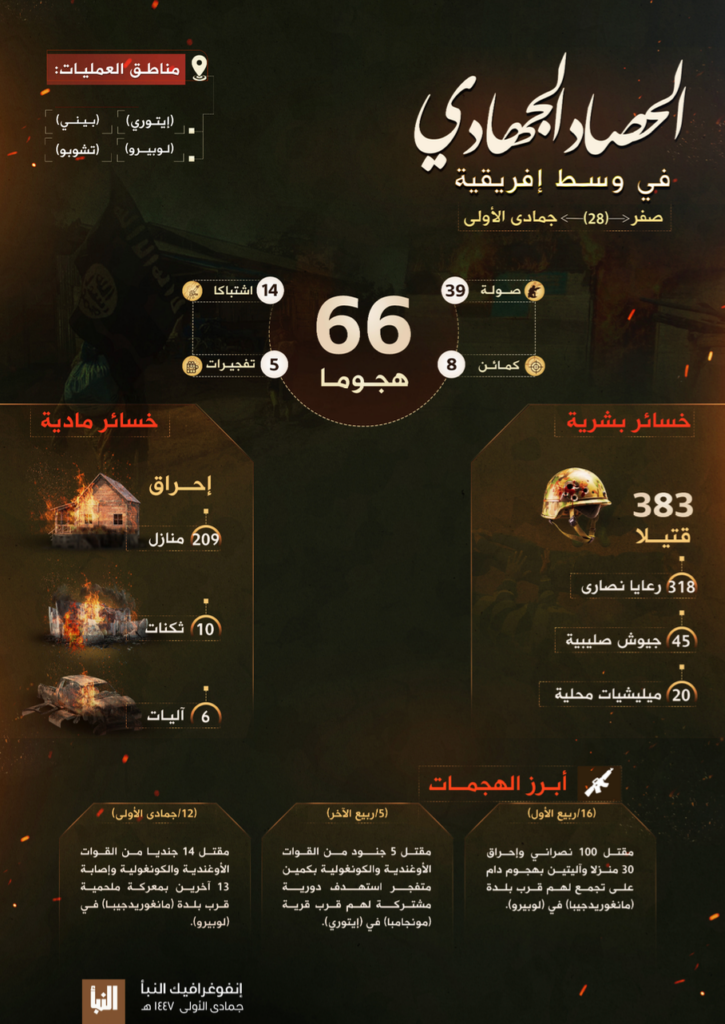
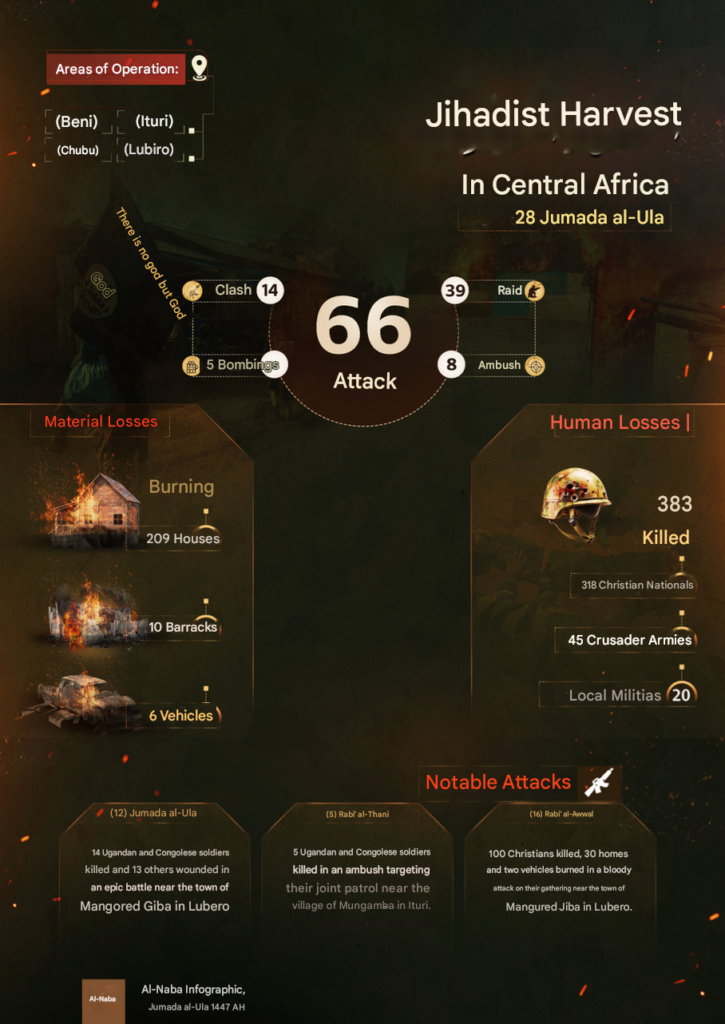
Al Naba post on activity in Africa


Al Naba post on activity in Africa
According to news sources, there are several factors why terrorist groups have succeeded in Africa. “First, porous borders allow fighters, weapons, and illicit flows to move easily across states. Second, ungoverned spaces give militants the safe havens to regroup, entrench themselves, and even provide basic services absent from the state. Third, corruption weakens trust in security institutions and weakens counterterrorism capacity, making governments part of the problem. Fourth, deep poverty and a growing youth bulge population create fertile ground for recruitment, while limited opportunities leave many vulnerable to extremist narratives.” More than two-thirds of IS activity in the first half of 2025 occurred on the African continent, with affiliates spanning the Sahel to Mozambique now occupying a central place in the group’s propaganda. This expansion is accompanied by increasing interconnectivity among regional branches. The Islamic State West Africa Province (ISWAP) and the Islamic State Somalia Province (ISSP) coordinate across borders in West Africa, while the Islamic State Central Africa Province (ISCAP) links operations between the Democratic Republic of Congo and Uganda. In the Horn of Africa, IS Somalia functions as a key financial and logistical hub through the al-Karrar office, reinforcing Africa’s role as an integral pillar of the organization’s transnational infrastructure.

Table of Prominent ISIS Activity in Africa
The Islamic State has adapted to territorial losses by shifting its strategy toward digital recruitment, narrative management, and geographically dispersed operations. The use of AI-assisted recruitment tools, flexible propaganda narratives, and an increased focus on Africa has enabled the group to sustain operational relevance while shortening radicalization timelines, particularly among younger audiences. These trends indicate that the current threat environment is shaped less by physical control of territory and more by decentralized networks operating across digital platforms and fragile governance spaces. Counterterrorism efforts must therefore prioritize monitoring online ecosystems, disrupting extremist narratives, and addressing vulnerabilities in regions where weak state capacity and high online engagement converge.
Lead Analyst:
Ellie Munshi is an analyst at the EdgeTheory Lab. She is studying Strategic Intelligence in National Security and Economics at Patrick Henry College. She has led special projects for the college focused on Anti-Human Trafficking, Chinese influence in Africa, AI influence on policymakers, and was also an intelligence analyst intern at the Department of War.