Menu
This EdgeTheory Narrative Intelligence report examines the 2026 Iranian protest cycle through the lens of information power, narrative competition, and foreign influence—revealing how perceptions of instability, legitimacy, and escalation are actively shaped in the global information environment.
Drawing on geospatial analysis, narrative attribution, and network detection across websites, social media, RSS feeds, and X, the report maps how narratives around economic collapse, state violence, foreign interference, and regime change propagate and reinforce one another. The analysis traces how state media, diaspora influencers, foreign-aligned information actors, and automated networks interact—using emotional framing and coordinated amplification to shape public understanding and policy risk.
Rather than treating protests as isolated events, the report shows how narrative dominance has become a decisive factor in crisis escalation, influencing legitimacy and international response long before ground truth can be independently verified.
This EdgeTheory report synthesizes geospatial, narrative attribution, and network analysis surrounding the 2026 Iranian protest cycle, focusing on how competing domestic and foreign-aligned narratives shape perceptions of instability, legitimacy, and intervention. Drawing from multi-platform collection streams—including websites, social media actors, RSS feeds, and X posts—the brief maps how narratives about economic collapse, state violence, foreign interference, and regime change propagate across the global information environment. The report employs EdgeTheory’s network-detection, emotion-classification, and narrative-amplification tools to trace how state media, diaspora influencers, foreign information actors, and automated networks interact and reinforce messaging. In doing so, it provides a layered view of how information power, emotional framing, and geopolitical competition intersect to shape public understanding of the protests and the risks of broader regional escalation.
Beginning in late December 2025, Iran experienced widespread protests triggered by severe economic deterioration, including historic inflation, currency collapse, and rising cost of living pressures on merchants and working-class populations. What began as localized economic grievances rapidly expanded into nationwide demonstrations met with violent state repression, mass arrests, and contested death tolls. As events unfolded, the information environment became as consequential as developments on the ground, with state-controlled media, opposition networks, diaspora communities, and foreign actors all advancing divergent interpretations of the unrest. Narratives ranged from portraying the protests as organic popular resistance to framing them as externally engineered destabilization efforts linked to the U.S. and Israel. This contested information landscape—shaped by social media virality, algorithmic amplification, and strategic disinformation—complicates independent assessment of both the protests’ scale and their political trajectory.
Foreign manipulation of information surrounding the 2026 Iran protests has significantly shaped how the crisis is perceived across domestic, regional, and global audiences. Rather than a single disinformation campaign, the information environment reflects layered and competing influence operations that distort reality and intensify polarization. Foreign actors have circulated recycled footage from past protests, stripped of time and location markers, alongside digitally altered and AI-generated videos suggesting airstrikes or staged mass uprisings. These viral visuals mobilize international audiences while simultaneously giving Tehran material to discredit broader protest reporting, creating a persistent “signal versus noise” problem. Meanwhile, Russia and China have amplified “color revolution” narratives through coordinated media and influencer networks, while other state and non-state actors have selectively boosted content that delegitimizes protesters. The result is a fragmented information space in which competing manipulations obscure verifiable ground truth.
On the other side, anti-regime narratives are driven by diaspora activists, OSINT accounts, and citizen journalists who circulate raw footage of crackdowns, morgues, and mass arrests, often with limited verification.
Protest discourse is not organic or decentralized, but structured around competing, highly organized narrative ecosystems. On one side, pro-regime messaging is amplified through a combination of state-controlled media (Press TV, Fars News), coordinated bot and automation networks, and influential social media actors such as @Partisangirl, Arya (@AryJeay), and Lord Bebo. These actors consistently frame the protests as foreign-manufactured chaos, portray Tehran as stable, and delegitimize protesters as manipulated or externally funded.
On the other side, anti-regime narratives are driven by diaspora activists, OSINT accounts, and citizen journalists who circulate raw footage of crackdowns, morgues, and mass arrests, often with limited verification. Traditional media outlets (BBC, CNN, Al Jazeera) act as secondary amplifiers, selecting and broadcasting user-generated content into mainstream visibility. The result is a bifurcated information space where audiences rarely encounter the same facts, but instead consume parallel realities that reinforce preexisting political identities. This structured competition means that “truth” is less a neutral shared baseline and more a strategic resource being fought over in real time.
Across EdgeTheory’s reliability assessments, most narratives cluster in a moderate range of accuracy (5–7), indicating that neither side operates purely through fabrication nor purely through truth. Instead, actors selectively deploy credible facts alongside speculative or misleading claims, making it increasingly difficult for audiences to separate evidence from advocacy. High-fidelity elements—such as verified casualty reports or economic data—are often embedded within broader narratives that serve partisan or geopolitical goals.
This selective blending of fact and interpretation weaponizes credibility: pro-regime outlets use isolated instances of fake content to discredit all protest reporting, while anti-regime actors leverage confirmed abuses to generalize about regime behavior. The result is a trust deficit in which audiences become cynical toward all information, paradoxically benefiting powerful actors who face less scrutiny. In this environment, credibility is not a neutral benchmark but a strategic asset to be claimed, contested, and manipulated.

Geospatial Narrative sources (yellow) and targets (red)
The most frequently amplified content centers on Iran’s widespread protests driven by severe economic hardship, including inflation and currency collapse, sparking nationwide unrest and violent crackdowns.
The narrative initially emerged from Dayton Avenue, headed for Ahvāz. As it spread, the most frequent origin shifted to New Delhi, and the most frequent destination shifted to Tehran. There are a total of 19 points of origin, and 6 destinations.
The most frequently amplified content centers on Iran’s widespread protests driven by severe economic hardship, including inflation and currency collapse, sparking nationwide unrest and violent crackdowns. Rising death tolls and mass arrests underscore the severity, while the government blames foreign interference, mainly from the U.S. and Israel. External actors are portrayed as exploiting dissent to destabilize Iran, fueling fears of regime change akin to Libya.
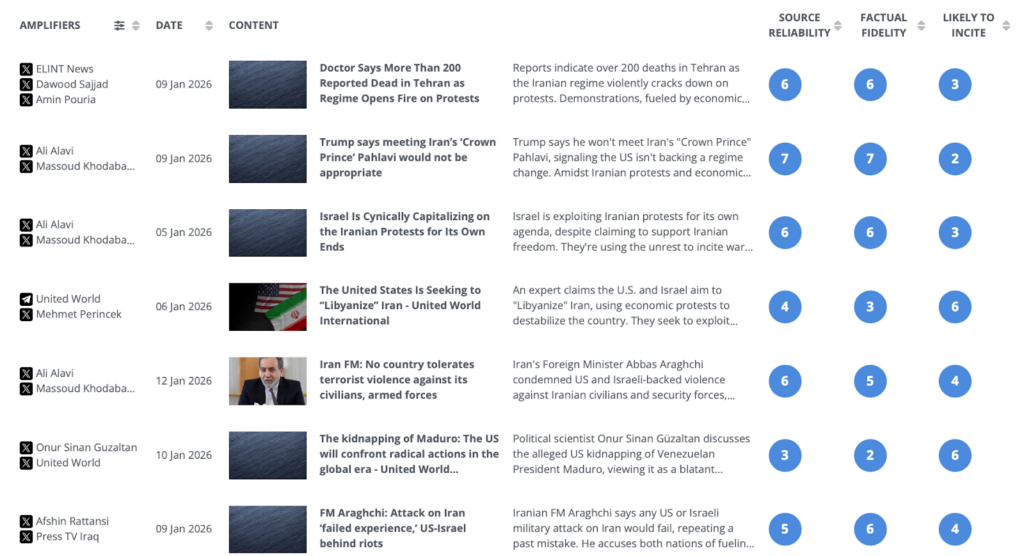
EdgeTheory Global Cognitive Adversaries (GCA) Narrative Classifier
The primary sources amplifying this narrative are predominantly Indian-aligned, closely followed by Russian-alignment. Key vectors spreading narratives include social media actors, state-controlled Iranian media, and bots and automated networks. Influential actors shaping narratives around the Iran protests include Maram Susli, known as @Partisangirl on X, a Syrian-Australian influencer with over 500,000 followers who consistently portrays Tehran as stable and frames the unrest as Western/Israeli misinformation campaigns. Her posts, often from Australia, downplay violence and accuse protesters of being foreign agents, aligning with pro-regime lines and garnering significant engagement from Axis of Resistance sympathizers. Suleiman Ahmed, another pro-Islamic Republic voice, shares content like videos of anti-monarchist acts, such as burning images of Reza Shah, to discredit opposition figures like Reza Pahlavi; his reach extends through niche Middle East commentary circles.
On the anti-regime side, Vahid, a US-based Iranian activist, has emerged as a key conduit for protest footage, posting verified videos from Tehran morgues showing crackdown victims, with his content reaching tens of thousands via diaspora networks despite not being a household name.
On the anti-regime side, Vahid, a US-based Iranian activist, has emerged as a key conduit for protest footage, posting verified videos from Tehran morgues showing crackdown victims, with his content reaching tens of thousands via diaspora networks despite not being a household name. Arya (@AryJeay), an Iranian researcher focused on hybrid warfare, amplifies claims of Israeli Mossad and CIA guidance for protesters, citing Israeli journalists like Zvi Yehezkeli; with over 65,000 views on key threads, Arya's analysis influences pro-regime audiences skeptical of organic unrest. Lord Bebo (@MyLordBebo), a self-described anti-woke content curator with a focus on global conflicts, spreads pro-regime narratives by sharing videos of counter-protests in Qom and condemning foreign meddling, achieving high engagement (over 22,000 views per post) in alternative media spheres. Jangjou (@Jangjouye), an Iranian abroad writing on domestic politics, positions himself as a moderate voice opposing both foreign interference and regime violence, with posts like his rejection of bots and exile accounts gaining over 80,000 views and resonating in diaspora discussions.Thana Ebrahimi (@__Injaneb96), a PhD candidate fighting Islamists, critiques regime mouthpieces like Farnaz Fasihi of The New York Times, with her exposés on propaganda earning thousands of likes and shares among anti-theocracy activists. These actors, often with follower counts in the tens to hundreds of thousands, operate in echo chambers but wield outsized influence through viral threads and cross-amplification.
State-controlled Iranian media, like Press TV and Fars News, push narratives blaming foreign interference from the US and Israel, portraying protests as orchestrated sabotage rather than genuine economic grievances. On the opposing side, Western and Israeli-linked accounts recirculate videos and images—some recycled from past events or enhanced with AI—to exaggerate the scale of unrest and regime brutality. Bots and automated networks play a significant role, with reports of swarms hijacking profiles to seed subversive content, such as doctored anthems or fake prison uprisings, aiming to steer narratives toward regime change. Traditional media outlets, including Al Jazeera, BBC, and CNN, act as amplifiers by verifying and broadcasting user-generated content, though they often face accusations of bias—Western sources for downplaying regime support, and pro-regime outlets for fabricating calm in Tehran. Encrypted apps and citizen journalism further decentralize information flow, allowing protesters to share raw footage despite blackouts, but this also enables rapid disinformation spread.
State-controlled Iranian media, like Press TV and Fars News, push narratives blaming foreign interference from the US and Israel, portraying protests as orchestrated sabotage rather than genuine economic grievances.
Across the summaries in the EdgeTheory GCA Narrative Classifier, the aggregated ratings reflect generally moderate reliability and accuracy, mostly ranging from 5 to 7, indicating a mixture of credible and somewhat less substantiated information. Incitement scores largely fall between 2 and 4, suggesting most items aim to inform without strong provocation. However, some entries display higher incitement (up to 6) alongside lower accuracy and reliability, signaling attempts to polarize or exaggerate stakes within the coverage. Overall, the content blends factual reporting with occasional narrative-driven or politically charged perspectives.
A 6-fidelity medical account documenting 217 bodies across six Tehran hospitals from live fire by regime forces establishes that the crackdown has been lethal and systematic, supporting broader estimates of hundreds to thousands killed nationwide. Also at 6, Israeli officials’ public encouragement of protesters reveals a parallel effort to instrumentalize the unrest for regional pressure on Tehran, rather than purely humanitarian concern. Finally, a 6-fidelity statement from Foreign Minister Abbas Araghchi blaming U.S.-Israeli involvement while professing a preference for diplomacy illustrates the regime’s strategy of externalizing responsibility for the violence.
Foreign manipulation of news surrounding the 2026 Iran protests has been multifaceted, with Israel and the US accused of orchestrating influence operations to destabilize the regime, including AI-generated content like fake strikes on Evin Prison and deepfake videos simulating uprisings. Israeli officials, including a diplomat sharing AI-manipulated air-strike footage, and journalists like Zvi Yehezkeli admitting Mossad guidance for protesters, have fueled Tehran's claims of covert operations exploiting ethnic divisions. The US, under President Trump, has amplified this through rhetoric threatening intervention and Mike Pompeo's admissions of Mossad agents aiding protesters, which critics say delegitimizes genuine grievances by framing them as foreign plots.

The National post of AI generated content in Iranian Protests
Conversely, Russia and China back Iran's narrative, condemning "color revolutions" and external interference, with Russian propaganda aggregating manipulated content to expose alleged Western psyops and justify repression.Turkey's foreign minister has echoed accusations against Mossad, while Indian and Afghan social media teams are alleged to flood platforms with fake narratives for regime change. This dual manipulation—pro-regime denial of unrest and anti-regime exaggeration—creates doubt, as seen in recycled footage and blurred videos claimed to hide AI alterations, ultimately benefiting the regime by providing pretexts for crackdowns.
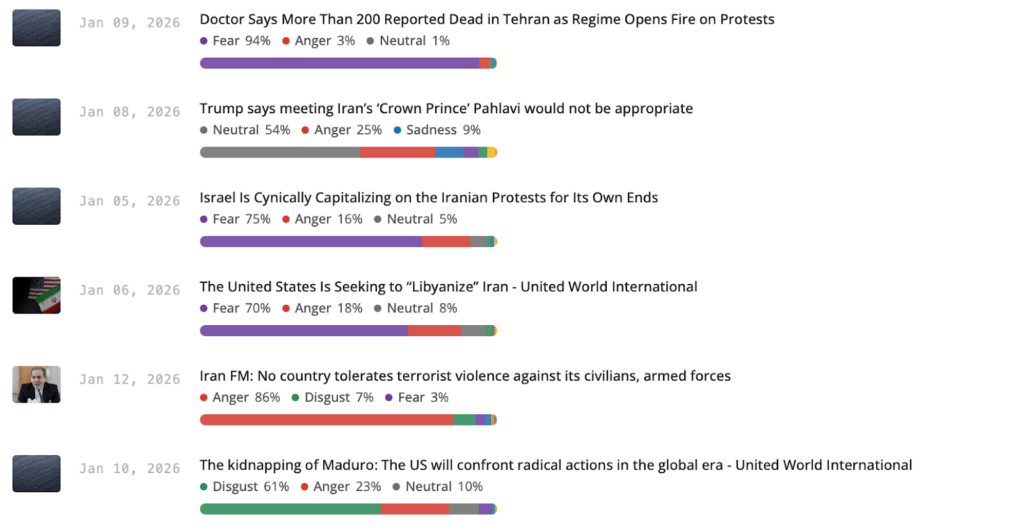
Edge Theory Emotion Profile Classifier
Analysis of headlines about the 2026 Iranian protests shows that fear is the dominant emotional framing, followed by anger and then neutrality. Headlines that scored highest for fear tended to portray the protests as a threat to Iran’s stability and sovereignty rather than simply domestic unrest. The most fear-driven narratives included reports of over 200 deaths in Tehran from regime crackdowns (94% fear), claims that Israel was exploiting the protests (75% fear), and assertions that the United States sought to “Libyanize” Iran (70% fear). These frames suggest a consistent narrative that the protests could lead to foreign-backed regime change, drawing parallels to past interventions like Libya.
Foreign manipulation of news surrounding the 2026 Iran protests has been multifaceted, with Israel and the US accused of orchestrating influence operations to destabilize the regime, including AI-generated content like fake strikes on Evin Prison and deepfake videos simulating uprisings.
Many of these fear-focused headlines, often originating from outlets such as United World International, emphasize risks of violence, chaos, and external interference. This framing may increase public anxiety and portray protesters as manipulated by foreign actors, while minimizing underlying economic grievances such as the impact of sanctions.
This pattern indicates that fear is being strategically deployed by regime-aligned media and officials to shift the frame from internal governance failures—such as economic hardship exacerbated by sanctions—to external conspiracy and invasion. In doing so, they can recast protesters not as citizens with grievances but as instruments of hostile foreign powers, thereby morally and politically justifying crackdowns.
Anger was most prominent in regime-aligned statements, particularly the Iranian Foreign Minister’s condemnation of “terrorist violence” (86% anger), reflecting a defensive strategy that shifts blame to external enemies. Neutral framing appeared more frequently in coverage of figures like Crown Prince Pahlavi, indicating more measured or diplomatic commentary.
| Account Handle | Follower Count | Bio Summary | Key Amplification Examples |
| @Partisangirl (Maram Susli, aka Syrian Girl) | 533,908 | Analyst, scientist, journalist; focuses on Middle East geopolitics with a pro-Syria/Iran stance. | Posts videos and images from Tehran showing "normal life" amid protests, claiming Western media lies about Iran to push regime change for Israel/US interests. Frames unrest as US/Israeli misinformation; one edited AI image showed her burning an Israeli flag in Tehran to symbolize resistance to foreign plots. High engagement on posts dismissing protests as foreign-engineered. |
| @BenjaminNorton | 332,142 | Journalist and political economist; editor of Geopolitical Economy Report; critical of US foreign policy. | Compares Iran protests to US-sponsored 2019 Hong Kong riots, alleging similar tactics of violence and propaganda to justify intervention. Argues protesters are used to "manufacture regime collapse" via US manipulation, drawing parallels to color revolutions. Recent posts (e.g., with 350+ likes) highlight this as part of broader anti-US imperialism narrative. |
| @hajdogin | 14,764 | Dedicated to Imam Hussein; retweets not endorsements; Persian-language focus on pro-Islamic themes. | Shares videos claiming CIA agents incite chaos in Iranian crowds, linking it to US police actions against protesters. Uses #ShutUpTrump to oppose US threats, portraying demonstrations as economic issues hijacked by American interference. One post garnered 1,500+ likes and 20,000+ views, indicating growing popularity. |
| @samad_khaledi | 1,953 | Focuses on condemning global injustice; pro-Iranian savior themes. | Defends Iran's security forces against claims of killing protesters, calling out US intervention calls as pretexts for attack. Frames anti-regime voices as "foreign-trained enemies" backed by the US, with posts responding to viral protest imagery to push back against Western narratives. |
| @zainab_mirza28 | 1,320 | Promotes Khomeinism and Wilayat (guardianship); anti-Zionist and pro-resistance axis. | Accuses US CIA-linked and Zionist accounts of misrepresenting pro-Iran rallies as anti-regime protests. Shares content rejecting Pahlavi (exiled opposition) and emphasizing Iran's dignity against American interference, portraying unrest as externally amplified misinformation. |
Twitter network narratives
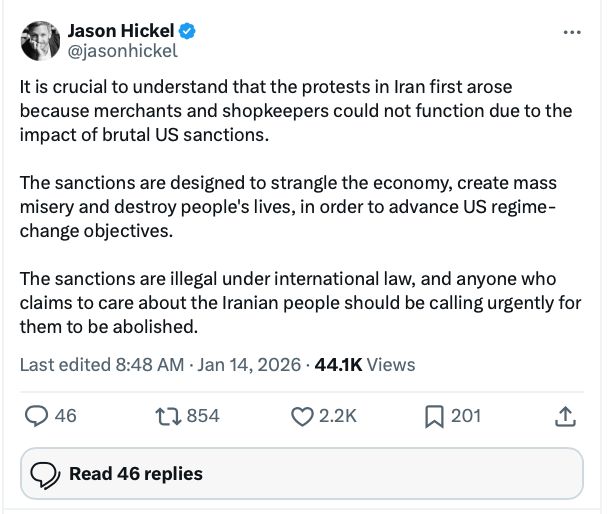
X post by Jason Hickel
Jason Hickel’s January 14, 2026 X post, which quickly drew tens of thousands of views and widespread engagement, functions as a key narrative pivot in online discussion of the Iran protests by framing the unrest primarily as the result of crippling U.S. sanctions rather than internal political or social grievances. As an established critic of global inequality, Hickel argues that sanctions have “strangled the economy” and inflicted widespread hardship, pushing everyday Iranians into crisis and fueling protest activity. By emphasizing external economic pressure over domestic policy failures, his message redirects blame toward foreign actors and aligns with broader narratives that cast the protests as influenced or exploited by U.S. interests. This framing resonates with audiences skeptical of Western intervention, contributes to polarized debate online, and highlights how influential individuals can shape narrative direction by blending factual economic effects with strategic political interpretation.

X post by Archie Leishman
Archie Leishman's January 12, 2026, X post—shared by a UK-based user with about 1,400 followers—highlights a headline from The Times claiming Tehran declared the situation "under control" despite 500 confirmed deaths in the protests, accompanied by a photo of a massive crowd waving Iranian flags. The post's call for immediate involvement from U.S. President Donald Trump and Israeli Prime Minister Benjamin Netanyahu ("BiBi") echoes diaspora and conservative voices urging external pressure to break the stalemate, especially as Trump repeatedly threatened intervention (e.g., "help is on the way" and warnings of "strong action" against executions) and discussed options with officials, while Netanyahu engaged in related talks.
Such calls amplified geopolitical tensions, fueling regime warnings of retaliation against U.S. bases or Israel if attacked, and contributing to polarized narratives: they bolstered protester hopes for support but risked legitimizing Tehran's claims of foreign-orchestrated chaos (blaming U.S./Israeli "exploitation"), potentially justifying harsher repression.
This report also shows that narrative classifiers and emotion profiles can accurately reveal the ground truths of not only the protests but also how foreign actors are distorting and manipulating this crisis. Formulating intervention strategies must take into account the ground truths narrative intelligence reveals.
The 2026 Iran protests illustrate how modern political crises are fought simultaneously in streets and in information space. While economic hardship and state repression remain core drivers of unrest, the global narrative battle has profoundly shaped how the crisis is interpreted, both within Iran and internationally. Fear-based framing, foreign influence operations, and polarized social media ecosystems have deepened mistrust, distorted facts, and provided rhetorical cover for harsh crackdowns. Rather than clarifying reality, the information environment has fragmented it—producing parallel, mutually reinforcing narratives that serve competing geopolitical interests. Absent meaningful economic reform, political liberalization, or reduced external interference, Iran remains vulnerable to recurring cycles of protest and repression, with future outcomes likely to be determined as much by information power as by events on the ground.
This report also shows that narrative classifiers and emotion profiles can accurately reveal the ground truths of not only the protests but also how foreign actors are distorting and manipulating this crisis. Formulating intervention strategies must take into account the ground truths narrative intelligence reveals.
Formulating intervention strategies must take into account the ground truths narrative intelligence reveals.
Lead Analyst:
Ellie Munshi is an analyst at the EdgeTheory Lab. She is studying Strategic Intelligence in National Security and Economics at Patrick Henry College. She has led special projects for the college focused on Anti-Human Trafficking, Chinese influence in Africa, AI influence on policymakers, and is also an intelligence analyst intern at the Department of War.

