
Menu
This EdgeTheory Narrative Intelligence report examines how vaccine-related narratives are constructed, amplified, and escalated across ideologically distinct U.S. media ecosystems—revealing how identical health signals produce sharply different interpretations, pressures, and behavioral responses.
Drawing on parallel narrative briefs covering the same time window, the analysis traces how measles outbreaks, CDC guideline changes, flu severity, legal challenges, and global health developments are framed differently depending on source ecosystem and audience identity. Rather than evaluating medical accuracy or public health policy, the report focuses on how meaning is assigned, where emotional pressure accumulates, and why narrative momentum often precedes measurable shifts in trust, behavior, and institutional response.
By mapping narrative themes, emotional framing, escalation patterns, and source alignment, the report shows why vaccine narratives are not fixed problems to correct—but dynamic environments organizations must understand and navigate in high-scrutiny markets where perception moves faster than data.
Across industries, leaders are often surprised by how quickly trust can erode before events indicate a shift in perspectives. In the vaccine media landscape, public trust shifts rapidly across regions and communities, often untethered to any new clinical evidence or regulatory action. These shifts emerge when narratives form, spread, and gain influence across distinct information environments.
This analysis evaluates narrative amplification across ideologically distinct U.S. media ecosystems over a 5-week window (Dec 19, 2025 - Jan 26, 2026), tracking over 1,000 narrative items from 329 sources. Our assessment focuses on dominant themes, emotional framing strategies, and escalation mechanisms that shape perception and downstream decision-making.
Examining these narrative mechanics enables analysts to map how meaning diverges, where pressure accumulates on companies and customers alike, and why the same signal can produce opposing behavioral responses depending on who encounters and amplifies it.
Both conservative and liberal media ecosystems amplify identical health signals—measles outbreaks, declining vaccination rates, flu severity, CDC guideline changes, legal challenges, and WHO withdrawal—but interpret them through competing explanatory frames. These narrative influences shape perception, risk tolerance, and response behavior, often before organizations recognize pressure is forming. Rather than comparing sentiment alone, our assessment focuses on three structural dimensions that determine how perspectives travel, and pressure accumulates:
These structures revealed in EdgeTheory’s Narrative Intelligence (NARINT) briefs form the basis of divergent themes across media ecosystems, audiences, and companies.
Core Finding: The Interpretive Layer Drives Risk
Both ecosystems repeatedly amplify the same factual signals:
What differs is what those signals are made to mean—and where responsibility is assigned.
Narrative risk escalates not when facts change, but when explanatory frames harden and begin to travel faster than institutional responses.
| Signal | Conservative Interpretation | Liberal Interpretation |
| Measles outbreaks | Policy failure and institutional breakdown | Dangerous hesitancy requiring urgent action |
| CDC guideline changes | Credibility loss and politicization | Threat to public health norms |
| WHO withdrawal | National preparedness and intelligence risk | Retreat from global cooperation |
Divergent narrative signals identified in EdgeTheory’s NARINT brief on vaccines.
Conservative-oriented amplifications are framing public health developments as downstream consequences of institutional failure and governance breakdown.
Across conservative-aligned sources, vaccines are rarely discussed as isolated medical interventions. Instead, they are embedded in a broader narrative about legitimacy, sovereignty, and institutional trust.
Key structural patterns include:
The effect is cumulative. Health threats feel unresolved, not because they are denied, but because they are subordinated to a larger story about institutional decay.
Liberal-oriented amplification centers on immediate harm prevention, moral urgency, and measurable human impact.
Here, outbreaks and deaths are not symptoms of institutional collapse, but evidence of preventable failure requiring action.
Recurring structural features include:

Both media ecosystems rely primarily on neutral framing, with emotion selectively activated to serve targeted functions. The difference lies not in intensity but in how emotion is deployed to guide an audience’s interpretation and response to particular events and issues.
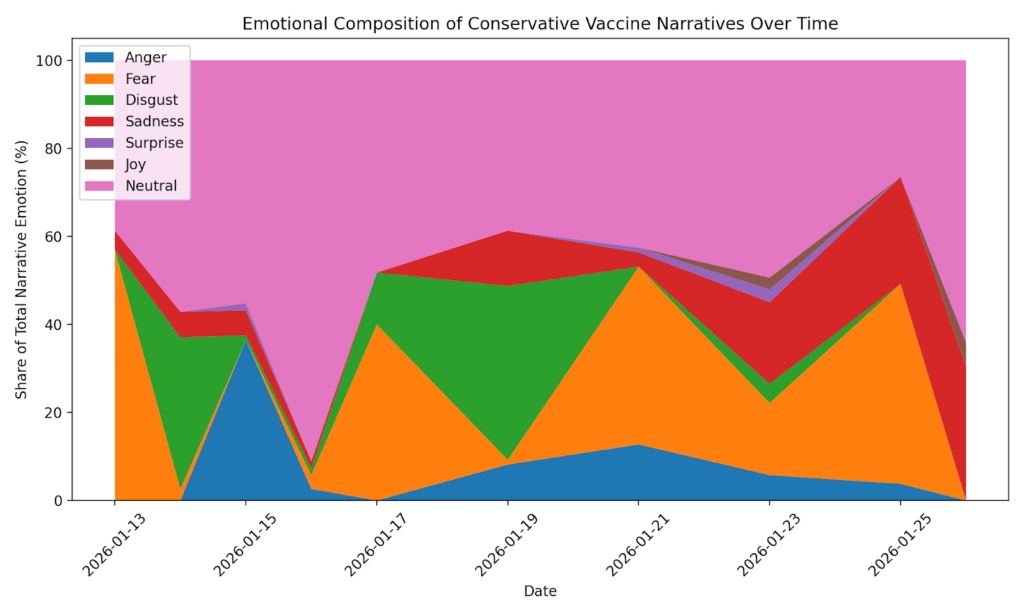
Conservative Pattern: Structural Emotion
Fear rises around loss of national preparedness or control of information: withdrawal from the WHO, changes to disease surveillance systems, and distrust of social platforms. Anger spikes at perceived overreach and legal conflicts. Disgust and sadness form a persistent layer reinforcing themes of institutional decay. Across these emotions, each narrative investigates claims of scientific legitimacy and implies general distrust.
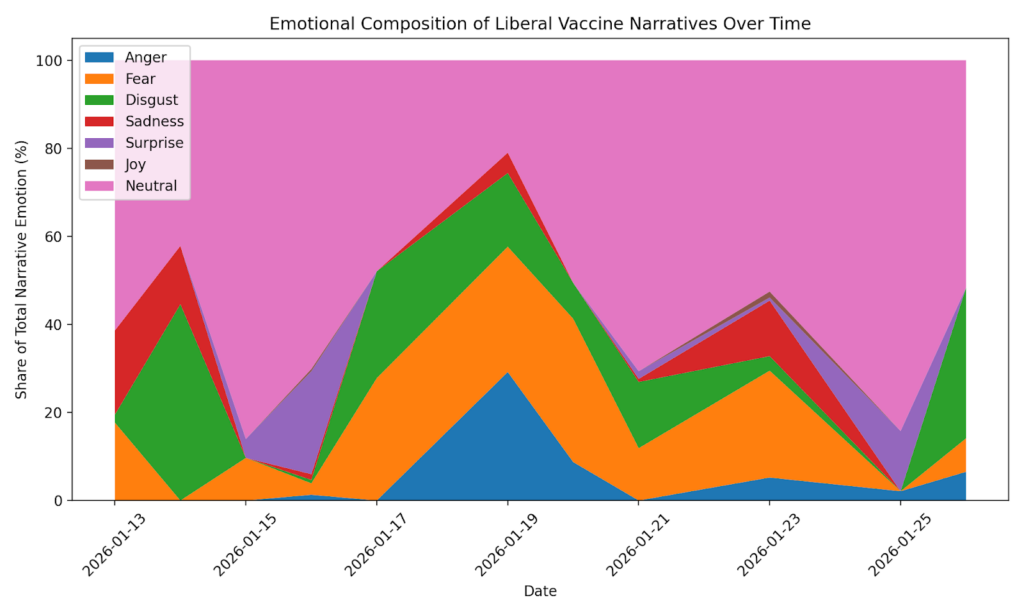
Liberal Pattern: Human-Impact Emotion
Fear remains sustained and steady, tracking measles resurgence, RSV spread, and child flu deaths (216 fatalities highlighted as a 15-year high). Disgust increases around policy rollbacks and vaccine skepticism. Sadness follows stories of vulnerable populations and inequitable access. In this media ecosystem, emotion heightens urgency and moral responsibility, creating an environment more conducive to action than criticism.
Narrative escalators describe recurring patterns that amplify attention, emotional intensity, and persistence beyond your typical news cycle. By transforming shared facts into divergent pressures, escalators indicate where attention and reputational risk are likely to compound.
Attack vectors leveraged in conservative-oriented media.
Attack vectors are leveraged in liberal-oriented media.
Both sides rely on real events, but selective narrative escalation results in divergent perceptions and behaviors.
EdgeTheory identified a growing divergence around vaccine safety driven by adversarial sources contributing to a fragmented media environment. Within this landscape, a peer-reviewed study claiming mRNA vaccines cause genetic disruption was amplified 16 times by coordinated adversarial sources in foreign countries. These networks function as a visibility multiplier for content already polarizing in U.S. media networks. EdgeTheory’s NARINT brief further observed malign influencers reframing the standard peer-review timeline as evidence of a “Bio-Pharmaceutical Complex” and intentional censorship. This narrative campaign risks reinforcing pre-existing skepticism among domestic audiences. Such amplifications recast legitimate regulatory processes as conspiracy, increasing reputational risk in an already polarized environment.
Common “Entities” identified across narrative items in EdgeTheory’s NARINT brief.
Top sources and influential posts using the term “Bio-pharmaceutical Complex.”
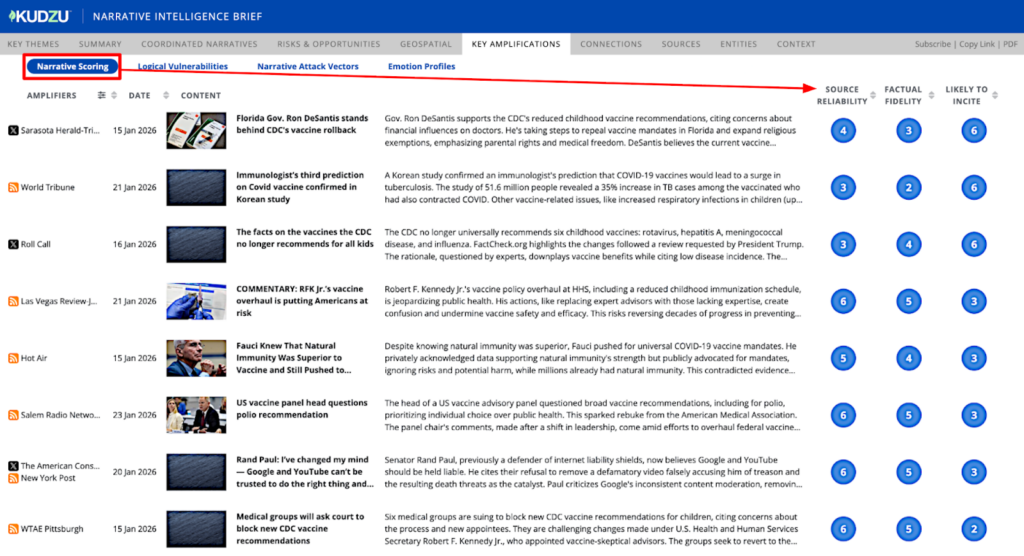
Because this narrative relies on misinterpretation of scientific standards, audiences may be receptive to simple corrections to online narratives. However, EdgeTheory identified that the charged terminology “Bio-Pharmaceutical Complex” is being promoted by multiple sources with moderate-to-high incitement rates. This level of influence likely reinforces skepticism in targeted audiences.
Likelihood the narrative incites action and vulnerabilities in the narrative as identified by EdgeTheory’s NARINT brief
Narratives translate into real-world pressure before sentiment data, polling, or regulatory action catch up. Complex emotional targets, framing techniques, and key phrases can make it difficult to predict market effects.
Understanding:
provides early visibility into reputational exposure, policy pressure, and behavioral risk.
The vaccine narrative divide is not primarily about disease risk disagreement. It is about where responsibility is assigned and which explanations are reinforced through targeted amplifications.
Emotion Profiles of highly amplified items.
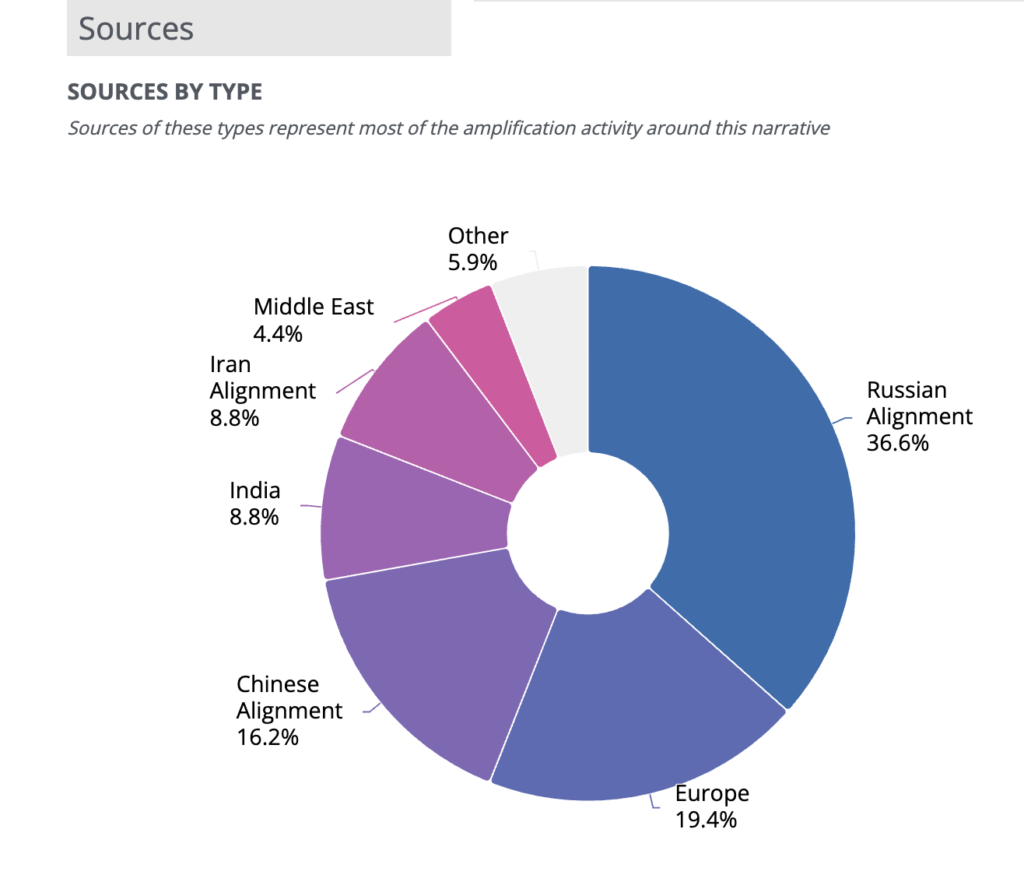
Source alignment in EdgeTheory briefs reveals adversarial priorities and intentions.
These sources leverage charged language to poison the well of online activity surrounding politically and emotionally charged topics. Whatever their intent, the effect is deep reputational and even operational harm, as we later identify.
Narrative influence tactics identified in EdgeTheory’s Narrative Intelligence brief on vaccines.
By tracking sources across various feed types (traditional news sites, social media, etc.), NARINT identifies risks and opportunities stemming from these coordinated narrative attacks. The image was taken from the Risks & Opportunities section of our NARINT brief on vaccines.

NARINT briefs leverage diverse source types to identify opportunities for constructive narrative engagement.
Ultimately, campaigns that anticipate how adversarial narratives will be interpreted differently across ecosystems can avoid unintentionally reinforcing skepticism and more effectively focus their efforts.
Operational Dimensions Across Stakeholder Functions
Leadership: Narrative campaigns threaten investor confidence, recruitment, and regulatory relationships before traditional metrics register a change. Real-time visibility into narrative vectors enables proactive positioning ahead of impacts to market capitalization. Further understanding which narratives cannot be collapsed allows leaders to plan around them, not against them
Operations: Emerging market facilities face reputational damage, disrupting local partnerships. An India counterfeiting narrative demonstrates how product integrity concerns spread beyond local markets. Identifying narrative attacks enables optimized messaging and relationship-building, allowing organizations to surge resources where needed or exercise restraint where a response might amplify backlash.
Personnel: Scientific staff can face harassment when research contradicts prominent adversarial narratives. Recognizing which explanatory frames are hardening earliest in emotional profiles enables early planning.
The strategic question is no longer whether trust is rising or falling. The question is-
Which narratives are shaping belief right now?
And how early would you want to understand them before they harden into behavior, policy, or market impact?
Organizations that answer this question can gain time: time to interpret and respond with precision rather than rushed messaging.
In environments where perception moves faster than data, narrative intelligence becomes a necessary strategic capability.

