
Menu
China’s cognitive campaign includes state media and platforms such as Weibo and Rednote to generate high-volume narratives that legitimize escalation and recast deterrence by the PRC as a moral imperative. Multiple articles from WhatsonWeibo.com have cited weibo posts claiming China’s moral high ground in legitimizing forceful reunification narratives. China’s information warfare surrounding Taiwan is increasingly characterized by synchronized digital propaganda with real-world military maneuvers such as PLA airspace violations, naval operations, and cyber attacks. These narratives construct a closed-loop influence architecture designed to destabilize Taiwan’s sovereignty claims and erode regional support networks. The messaging appears aimed not just at audience persuasion but psychological attrition, preparing the information environment for potential forceful reunification.
Beijing’s core strategy leverages Shi—the cultivation of strategic advantage by shaping momentum and perception—expressed through synchronized kinetic signaling and rhetorical saturation. This brief draws on EdgeTheory’s NARINT intelligence and EdgeTheory assistant synthesis to map how legal, ideological, and emotional messaging converges into a full-spectrum campaign. These influence efforts extend beyond the Taiwan Strait, targeting Southeast and South Asia with tailored narratives that exploit Cold War framings, anti-colonial sentiment, and regional insecurity. By charting the mechanics and reach of China’s narrative warfare, this analysis highlights the reputational risks, strategic blind spots, and early indicators that policymakers and institutions must now monitor with greater urgency.
1. Influence Synchronization Between PLA Posturing and Narrative Operations
Chinese Foreign Malign Influencers are tightly coupling real-world military movements (e.g., live-fire drills, encirclement exercises) with digital psychological operations across Weibo and Rednote. Chinese Foreign Malign Influencers closely couple real-world military movements—such as live-fire drills and encirclement.This blend of physical and digital deterrence functions as an early warning indicator of escalatory intent, not merely rhetorical posturing.
2. Coordinated Narrative Campaign Framing China’s Forceful Reunification as Justified Response
China’s Foreign Malign Influencers are orchestrating a coordinated campaign to portray forceful reunification as a justified response to perceived threats from Taiwan’s democratic system and international alignment. The effort is designed to politically legitimize escalation while simultaneously persuading the Taiwanese public that reunification is both inevitable and necessary. Using Shi to shape momentum, FMIs flood digital platforms with military imagery, nationalist rhetoric, and ideological messaging aimed at weakening morale, undermining resistance, and normalizing PLA aggression as defensive and morally imperative.
China’s narrative warfare centers on leveraging social media amplifiers—primarily on Weibo and Rednote—to align public perception with military activity. Foreign Malign Influencers (FMIs) coordinate messaging that mirrors PLA maneuvers, reinforcing claims of sovereignty and legitimacy. Narrative surges often coincide with airspace incursions, naval movements, and cyber operations, indicating deliberate synchronization to prepare the information environment for escalation.

NARINT Mapping from on Israel-Iran Conflict with narrative sources (yellow) and targets (red)
Beijing functions as the central node for narrative projection across the Indo-Pacific, with Taiwan positioned as both the ideological adversary and narrative target. From this hub, state-linked actors like Ecns.cn amplify themes that label President Lai Ching-te’s administration as destabilizing and “separatist,” framing such rhetoric as justification for escalatory countermeasures. The PLA’s posture is depicted not as aggression, but as calibrated defense—strategically framed to rebrand China as a regional stabilizer. This spatial-narrative convergence reinforces Beijing’s claim to sovereign authority while exporting a normalized view of militarized deterrence, effectively reshaping the global interpretive map of the Taiwan Strait.
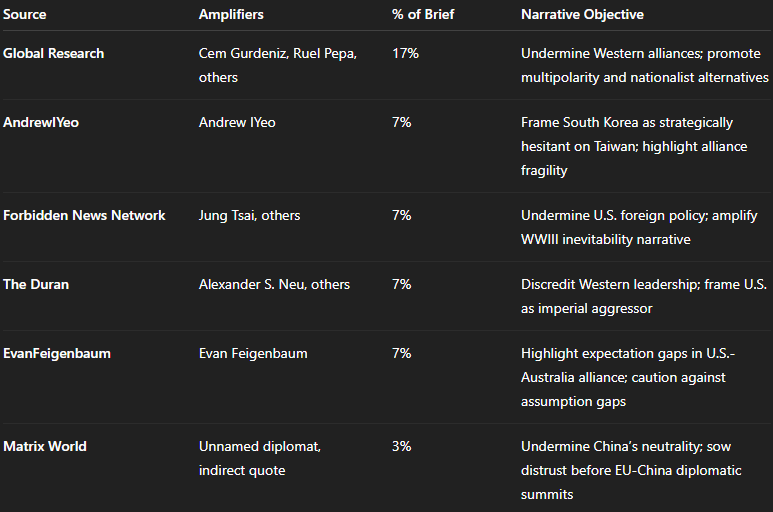
Summary of narrative strategies from ChatGPT categorizing most amplified sources in EdgeTheory briefs
The top five amplifiers play a strategic role in shaping cross-border perceptions and legitimacy narratives in the China-Taiwan conflict. These outlets range from overt Chinese state propaganda to more neutral-seeming foreign platforms, each influencing how regional instability is interpreted. State-aligned sources reinforce Beijing’s sovereignty claims and frame Taiwan’s leadership as illegitimate, while foreign outlets like WION and ZeroHedge extend that influence into international discourse, repackaging official narratives through the lens of military escalation, U.S. involvement, or multipolar power dynamics.
These amplifiers create a narrative environment that blends influence with selective facts,shaping sentiment on Taiwan’s status, security posture, and international support. This narrative pressure contributes to the erosion of consensus on Taiwan’s sovereignty, primes audiences for escalation as plausible, and increases reputational risk for governments or institutions seen as supporting Taiwan’s autonomy.

Screenshot of annotated source alignment chart from EdgeTheory NARINT brief
According to EdgeTheory narrative tracking capabilities, nearly 60% of discourse surrounding the China-Taiwan conflict originates from Russian and Chinese-aligned media, forming a seemingly coordinated narrative offensive. Chinese sources aggressively reinforce sovereignty claims, delegitimize Taiwan’s leadership, and frame military escalation as a necessary defense of territorial integrity. Together, these narratives construct a dense influence ecosystem that erodes international consensus and normalizes Beijing’s confrontational posture.
Secondary actors—including India, Iran, and Middle Eastern outlets—introduce divergent perspectives that complicate the narrative environment. Indian media tend to promote restraint and regional stability, while Iranian and Arab-language sources often use the conflict to critique U.S. involvement. European and neutral voices remain limited, contributing little counterbalance. This narrative fragmentation undermines clarity, increases reputational risk for Taiwan’s supporters, and weakens coherent policy responses.

Screenshot of article by vz.ru portraying Taiwan as a microcosm of geopolitical struggle
Russian outlets portray Taiwan as a geopolitical fault line in a broader multipolar power struggle, using anti-Western messaging to weaken allied cohesion.
FMIs, spearheaded by Chinese state outlets like Ecns.cn and China News Service and amplified via social platforms such as Weibo and Rednote, produced 99 narrative items over 30 days from 39 distinct sources, tightly synchronizing with PLA military maneuvers near Taiwan. These narratives mirror real-time military maneuvers—such as airspace incursions, naval deployments, and non-kinetic threats—while framing Taiwan’s leadership as illegitimate and “separatist.” Coordinated headlines and viral social content deploy charged language like “crush separatist fantasies” and “Taiwan is already Chinese,” presenting escalation as both justified and inevitable.

Screenshot of geospatial narrative origins (yellow) and targets (red) from EdgeTheory brief on China-Taiwan conflict
Geospatial analysis reveals that China’s narrative campaigns are closely aligned with digital infrastructure vulnerabilities, particularly undersea cable chokepoints connecting Taiwan to global networks. Amplified messaging from Ecns.cn, China News Service, and RT frames Taiwan’s independence rhetoric as a threat justifying potential kinetic action—implying digital isolation as a tool of force. Hong Kong, under Beijing’s control, links directly to Taiwan, Japan, and the Philippines via high-density cable routes, making it a strategic chokepoint China could exploit to disrupt Taiwan’s communications. This aligns with broader Chinese narratives portraying Taiwan as isolated and illegitimate, while India’s expanding role in digital infrastructure through Chennai offers a subtle counterbalance echoed in regional pro-Western amplifiers.

Image from CGTN highlighting Taiwan-China conflict titled “Taiwan secession strongly thwarted”
Chinese state-affiliated amplifiers such as Sina – Finance and CGTN Officials are actively constructing a sovereignty-centered narrative that casts China’s military drills, sanctions, and diplomatic moves near Taiwan as measured, lawful responses to foreign provocation—primarily from the United States. These outlets employ restrained, bureaucratic language like “legitimate protection of sovereignty” and “restoration of national unity” to mask escalation beneath a façade of procedural normalcy. By avoiding overt emotional cues, the narrative maintains an image of rational statecraft while reinforcing territorial claims. This framing strategy not only consolidates domestic consensus but also positions China as the aggrieved stabilizer in global discourse, especially amid 2025’s intensified exercises, which are depicted as routine and defensive rather than aggressive or destabilizing.
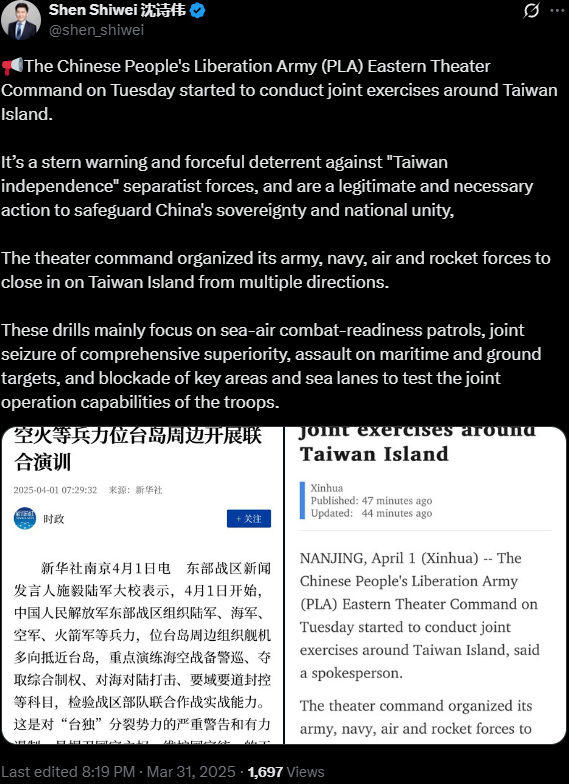
Image from X (formerly twitter) profile Shen Shiwei about PLA joint exercises near Taiwan
The PLA Eastern Theater Command’s joint exercises near Taiwan function less as tactical surprises and more as strategic signaling campaigns—recurring demonstrations of force that reinforce Beijing’s deterrence narrative and territorial intent. Though these maneuvers are part of an established pattern, their sustained frequency signals operational readiness and institutional will, projecting continuous pressure without triggering overt escalation. This persistence amplifies the psychological and geopolitical strain across the Taiwan Strait, heightening miscalculation risk while normalizing PLA activity as a baseline condition. In narrative terms, the exercises act as a calibrated warning—shaping international perception, complicating diplomatic de-escalation, and embedding China’s message of resolve into the regional security architecture.

X (formerly Twitter) post amplifying One-China narrative from June 26
China is increasingly linking military actions with ideological messaging to reinforce its claims over Taiwan. An X (formerly Twitter) repost of a June 26 post by the Chinese Embassy in the U.S. reaffirmed the one-China principle—the official policy of the People’s Republic of China that asserts there is only one sovereign China and that Taiwan is an inseparable part of its territory. According to the U.S. Congressional Research Service, this principle is the foundation of China’s foreign policy and a core condition for diplomatic relations with Beijing. By pairing military drills with ideological messaging reaffirming its claims, China signals that its stance on Taiwan concerns both national sovereignty and the international order.
Beijing reinforces its claim by citing international law and asserting global consensus. The post references the UN Charter and claims backing from “multiple leaders” to frame Taiwan’s status as widely accepted and settled. This narrative aims to undermine Taiwan’s sovereignty claims and portray pro-independence efforts as violations of international norms. By framing military maneuvers as defensive and grounded in accepted international principles, China aims to isolate pro-independence voices while justifying its escalation. This blend of kinetic activity and diplomatic messaging lies at the core of China’s cognitive warfare strategy in the Taiwan conflict.
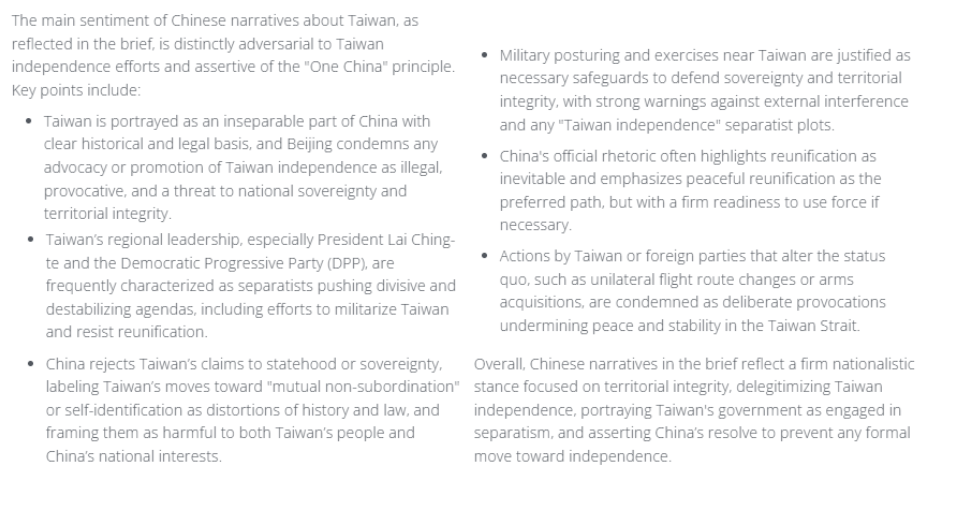
NARINT AI assistant from EdgeTheory brief providing context for China-Taiwan Conflict
The EdgeTheory AI assistant functions as an interactive tool throughout the briefs. It provides synthesized insights that simplify complex geopolitical dynamics into actionable intelligence. For example, the EdgeTheory assistant concisely outlined dominant themes in Chinese narratives regarding Taiwan, highlighting China's firm adherence to the “One China” principle and denial of Taiwanese sovereignty. The EdgeTheory assistant highlighted Beijing’s framing of Taiwanese independence as a legal distortion and a threat to Chinese unity, portraying Taiwan’s leaders as separatists. These observations contextualize the ideological basis behind China's media messaging and clarify how narrative framing justifies military exercises and diplomatic condemnation.
In this brief, the EdgeTheory assistants summary provides a foundation for structuring the broader analysis. Its breakdown of key narrative claims, including China’s portrayal of reunification as inevitable and the framing of Taiwan’s actions as provocations, offered a clear baseline from which subsequent sections elaborated on rhetorical trends, threat perception, and reputational targeting. The insights guided prioritization of narrative themes for further exploration, particularly focusing on PLA signaling, digital propaganda patterns, and reputational attacks on Taiwanese leadership. Identifying gaps in narrative coverage, including less focus on economic messaging, the EdgeTheory assistant provided clear guidance for additional data collection or analysis to enhance the brief’s comprehensiveness.

NARINT AI assistant from EdgeTheory brief providing context for China-Taiwan Conflict
EdgeTheory’s assistant identifies China’s narrative asserting Taiwan as a “core interest” and justifying forceful reunification under Xi Jinping functions as a strategic tool to normalize military pressure and frame coercion as national defense. Through increasingly frequent PLA naval deployments and joint drills, Beijing signals both operational readiness and psychological dominance, casting Taiwanese independence as an existential threat. This narrative aims to delegitimize Taiwan’s leadership, erode international support, and discredit U.S. regional presence as provocative interference.
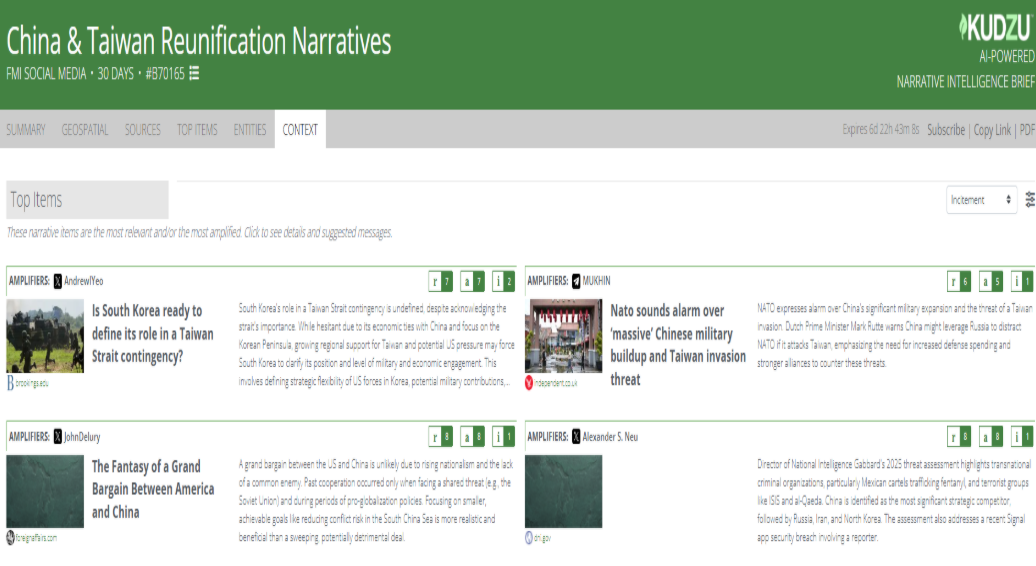
Top Items from NARINT EdgeTheory Brief
A 30-day narrative intelligence brief on China–Taiwan reunification reveals a sharp uptick in incitement-driven discourse, with top-performing narratives focusing on Chinese military aggression, allied response scenarios, and perceived inevitability of conflict. The most inciting items—posts highlighting South Korea’s rumored involvement in a Taiwan Strait contingency and NATO’s alarm over a Chinese military buildup—recorded the highest engagement and virality, reflecting elevated audience sensitivity to regional war scenarios. These narratives serve dual functions: signaling Chinese strategic pressure while amplifying anxieties among U.S. allies and international observers. Posts linking PLA exercises to potential invasion timelines or framing Taiwan’s defenses as insufficient also triggered high amplification, particularly on platforms like RedNote and Weibo, where nationalist sentiment and foreign threat perception drive algorithmic prioritization.
The narratives with top incitement rates frame the Taiwan Strait not merely as a flashpoint, but as a theater of imminent confrontation—drawing in actors like NATO, South Korea, and the U.S. into an unfolding meta-conflict. The inclusion of speculative diplomacy, such as the so-called “Fantasy of a Grand Bargain,” adds narrative complexity while subtly eroding trust in Western strategic clarity. Meanwhile, Taiwan’s response—highlighted through increased defense spending and civil readiness—emerges as a counter-narrative of resilience, though often overshadowed by the dominance of invasion-centered framing. As social platforms magnify these narratives, Kudzu’s data suggests that incitement, not information, is driving the tempo—turning perception into a geopolitical accelerant with implications for deterrence, alliance cohesion, and escalation risk.
EdgeTheory’s Foreign Malign Influencers (FMI) module has identified a concentrated campaign over the past 30 days involving 117 sources and 312 narrative items that collectively advance China’s imperative to reunify with Taiwan by force. Central to this effort is the ancient Chinese concept of shi—the deliberate cultivation of strategic advantage through shaping momentum, perception, and power dynamics. Beijing’s messaging ecosystem blends state media, social platforms, and foreign amplifiers to portray Taiwan’s democratic actions and its alliance with the U.S. as provocative threats, while framing Chinese military and diplomatic maneuvers—such as the new Taiwan Strait flight routes—as justified assertions of sovereignty. This information offensive applies layered psychological pressure designed to weaken Taiwan’s resolve and influence regional perceptions in favor of China’s reunification agenda.
China’s cognitive warfare closely parallels Russia’s territorial ideology, equating control over contested lands with national legitimacy and power. The messaging saturates social media channels with images of Chinese military strength—highlighting advanced platforms like the J-35A stealth fighter and Shandong aircraft carrier—while portraying Taiwan’s democratic identity as a divisive betrayal of Chinese unity. This fusion of ideological amplification and military signaling increases the risk of miscalculation and escalates tensions across the Taiwan Strait and the broader Indo-Pacific region.

EdgeTheory brief highlighting narrative source Beijing (yellow) & target Kazkhastan (red)
A June 18 article from another well-known CCP propaganda outlet, Guangming Daily, highlighted President Xi Jinping’s meeting with Kyrgyz President Sadyr Japarov at the China–Central Asia Summit, where Japarov reaffirmed Beijing’s core narrative endorsing the one-China principle, opposing Taiwan independence, and rejecting foreign interference. This official framing serves to project regional diplomatic support for China’s Taiwan stance, reinforcing the narrative of Taiwan as an internal matter backed by international partners.
Analysis of less-known but credible sources amplifying Guangming Daily reveals a network of regional state-affiliated media and respected local outlets, such as Kyrgyzstan’s 24.kg, Kazakhstan’s Kazinform, and Uzbekistan’s UzReport, alongside Central Asian political analysts on platforms like The Diplomat and Eurasianet. While these sources maintain limited international reach compared to global outlets, their alignment with CCP messaging suggests a coordinated regional amplification effort. This pattern highlights how Beijing’s narrative is extended through credible regional partners, expanding its legitimacy in Central Asia even as independent verification of popular support remains limited.
EdgeTheory assistant NARINT brief
The EdgeTheory assistant was asked “What are the main sentiments of Chinese Narratives about Taiwan”. The assistant then highlights a focused campaign using legal legitimacy and psychological pressure to undermine Taiwan’s sovereignty. State-backed messaging cites international documents like UN Resolution 2758 to frame Taiwan as part of China, portraying independence efforts as violations of global consensus. Psychological operations such as the “10 Lectures on Unity” prime audiences to see reunification as inevitable and just, while Taiwan’s leaders, especially in the DPP, are cast as agitators threatening stability.
This legal-psychological framework is fused with militarized rhetoric and diplomatic delegitimization, isolating Taiwan while reinforcing China's reunification agenda. The EdgeTheory assistant detects persistent PLA-linked messaging vowing to “crush” separatists—signals that normalize force within a pre-defined strategic timeline. These narratives are not ad hoc; they operate within the doctrinal logic outlined in Unrestricted Warfare which emphasizes blending legal, psychological, and military tools to shape adversary behavior without declaring war. Through tonal analysis and narrative mapping, this fusion becomes clear: Beijing’s messaging ecosystem interlocks deterrent language with international lawfare, constructing a psychological architecture that sustains pressure and restricts Taiwan’s diplomatic maneuverability.
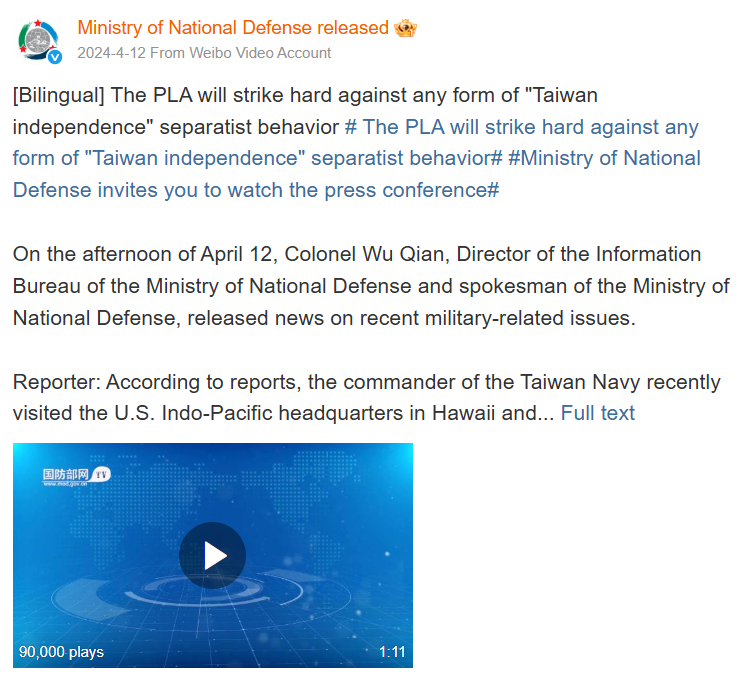
Weibo post in Mandarin highlighting “Taiwan separatist behavior” on April 12
Narrative dynamics in the Taiwan-China conflict have entered a new phase of hybrid escalation, as the PLA intensifies both rhetorical pressure and operational activity alongside coordinated propaganda. The Ministry of National Defense’s recent condemnation of “Taiwan independence” echoes prior messaging on social media and from outlets such as CGTN and ECNS.cn, portraying Taiwan’s leadership as illegitimate and destabilizing. These narratives are reinforced by kinetic maneuvers—airspace violations, maritime incursions, and naval deployments—aimed at normalizing the use of force and blurring deterrence thresholds. Colonel Wu Qian’s press conference on PLA combat readiness serves as both internal signaling and external deterrence, creating a feedback loop where narrative and military actions escalate in tandem.
Simultaneously, Taiwan’s naval visit to the U.S. Indo-Pacific Command has shifted the international narrative, provoking stronger Chinese responses. Beijing frames the visit as a sovereignty breach, using it to justify heightened military readiness and tighter information control, especially through strategic choke points like Hong Kong. This fusion of kinetic posture with narrative dominance exemplifies China’s evolving hybrid warfare strategy. Taiwan’s partners now confront a fragmented information environment—shaped by misperceptions, narrative inflation, and operational ambiguity—that complicates coordinated response across the Indo-Pacific.
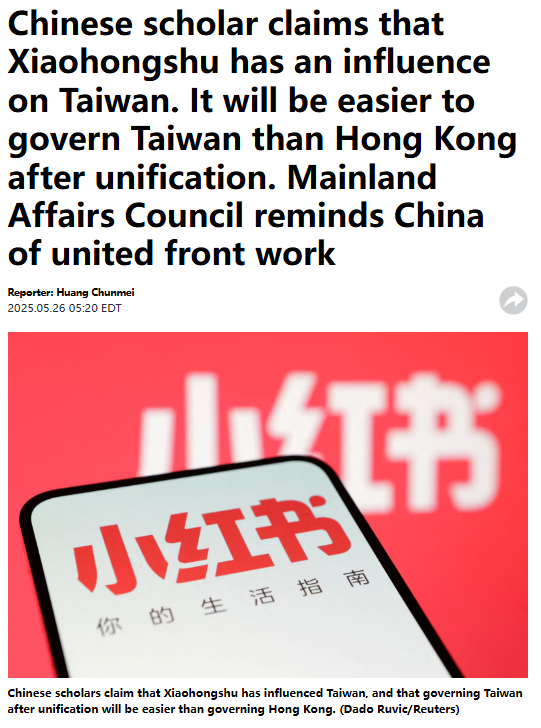
Image from RFA website about Rednote influence on China-Taiwan reunification
Content surfaced from Rednote in English reveals how digital sentiment analysis is being leveraged to track and influence public attitudes surrounding Taiwan’s reunification. The platform’s data shows spikes in aggressive nationalism and pro-reunification sentiment following major PLA operations, suggesting an intentional feedback loop between state-driven narratives and grassroots amplification. This reinforces the view that China’s strategic objectives are not only advanced through military signaling but also through the emotional conditioning of its domestic audience.
Rednote’s insights offer a valuable lens into the reputational battlespace, where psychological pressure and ideological framing serve as force multipliers for China’s coercive diplomacy. The platform’s tracking capabilities reveal that digital opinion is increasingly weaponized to marginalize moderate voices and pressure local influencers to conform, thus closing the narrative space. In parallel with military escalation noted in the NARINT brief, Rednote provides critical context to understand how the social narrative is being systematically steered toward confrontation.
Foreign Malign Influencers (FMIs) play a key role in China’s by aligning psychological operations with military actions to create a coercive narrative around Taiwan. Taiwan is framed not just as disputed territory but as a reputational target, subjected to layered narratives blending legal, ideological, and kinetic justifications for Beijing’s growing pressure. EdgeTheory’s narrative intelligence tools, especially itsEdgeTheory assistant and NARINT mapping, have been vital in decoding this mix of sentiment manipulation and geopolitical moves. The assistant's real-time analysis helped identify key narratives and early warning signs, showing how digital sentiment is used to strengthen pro-reunification views and suppress dissent.


