
Menu
Menu
Signals of the Strait of Hormuz closure were visible in the information environment weeks before the disruption reached Western headlines — or any supply chain risk dashboard.
By the time most organizations recognized the crisis, the narrative driving it had already formed, spread, and begun moving markets. Insurance premiums were rising. Shipping routes were being reconsidered. Commodity traders were already pricing in uncertainty.
This report examines how Iranian state messaging around the Strait of Hormuz functions as a measurable precursor to supply chain disruption — and what those signals looked like before the crisis became a crisis.
It covers the four narrative themes Iran deployed to shape global perceptions of the Strait, how that messaging amplified through state media, social networks, and Western outlets, and what supply chain risk teams can monitor to detect similar escalation patterns earlier.
The window to act proactively is always open before the narrative matures. This report shows what it looks like before it closes.
EdgeTheory Narrative Intelligence Report | March 2026
Global markets have grown increasingly volatile as Iran’s closure of the Strait of Hormuz has disrupted global oil flows, forcing energy supply chain managers into crisis mode. Firms now find themselves rapidly rerouting shipments around the Cape of Good Hope, securing alternative suppliers in West Africa and the Americas, and drawing down strategic and commercial reserves. Managers are being forced to renegotiate contracts, locking in spot cargoes at elevated prices, and coordinating closely with insurers and shippers as risk premiums surge. At the same time, they are implementing demand-side measures—prioritizing critical customers, adjusting delivery schedules, and hedging against further price shocks—while preparing contingency plans for prolonged disruption.
Yet signals of a potential closure began appearing as early as mid-February, before the war had even commenced. Had these signals been more widely amplified, the fallout from the closure might have been lessened. In short, narrative activity surrounding the Strait of Hormuz offers a measurable precursor to economic and supply chain disruption. By analyzing the themes, amplification patterns, and downstream effects of Iranian messaging, the following report highlights the growing importance of narrative intelligence as a tool for anticipating risk in highly interconnected global systems. The report situates information flows alongside physical events, demonstrating how perceptions of instability can influence markets, logistics, and decision-making before tangible disruptions occur. In doing so, it provides supply chain professionals with a framework for interpreting narrative signals as actionable indicators of emerging volatility.
Iran's recent closure of the Strait of Hormuz has already impacted gas prices in the U.S., demonstrating that a single geopolitical narrative can move global energy markets before the first ship even changes course. Now Tehran has declared the Strait to be permanently closed to American or Israeli vessels, as well as any ship headed to either destination. In the aftermath of this announcement, a number of narratives have appeared, all of which are aimed at shaping global perceptions of who really controls this major waterway, through which about 20 percent of the world's oil supply moves.
The most active contributor to these narratives thus far is the state of Iran. Both state-aligned media and senior officials are increasingly framing the Strait of Hormuz and Persian Gulf shipping lanes as pressure points for squeezing western economies, including the U.S. Many of the narratives they employ use threatening language promising to destroy any American or Israeli vessels entering the Strait. In this manner, the narratives threaten Americans with energy disruption, shipping insecurity, and global economic consequences. While these narratives do not necessarily signal imminent military action, they nonetheless shape expectations of instability, influence market perceptions, and amplify geopolitical risk narratives.
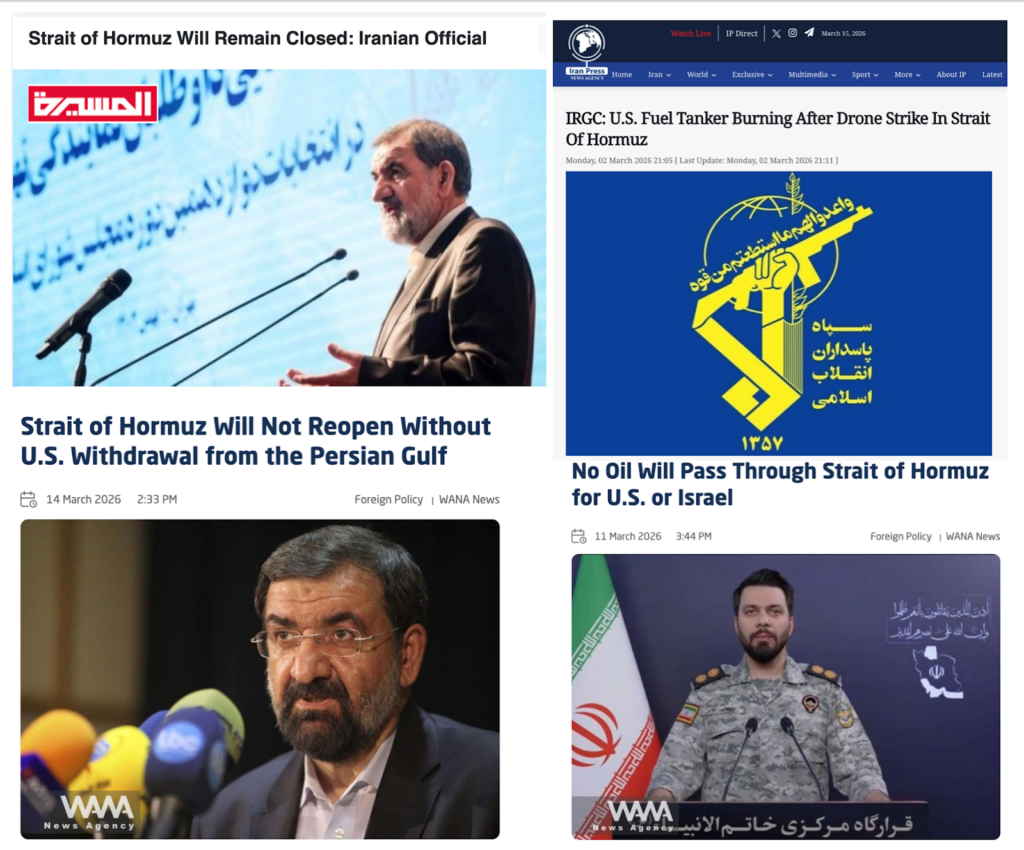
A sampling of Iranian narrative items addressing the closure of Hormuz
Yet narrative campaigns can themselves become a supply chain risk indicator. When state-aligned media and policymakers amplify warnings about blocking shipping lanes, targeting vessels, or enforcing territorial claims, the messaging may signal heightened political intent or preparation for coercive maritime activity. Even without immediate military action, such narratives can influence shipping insurers, logistics planners, and commodity markets, prompting route changes, higher insurance premiums, and precautionary delays.
But monitoring narrative trends can help organizations anticipate supply-chain volatility before physical disruptions occur. By the time most organizations recognized the Strait closure as a supply chain crisis, narratives signaling its shutdown had already been circulating for weeks. The window to act early had already closed. Monitoring narrative trends gives organizations that window back. Monitoring narrative trends gives organizations that window back—enabling earlier risk detection, faster contingency planning, and more deliberate decisions on sourcing, routing, and inventory before disruptions fully materialize.
The global supply chain is an intricate and highly interconnected system that links manufacturing, transportation, distribution, and retail across dozens of countries. Modern production often depends on components sourced from multiple regions, meaning a single product may cross international borders several times before reaching consumers. Because of this complexity, disruptions in one part of the network can quickly ripple across industries and continents. Businesses rely on tightly coordinated logistics, digital tracking systems, and just-in-time inventory practices to keep goods moving efficiently. While this structure enables lower costs and global access to products, it also makes the supply chain delicate, making it easy for small disturbances to trigger widespread economic consequences.
As noted above, roughly 20% of global petroleum shipments transit the Strait of Hormuz. And when one-fifth of the world's oil supply has to be rerouted to longer shipping lanes, instability is the inevitable result. Shipping insurance rates, freight costs, and logistics planning can all be impacted by the fallout. Yet energy price volatility directly affects nearly every component of the supply chain, including sourcing, manufacturing, transportation, and even distribution.
Fortunately for supply chain managers, narratives about disruption often precede real economic earthquakes. While narrative intelligence may not offer a foolproof predictor of coming events, it can nonetheless provide managers with clues about potential rises in insurance costs, likely inventory shortages, and other possibilities. In the case of Iran, then, monitoring narrative activity around the Strait of Hormuz can provide an early indicator of potential stress within the global supply chain. This is the reason why supply chain professionals should monitor information signals, instead of just physical events.
One heavily amplified Iranian narrative centers on heightened tensions and military activity in the Strait of Hormuz, a crucial global energy chokepoint controlled by Iran's IRGC Navy. Recurring themes in this narrative include Iran’s demonstrated readiness to close or restrict the strait through naval drills, drone attacks on tankers disregarding Iranian warnings, and strategic shifts like requesting oil payments in yuan. The narratives highlight the geopolitical contest between Iran and the US, with implications for regional stability and global energy markets.
Typical of this approach is an item published by WANA on March 11th. It quoted Ebrahim Zolfaqari, spokesman for the Khatam al-Anbiya Central Headquarters, as saying that "we will never allow even one liter of oil to pass through the Strait of Hormuz for the benefit of the United States, the Zionists, and their partners." Similarly, an item published on the same day by YPA asserted that "the Strait of Hormuz was under the control and management of the IRGC’s naval forces, adding that the United States and its partners would not be allowed to navigate through the strategic waterway."
Narrative item published by Yemen Press Agency, Mar 11, 2026
The implication behind this messaging is that Iran is capable of economic retaliation against sanctions or military pressure, that Tehran has the means to create significant political worries for President Trump through elevated oil and gas prices. Here, Iran is implying that it controls the gateway to global energy flows. Tehran is also suggesting that Western economies depend on Gulf shipping security, which it is able to disrupt at a moment's notice.
Essentially, Iranian narratives about the Strait function as a scare tactic. They appear designed to create anxieties in the West about not merely access to petroleum, but also the consequences that could potentially result from an attempted transit by Israeli or American vessels. The apparent goal of this messaging is to generate domestic political pressure on the White House, with voters and lawmakers demanding the U.S. withdraw from Iran forthwith. And the likelihood of a resulting political fallout is all the greater when we recall that gas prices in the U.S. are already on the rise as a result of diminished oil supplies.
Tehran's messaging around the Strait of Hormuz includes more than mere warnings about attempted crossings, however. It also relies on various supporting themes to give its messaging a larger context and maximize its impact. One such theme is American economic vulnerability, in which Tehran calls attention to market instabilities in the U.S., often exaggerating them in the process. These narratives portray the U.S. economy as highly exposed to global energy markets, arguing that disruptions to Gulf oil flows would trigger sharp increases in fuel prices, ripple through transportation and manufacturing sectors, and ultimately burden American consumers. By highlighting inflation sensitivity and dependence on stable maritime trade routes, the messaging frames U.S. economic resilience as more fragile than commonly perceived.
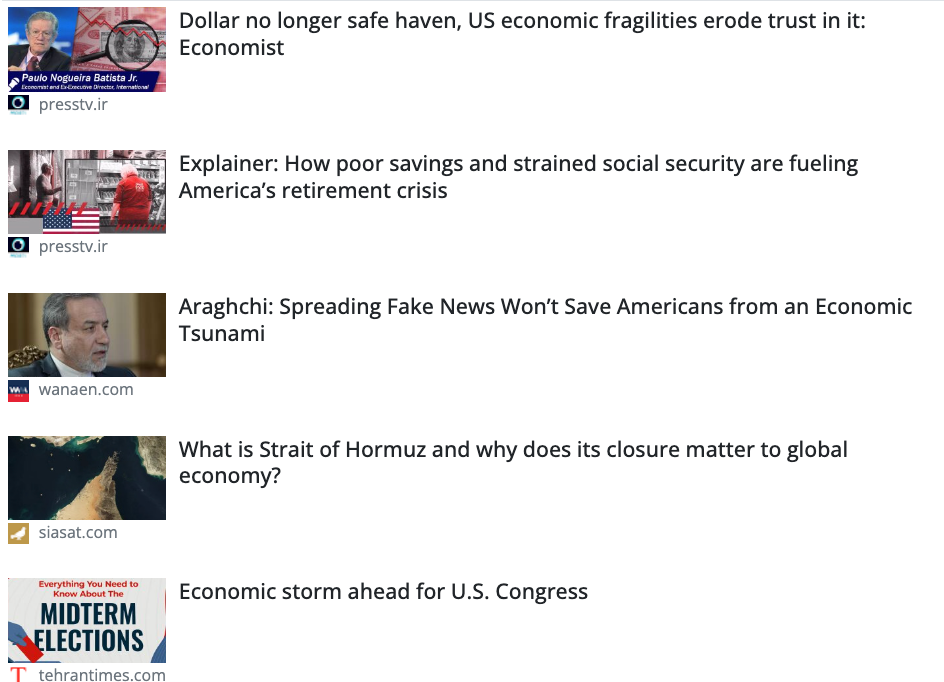
A sampling of Iranian narratives highlighting American economic vulnerability
In parallel, these narratives stress the interconnectedness—and perceived brittleness—of global supply chains, suggesting that even temporary disruptions in the Strait could cascade into widespread shortages, market instability, and financial volatility across Western economies. The underlying implication is strategic: while the U.S. may dominate militarily, Iran can impose significant asymmetric costs through economic disruption. This framing positions Iran’s geographic leverage not merely as a regional asset, but as a tool capable of reshaping the broader balance of power by exploiting systemic economic dependencies.
Iranian messaging also foregrounds themes of global shipping instability by emphasizing maritime insecurity and the risks facing commercial transit. These narratives highlight the vulnerability of shipping lanes through references to tanker seizures, naval confrontations, and warnings directed at commercial vessels operating in the region. By repeatedly invoking these incidents, the messaging seeks to normalize the idea that routine passage through the Strait is no longer guaranteed, but instead subject to sudden disruption, escalation, or coercive enforcement.

Two Iranian narrative items highlighting shipping instabilities and the critical importance of the Strait of Hormuz, published on March 4th and 12th.
The broader implication is that the Strait could evolve from a stable artery of global commerce into a contested and unpredictable zone. This framing is designed to heighten anxieties among international stakeholders by suggesting that even limited tensions could trigger cascading effects across global trade networks. In doing so, Iran positions maritime uncertainty itself as a strategic lever, reinforcing the notion that it can influence not only regional security dynamics but also the reliability of critical global supply routes.
Iranian messaging also underscores Western reliance on Gulf energy flows to highlight a critical vulnerability in the global economy. These messages emphasize that a significant share of the world’s oil and liquefied natural gas transits through narrow maritime chokepoints, portraying the Strait as an indispensable artery for energy supply. By stressing the concentration of energy resources in the region and the limited availability of immediate alternatives, the narratives frame Western economies as deeply reliant on uninterrupted access to Middle Eastern exports.
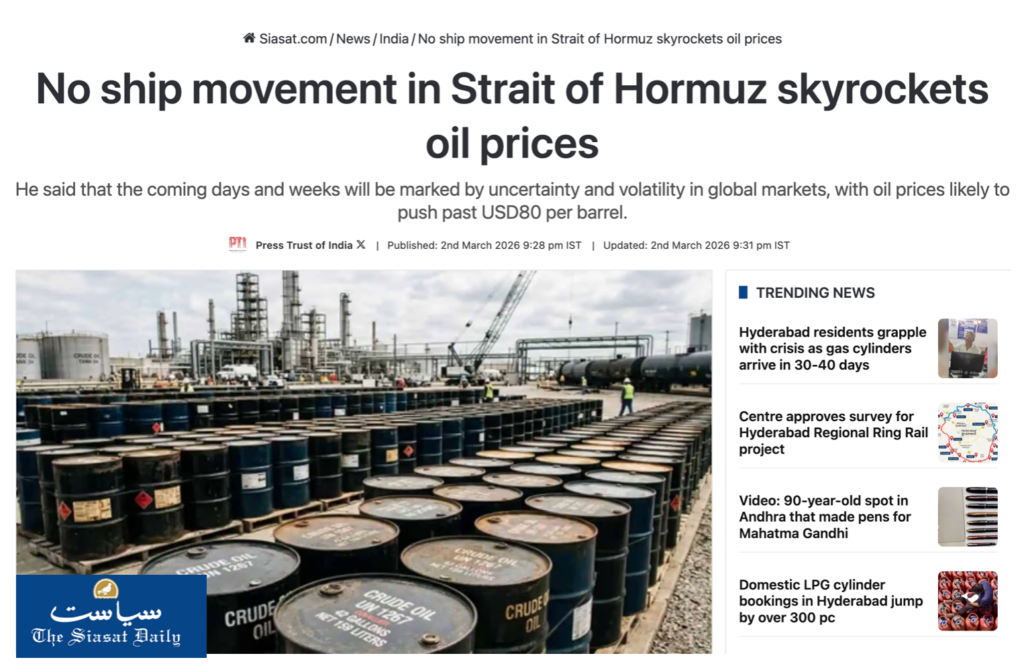
A pro-Iranian narrative item published on March 2nd, 2026, highlighting U.S. dependence on the Strait of Hormuz for affordable petroleum
Within this framing, particular attention is given to the cascading consequences of disruption—ranging from supply shortages and price spikes to broader economic instability. References to shipping vulnerability and the ease with which transit could be impeded reinforce the idea that even limited interference could have outsized global effects. The strategic implication is clear: without directly confronting Western military power, Iran can still exert meaningful influence over global markets by leveraging its proximity to a vital energy chokepoint, positioning itself as an indirect but consequential actor in the international economic system.
On March 12, 2026, Iran's new Supreme Leader tweeted in support of keeping the Strait closed as a means of "leverage," against the U.S., implying that Americans are reliant on it as a source of low-priced petroleum products.
The originating source for most Iranian narratives is Tehran, itself, which controls both state policy and the media through which it is communicated. Typically, this messaging is then supplemented with military and security announcements that reinforce its central talking points. These bulletins are picked up and reported by state media outlets, as well. At the same time, pro-Iranian accounts across social media often amplify Tehran's messaging, giving even wider exposure to its narratives. When the issue is impactful enough, as it is here, western media outlets may also report on and amplify Iranian propaganda, though they may no longer frame it in the way Tehran intended.
This is largely the propagation pathway that Iranian narratives around the Strait of Hormuz have followed. The Strait was officially closed on March 2nd, with the first media announcements from Tehran appearing on March 4th. However, warnings about a potential closing appeared much earlier. On February 18th, for instance, the Yemen Press Agency amplified a statement by Rear Admiral Alireza Tangsiri to the effect that the Islamic Revolutionary Guard Corps (IRGC) was "ready to close the strategic Strait of Hormuz upon an order by Iran’s top echelons." The purpose of this early narrative was likely to discourage a U.S.-Israeli assault on Iran, an aim at which it did not succeed.

Narrative item published by Yemen Press Agency, Feb. 18, 2026
By early March, however, pro-Iranian accounts across social media also began amplifying Tehran's warnings about the Strait. One user, for instance, cautioned that "threats to Iran must end permanently, or an unprecedented energy crisis will soon crash the global economy." Another advised that "any foreign power that thinks it can dictate the Strait of #Hormuz from the outside would do well to review the history of the #PersianGulf."
Pro-Iranian X account framing the Strait closure as a means of "crashing the global economy." Posted March 11th, 2026.
The U.S. media also amplified Iranian narratives, apparently taking them largely at face value. Outlets across the country expressed serious concerns over the potentially dwindling oil reserves and the subsequent economic fallout. In this instance, though, the coverage was largely a reaction to Tehran's announced closure, which had been reported elsewhere across the global media, rather than a response to pro-Iranian propaganda found on social media.
Indeed, over the past thirty days, EdgeTheory has collected some 6.613 narrative items from nearly 500 American media sources. The political orientation of these publications was fairly evenly distributed, although narrative items with a left-center viewpoint carried a slight majority of thirty percent. The smallest segment, meanwhile, consisted of right bias reporting, which came in at just twelve percent. Regardless of orientation, though, most outlets agreed the Strait's closure created a potential crisis for American business. Even Conservative News Today fretted aloud that the entirety of the national economy was in trouble.

Political distribution of U.S. media outlets reporting on the Strait of Hormuz
Yet the Hormuz episode also illustrates how a single individual can become the focal point around which a broader narrative forms. In this case, President Trump has assumed that role, urging shippers to transit the Strait despite Tehran’s warnings. His assertion that the waterway is “safe” has been echoed by several outlets tracked by EdgeTheory, though it has gained far less traction than Iran’s repeated warnings of missile and drone strikes.
Two narrative items published in the U.S. expressing skepticism about President President Trump's claims that the Strait is safe for transit. Both appeared March 10, 2026.
The U.S. media’s emphasis on Iran’s messaging over President Trump’s can be understood as a form of framing that reinforces perceptions of economic and supply chain risk. By foregrounding threats to shipping, energy flows, and regional stability, its coverage amplifies uncertainty and worst-case scenarios. In doing so, it conditions audiences to interpret the situation primarily through a lens of disruption and vulnerability, rather than reassurance, shaping both market sentiment and operational decision-making.
Adding to the gravity of the narrative were headlines emphasizing the reluctance of American allies to become involved. These accounts reinforced the sense of isolation and uncertainty surrounding the crisis, suggesting limited collective capacity to secure the Strait. In turn, they deepened perceptions of vulnerability in global energy flows, further heightening market anxiety and complicating planning for those dependent on stable supply routes.
Simply understanding how media framing can shape public sentiment can enable supply chain managers to foresee—and adapt to—disruptions on the horizon. By recognizing when narratives begin to amplify risk, volatility, or scarcity, managers can anticipate shifts in market behavior, pricing, and partner decision-making. This awareness supports earlier contingency planning, from securing alternative suppliers to adjusting logistics routes and inventory strategies, allowing organizations to respond proactively rather than reactively as conditions evolve.

A sampling of American narrative items highlighting President Trump's inability to find allies to reopen the Strait of Hormuz
Taken together, the Strait narratives illustrate a layered and mutually reinforcing propagation cycle in which Iranian state messaging, regional amplifiers, and American media coverage converge to magnify perceptions of a crisis. Tehran’s narratives are extended through social media ecosystems and, at times, refracted through Western reporting that nonetheless sustains their core themes of instability and economic risk. The result is a feedback loop in which warnings of disruption gain credibility and urgency as they circulate across increasingly diverse platforms. In this environment, even skeptical or critical coverage can inadvertently reinforce the underlying narrative of vulnerability and uncertainty. Ultimately, the Strait becomes not only a physical chokepoint, but an informational one, where perception and pressure operate in tandem.
Early warning indicators can often be detected through shifts in media narratives, particularly those tied to maritime security and energy transit. An increase in reporting on naval confrontations, tanker seizures, or close encounters in strategic waterways may signal a deteriorating security environment. Similarly, the emergence of explicit warnings directed at commercial shipping—whether from state officials, military actors, or affiliated media—can indicate a heightened risk to routine transit. These narrative signals are often accompanied by messaging that frames energy exports as leverage, suggesting the potential use of supply restrictions or transit interference as retaliatory tools.
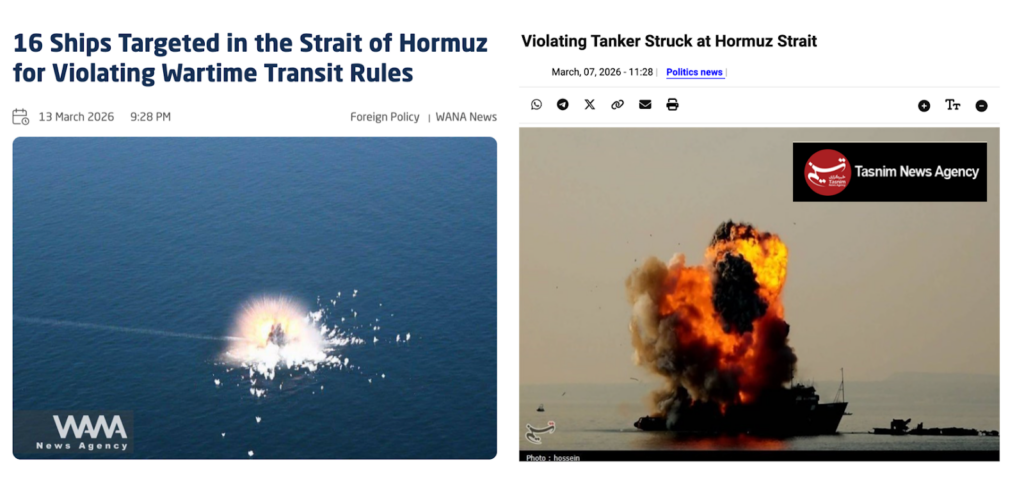
Three sample Iranian narrative items with early warning potential for supply chain managers.
For supply chain analysts, tracking these developments provides a practical means of anticipating disruption before it materializes into physical or market data. Escalatory rhetoric tied to sanctions, military actions, or geopolitical flashpoints can serve as a leading indicator of volatility, particularly when it is echoed across multiple channels, including state media and aligned social platforms. As these narratives intensify, they may reflect not only strategic signaling but also preparatory justification for future actions. Incorporating narrative monitoring into analytical frameworks therefore enhances situational awareness, enabling earlier risk assessment and more proactive mitigation planning in the face of potential maritime or energy-related disruptions.
Narrative activity surrounding the Strait of Hormuz has direct implications for commercial risk assessment, as shifts in messaging can influence how markets and industries anticipate disruption. These narratives do not operate in isolation; rather, they shape expectations across multiple interconnected sectors, including energy markets, shipping routes, manufacturing supply chains, and investor sentiment. As perceptions of risk intensify, they can drive real-world adjustments in pricing, logistics, production, and capital allocation. Understanding how these sectors respond to narrative signals is therefore essential for assessing the broader economic and supply chain consequences of heightened tensions in the region.
Narrative escalation can translate quickly into oil price volatility, as markets react not only to physical disruptions but to perceived risk. Messaging that emphasizes potential closures or retaliation against energy flows often triggers speculative trading and precautionary stockpiling. This can drive short-term price spikes, increasing fuel costs across freight, aviation, and ground transport sectors. Even in the absence of actual disruption, sustained narrative pressure can keep energy markets elevated and unstable.
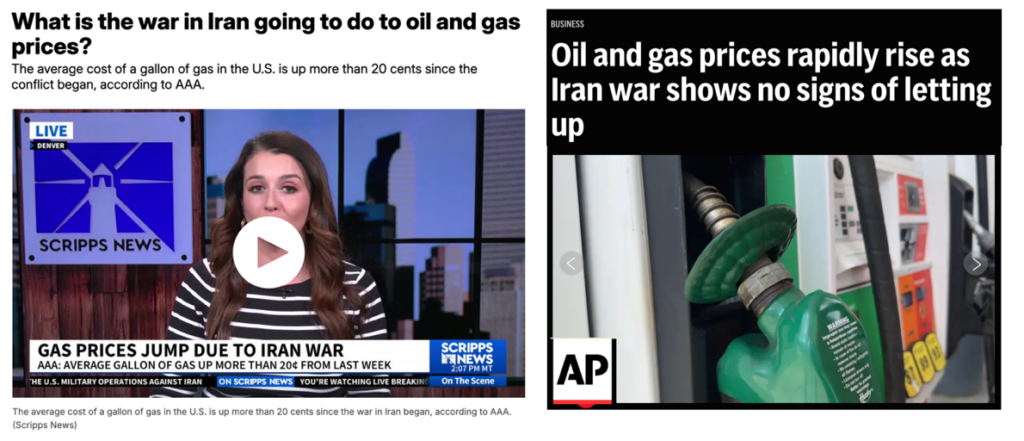
Narrative items such as these can signal future volatility in oil and gas markets.
Heightened rhetoric surrounding maritime insecurity can influence shipping behavior by raising insurance premiums and altering risk calculations for transit through contested waters. Reports of naval incidents or threats to commercial vessels may prompt insurers to reclassify routes as high-risk, increasing operating costs. Shipping firms may respond by rerouting vessels, leading to longer transit times and additional fuel consumption. These adjustments can create bottlenecks and delays that ripple across global trade networks.
Narratives about shipping insecurity can increase operating costs in a variety of ways.
Manufacturing sectors—particularly those reliant on petrochemical inputs—are highly sensitive to disruptions in Gulf energy flows. Narrative-driven increases in oil and gas prices can raise the cost of raw materials, plastics, and chemical derivatives used across multiple industries. At the same time, higher transportation costs can compound these pressures, affecting both inbound materials and outbound finished goods. The result is a tightening of margins and potential delays in production cycles.
Narratives emphasizing instability can shape investor behavior by amplifying perceptions of geopolitical risk. Financial markets may respond with increased volatility in logistics, energy, and commodities sectors as traders adjust to evolving risk signals. Negative sentiment can lead to capital flight from exposed industries, while safe-haven assets may see increased demand. Over time, sustained narrative pressure can influence broader market confidence, reinforcing cycles of uncertainty and reactive investment behavior.
Strategic insight begins with recognizing that narrative escalation often functions as an early signal of emerging disruption. Before physical constraints materialize, there is typically a discernible increase in messaging tied to geopolitical tension, maritime risk, and economic leverage. Monitoring these shifts allows organizations to detect changes in intent, posture, and escalation patterns earlier than traditional indicators, such as price movements or shipment delays. In this sense, the narrative environment becomes a forward-looking layer of intelligence rather than a reactive source of information.
Through systematic narrative monitoring, supply chain teams can develop a more proactive risk posture. For example, a surge in rhetoric linking sanctions to potential retaliation in energy corridors may foreshadow volatility in oil markets, while repeated warnings directed at commercial vessels can indicate rising insurance costs or rerouting pressures. When these signals appear across multiple channels, they often reflect a coordinated messaging effort that aligns with real-world strategic considerations. Integrating this type of monitoring into existing risk frameworks enables earlier scenario planning, supplier diversification, and contingency routing.
Two narrative items published by Iran's WANA News Agency, dated February 27th and March 10th. Headlines such as these can point to future instabilities, allowing supply chain managers to prepare for contingencies ahead of time.
A risk team typically interprets narrative escalation as a series of actionable signals. In the early stage, heightened rhetoric—especially from official or state-aligned sources—triggers increased monitoring, with analysts tracking themes, frequency, and audience targeting. As messaging spreads across multiple channels and geographies, cross-channel amplification signals potential coordination, prompting scenario development and stress-testing of plausible outcomes. Once narratives begin influencing mainstream media, market sentiment, or policy discourse, teams shift to evaluating operational impacts—such as supply disruptions, price volatility, or regulatory shifts—and consider adjustments to logistics, sourcing, or contingency planning.
Ultimately, organizations that incorporate narrative intelligence into their risk strategies are better positioned to anticipate and mitigate disruption. Rather than waiting for measurable impacts to cascade through markets and logistics networks, they can act on leading indicators that reveal how conditions are likely to evolve. This approach not only improves resilience but also enhances decision-making under uncertainty, allowing firms to respond with greater speed and precision as geopolitical tensions unfold around vital trade arteries like the Strait of Hormuz.
Narrative intelligence provides supply chain organizations with a critical early-warning capability by identifying shifts in the information environment before they translate into operational disruption. By systematically monitoring these signals, organizations can detect emerging instability earlier than traditional methods allow, enabling more informed and timely decision-making. This forward-looking approach transforms narrative activity into a practical tool for anticipating supply chain stress.
EdgeTheory’s narrative intelligence technology is specifically designed to operationalize this capability for supply chain managers. It can detect emerging geopolitical narratives in real time, allowing analysts to track how tensions are developing across regions and market sectors. It also identifies patterns of narrative amplification across global media ecosystems, highlighting when specific themes—such as maritime insecurity or energy disruption—are gaining traction. In addition, it monitors escalation around strategic economic infrastructure, including key shipping lanes and energy corridors, providing visibility into areas where risk may be intensifying.
By translating these information signals into actionable risk indicators, it enables organizations to move from passive awareness to proactive mitigation. Supply chain managers can use these insights to act before disruption materializes rather than respond after it already has. And by tracking changes in a given narrative, such as the Strait closure, the EdgeTheory platform also enables more flexible and cost-effective contingency planning, allowing managers to plan for - rather than respond to - sudden changes in the geopolitical or commercial environments.
The closure of the Strait of Hormuz underscores the extent to which modern supply chains are shaped as much by information dynamics as by physical constraints. Iranian narratives have contributed to a feedback loop that heightens perceptions of risk and accelerates economic responses across key sectors. For supply chain risk teams, this environment reinforces the value of monitoring narrative escalation as an early warning mechanism. Tools like EdgeTheory’s demonstrate how these signals can be translated into practical insights. Ultimately, organizations that integrate narrative intelligence into their risk frameworks will be better equipped to navigate uncertainty and face global disruptions, because disruption now often begins in the information environment before it shows up in the supply chain.

