
Menu
This report analyzes the 3 January 2024 bombing in Kerman as both a mass-casualty attack and a catalytic information event. It integrates geospatial indicators, narrative attribution patterns, and cross-platform information flows to assess how competing actors shaped and contested meaning in the aftermath across regional and transnational audiences.
On 3 January 2024, twin bombings near the grave of Qasem Soleimani in Kerman killed more than 90 people during a mass commemoration ceremony marking the fourth anniversary of his death in a U.S. drone strike. The attack was later claimed by Islamic State-Khorasan Province (ISIS-K), triggering an immediate information contest over attribution and strategic meaning.
The event illustrates how violent incidents function as both operational acts and narrative inflection points. ISIS-K framed the bombing as a sectarian strike against a Shi’a ritual gathering, while Iranian authorities embedded the event within their “axis of resistance” narrative and broader confrontation with Israel and the United States.
This report analyzes the 3 January 2024 bombing in Kerman as both a mass-casualty attack and a catalytic information event. It integrates geospatial indicators, narrative attribution patterns, and cross-platform information flows to assess how competing actors shaped, contested, and operationalized meaning in the aftermath. Drawing on Telegram channels, X posts, state-affiliated media, diaspora outlets, and open-source reporting, the study maps how narratives from government officials, influencers, and militant organizations originated, evolved, and diffused across regional and transnational audiences.
On 3 January 2024, twin bombings near the grave of Qasem Soleimani in Kerman killed more than 90 people during a mass commemoration ceremony marking the fourth anniversary of his death in a U.S. drone strike. The attack was later claimed by Islamic State-Khorasan Province (ISIS-K), the Afghan branch of the Islamic State. It constitutes the deadliest terrorist incident in the Islamic Republic’s modern history and occurred amid heightened regional tension following the 7 October 2023 attacks and the Gaza war.
The Kerman bombings immediately triggered a layered information contest. Iranian officials rapidly attributed the attack to Israel and the United States before investigative findings were made public. Approximately twenty hours later, ISIS-K issued a formal claim through its propaganda outlet, Amaq News Agency, explicitly framing the attack as a sectarian operation against a Shi’a ritual gathering. The competing narratives did not simply dispute responsibility; they reflected fundamentally different strategic logics. Tehran embedded the attack within its “axis of resistance” doctrine and foreign interference framework, while ISIS-K sought to position the bombing as the opening salvo of an expanded anti-Iran campaign grounded in sectarian vengeance and transnational jihadist resurgence.
ISIS-K deliberately characterized the bombings as targeting a “large gathering of polytheist Shiites” commemorating Qasem Soleimani. By specifying the ceremonial context, the group positioned the attack as a religiously sanctioned act of vengeance rather than indiscriminate violence. This framing reinforced the organization’s broader sectarian narrative, tied the operation to a historical grievance against Soleimani’s anti-ISIS campaigns in Iraq and Syria, and signaled the opening of a potential wider campaign against Iran. The public release of images and martyrdom claims amplified the narrative, demonstrating operational reach and ideological coherence to supporters.
Iranian authorities immediately attributed the attack to Israel and the United States, framing it as part of a broader foreign destabilization campaign. When ISIS-K claimed responsibility, the regime incorporated the claim into its existing narrative rather than conceding, questioning authenticity, and emphasizing external manipulation. The interaction of these competing narratives illustrates a dual information environment in which terrorist acts serve as instruments of both operational and rhetorical power: ISIS-K seeks to assert ideological and strategic legitimacy, while the Iranian state seeks to preserve regime authority, domestic stability, and geopolitical framing.
ISIS-K framed Kerman as a sectarian operation against Shi’a ritual gatherings.
Prior to Kerman, ISIS-K’s anti-Iran rhetoric was largely aspirational, focused on denunciations of Shi’a governance and regional influence. The Kerman bombing, however, represented a tangible projection of operational capacity inside Iran and was embedded in propaganda emphasizing sectarian and globalized jihadist momentum. Analysts and jihadist monitoring note that this attack is consistent with a broader pattern of external operations—similar in framing to prior attacks in Tehran and shrine sites—indicating that ISIS-K is increasingly signaling a sustained campaign targeting Iran as a central strategic and ideological adversary.
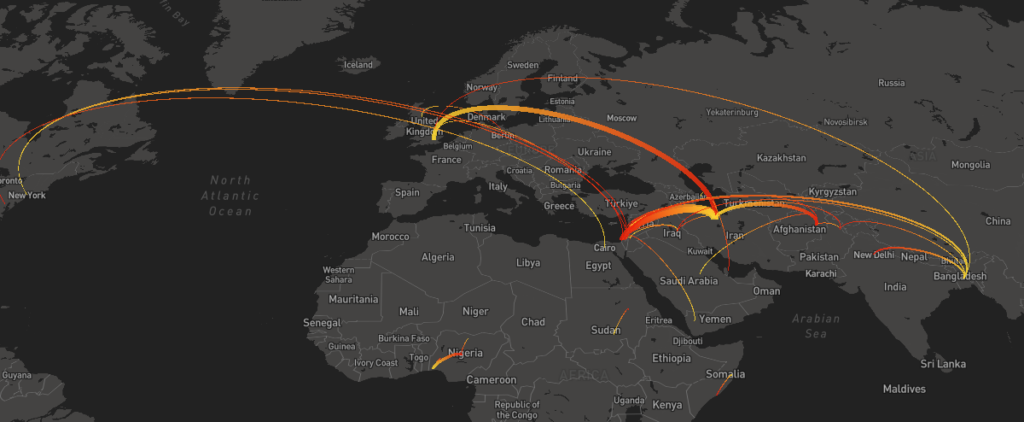
Geospatial Narrative Sources (yellow) and targets (red)
The narrative initially emerged from Keşlə, headed for Doha. As it spread, the most frequent origin shifted to Tehran, and the most frequent destination shifted to Tehran. The most frequently amplified content centers on Iranian military and political responses to Israeli actions, particularly the assassination of IRGC commanders, underscoring themes of martyrdom, resistance, and calls for retaliation against Israel. Related narratives emphasize regional alliances, such as with Syria, Lebanon, and Pakistan, portraying a unified front against Israel and Western influence. Additionally, themes of propaganda, disinformation campaigns, and election-related information warfare appear, highlighting online and media-driven efforts to influence public perception and political outcomes in various countries. These narratives frequently feature polarized, militant rhetoric tied to ongoing regional conflicts.
Related narratives emphasize regional alliances, such as with Syria, Lebanon, and Pakistan, portraying a unified front against Israel and Western influence.
The attack targeted crowds commemorating the fourth anniversary of Soleimani’s killing. The Islamic State’s Afghan affiliate, Islamic State – Khorasan Province (ISIS-K), claimed responsibility. The operation marked one of the deadliest terrorist attacks inside Iran in decades and represented a major expansion of ISIS-K’s external operations footprint.
The Islamic State’s propaganda apparatus moved quickly to shape its own narrative of the January 3, 2024 Kerman bombings. Under the banner of Amaq News Agency, the Islamic State’s propaganda posted the images of two alleged suicide bombers and claimed the operation was a revenge attack tied explicitly to Qasem Soleimani’s campaign against the group in Iraq. By framing the bombings as part of a newly announced campaign—reportedly branded “Kill them where you find them”—the Islamic State sought to embed the attack within its broader strategic messaging: retaliatory justice, sectarian confrontation, and globalized jihadist momentum.
The importance of this narrative lies in its attempt to assert ownership, coherence, and ideological consistency. For ISIS-K, claiming responsibility in detailed, symbolic terms serves multiple functions. It reinforces credibility among supporters by demonstrating operational reach inside a heavily securitized state; it ties the attack to a longer arc of grievance against Iran’s regional role; and it reframes the bombing not as indiscriminate violence but as targeted vengeance against a figure central to Iran’s anti-ISIS military campaign. By visually presenting the alleged perpetrators against recognizable jihadist iconography, the propaganda aims to authenticate the claim and project continuity with the Islamic State’s established brand.
Strategically, this messaging competes directly with Tehran’s preferred framing. Where Iranian officials embedded the tragedy within the “axis of resistance” doctrine—externalizing blame toward Israel and the United States—the Islamic State’s communiqué attempts to narrow attribution squarely onto itself and its sectarian war against Shia Iran. In doing so, it challenges the regime’s ability to subsume the attack into its geopolitical confrontation with state adversaries. The propaganda therefore becomes part of a parallel information battle: ISIS-K seeks to amplify sectarian polarization and advertise capability, while the Iranian state works to integrate the event into its resistance narrative and broader regional struggle.

X post by the Khoresan Diary
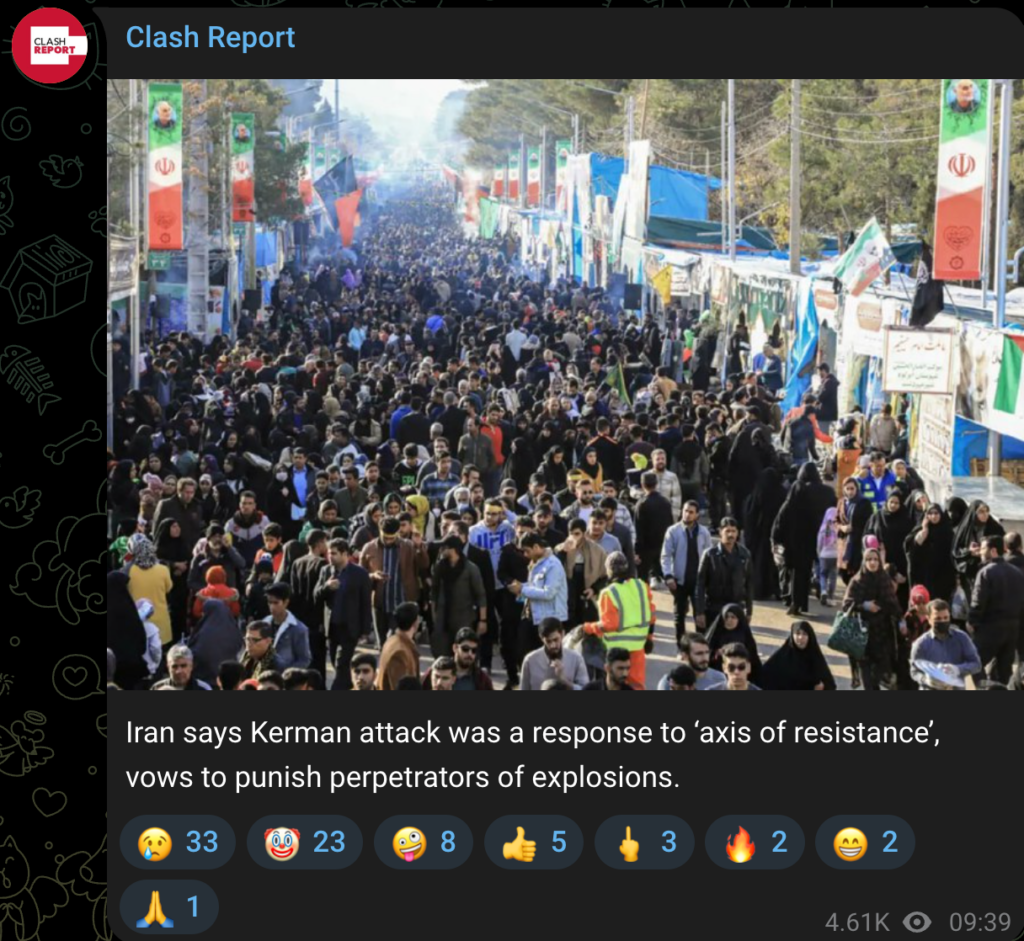
Iranian response to Kerman Attack
Leading to the attack:

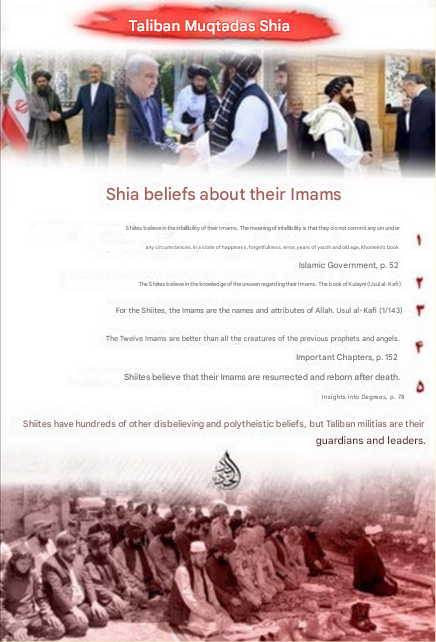
Propaganda poster published by Al-Hadid Media on 11 December 2023 criticizing the Taliban’s relations with Iran and Shia beliefs
Prior to the Kerman bombing, ISIS-K’s messaging toward Iran was largely aspirational and ideologically oriented rather than operationally demonstrable. The group consistently framed Shi’a governance and the Iranian state as illegitimate and oppressive, emphasizing religiously sanctioned grievances rooted in its Salafi-jihadist worldview. Public statements, propaganda releases, and discussions on jihadist forums primarily focused on denunciations of Shi’a authority, the perceived persecution of Sunni Muslims, and the broader regional influence of Iran.
Following the attack:
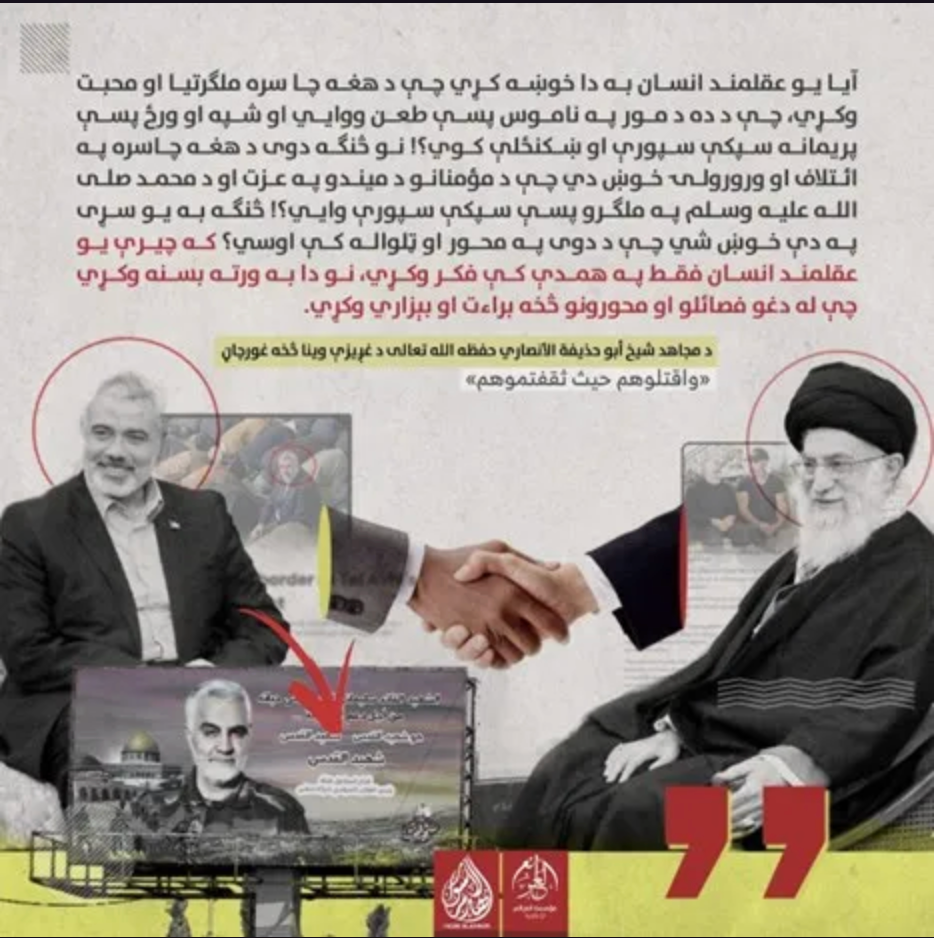
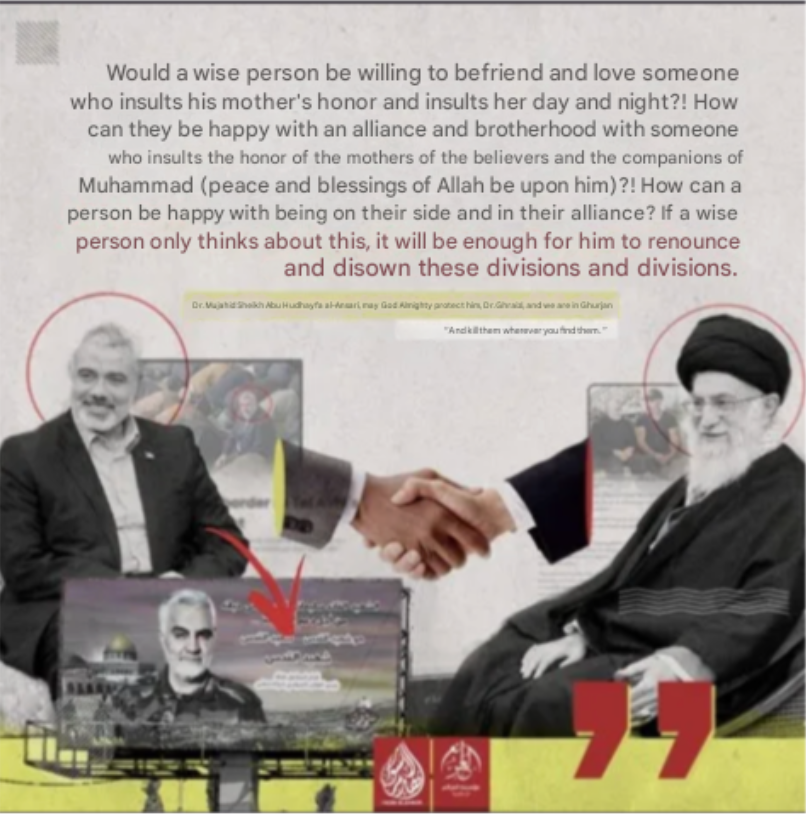
Propaganda poster released by ISKP-affiliated Al-Azaim media on 8 January 2024. ISKP propaganda channels released a poster to justify the contradiction between the Gaza-focused rhetoric of the "And Kill Them Wherever You Find Them" militant campaign and the attack in a city of Iran, a country that supports the Palestine cause. The Islamic State group cited Iran's alleged killing of Sunni Muslims in Syria, Iraq, and Yemen, questioning its defence of Muslims in Gaza. Furthermore, the IS group criticizes the relationship between Hamas and Iran, accusing Hamas of associating with Shia Iran, which, according to the group, disrespects the wife and companions of Prophet Mohammad.
Threats against Iranian targets were rhetorical, often framed as promises of future retaliation rather than evidence of imminent capability. The organization sought to cultivate an image of ideological coherence and transnational relevance, portraying itself as a vanguard of Sunni jihad against Shi’a powers across the Middle East and Central Asia. At this stage, operations were largely limited to Afghanistan, and the messaging relied on moral and theological justifications to inspire followers and project influence, rather than showcasing the ability to strike high-profile targets within Iran itself.
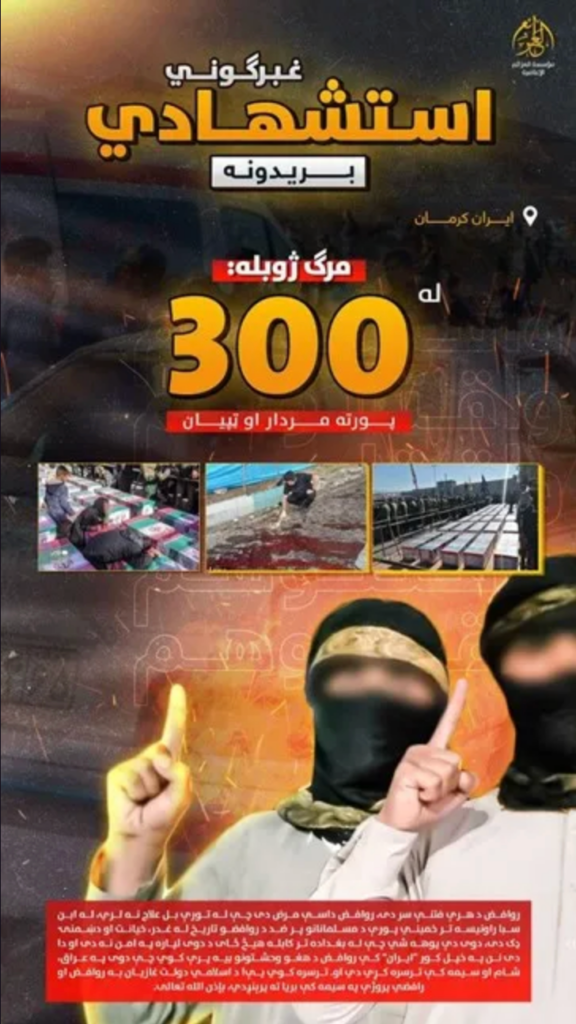

Propaganda poster released by ISKP affiliated Al-Azaim Media on 6 January 2024 threatening the Rawafid (Shia)
The Kerman attack marked a significant rhetorical escalation. From ISIS-K’s perspective, the bombings themselves became a propaganda asset, reframing Iran not merely as an ideological adversary but as a vulnerable, penetrable battlefield against a core enemy. In the formal ISIS statement claiming responsibility for Kerman, the group detailed that two of its operatives “set out towards a large gathering of polytheist Shiites” during a ceremony marking the death of Qasem Soleimani, whom it condemned as having led massacres against Muslims.
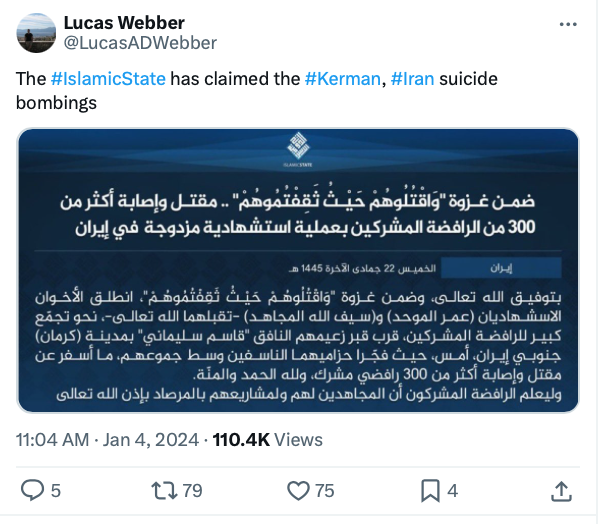
ISIS claim of the Kerman bombings
Prior to Kerman, much of ISIS-K’s narrative about confronting powerful states like Iran or Russia was rhetorical. After it conducted the attack and posted claims and images on its channels (e.g., showing the alleged bombers), the group treated the successful execution of the bombing as evidence of divine favor and strategic relevance beyond Afghanistan.
This language was not generic — it specifically identified the suicide attack as an operation against Shi’a ritual gatherings and celebrated it as a legitimate jihadist action against “polytheists” (a term ISIS uses to denounce Shi’a) in Iran. In the wake of that attack, the narrative expanded in several discernible ways. Prior to Kerman, much of ISIS-K’s narrative about confronting powerful states like Iran or Russia was rhetorical. After it conducted the attack and posted claims and images on its channels (e.g., showing the alleged bombers), the group treated the successful execution of the bombing as evidence of divine favor and strategic relevance beyond Afghanistan. This bolstered its claims to being a global threat rather than a localized insurgency. Before Kerman, pledges to attack Iranian territory were largely aspirational and circulated through niche jihadist forums. After Kerman, ISIS-K’s messaging implicitly argued that Iran’s military and intelligence services could not protect even high-profile gatherings like Soleimani commemorations. This was reflected in amplified messaging on jihadist Telegram channels claiming martyrdom of the two attackers, identifying them by takfiri names (e.g., Omar al-Muwahid and Saif Allah al-Mujahid), and describing the operation as successful in the face of supposed enemies. Such naming conventions and post-attack glorification are tactical narrative tools in ISIS propaganda. According to jihadist media monitoring, ISIS media outlets (e.g., Al-Furqan / ISIS propaganda channels) have released content specifically about the Kerman attack that tries to justify it as legitimate jihad against Shi’a Muslims saying “kill them wherever you find them,” and embed it in longer propaganda pieces — indicating the group intends to spin it as part of a broader narrative, not just an isolated act.
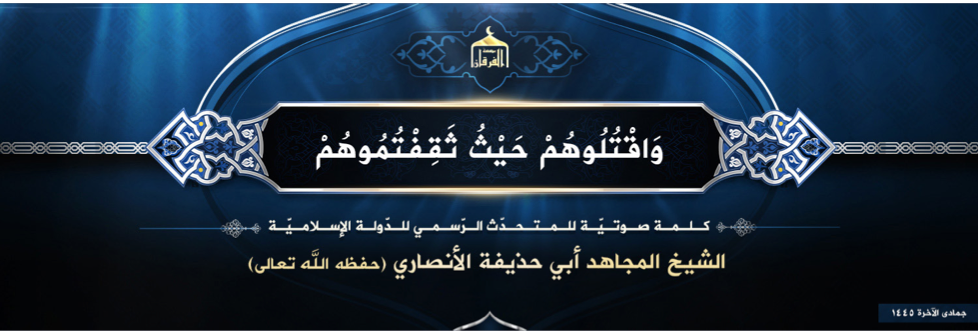

Al Naba Issue 424
A deadly attack against Iran, a formidable Shia state, lends ideological credence to ISIS-K’s words in the eyes of its followers. It also potentially facilitates the recruitment of individuals who are proponents of anti-Shia ideologies in the Muslim world.
External attacks like the Kerman bombings are consistent with a growing pattern of transnational operations, rather than one-off incidents. Attacks in Iran (Kerman), Russia (Moscow), and other locations demonstrate ISIS-K meeting structural thresholds for external operations — signaling a strategic shift toward campaigns beyond local insurgency.
The narrative before the Kerman attack was largely about ideological confrontation with Shi’a states and local insurgency goals, grounded in religious justifications and aspirational threats.

X post by UANI
In sum, the narrative before the Kerman attack was largely about ideological confrontation with Shi’a states and local insurgency goals, grounded in religious justifications and aspirational threats. After Kerman, the narrative pivoted to celebrate a demonstrable strategic blow against a major Shi’a power, elevate ISIS-K’s operational credibility, and reposition the group’s messaging to highlight its expanding reach — all while still framing such attacks within its sectarian Salafi-jihadist worldview.
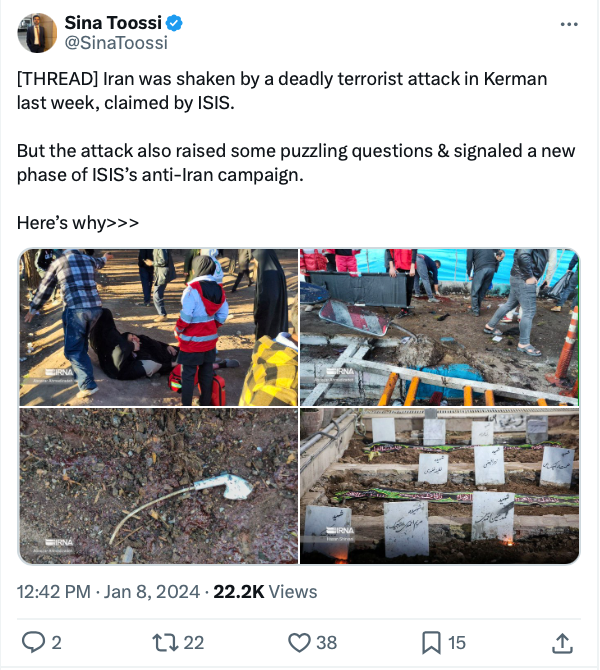
X post by Sina Toossi
The Kerman bombings were not only a mass-casualty terrorist attack but also a catalyst for a high-velocity information confrontation. ISIS-K framed the operation as a sectarian strike against a Shi’a ritual gathering and positioned it within a broader retaliatory campaign against Iran. The attack allowed the group to transition from aspirational anti-Iran rhetoric to demonstrate operational capability, reinforcing claims of divine favor, geographic reach, and strategic resurgence.
The attack allowed the group to transition from aspirational anti-Iran rhetoric to demonstrate operational capability, reinforcing claims of divine favor, geographic reach, and strategic resurgence.
Simultaneously, Iranian authorities embedded the event within their established “axis of resistance” narrative architecture, prioritizing foreign state adversaries as principal culprits even after ISIS-K’s claim. Rather than conceding informational ground, the regime layered the jihadist attribution into its broader geopolitical framing.
The result is a dual narrative structure: ISIS-K leveraging the bombing to signal an expanded anti-Iran campaign rooted in sectarian ideology, and Tehran recontextualizing the same event to reinforce its confrontation with Israel and the United States. The Kerman attack, therefore, illustrates how violent events function simultaneously as operational acts and narrative inflection points—reshaping not only security dynamics but also the informational terrain across which legitimacy, blame, and strategic positioning are contested.
Cover photo credit: Fars Media Corporation, CC BY 4.0,
*This report is a historical case study using NARINT.*
Lead Analyst:
Ellie Munshi is an analyst at the EdgeTheory Lab. She is studying Strategic Intelligence in National Security and Economics at Patrick Henry College. She has led special projects for the college focused on Anti-Human Trafficking, Chinese influence in Africa, AI influence on policymakers, and was also an intelligence analyst intern at the Department of War.

