
Menu
The report analyzes competing narratives across state media, policy institutions, industry sources, independent outlets, social media, and activist networks, covering AI competition, environmental impacts, surveillance, and digital sovereignty.
Using EdgeRunner, an AI powered source discovery agent, the assessment combines Narrative Intelligence (NARINT), Emotional Profile Classification, and network analysis to reveal how governments, corporations, activists, and alternative media shape public perceptions of AI infrastructure.
This report examines the information environment surrounding AI data center development and its implications for U.S. technological competitiveness. EdgeTheory’s all-source analytics identified competing narratives across state media, policy institutions, industry sources, independent outlets, social media, and activist networks discussing AI infrastructure, environmental concerns, surveillance, and digital sovereignty. As access to compute increasingly determines leadership in artificial intelligence, data centers have emerged as both strategic assets and contested political, narrative, and public relations liabilities.
Using EdgeRunner, an AI-powered source discovery agent, this assessment examines the threat intelligence landscape surrounding AI infrastructure. Our analysis identified persistent discussion of AI competition, environmental impacts, energy consumption, community opposition, surveillance concerns, and digital sovereignty. Particular attention was given to emotional profiles that were identified as key drivers of narrative amplification, including competing frameworks of data centers as strategic necessities or as threats to communities and civil liberties. By combining Narrative Intelligence (NARINT), emotional profiling, and network analysis, EdgeRunner identified how governments, corporations, activists, and alternative media are shaping public perceptions surrounding AI infrastructure development.
EdgeTheory’s analysis of this information environment is grounded in an integrated analytic pipeline combining EdgeRunner source discovery, NARINT attack vector identification, Emotional Profile Classification, and network-based amplification analysis. This framework enables the identification not only of what narratives exist across the information ecosystem, but how they propagate, which actors amplify them, and how emotional framing shapes engagement strategies.
The conflict over data center development is increasingly an information contest where superior narratives shape public perceptions, regulatory outcomes, investment decisions, and ultimately the pace of AI advancement.
The debate surrounding AI data centers extends far beyond questions of energy consumption and local zoning regulations. Data centers increasingly represent strategic infrastructure with implications for economic competitiveness, technological leadership, and national security. Competing actors with vested interests in these sectors frame these facilities in sharply different ways. Governments and policy institutions emphasize AI leadership, digital sovereignty, and economic resilience, while activist networks, independent media, and fringe communities tend to highlight environmental costs, corporate influence, surveillance, and social disruption.
Within this framework, narrative competition is assessed as a measurable information process in which content is not only categorized thematically, but evaluated for emotional salience, amplification velocity, and cross-network connectivity. This allows competing framings of AI data center development to be compared not just in content, but in influence potential and propagation dynamics. With this capability, EdgeTheory uncovered source networks promoting narrative attack vectors that threaten to undermine election integrity by promoting oversimplified policies that align with adversarial influence objectives.
Narrative Intelligence (NARINT) reveals that the conflict over data center development is increasingly an information contest where superior narratives shape public perceptions, regulatory outcomes, investment decisions, and ultimately the pace of AI advancement. Understanding these narratives is therefore critical to assessing risks to U.S. technological competitiveness and identifying emerging sources of information-driven friction, enterprise costs, and kinetic threats.
Applying this framework, EdgeTheory found limited evidence that Chinese state media are directly exploiting anti-data-center narratives to influence U.S. midterm elections. Chinese sources overwhelmingly frame AI infrastructure as a strategic national priority rather than promoting opposition narratives. Instead, anti-data-center messaging is primarily driven by domestic activists, environmental organizations, independent media, and select Russian-aligned and fringe sources.
Community groups and Russian-aligned sources were the primary drivers of these fear- and distrust-based narratives such as Counter Currents, Geopolitics & Empire, RealVanJackson, and Kit Klarenburg.
EdgeTheory Emotional Profile Classifiers found fear to be the dominant emotion driving discussion of AI data centers. The strongest emotional reactions were generated by narratives surrounding surveillance, government monitoring, environmental damage, local opposition, and accusations against technology companies and intelligence agencies. Community groups and Russian-aligned sources were the primary drivers of these fear- and distrust-based narratives such as Counter Currents, Geopolitics & Empire, RealVanJackson, and Kit Klarenburg. Investigating secondary peaks in anger and disgust revealed that opposition messaging frequently relies on moral outrage and distrust of governments, technology companies, and intelligence institutions. Positive narratives emphasizing economic growth and AI competitiveness generated periodic spikes in optimism and joy, but these reactions were significantly weaker and less sustained than negative emotional patterns. The emotional environment suggests that data center discussions are increasingly framed in terms of perceived threats rather than technological opportunity or measured political discourse, creating conditions favorable to the rapid mobilization of opposition and policy reform narratives.
Our analysis found that opposition messaging consistently frames AI data centers as environmental threats, surveillance tools, and burdens on local communities. Our analysis finds that anti–data center narratives are grounded in legitimate local concerns over electricity demand, water use, air quality, noise, utility costs, zoning, and community consent. DOE/LBNL reporting shows U.S. data center electricity use reached 176 TWh in 2023 and could rise to 325–580 TWh by 2028, giving environmental and infrastructure concerns a factual basis. Monterey Park also shows that opposition can emerge from genuine grassroots organizing, with residents voting overwhelmingly to ban data centers after local concerns over water, air quality, neighborhoods, and quality of life. As narrative pressure shifts public discourse away from balanced policymaking, delays to U.S. infrastructure expansion create opportunities for strategic competitors to gain advantages in AI development.
Discussions surrounding data centers rarely remain limited to zoning, energy consumption, or environmental impacts. Geopolitics & Empire, MintPress News, Orinoco Tribune, and AnonHQ frequently connected local infrastructure debates to broader narratives involving surveillance, corporate overreach, government corruption, and authoritarian control. This narrative convergence is most evident among activist and critical media, Russian-aligned and fringe sources, and online communities that link local infrastructure debates to broader anti-government and anti-technology grievances. By broadening the issue beyond directly affected communities, these narratives mobilize diverse audiences around a common grievance framework.
EdgeTheory analyzed all-source intelligence surrounding AI data center development using a combination of Narrative Intelligence (NARINT), source discovery, emotional analysis, and network mapping. The analysis incorporated reporting from state media, policy institutions, industry publications, independent media outlets, organizations, social media platforms, and online communities discussing AI infrastructure, data centers, energy consumption, environmental impacts, and digital sovereignty.
To identify the most relevant sources and narratives, analysts deployed EdgeRunner, an agentic source discovery tool that independently identifies, analyzes, tags, and scores sources based on topical relevance, influence, affiliation, language, and narrative alignment. EdgeRunner surfaced high-fidelity sources discussing data centers across multiple information ecosystems, enabling analysts to compare narratives promoted across actor networks. Narrative scores and source connections were then leveraged to identify relationships between seemingly independent narratives, sources, and amplifiers across the broader information environment.
Using NARINT, analysts categorized discussions into dominant narrative themes, including AI competitiveness, digital sovereignty, energy security, environmental impacts, community opposition, surveillance concerns, and infrastructure overcapacity. EdgeTheory’s Emotional Profile Classifier was used to identify the emotions most frequently leveraged within these narratives and assess where fear, distrust, anger, economic anxiety, or technological optimism were being amplified to influence audience perception. Connection mapping and amplification analysis further identified influential accounts and communities driving engagement across platforms.
This methodology enabled the identification of competing information ecosystems surrounding AI infrastructure development, the actors most responsible for amplifying those narratives, and the potential implications for U.S. technological competitiveness. By combining narrative analysis, emotional profiling, source scoring, and network mapping, EdgeTheory identified not only what narratives are present, but how they spread, the main actors promoting them, and where those actors may seek to exploit existing concerns to shape public perceptions and AI infrastructure policy.
Fear-based messaging appears most effective at amplifying concerns over environmental, privacy, and societal risks, while anger and disgust are used to encourage opposition and distrust.
EdgeRunner source discovery and NARINT classification was applied to global policy and state-media narratives to assess how AI infrastructure is framed within geopolitical competition discourse. Emotional and amplification signals are used selectively to identify which frames are most likely to influence strategic positioning.
A recent report highlighted by OpenAI and reported by Politico warns that China is rapidly expanding AI-related infrastructure and could outpace the United States in data center capacity if U.S. buildout slows. The report argues that access to compute and supporting infrastructure has become a decisive factor in the global AI race.
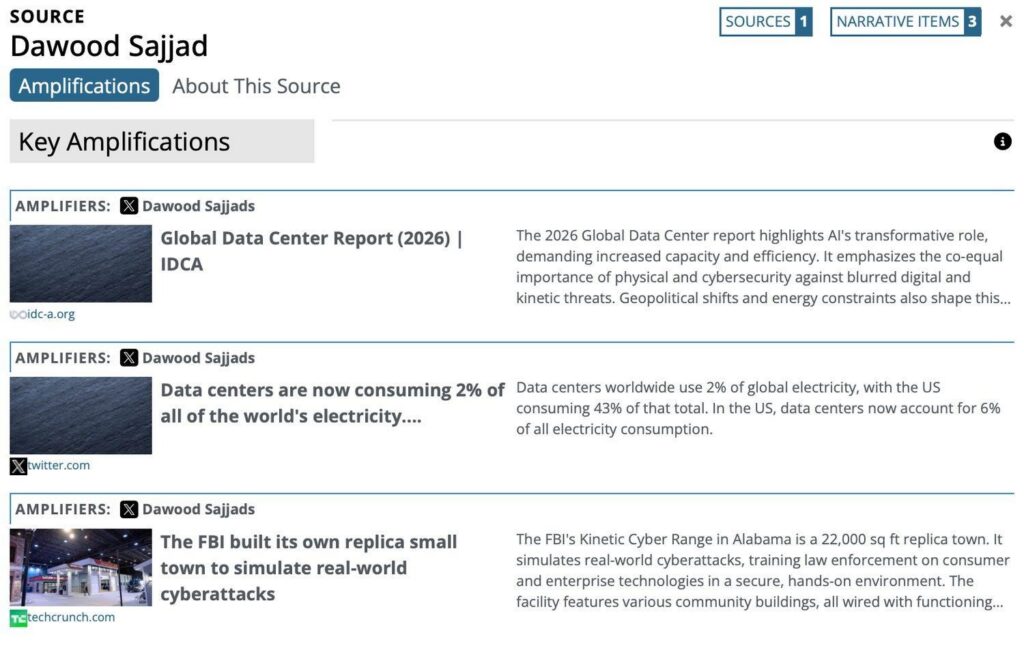
EdgeTheory Narrative Source Classifier — amplification profile for key X amplifier Dawood Sajjad.
EdgeTheory’s NARINT analysis found that data center development has become a highly contested information issue characterized by competing, high-fear narratives. While many concerns are legitimate, narrative analysis indicates that sustained amplification of specific anti-data center narrative attack vectors could translate into opposition, litigation, and restrictive policies that constrain U.S. access to compute, energy, and capital. Failure to recognize how these narratives evolve and spread risks ceding strategic advantages in AI development to competitors with fewer constraints.
This section synthesizes EdgeRunner-discovered cross-platform discourse on data centers to evaluate the distribution of narrative framing across institutional, activist, and independent media ecosystems. NARINT clustering and amplification analysis are used to identify where narrative convergence and cross-domain reframing occur.
EdgeTheory identified discussion of AI data centers across every major information ecosystem analyzed—including state media, industry publications, policy institutions, independent outlets, activist organizations, X, Telegram, YouTube, and online communities—indicating the issue has become a high-volume cross-domain narrative.
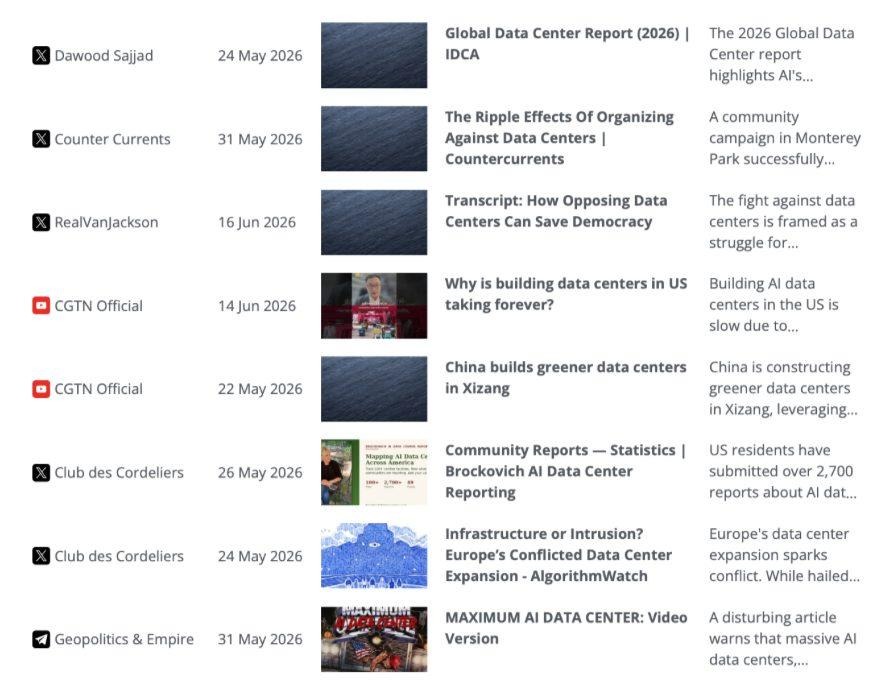
EdgeTheory NARINT analysis identified data center discussion as widespread across social media platforms including X, Telegram, YouTube, and online posts.
Amplification analysis identified X user Dawood Sajjad as a key amplifier of data center narratives. The account repeatedly elevated reports emphasizing the growing energy demands of data centers, the strategic importance of AI infrastructure, and cybersecurity considerations. Amplified content included IDC’s Global Data Center Report (2026), statistics highlighting data centers’ increasing share of electricity consumption, and reporting on the FBI’s cyber range designed to simulate attacks on critical infrastructure.
The source has high-volume posts across broad topics, and its amplification pattern reveals the account is a node between key discussions. This behavior is indicative of widescale discussions bridging high-volume and high-intensity topics, solidifying the data center issue as a prime node for influence campaigns.

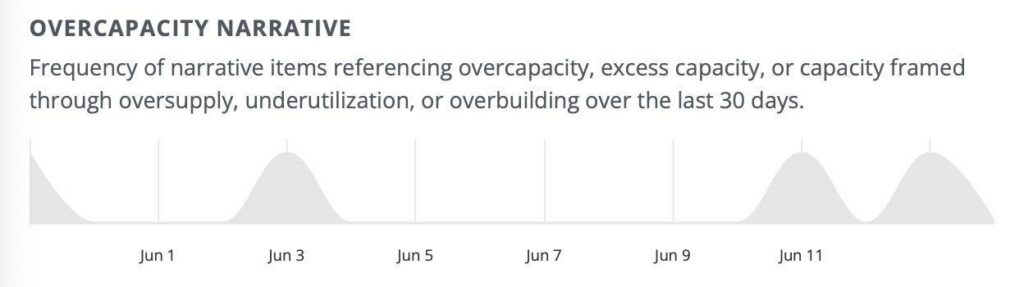
EdgeTheory Narrative Sparklines measure how frequently specific narrative themes appear across reporting over time. The harm and overcapacity sparklines show recurring spikes in narratives portraying AI data centers as economic burdens, environmental threats, and examples of excessive infrastructure expansion.
EdgeTheory Emotional Profile Classifiers found fear to be the dominant emotion driving discussion of AI data centers, particularly during periods of controversy surrounding surveillance, local opposition, and rapid infrastructure expansion. Sustained fear spikes suggest that the issue is increasingly framed in terms of perceived threats to communities, privacy, and democratic accountability rather than purely technological or economic benefits.
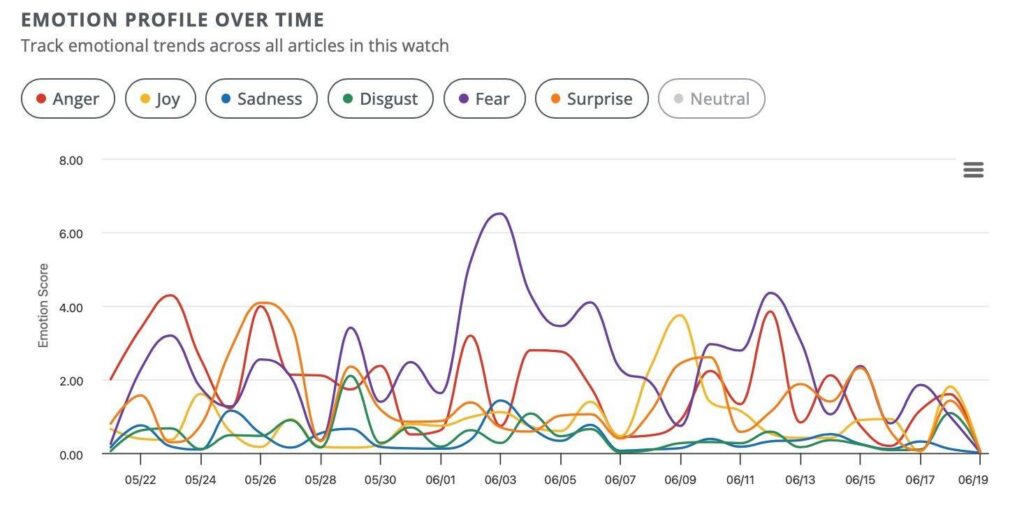
EdgeTheory Emotional Profile Classifier — emotional trends tracked across all articles in this watch.
Secondary peaks in anger, surprise, and disgust indicate that opposition narratives are not limited to concern, but are also mobilizing moral outrage and distrust toward governments, technology companies, and intelligence agencies. Individual articles associated with accusations of spying on critics, monitoring political opposition, and local bans on data centers generated especially high concentrations of fear and anger, while stories emphasizing resistance to data centers frequently produced disgust-driven reactions.






EdgeTheory Emotional Profile Classifiers revealing narrative targets and influence techniques across individual articles.
The presence of multiple competing emotional drivers suggests a fragmented information environment in which different narratives are activating distinct audiences. Fear-based messaging appears most effective at amplifying concerns over environmental, privacy, and societal risks, while anger and disgust are used to encourage opposition and distrust. In contrast, positive narratives highlighting data centers as essential infrastructure occasionally generated spikes in joy, but these reactions were episodic and significantly weaker than negative emotional patterns.
EdgeTheory’s NARINT analysis identified many sources emphasizing data centers as critical to economic competitiveness, technological leadership, AI development, digital sovereignty, infrastructure modernization, energy strategy, or national development. Notable examples include:
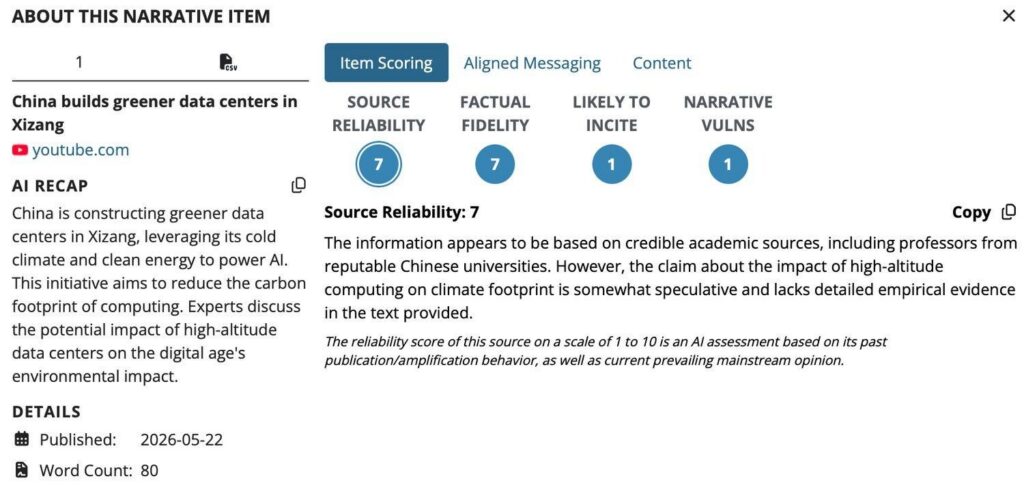
EdgeTheory Narrative Intelligence Classifier.

EdgeTheory Narrative Intelligence Classifier.

EdgeTheory Narrative Intelligence Classifier.
A substantial number of sources frame data centers as problematic due to overcapacity, economic inefficiency, environmental degradation, resource depletion, public cost burdens, social disruption, and health impacts. Key themes include:
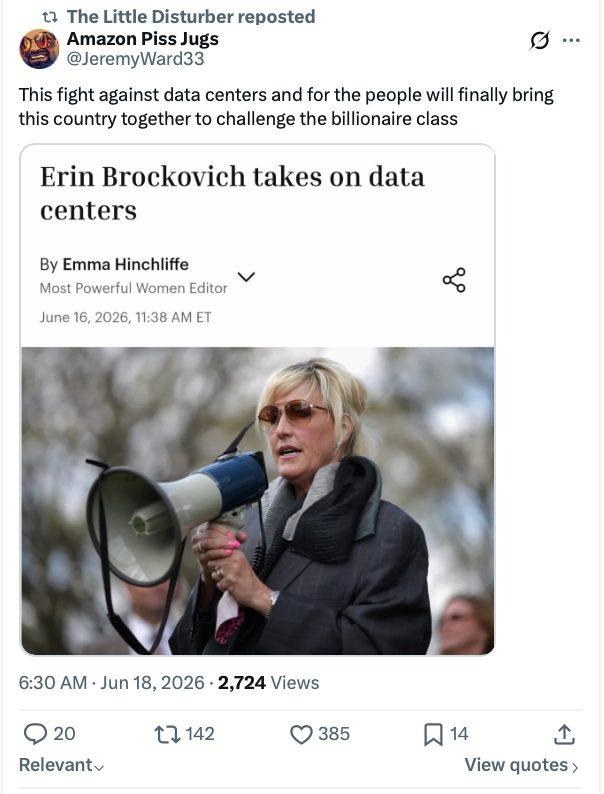
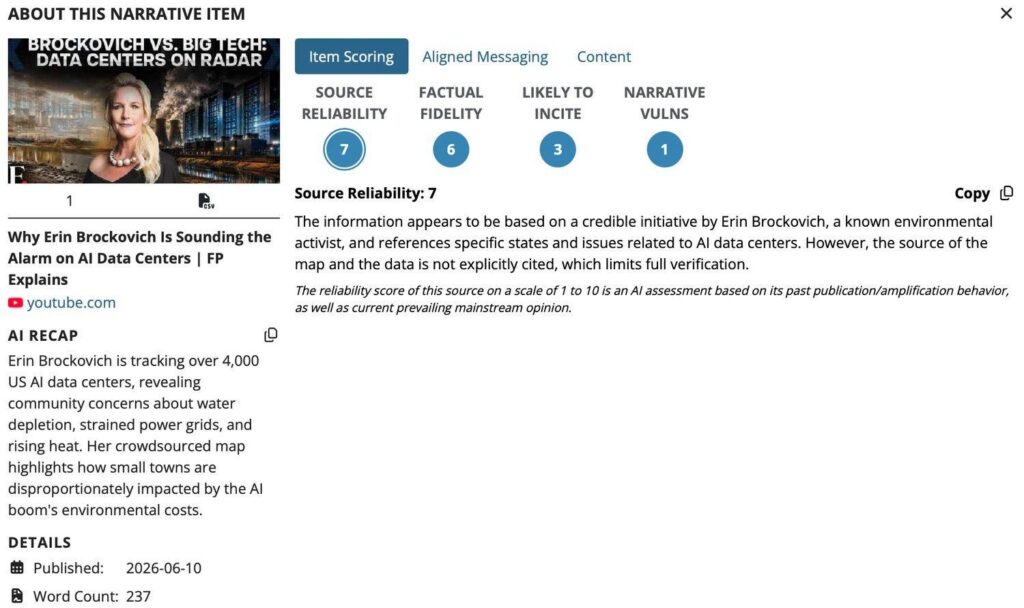
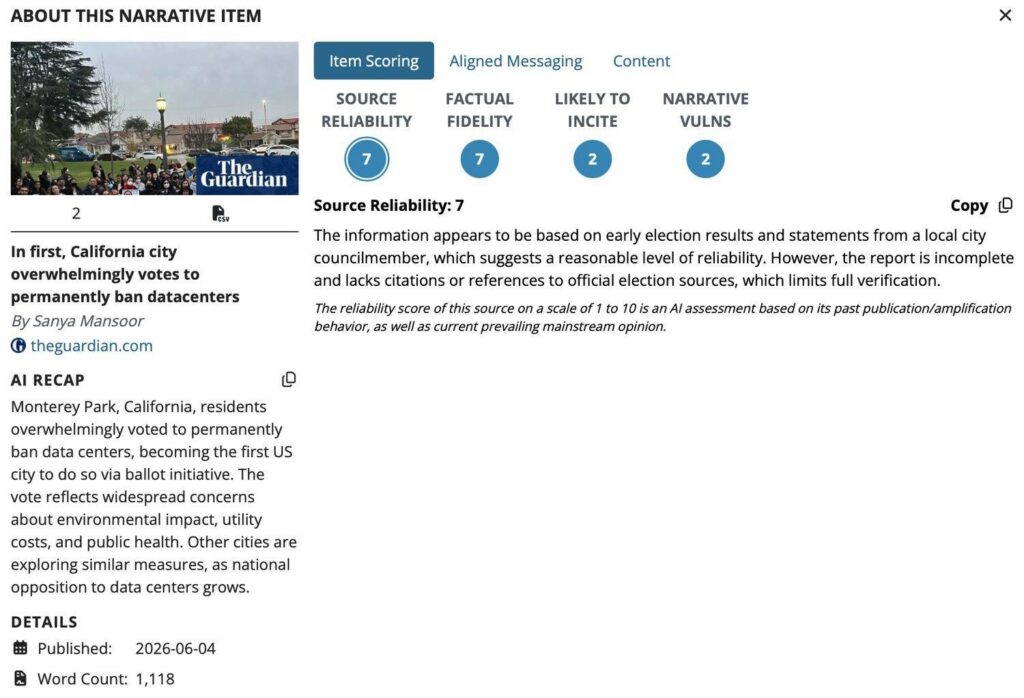
EdgeTheory NARINT surfaced sources on YouTube and X discussing data centers framed in terms of overcapacity and harm, with additional user engagement explicitly connecting data centers to larger sociopolitical issues, such as national cohesion and wealth equality.
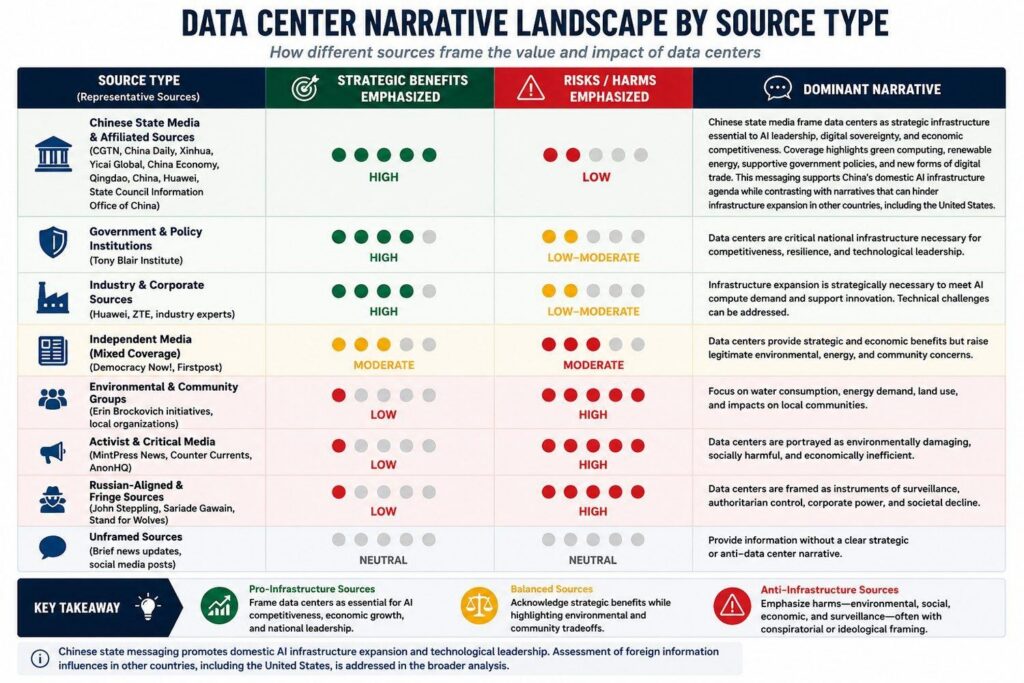
AI-generated infographic summarizing EdgeWatch findings: the Data Center Narrative Landscape by Source Type.
The narratives presented by adversarial sources in EdgeTheory’s NARINT Watches focus heavily on the rapid expansion of AI data centers and their associated social, environmental, and political impacts. These narratives are amplified through a variety of emotionally charged themes, including environmental degradation, community displacement, surveillance, job loss, and authoritarian control. The content is disseminated primarily by sources aligned with Russian, Chinese, and other adversarial interests, often leveraging social media, independent journalism, and state-affiliated media to reach diverse audiences.
Key issues intersect with upcoming midterm elections, including environmental concerns, economic inequality, government transparency, and civil liberties. Highly amplified and emotionally engaging narratives emphasize the negative local impacts of data centers—such as water depletion, rising electricity costs, noise pollution, and health risks—while framing the expansion of AI infrastructure as a tool for mass surveillance and social control. These stories resonate with diverse voter bases worried about divergent issues including climate change, economic displacement, and government overreach. The combination of emotional potency with topic flexibility enables adversarial actors to leverage the data center narrative to mobilize opposition to incumbent politicians who are implicitly framed as complicit or indifferent to a wide variety of voter concerns.
The combination of emotional potency with topic flexibility enables adversarial actors to leverage the data center narrative to mobilize opposition to incumbent politicians who are implicitly framed as complicit or indifferent to a wide variety of voter concerns.
This section is derived from combined NARINT classification and amplification pathway analysis to identify recurring rhetorical and structural patterns used to increase engagement and narrative persistence across platforms. EdgeTheory NARINT watches identified attack vectors and logical vulnerabilities promoted in narratives. A few strategies include:
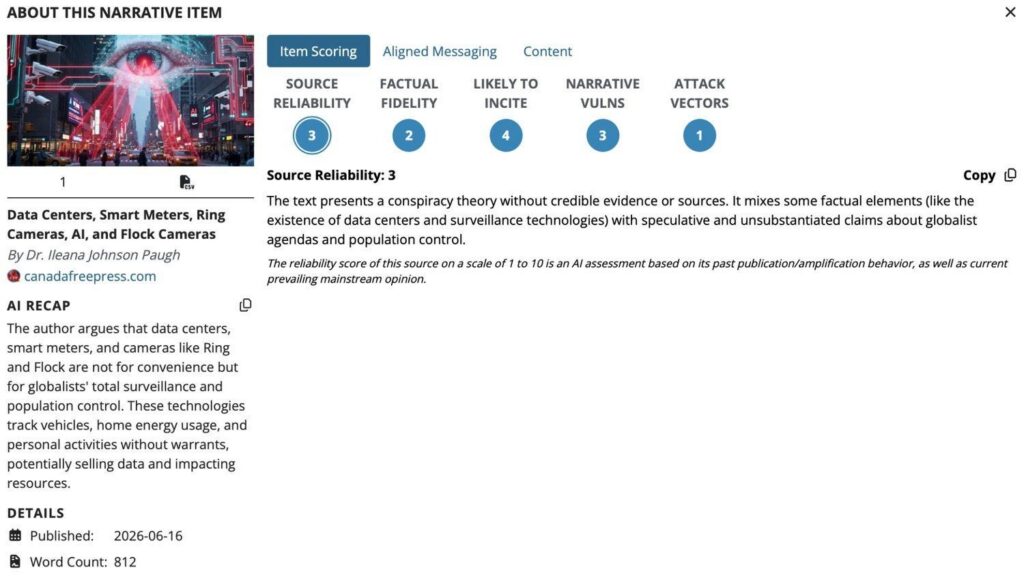
EdgeTheory Narrative Intelligence Classifier highlighting an article that discusses concerns of data centers being used as tools for global surveillance and total control.
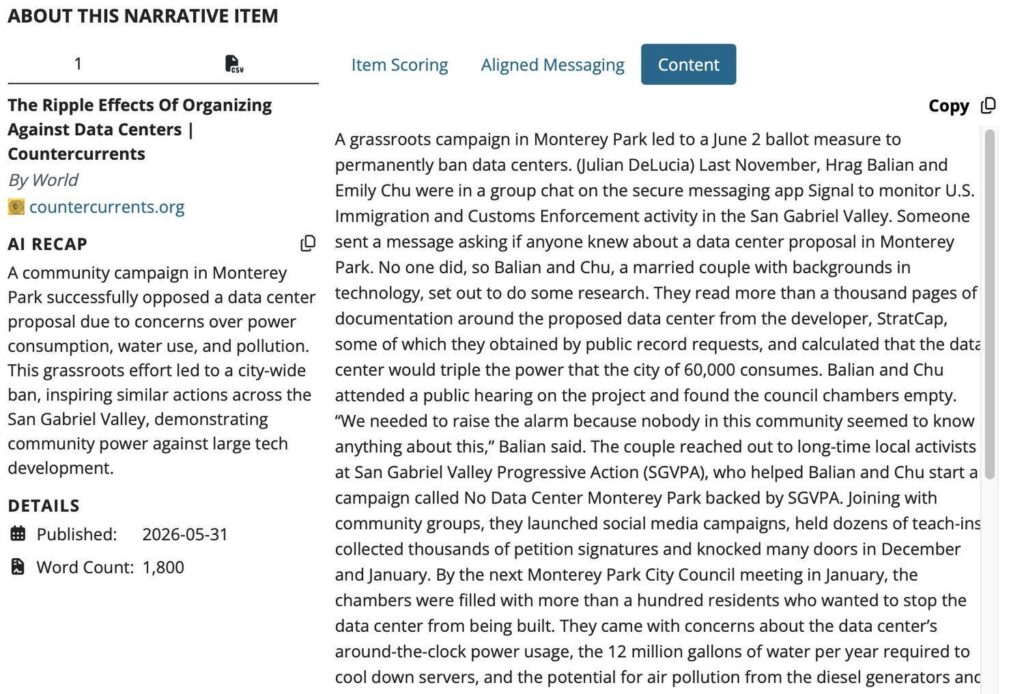
EdgeTheory Narrative Intelligence Classifier showing an example of political mobilization in Monterey Park.
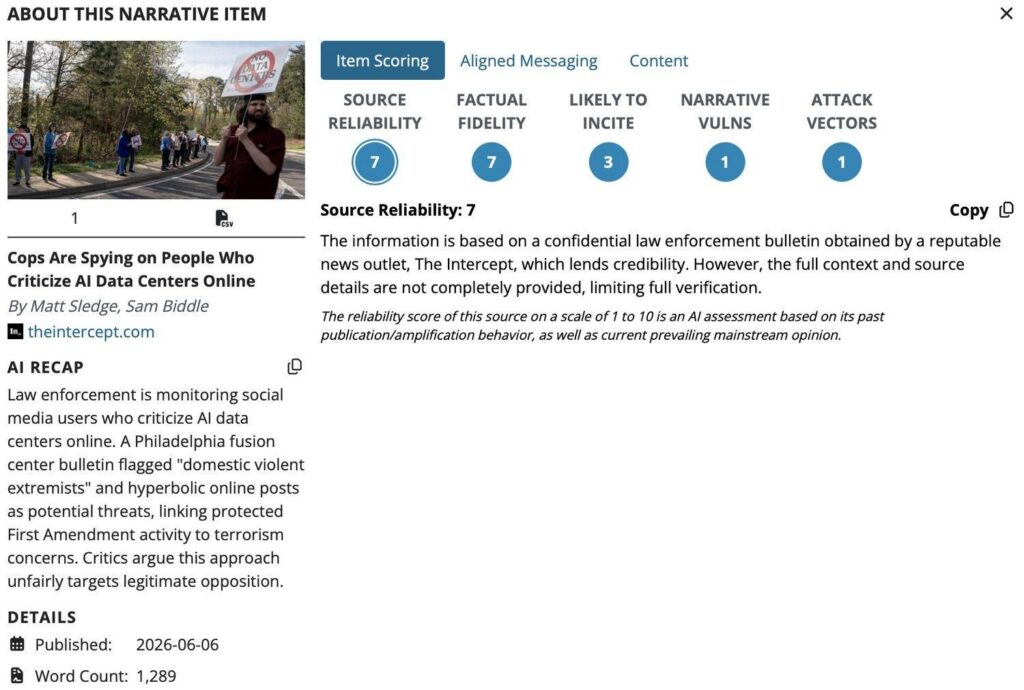
EdgeTheory’s Narrative Intelligence Classifier revealed anti-law enforcement narratives merging with data center narratives, expanding their influence.
These influence efforts generally favor candidates who oppose large-scale AI data center expansion and support environmental protections, community rights, and greater oversight of corporate and government power. NARINT enables identification of strategic outcomes including:
EdgeTheory’s Narrative Intelligence (NARINT) capabilities combine AI-enabled narrative, emotion, and influence network analysis to identify how information campaigns evolve, who is amplifying them, and where they are most likely to shape public opinion and policy. By tracking these patterns across thousands of sources in near real time, NARINT provides early warning of emerging attack vectors before they translate into tangible impacts on critical infrastructure and U.S. strategic interests.
Narratives portraying data centers as environmentally destructive, economically harmful, and tools of surveillance have the potential to slow AI infrastructure development through regulatory restrictions, litigation, and public opposition. If widely adopted, these narratives could constrain U.S. access to compute, energy, and capital, weakening America’s competitive position in artificial intelligence relative to strategic competitors.
Opposition to data center expansion centers on several themes: excessive electricity and water consumption, pollution, rising utility costs, limited local economic benefits, health impacts, lack of transparency, and concerns over surveillance and digital control. These narratives frame data centers as burdens on communities rather than strategic assets and have gained traction among activist groups, independent media, and some fringe commentators.
The preferred remedies advanced by opponents include moratoriums on new construction, stricter environmental reviews, increased public oversight, zoning restrictions, energy and water consumption limits, and legal challenges. Other proposals seek to slow the pace of AI infrastructure development or shift computing toward smaller, decentralized systems. If these narratives translate into policy, the United States risks delaying data center buildout at a time when access to compute, power, and physical infrastructure is increasingly determining AI leadership. Reduced infrastructure capacity would limit model training and deployment, discourage investment, and create opportunities for competitors with fewer regulatory constraints to gain advantages in AI development, cloud services, and associated technologies.
Unlike previous technology sectors, compute infrastructure cannot be rapidly replaced once constrained by permitting delays, litigation, or energy shortages, making infrastructure development itself a strategic advantage.
Failure to incorporate intelligence on the information environment surrounding data centers risks causing policymakers to underestimate how narratives can translate into infrastructure delays.
Narratives portraying data centers as environmental hazards, economic burdens, and tools of surveillance have the potential to create infrastructure bottlenecks that slow AI development. Delays, moratoriums, and increased regulatory scrutiny would raise costs, discourage investment, and constrain the compute capacity needed to train and deploy advanced AI systems. These constraints could also increase dependence on foreign infrastructure and encourage talent and capital to migrate to countries with more favorable environments for AI development.
Responding to narrative threats is a critical step in the narrative kill chain. Adversarial actors successfully infiltrating voter bases with targeted narratives sets a precedent where such actors are likely to further exploit the information environment by identifying how the next geopolitical power struggle can be translated into issues that mobilize key voter blocks in favor of foreign interests.
The current narrative landscape reveals an all-or-nothing emotional amplification of demands on policymakers. NARINT enables targeted messaging to counter divisive rhetoric and build consensus between stakeholders to move forward responsibly. Advanced adversarial networks seek division, but narrative intelligence reveals the necessary constructive, aligned messaging for coalition building. Policymakers may fail to distinguish between organic opposition and amplified narratives, resulting in reactive policies that unnecessarily restrict AI capacity. Such outcomes would weaken America’s ability to attract investment, retain talent, scale frontier models, and maintain advantages in cloud services and emerging technologies.
Responding to narrative threats is a critical step in the narrative kill chain. Adversarial actors successfully infiltrating voter bases with targeted narratives sets a precedent where such actors are likely to further exploit the information environment by identifying how the next geopolitical power struggle can be translated into issues that mobilize key voter blocks in favor of foreign interests.
Narrative aggregation, emotional vectorization, source network mapping, and tagging capabilities make it possible to detect how concerns surrounding data centers evolve, which actors are amplifying them, and where narratives are gaining traction. These capabilities enable earlier identification of emerging opposition campaigns and provide policymakers with intelligence that would not be apparent from isolated reporting or traditional media analysis alone.
AI data centers have become a contested information issue where public opinion, regulatory decisions, and strategic competition increasingly intersect. EdgeTheory’s NARINT analysis found that fear and distrust consistently dominate discussion of AI infrastructure, with narratives centered on environmental impacts, surveillance, and community harm generating the strongest emotional engagement. While many of these concerns are rooted in legitimate local issues, they are increasingly merged into broader anti-technology and anti-government narratives that expand their reach well beyond affected communities.
Rather than revealing a coordinated disinformation campaign, the analysis shows how credible local grievances can be amplified across activist, independent, fringe, and, in some cases, foreign-aligned information networks to increase opposition to AI infrastructure. As these narratives converge and gain momentum, they shift public discourse toward project cancellation, litigation, and restrictive regulation rather than balanced policy solutions. If sustained, this information environment could slow U.S. data center development at a time when compute infrastructure is becoming a decisive factor in global AI competition.
NARINT provides the ability to distinguish between legitimate community concerns and coordinated narrative amplification, enabling policymakers to identify emerging influence campaigns, understand how narratives evolve across information ecosystems, and respond before they translate into strategic disadvantages for U.S. AI competitiveness.

