
Menu
Disney's Emerging Brand Vulnerabilities: A Narrative Intelligence Analysis
Disney has built one of the world's most valuable brands through decades of storytelling, emotional connection, and consumer trust. But even iconic brands are shaped by evolving public narratives.
This Narrative Intelligence Analysis examines how conversations surrounding affordability, customer experience, creative direction, streaming value, and trust have evolved into broader narratives that may influence consumer behavior, investor confidence, and long-term brand equity.
Using Disney as a case study, the report demonstrates how narratives emerge, amplify across digital ecosystems, and become strategic business risks long before they appear in traditional business metrics.
What can every organization learn from Disney's experience?
Download the report to discover how Narrative Intelligence helps leaders identify emerging narratives, changing stakeholder perceptions, and developing trust deficits before they become business challenges.
This report examines converging narratives that pose growing reputational risk to The Walt Disney Company, drawn from EdgeTheory's C2 narrative intelligence platform.
| Most Important Insight | Disney's most influential critics are often loyal customers and fans — not opponents. Their criticism reflects disappointment rather than hostility, which makes it more credible and more consequential. |
| Primary Risk | A growing disconnect between Disney's historic brand promise and the consumer experience is driving multiple reinforcing narratives across affordability, complexity, content quality, and trust. |
| Why It Matters | These narratives directly threaten pricing power, subscriber retention, repeat park visitation, franchise value, and long-term brand equity across every major Disney business line. |
| What Narrative Intelligence Reveals | The vulnerabilities were visible in narrative data long before they surfaced in traditional performance metrics — following a predictable six-stage amplification cycle from individual complaint to investor concern. |
| Strategic Lesson | Organizations that monitor narratives early gain the opportunity to address concerns before perceptions become entrenched. Narratives become business risks long before they become business metrics. |
Disney remains one of the world's strongest brands — but narrative analysis reveals a growing disconnect between Disney's historic promise and how consumers increasingly describe their experiences. That disconnect is the subject of this report.
In recent years, Disney has faced a growing collection of narratives that challenge its value proposition — none of them primarily ideological. Consumers question whether Disney's experiences justify their costs, whether its creative output remains innovative, and whether the company still prioritizes the customer experience over financial performance. Individually, these concerns are manageable. Collectively, they reinforce one another into a broader perception that Disney's exceptional value may be eroding. Reputation rarely changes overnight. Narratives change it one conversation at a time.
This report examines the emergence and evolution of these narratives through the lens of narrative intelligence — identifying recurring themes, amplification pathways, and emotional drivers that influence consumer behavior long before their effects appear in traditional business metrics. Disney's experience is instructive for any organization: even the world's strongest brands are vulnerable to the narratives forming around them.
Disney remains one of the world's most recognizable brands, but recent narrative analysis reveals a growing collection of concerns surrounding the company's evolving relationship with consumers. This report examines three interconnected areas of reputational vulnerability: consumer experience (affordability and complexity), content and innovation (streaming fatigue and creative dependence), and consumer trust and brand alignment. By examining how these narratives emerge, spread, and converge, this report identifies the reputational risks most likely to shape consumer behavior in the years ahead.
The findings are drawn from EdgeTheory's C2 narrative intelligence platform. C2 continuously aggregates news articles, social media posts, blogs, forums, and other open-source content, enabling analysts to identify emerging themes, monitor sentiment, and measure narrative amplification across diverse information environments. Through AI-assisted thematic analysis, emotional profiling, and amplification tracking, C2 detects reputational vulnerabilities before they become visible through traditional business metrics.
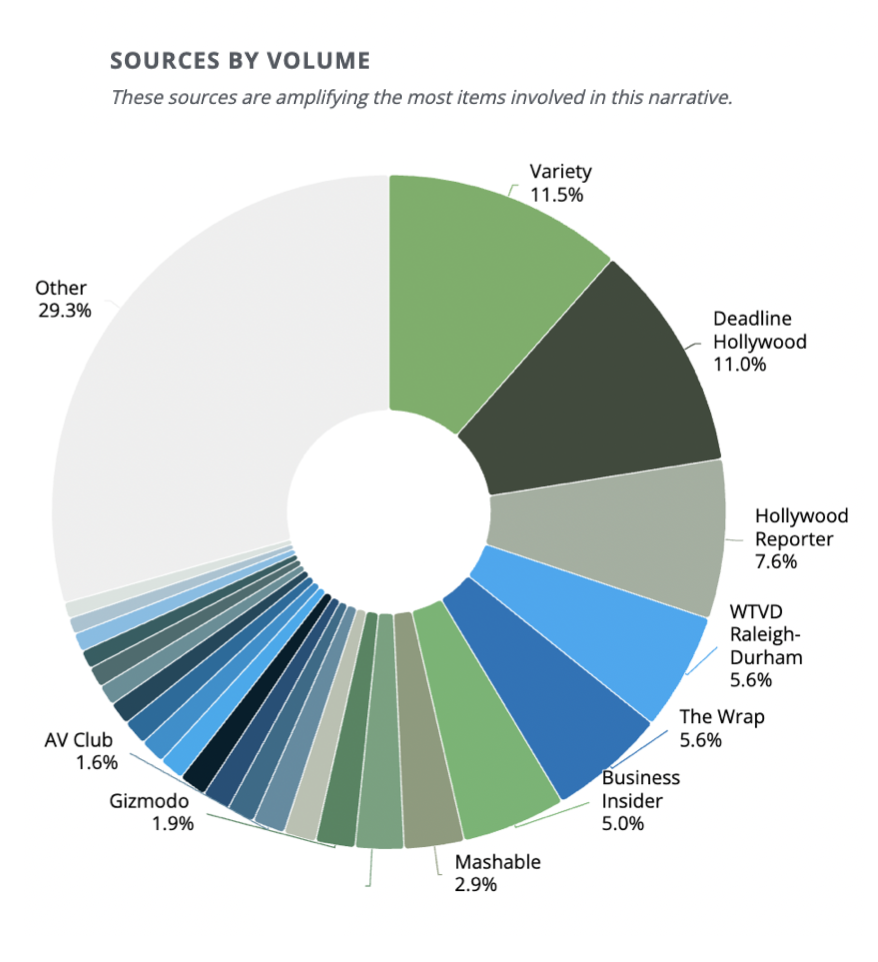
EdgeTheory's Narrative Intelligence C2 platform compiles publication data for each narrative it tracks. This pie chart shows a sample of outlets publishing Disney narratives in June 2026, with Variety producing the most content of any single publisher.
Understanding a narrative is only the first step in assessing reputational risk. Equally important is understanding how narratives spread, who amplifies them, and why certain messages gain traction while others fade. Disney's experience provides a clear example: most negative narratives did not originate in traditional media. They emerged from individual consumer experiences before moving into fan communities, influencer ecosystems, mainstream media, and ultimately investor discussions.
This progression follows a predictable six-stage cycle. Understanding it is essential context for the vulnerability analysis that follows — and for any organization seeking to intervene before narratives become entrenched.
Most Disney narratives begin with individual experiences — a family shocked by the total cost of a vacation, a subscriber questioning a price increase, a long-time fan disappointed by a new release, a visitor frustrated by reservation complexity. Individually, these carry little weight. The critical factor is whether similar experiences begin to recur independently among many consumers. When they do, the foundations of a narrative emerge.
At this stage, criticism is personal and constructive. Importantly, many consumers expressing dissatisfaction still identify themselves as Disney supporters — a dynamic that significantly increases the credibility of the criticism.
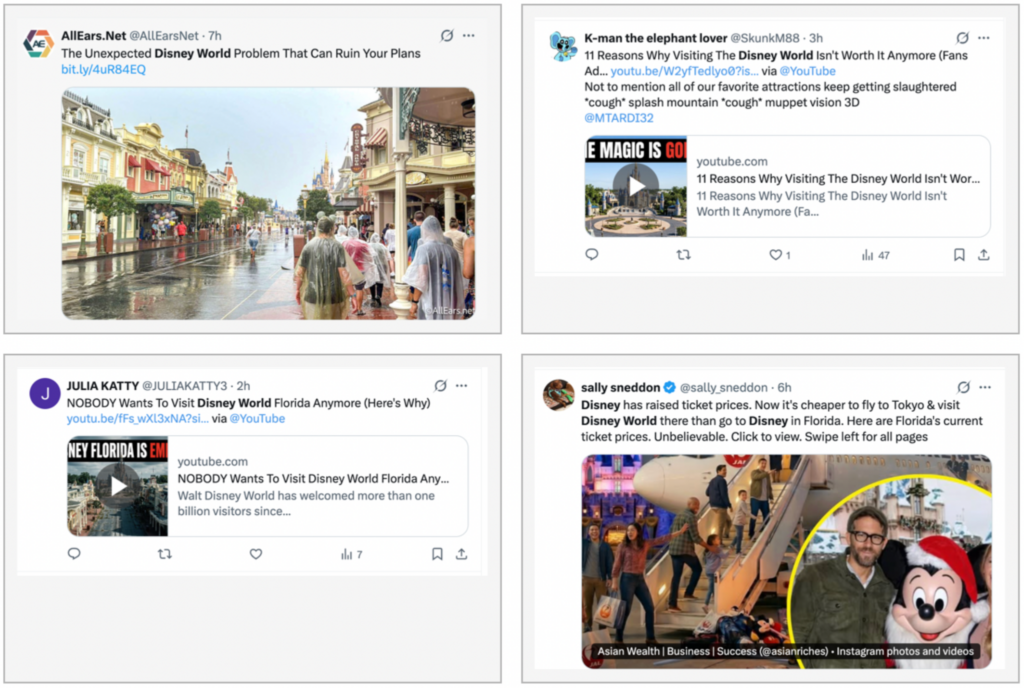
Sample consumer narratives from X and YouTube emphasizing various concerns associated with visiting Disney.
Individual experiences enter Disney's vast fan ecosystem — Reddit communities, Facebook groups, travel forums, theme park discussion boards, and YouTube comment sections. Within these environments, complaints either gain validation or disappear. When hundreds of users independently describe the same frustration, a shared understanding emerges that the issue is systemic, not personal. This transition from individual complaint to perceived pattern is a critical inflection point.
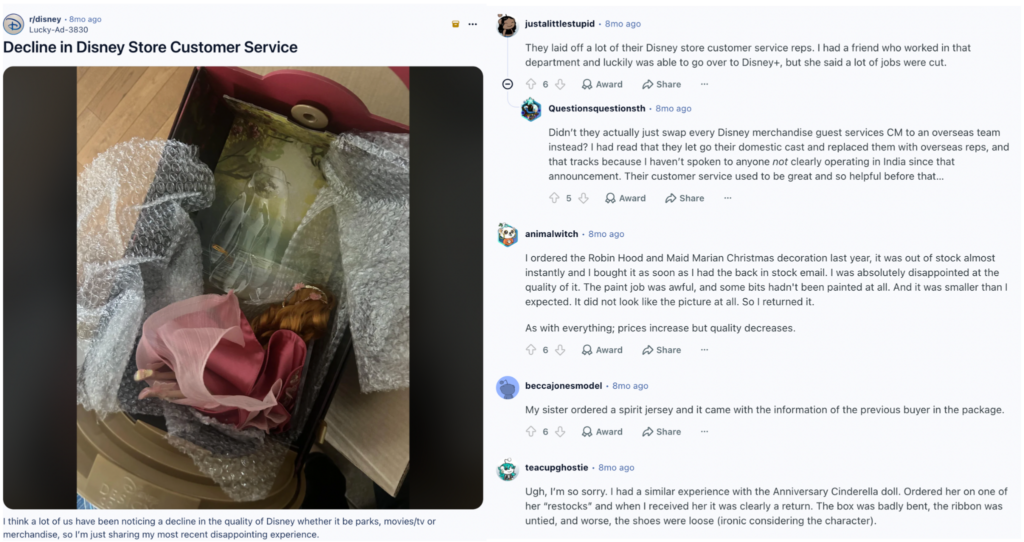
A Disney customer complaint was posted to Reddit in November 2025. The comments illustrate the community validation dynamic at scale.
Once a narrative gains traction in fan communities, content creators take notice. Disney's ecosystem supports thousands of creators focused on theme parks, travel planning, film reviews, streaming, and entertainment news. These creators act as intermediaries between consumer discussions and much larger audiences — and they frequently identify emerging themes before traditional journalists do. Topics that spark controversy and consumer frustration drive strong engagement, substantially accelerating the narrative's reach.
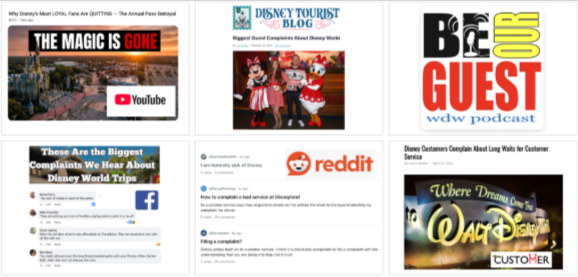
A sampling of Disney influencers from around the web, including YouTubers, travel blogs, podcasts, and industry-focused publications.
As narratives gain visibility among influencers, journalists and analysts incorporate those themes into broader reporting, lending legitimacy to what previously existed only in niche communities. Coverage includes consumer surveys, attendance trends, streaming metrics, box office performance, and expert interviews. At this stage, the narrative enters mainstream discourse — reaching audiences far beyond Disney's core fan base.

Representative narratives from June 2026 show media outlets around the globe adopting and amplifying content critical of Disney.
One of the most consequential phases occurs when consumer narratives begin influencing investor discussions. Analysts monitor consumer sentiment, subscriber retention, brand perception, and attendance trends. For Disney, the connection to financial outcomes is direct across each business pillar: premium pricing depends on brand strength; parks depend on repeat visitation; streaming depends on subscriber retention; franchises depend on emotional engagement. When narratives suggest weakening loyalty, reduced pricing power, or long-term brand erosion, they begin influencing perceptions of future value — not just current performance.

Representative narratives from June 2026 highlight various concerns among Disney investors.
Convergence occurs when audiences stop evaluating individual issues separately and begin treating them as evidence of a single, broader organizational problem. This is the most dangerous stage because it changes how all future information is interpreted. New criticisms receive amplified attention. Positive developments are discounted. Consumer trust becomes harder to rebuild. Once convergence occurs, the window for effective intervention narrows significantly.

Emotional variance of Disney-related narratives, June 7–21, 2026, showing sustained levels of anger, sadness, disgust, and fear.
Several factors make Disney-related criticisms particularly effective in digital environments. Emotional resonance: Disney occupies a deeply emotional place in consumers' lives, and disappointment generates stronger engagement than satisfaction. Nostalgia: comparisons to idealized past experiences make any perceived decline feel more significant. Shared financial pressure: affordability concerns connect individual experiences to broader economic anxiety. Community reinforcement: Disney's highly engaged fan base accelerates narrative spread through repeated discussion and validation.

The EdgeTheory C2 platform measures the emotional makeup of each published item in its database. Note the high level of anger in the second item from the top, generated by a Disney programming change.
Disney is an ideal case study in narrative risk for specific reasons — none of which require knowledge of the company's history to understand.
#1. Disney is one of the world's strongest brands. It commands immediate recognition across all demographics, geographies, and generations. Any executive reading this report already understands intuitively what the Disney brand represents and why it matters.
#2. Disney's business model is built on emotional connection. Unlike companies whose reputations rest primarily on product quality or price, Disney has always sold experiences, memories, and aspiration. That emotional foundation is what allows Disney to command premium pricing across parks, streaming, merchandise, theatrical releases, and a cruise business simultaneously.
#3. And most important for this report — that same emotional foundation creates heightened vulnerability. Strong brands aren't immune to narrative risk. They often face more of it. Consumers who care deeply about a brand react more strongly when expectations are not met, and their criticism carries more credibility with other consumers than criticism from those who never cared.
Disney's experience illustrates a dynamic that applies to any organization with a strong brand, a loyal customer base, or a reputation built on trust: the narratives most worth monitoring are often the ones driven by your most engaged customers.
Two of the most persistent narrative clusters concern the consumer experience directly: cost and complexity. Both share a common emotional driver — the sense that Disney has moved away from the effortless, accessible experience that historically defined the brand.
| The Most Dangerous Narratives Are Often Driven by Loyal CustomersMany of Disney's most vocal critics are not opponents of the brand. They are long-time customers and fans whose criticism reflects disappointment rather than hostility. Narratives rooted in disappointment from loyal customers are more credible, harder to dismiss, and ultimately more damaging than criticism from those who were never Disney advocates. |
No criticism appears more consistently than concerns about cost. Disney positioned itself for decades as premium but broadly accessible. Increasingly, consumers describe Disney vacations as major financial undertakings requiring extensive planning. The perception extends beyond hotel admission, dining, parking, access to premium attractions, and merchandise. Many consumers no longer view these increases as proportional to the value they receive.
A nostalgic component amplifies these narratives. Consumers frequently compare current prices with memories of previous visits, making the perceived decline feel personal.
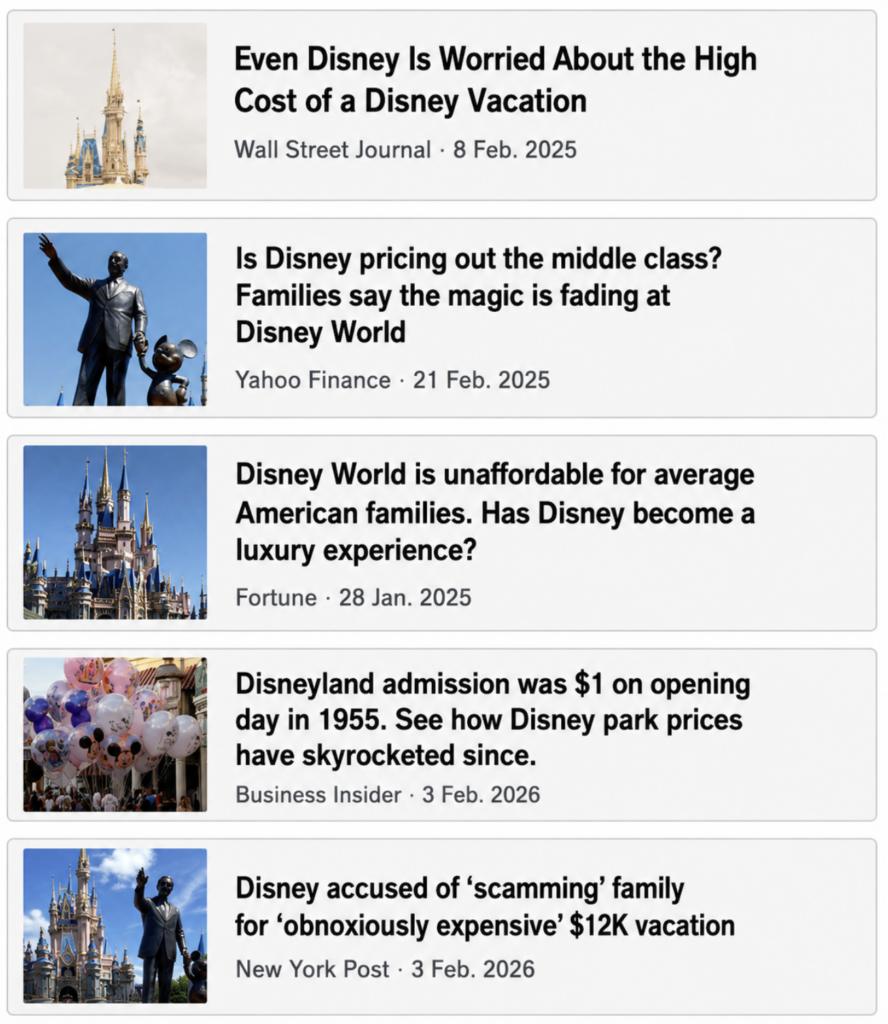
Representative narratives from 2025 and 2026 illustrate growing concerns about Disney's pricing.
The affordability narrative generates financial anxiety, family disappointment, nostalgia, resentment, and a sense of exclusion — directly challenging Disney's image as a place where families create shared memories.
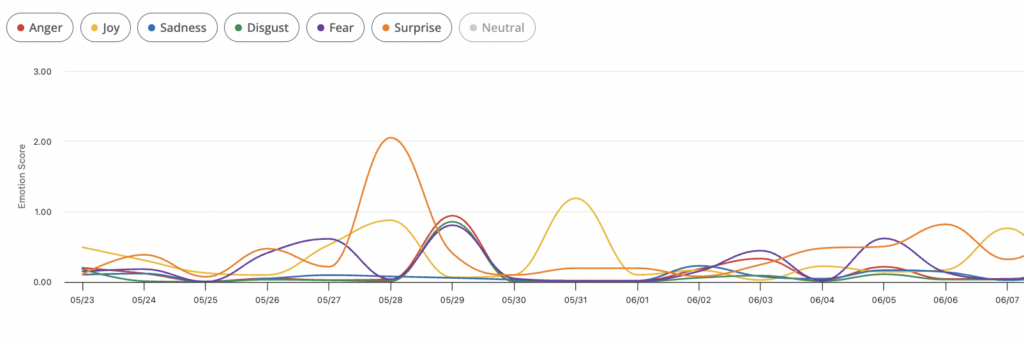
EdgeTheory's C2 platform tracks the emotional content of Disney narratives between May 23 and June 7, 2026, revealing sustained levels of anger, sadness, disgust, and fear.
Disney marketed its parks for generations as places where guests could escape everyday concerns. Modern Disney vacations increasingly require mobile applications, dining reservations, attraction scheduling, virtual queues, and extensive digital coordination. While introduced for operational efficiency, these systems are frequently described in public discourse as sources of stress rather than simplification.

Representative narratives dating back to 2024 reflect growing anxieties over the complexity of visiting a Disney theme park.
Complexity complaints generate frustration, stress, confusion, and disappointment. They resonate strongly because consumers readily share stories about unexpected inconveniences or perceived inefficiencies.
| Executive ImplicationFor Disney, both narratives erode the same asset: the perception of effortless magic that justifies premium pricing. When a vacation requires project management, the emotional ease that differentiates Disney from every competitor disappears — and with it, the rationale for the price premium.Business Implication: Affordability and complexity narratives, left unaddressed, threaten pricing power across all of Disney's business lines simultaneously. |
Two related narrative clusters challenge Disney's position as a creative leader: dissatisfaction with Disney+ and the perception that Disney's creative output has become overly dependent on existing intellectual property. Both affect consumer willingness to invest financially and emotionally in Disney's content ecosystem.
Disney+ launched as a compelling value proposition. Over time, broader industry trends have reshaped consumer attitudes. Rising subscription costs, content fragmentation, and intensifying competition have generated growing skepticism — and Disney+ has not been immune.
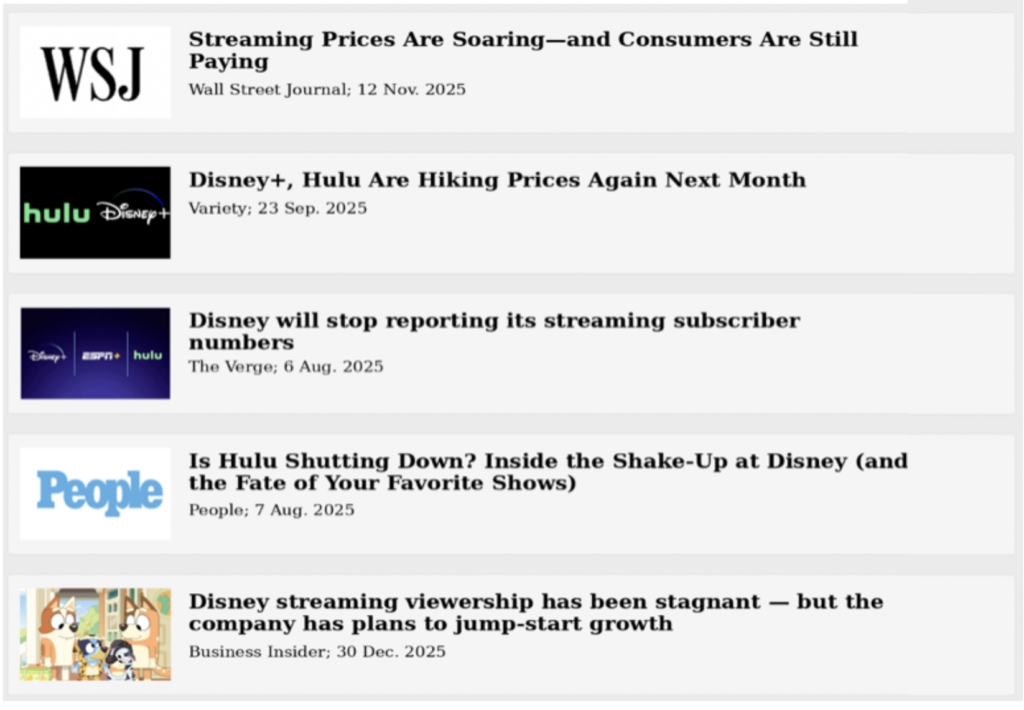
Representative narratives from 2025 reveal growing streaming fatigue and frustration with Disney's subscription packages.
Frustration, budget anxiety, consumer fatigue, and value skepticism dominate — often intensifying during periods of broader economic uncertainty when consumers reevaluate recurring expenses.
Disney's portfolio is built on some of the world's most valuable intellectual properties: Marvel, Star Wars, Pixar, and Disney Animation. These franchises have generated extraordinary commercial success. At the same time, narrative analysis reveals growing discussion about whether Disney continues to innovate at the pace that characterized earlier periods of its history.
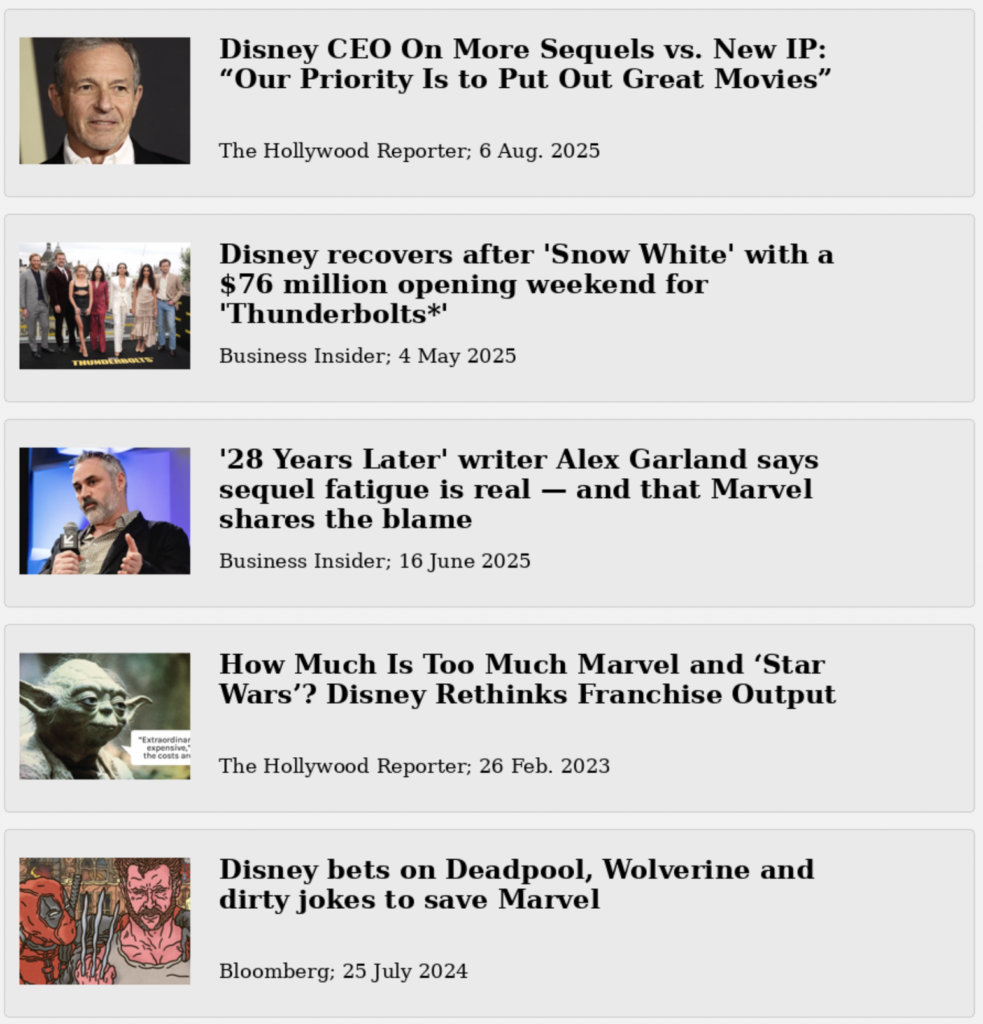
Representative narratives dating back to 2023 highlight a growing concern that Disney has lost its creative edge.
Nostalgia, disappointment, creative frustration, and cultural fatigue characterize these narratives. Many participants remain highly engaged Disney consumers — their criticism reflects affection, not rejection, reinforcing the loyal-fans dynamic identified earlier in this report.
| Executive ImplicationCreative fatigue narratives are compounding risks: franchise exhaustion in Marvel or Star Wars does not affect one business line — it simultaneously reduces theatrical performance, streaming appeal, park attraction viability, and merchandise revenue.Business Implication: Narrative-driven subscriber loss and content skepticism have direct implications for revenue forecasting, content investment decisions, and investor confidence in Disney's long-term growth strategy. |
The preceding narratives converge around a broader concern: whether Disney still prioritizes the consumer experience to the same extent that it prioritizes financial performance. This narrative does not focus on any single decision. It reflects a cumulative assessment formed through repeated interactions with the Disney ecosystem.
Unlike more specific criticisms, these narratives function as umbrella explanations — connecting multiple grievances into a single story about organizational priorities.
Betrayal, disillusionment, frustration, cynicism, and loss of trust characterize this narrative cluster. These emotions are particularly consequential because they affect how consumers interpret all future experiences. Once trust begins to erode, even minor frustrations reinforce existing negative perceptions — the defining characteristic of Stage Six convergence.
Each narrative cluster examined in this report reflects the same underlying tension: a growing gap between Disney's historic brand promise and the experiences consumers believe they are receiving today.
| Executive ImplicationTrust is the connective tissue across every Disney business line. Unlike a product failure that affects one category, trust erosion affects parks, streaming, theatrical releases, merchandise, and the cruise business simultaneously.Business Implication: When trust weakens, the premium consumers pay across all categories becomes less defensible — and the repeat engagement that drives Disney's economics becomes harder to sustain. |
Traditional business metrics measure outcomes. Narrative intelligence focuses on the precursors that shape those outcomes. Attendance figures reveal whether visitors arrived. Narratives help explain why they chose to visit — or not. Subscriber counts show whether customers remain. Narratives reveal whether they intend to stay. Revenue data shows what consumers purchased. Narratives reveal whether they believe those purchases delivered sufficient value.
Narratives become business risks long before they become business metrics. By the time negative perceptions are visible in performance indicators, the underlying narratives may already be established in public discourse. Organizations capable of identifying and responding to narratives early gain a meaningful advantage: they can protect brand equity, strengthen stakeholder trust, and adapt to changing consumer expectations before concerns become entrenched.
Revenue, market share, subscriber counts, and attendance data are essential — but inherently retrospective. They describe events that have already occurred. Narratives reveal developing risks before they appear in operational metrics: consumers begin questioning affordability before attendance declines; subscribers express dissatisfaction before cancellations increase. Disney's experience illustrates this clearly. Each stage of the six-stage amplification cycle offered a progressively narrower window for intervention. Organizations that monitor narratives gain access to the earlier stages — when options are broadest.
Disney possesses extraordinary advantages: global brand recognition, valuable intellectual property, significant financial resources, and deep customer loyalty. Yet these strengths do not eliminate narrative risk — they may increase it. Strong brands face heightened consumer expectations, and when those expectations are not met, the emotional reaction is more intense. The Disney case study demonstrates that the most consequential narratives are often not driven by indifference. They are driven by deep affection that has encountered disappointment.
Disney remains one of the world's most successful and influential brands — with extraordinary cultural relevance, deep emotional connections, and some of the most valuable entertainment properties.
But the narratives examined throughout this report point to a specific and measurable risk: a growing gap between the emotional relationship Disney has built over a century and the experiences consumers increasingly describe today. The core challenge is not awareness or relevance. It is preserving the emotional connection that has historically allowed Disney to command loyalty, trust, and premium pricing across generations — and across every business line simultaneously.
The most important lesson from Disney's experience is not that a strong brand faces criticism. It is that the narratives behind that criticism develop long before they appear in quarterly reports. They follow a predictable path — from individual frustration, through community validation and influencer amplification, into mainstream media and investor concern — and each stage offers a narrower window for response.
Every organization has narratives forming around it today. Some are favorable. Some are not. Most are developing well below the threshold of traditional monitoring tools. The question is not whether those narratives exist. The question is whether you have the visibility to see them — and the time to respond before they become business problems.
| The Case for Narrative Intelligence: Reputation rarely changes overnight. Narratives change it one conversation at a time — across thousands of individual interactions, long before the effects become visible in earnings reports, attendance figures, or subscriber counts.EdgeTheory's Narrative Intelligence platforms provide the visibility organizations need to identify narrative risks early, understand the emotional drivers behind them, and respond before perceptions become entrenched.If there is a topic, issue, brand, competitor, or emerging risk you would like to better understand, contact EdgeTheory at info@edgetheory.com to see how Narrative Intelligence can serve as an early warning system for your organization. |

