
Menu
This report examines the political, informational, and geopolitical dynamics shaping Armenia’s 2026 parliamentary election. EdgeTheory’s all-source analytics identified recurring themes across regional news, social media, and influence networks related to foreign interference and regional security concerns.. The June 07 election comes amid Armenia’s continued effort to reduce its dependence on Russia, deepen engagement with Western partners, and manage ongoing tensions with Azerbaijan and Turkey.
Using EdgeTheory’s EdgeRunner, an AI-powered source discovery agent designed to identify and analyze content related to Armenia’s 2026 elections, this assessment examines the threat intelligence landscape shaping Armenia’s 2026 parliamentary election. Our analysis identified sustained discussion surrounding Russian and Western influence, regional conflicts, Armenia’s evolving security partnerships, and concerns over election integrity. Particular attention is given to external influence campaigns, regional security dynamics, voter sentiment, and the election’s implications for Armenia’s future geopolitical alignment. By identifying narrative trends and emotional analysis, EdgeRunner assessed how foreign governments, regional actors, and domestic political movements are shaping public perceptions ahead of the vote.
Armenia’s 2026 parliamentary election is not solely a domestic political contest. It is increasingly a referendum on the country’s geopolitical alignment. Prime Minister Nikol Pashinyan’s government continues to pursue closer relations with Europe, the United States, France, and India while seeking normalization with Azerbaijan and Turkey. Opposition forces advocate stronger ties with Russia and a more confrontational approach toward regional security issues.
Rather than competing primarily over economic or domestic policy questions, political actors are increasingly competing over which external partnerships can best ensure Armenia’s security and sovereignty. Information dominance in this conflict has consequences for both Russia’s strategic access to the South Caucasus and American interests in the wars in Ukraine and Iran, and Narrative Intelligence (NARINT) reveals the most critical risks and opportunities.
EdgeTheory analyzed all-source intelligence arising from two sets of source modules discussing the 2026 Armenia elections. The first source module included the social media accounts of known GCA (Global Cognitive Adversary) sources, such as state media, influencers, and networks aligned with the interests of Russia, China, Iran, and other affiliations. The second source module comprised 350 sources (telegram, news, influencers, television channels, forums, etc) that regularly discuss Armenian politics, with 197 confirmed to be based in Armenia.
To retrieve these 350 high-reliability sources, we deployed EdgeRunner, an agentic source discovery tool that independently identifies, analyzes, tags, and scores sources based on topical relevance, country affiliation, language, and other metrics. Using this tool, EdgeTheory rapidly identified these high-fidelity sources on the Armenian election and created a source module to compare external pro-GCA narratives with internal Armenian reporting. This comparison enabled EdgeTheory analysts to identify Russian TTPs to influence the election and how local pro-Russia influencers in Armenia are amplifying these messages. We analyzed their likely successes, weaknesses, and how the wars in Ukraine and Iran shifted their information campaign strategies and narrative attack vector deployments.
This methodology enable the identification of several dominant influence operations and narrative vulnerabilities pro-Russia sources consistently elevated in an attempt to sway the democratic process to favor their preferred candidates. We reviewed over 5,000 unique sources discussing the election, refining to just the 350 most reliable influencers, and further identified 141 of those sources as promoting consistent pro-Russia content. By tagging these sources as pro-Russia, we were able to compare internal and external pro-Russian information warfare campaigns, resulting in three key findings.
The central question in Armenia's 2026 election is whether the country should continue reducing its dependence on Russia and deepen integration with Western partners, or preserve closer security, economic, and political ties with Moscow. Under Pashinyan, Armenia has expanded defense cooperation with France and India, strengthened engagement with the EU, pursued normalization talks with Azerbaijan and Turkey, and signaled interest in greater Western integration. NARINT analysis identified persistent Russian influence activity designed to challenge this trajectory through narratives emphasizing security risks, economic consequences, and regional instability. The stakes extend beyond diplomatic alignment. The election could influence Armenia's future security guarantees, military modernization partnerships, access to Western economic assistance and investment, relations with Russia, and the country's approach to negotiations with Azerbaijan following the loss of Nagorno-Karabakh. An information victory for pro-Western candidates would likely accelerate Armenia's strategic diversification away from Moscow, while a resurgence of pro-Russian influence could slow or reverse that shift. As a result, the narrative landscape reveals the election is increasingly viewed as a decision about Armenia's long-term security posture and geopolitical orientation rather than a contest focused primarily on domestic policy.
EdgeTheory’s Narrative analysis identified sustained Russian influence activity including disinformation campaigns, economic coercion, political messaging, and support for pro-Russian opposition forces. Reporting surfaced by EdgeRunner revealed Kremlin-linked information operations designed to undermine confidence in Pashinyan and frame Western integration as a path toward instability and economic decline. Concurrent leverage of fear as a dominant emotional profile leverages trade restrictions and diplomatic pressure to reinforce emotional preference for a pro-Russia candidate, suggesting Moscow is employing multiple instruments of influence to preserve its position in Armenia.
Major spikes in emotion profiles corresponding to discussions of Russia, NATO, EU integration, the wars in Ukraine and Iran, and the risk of renewed conflict with Azerbaijan indicate fear consistently dominates election-related narratives. Both pro-Russian and pro-Western actors rely heavily on security-focused messaging, but they frame threats differently. Pro-Russian narratives warn that continued distancing from Moscow could leave Armenia isolated, weaken security guarantees, and increase Armenia’s vulnerability to pressure from Azerbaijan and Turkey. Pro-Western narratives argue that Armenia's reliance on Russia failed to prevent the loss of Nagorno-Karabakh and has constrained the country's ability to diversify its security partnerships. The prevalence of fear-based messaging suggests voters are increasingly evaluating competing security futures rather than domestic policy platforms. NARINT monitoring across multiple domains of influence enables analysts to identify and measure these strategic-level shifts in the information environment. These insights provide decision-makers with early warning when large-scale information operations or changes in collective emotional profiles alter dominant sentiment, influence voter behavior, and shape downstream policy initiatives.
Armenia’s June 2026 parliamentary election is effectively a referendum on the country’s future geopolitical orientation. Prime Minister Nikol Pashinyan and his ruling Civil Contract party are campaigning on a platform of closer ties with Europe and the United States, normalization of relations with Azerbaijan and Turkey, and reducing Armenia’s dependence on Russia.
The main opposition is led by Samvel Karapetyan and the Strong Armenia coalition, which advocates restoring closer strategic ties with Russia, strengthening traditional national institutions such as the Armenian Apostolic Church, and taking a harder line on security and negotiations with Azerbaijan. Former president Robert Kocharyan and the Hayastan Alliance similarly emphasize security, national sovereignty, and renewed cooperation with Moscow.
As a result, the election is widely viewed as a choice between continuing Armenia’s westward pivot and peace agenda or returning to a more Russia-oriented foreign policy and security posture.
Former president Robert Kocharyan and the Hayastan Alliance similarly emphasize security, national sovereignty, and renewed cooperation with Moscow.
EdgeTheory’s analytics identified the growing use of paid political promotion, targeted social media campaigns, and AI-generated content that can blur the distinction between legitimate news, advertising, and political messaging. These trends increase the risk of narrative manipulation, make it more difficult for voters to assess the credibility of information, and create opportunities for ideological actors to shape public opinion through targeted narrative attack vectors.

EdgeTheory Narrative Intelligence Classifier identifies emerging concerns over election-related information integrity in Armenia, highlighting narratives around paid amplification, AI-generated content, and declining trust in independent media. This type of early-warning insight helps analysts detect information environment risks before they significantly influence public opinion or election outcomes.

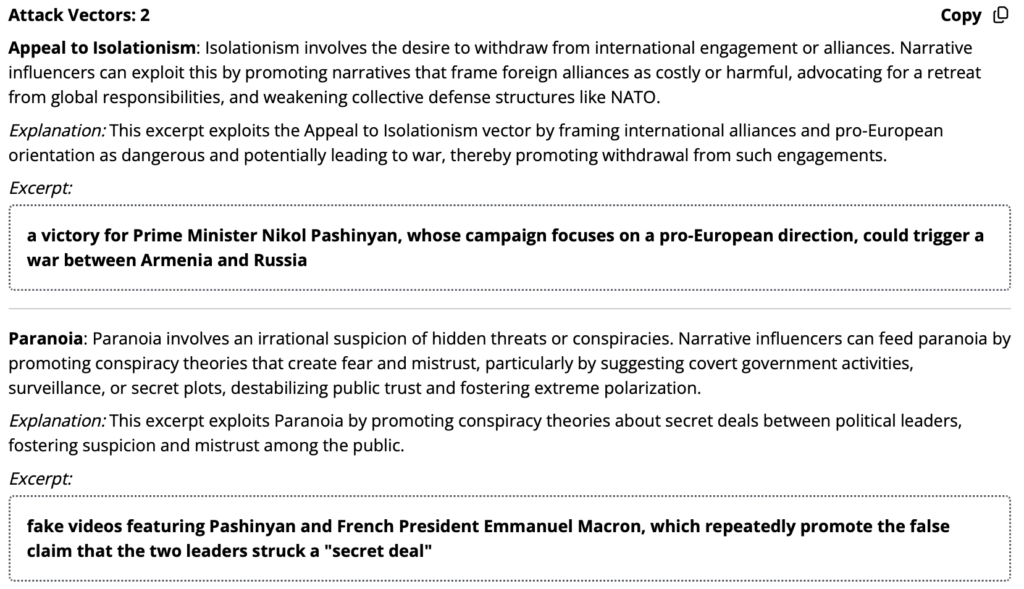
EdgeTheory NARINT Attack Vectors on fake amplified content
NARINT detection and response through EdgeWatch identified several countermeasures to likely disinformation attack vectors:
EdgeTheory Emotional Profile Classifiers found fear to be the dominant emotion driving discussion of Armenia's 2026 election. This creates a favorable environment for influence operations that amplify uncertainty, insecurity, and perceived external risks. The presence of secondary emotional spikes, including anger, surprise, and disgust, indicates a more sophisticated information environment in which multiple narratives are being used to target different audience segments and emotional triggers simultaneously. This pattern is consistent with multi-vector influence campaigns designed to increase engagement, polarization, and narrative penetration.

EdgeTheory Emotional Profile Classifier

EdgeTheory Emotional Profile Classifier
NARINT critically identifies this dynamic because it measures how narratives resonate emotionally across large-scale information environments. Traditional political analysis can identify competing messages, but NARINT reveals which narratives generate the strongest emotional response and therefore are most likely to influence voter behavior. In Armenia's election, emotional analysis indicates that fear—not ideology—is emerging as the primary mechanism domestic and foreign actors leverage to shape public opinion.
Azerbaijan and Turkey are involved through ongoing peace negotiations and regional connectivity initiatives such as the Trump Route for International Peace and Prosperity (TRIPP).
While Russia remains the most prominent external actor shaping Armenia’s 2026 parliamentary election environment, several other regional and international powers are also influencing the strategic landscape. Azerbaijan and Turkey are involved through ongoing peace negotiations and regional connectivity initiatives such as the Trump Route for International Peace and Prosperity (TRIPP). At the same time, France has deepened its strategic partnership with Armenia, while Armenia has expanded cooperation with NATO, raising concerns among critics that the country could become entangled in a geopolitical confrontation similar to Ukraine.
Turkey is actively engaged in normalization talks with Armenia. During a call with Prime Minister Nikol Pashinyan, Turkish President Recep Tayyip Erdoğan expressed support for regional stability and expanded economic ties. If successful, normalization would provide Armenia with an alternative partner outside the traditional Russia-West divide, increasing competition among external actors seeking to shape Armenia's strategic orientation and highlighting the importance of information awareness and rapid detection of influence operations as critical components of election security.

EdgeTheory’s NARINT platform identified growing discussion surrounding the phone call between Armenian Prime Minister Nikol Pashinyan and Turkish President Recep Tayyip Erdoğan, which emphasized continued normalization efforts between the two countries. Progress on normalization could provide Armenia with an alternative partner outside the traditional Russia-West divide, increasing competition among external actors seeking to shape the country's strategic direction.
Similarly, Azerbaijan’s role is prominent due to the peace agreement framework and the opening of border discussions aimed at stabilizing relations post-conflict. The viability of the Pashinyan-Aliyev peace framework, including the 17-point agreement initialed by both leaders, is likely to be shaped by the outcome of the 2026 parliamentary election.The demand from Azerbaijan that Armenia amend its constitution to remove references to territorial claims over Nagorno-Karabakh represents a flashpoint that influences may seize upon to drive a wedge between Armenian voters and western interests, creating a narrative vulnerability for Pashinyan.
EdgeWatch tracking the Armenia Elections surfaced that the Kremlin-backed Matryoshka bot network has conducted one of the most extensive disinformation operations in recent years targeting Armenia, producing hundreds of fake videos and narratives designed to undermine Pashinyan and promote pro-Kremlin candidates.
Moreover, reports of Israeli special forces operating from Azerbaijan during the Iran war highlight the depth of Azerbaijan–Israel security cooperation. For Armenia, this is significant because it strengthens Azerbaijan’s access to advanced military capabilities, intelligence support, and strategic partnerships, potentially widening the military imbalance between the two countries and increasing Armenian concerns about long-term security vulnerabilities.
Thus, while Azerbaijan and Turkey’s influence is less direct in the electoral process, their actions influence Armenia’s election by making peace negotiations, border security, and regional economic integration key issues for voters. These developments force voters to weigh the potential benefits of normalization against concerns about sovereignty, security, and future relations with Azerbaijan.
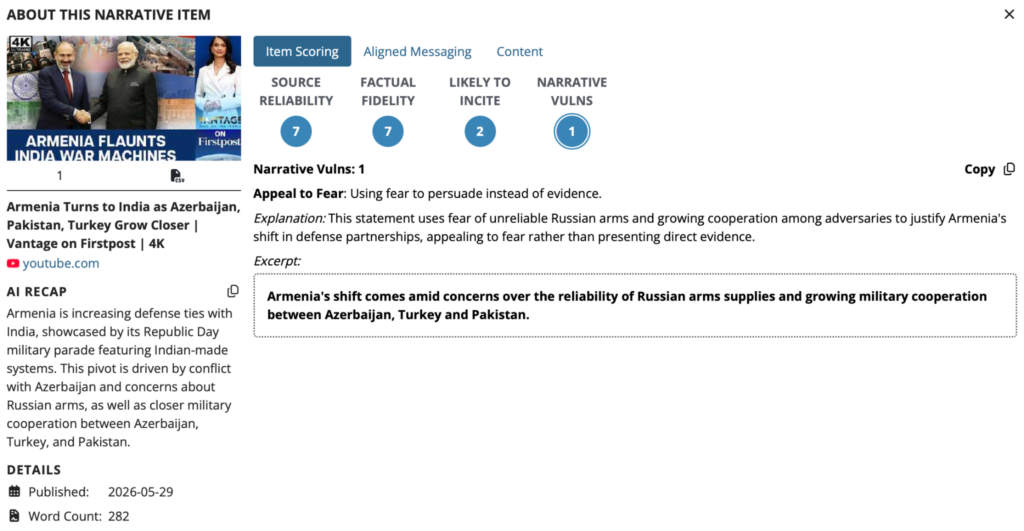
EdgeTheory’s NARINT platform identified narratives highlighting Armenia’s growing defense partnership with India as concerns increase over Russian military support and closer Azerbaijan–Turkey–Pakistan cooperation.
To the east, Armenia is increasingly seeking to diversify its defense partnerships beyond Russia, with reporting highlighting a growing security relationship with India. Armenia has publicly showcased Indian-made military systems and expanded defense procurement agreements as concerns grow over the reliability of Russian arms supplies following the Nagorno-Karabakh conflict.
EdgeTheory’s NARINT platform: Identifying allegations of Russian-backed efforts to mobilize Armenia-based voters living in Russia ahead of the election.
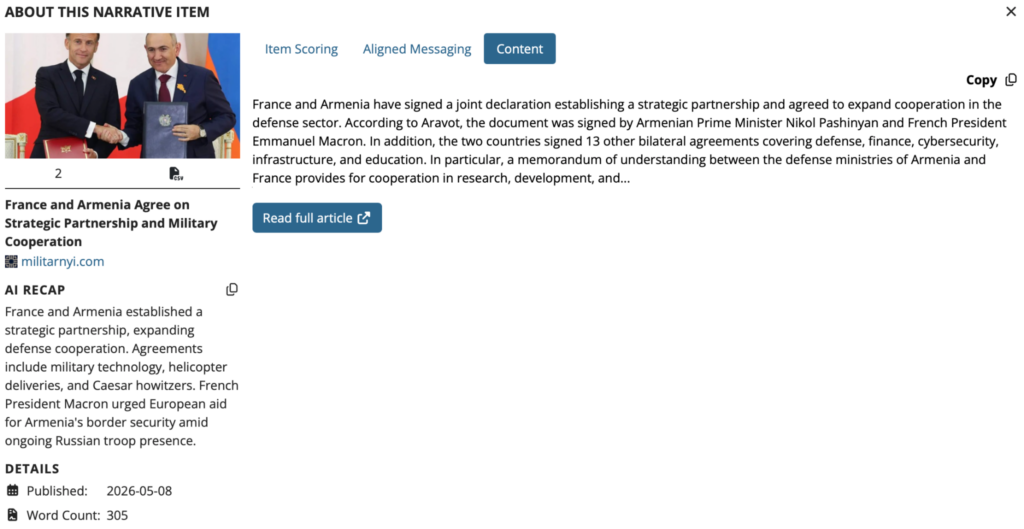
France has become one of Armenia’s most important Western security partners, expanding cooperation in defense, cybersecurity, and critical infrastructure while providing military assistance, including CAESAR howitzers and other defense systems. EdgeTheory’s NARINT analysis identified persistent Russian-aligned narratives portraying such Western security partnerships as escalatory, unreliable, or likely to draw Armenia into a broader confrontation with Russia. Beyond shaping public opinion, the strategic objective of such influence efforts is to undermine political support for Armenia’s diversification away from Russia. Success would likely be reflected in delayed or canceled defense agreements, reduced military cooperation, weakened public support for Western partnerships, or the election of political actors favoring closer alignment with Moscow.
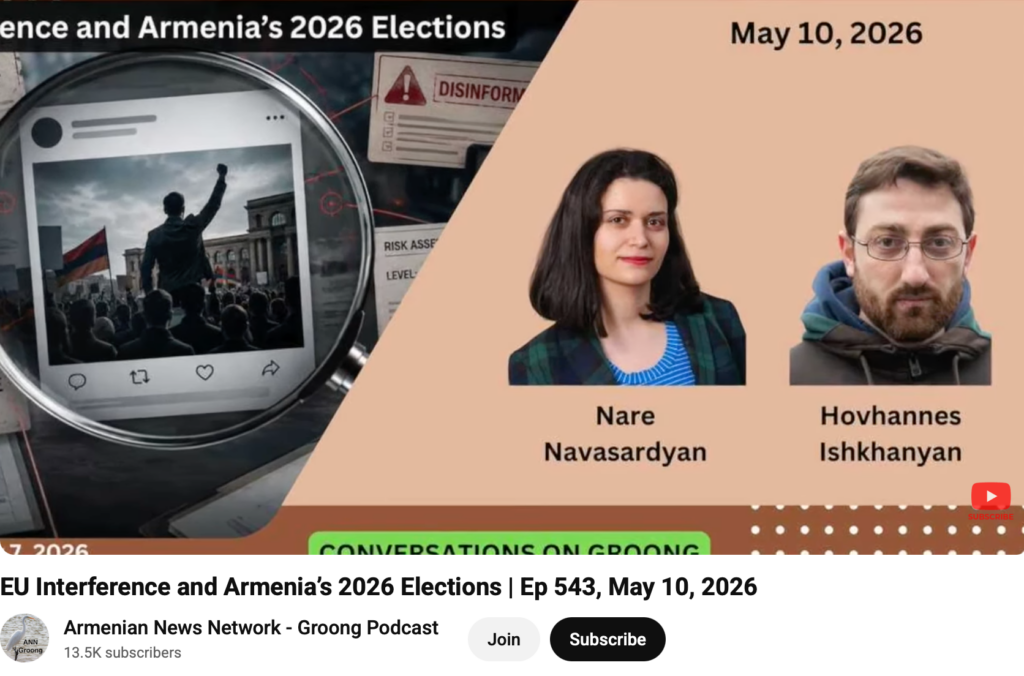
YouTube video identifying narratives alleging EU interference in Armenia’s 2026 election, reflecting broader concerns over foreign involvement and competing geopolitical alignments in Armenian politics.
EdgeTheory’s NARINT analysis identified Russia-aligned narratives frequently leverage cultural and religious themes, including claims that EU-backed initiatives seek to diminish the influence of the Russian Orthodox Church and traditional Russian-Armenian ties. Such messaging appears designed to undermine support for European integration by framing it as a threat to Armenia’s cultural identity and religious traditions.
Moreover, the EU has provided substantial financial aid to Armenia in response to economic pressures from Russia, including a reported 50 million euros aimed at offsetting Russian-imposed import bans and sanctions. The President of the European Commission described the recent reopening of trade routes with Türkiye, including the railway connection through Georgia and Türkiye as “an excellent step forward.” While this aid aims to strengthen Armenia's resilience, it also provides ammunition for Russian claims of foreign interference and the erosion of Armenian sovereignty. Consequently, effective foreign aid is beginning to rely on narrative wins as much as tangible assets.
EdgeTheory’s NARINT analysis identified Russian influence efforts designed to increase political and public resistance to cooperation with the European Union, France, NATO, and other Western partners. Evidence of Russian influence activity is extensive. By monitoring widescale reporting, EdgeTheory evaluated coordinated activity across large-scale disinformation campaigns, economic pressure, diplomatic signaling, and political support for pro-Russian opposition forces. Our EdgeWatch tracking the Armenia Elections surfaced that the Kremlin-backed Matryoshka bot network has conducted one of the most extensive disinformation operations in recent years targeting Armenia, producing hundreds of fake videos and narratives designed to undermine Pashinyan and promote pro-Kremlin candidates. This campaign began in early 2025 and intensified through 2026, focusing on false claims such as secret deals between Pashinyan and Western leaders to provoke conflict with Russia, and allegations about Pashinyan's health and corruption.
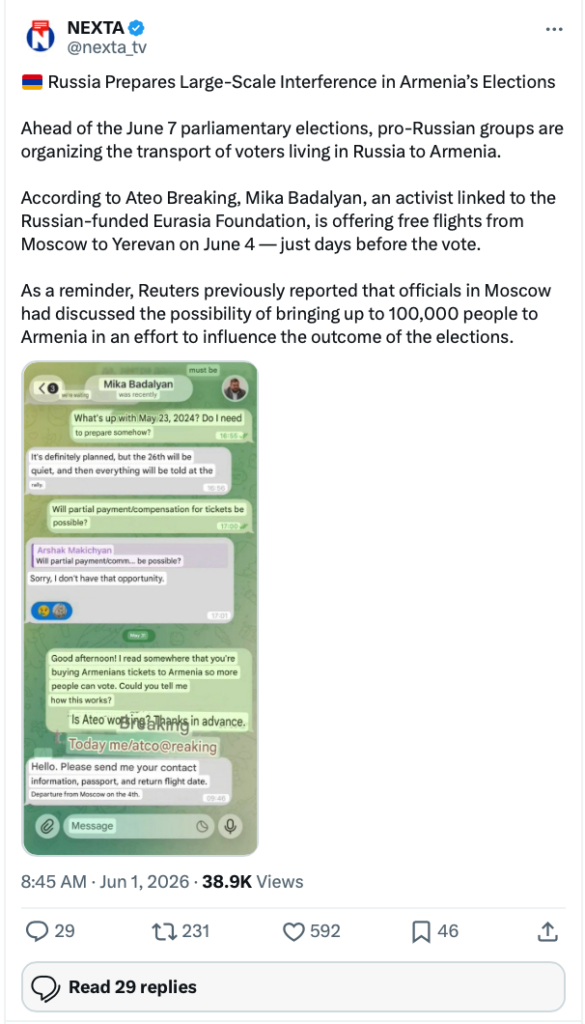
X post sourced from EdgeTheory’s NARINT platform identifying allegations of Russian-backed efforts to mobilize Armenia-based voters living in Russia ahead of the election.
Russian influence efforts have leveraged AI-generated content, fabricated media brands, and coordinated amplification across X, Telegram, and Bluesky. Reporting indicates that the volume and persistence of these activities exceeded those observed during Russia-linked influence operations targeting Moldova’s October 2024 presidential election and EU accession referendum.

EdgeTheory Narrative Intelligence Classifier surfacing Russian influence TTPs.
Russian state-linked political strategists and agencies, such as the Social Design Agency (SDA) and the Storm-1516 group, coordinate disinformation and influence operations targeting Armenia. Leaked documents indicate coordination between these groups and the Russian Presidential Administration. The campaigns seek to discredit Pashinyan, deepen political divisions, and amplify narratives favorable to pro-Russian opposition forces. These operations include fake news websites, Facebook ads, and coordinated messaging that exploit real events and fabricate scandals to manipulate public opinion. The campaigns also target the Armenian Apostolic Church and opposition figures, amplifying internal political conflicts.
Russian state-linked political strategists and agencies, such as the Social Design Agency (SDA) and the Storm-1516 group, coordinate disinformation and influence operations targeting Armenia. Leaked documents indicate coordination between these groups and the Russian Presidential Administration.
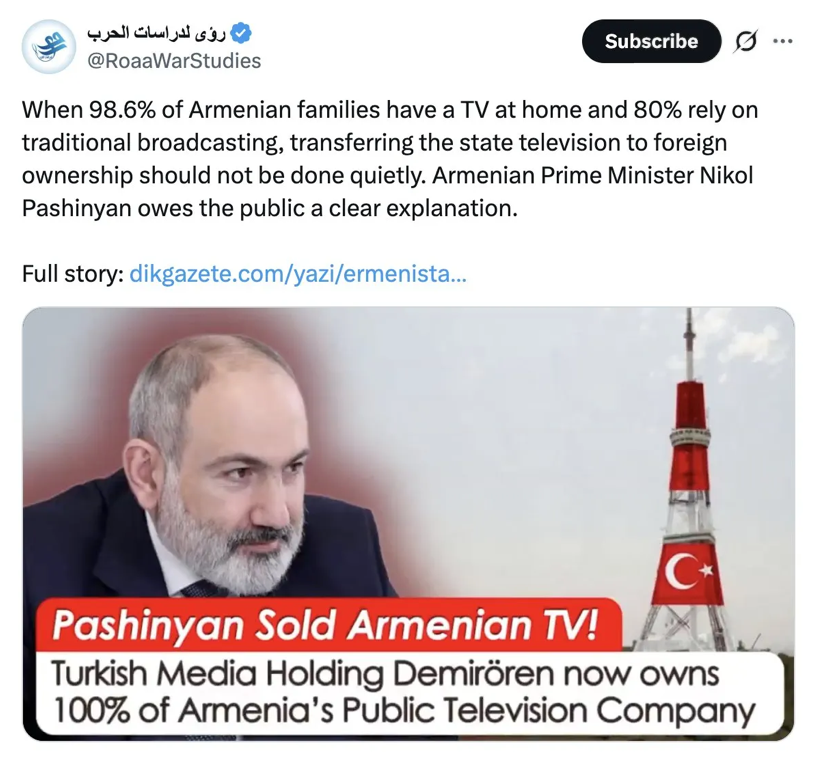
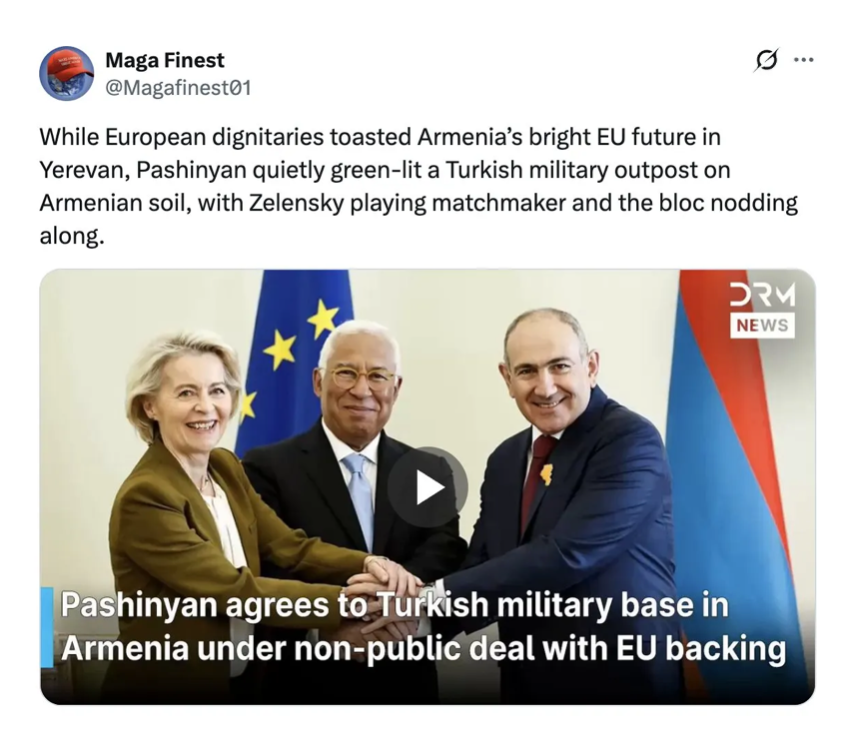
EdgeTheory NARINT identified disinformation campaigns targeting Armenia and Hungary. These campaigns aim to discredit political figures, promote fake narratives, and influence elections, potentially coordinating with Russia's Presidential Administration.
Economically, Russia has applied significant pressure on Armenia through import restrictions and trade barriers timed to coincide with the election. Measures include bans on Armenian agricultural products such as berries, vegetables, mineral water, flowers, and brandy, as well as a blockade of cargo trucks at the Upper Lars border crossing, Armenia's critical overland trade route to Russia. Russian officials have publicly linked the continuation of preferential trade terms and discounted gas prices to Armenia's membership in the Eurasian Economic Union (EAEU) and its political orientation.
Russian President Vladimir Putin and other senior officials have warned that Armenia risks losing substantial economic benefits if it pursues EU integration. To lend further credibility to the Russian perspective, the Russian government escalated diplomatic pressure by recalling its ambassador for consultations and issuing joint statements with other EAEU members threatening suspension of Armenia's membership. Russian Deputy Prime Minister Alexei Overchuk explicitly stated that future Russian commercial decisions toward Armenia will depend on the election outcome. Russia’s coordinated messaging is clear: choose between continued advancement in Russian-led integration or succumb to Western imperialism.

EdgeTheory’s NARINT platform identified a disinformation narrative on X built around a fabricated social media post falsely linking Armenia to potential U.S. military action against Iran.
Taken together, EdgeTheory's NARINT analysis identified a coordinated Russian influence effort that extends beyond information operations. Russian messaging is reinforced by tangible diplomatic and economic pressure, including trade restrictions, border disruptions, threats to Armenia's EAEU membership, and public warnings linking future economic benefits to the election outcome. NARINT further identified narratives leveraging fear-based attack vectors, particularly claims that Armenia risks losing access to Russian markets, energy benefits, and security guarantees if it continues pursuing closer ties with Europe.
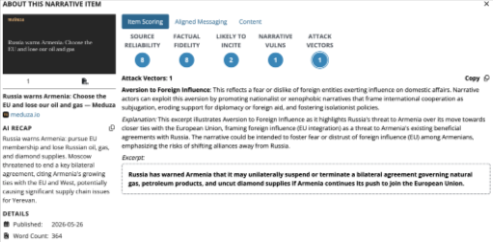
EdgeTheory Narrative Intelligence Attack Vector Classifier
The United States has demonstrated a growing interest and influence in Armenia's 2026 parliamentary elections, particularly in the context of Armenia's strategic orientation and regional security. NARINT analysis of US influence in the election further reveals how the Russian/Western strategies compare, including likely avenues for successful messaging and where Russia is making inroads.
EdgeTheory's NARINT analysis identified a coordinated Russian influence effort that extends beyond information operations. Russian messaging is reinforced by tangible diplomatic and economic pressure, including trade restrictions, border disruptions, threats to Armenia's EAEU membership, and public warnings linking future economic benefits to the election outcome.
US involvement can be seen in several ways:

X post by @Donald Trump sourced from EdgeTheory NARINT Classifier supporting Nikol Pashinyan

Article sourced by EdgeTheory NARINT Classifier saying that the EU remains a reliable partner and is helping Armenia strengthen democratic resilience against hybrid threats, foreign information manipulation and attempts to undermine confidence in democratic institutions.
EdgeTheory’s interactive EdgeAgent analyst synthesized thousands of narrative items to compare Russian and Western engagement strategies surrounding Armenia’s 2026 election. Western messaging primarily emphasizes the benefits of European integration, democratic reform, economic diversification, and regional peace initiatives, portraying closer ties with the EU and United States as pathways to greater stability and prosperity. In contrast, Russian-aligned narratives focus on exploiting economic dependencies and security concerns, often portraying Western integration as a threat to Armenia’s sovereignty and regional security. EdgeAgent analysis identified coordinated Russian disinformation activity, including narratives accusing Prime Minister Nikol Pashinyan of undermining Armenian interests while amplifying fears of conflict, economic disruption, and national decline. These findings suggest that while Western influence is centered on opportunity and reform, Russian influence efforts are focused on generating distrust, insecurity, and opposition to Armenia’s continued movement toward the West.
The wars in Ukraine and Iran have increased the geopolitical stakes of Armenia’s 2026 parliamentary election. Russia views Armenia’s growing engagement with the EU through the lens of the Ukraine conflict and has warned against deeper European integration.

EdgeTheory NARINT Classifier snippet indicating US-Armenia agreements are forming central narratives across multiple media domains, and represent high-stakes opportunities in the region for the US to promote and maintain its interests.

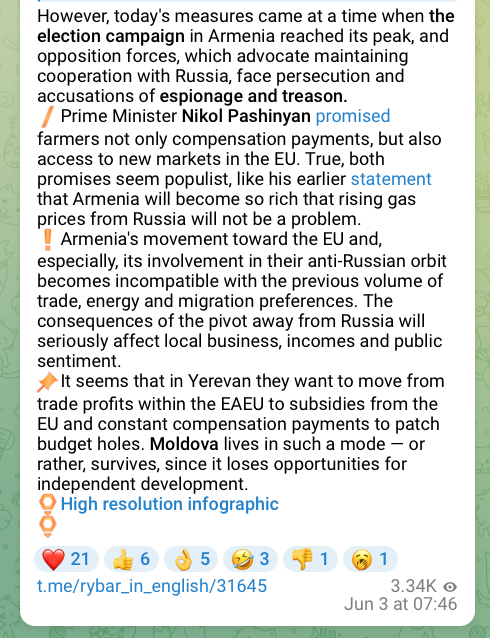
Telegram Post identified by EdgeTheory NARINT. Armenia faces geoeconomic fallout for its pro-EU/US political shift, which clashes with its continued EAEU/Russia market reliance. Russian import bans on Armenian products, affecting key exports, coincide with elections. This pivot risks economic disruption, as Armenia aligns with EU standards while benefiting from Russian market access.
Regional instability linked to the Iran conflict has further complicated Armenia’s strategic position. Debates surrounding proposed transit corridors connecting Azerbaijan to Nakhchivan, expanding Western involvement in the South Caucasus, and Armenia’s security relationships with both Iran and Western partners have intensified domestic political divisions. Together, the conflicts in Ukraine and Iran have increased the strategic importance of Armenia’s 2026 election. An election loss for Pashinyan could see the undoing of recently set security cooperation agreements, and the substantial reduction of US opportunities in the Caucasus.
The 2026 Armenian parliamentary election represents a critical inflection point for the country’s foreign policy and security posture. While Prime Minister Pashinyan remains positioned to benefit from a fragmented opposition, the election environment demonstrates that Armenia has become an arena for broader geopolitical competition among Russia, the European Union, and emerging regional partners such as France and India. This narrative conflict over information advantage inspires the rapid creation and deployment of hundreds of adversarial sources promoting thousands of narrative attacks. Source-centric analysis remains the critical architecture for continuously monitoring irregular information warfare campaigns. As sources come in and out of prominence, NARINT analysis identifies sentiment shifts, confirms foreign influence activity, anticipates strategic inflection points, assesses the success of potential engagement strategies, and ultimately informs timely policy, security, and investment decisions.
The strongest signal emerging from the analysis is that external influence, regional security, and geopolitical alignment are shaping voter perceptions more than domestic political issues. Regardless of the outcome, the election will likely determine the pace and direction of Armenia’s ongoing effort to redefine its position between Russian influence and deeper integration with the West. For the United States, the result could determine whether Armenia emerges as an accessible partner in the South Caucasus or remains constrained by dependence on Moscow.
By combining Narrative Intelligence, emotion analysis, and all-source monitoring, this analysis provides decision-makers with early warning on the narrative edge, awareness of emerging influence operations, shifts in voter sentiment, and evolving geopolitical forces shaping Armenia’s post-election trajectory.
Cover Photo Credits
Vladimir Putin: Premier.gov.ru
Armenian elections (2008): Serouj

