
Menu
This report examines the information environment surrounding Colombia’s 2026 presidential election and indicators of foreign influence, narrative manipulation, and electoral risk. Current reporting suggests the contest is developing within a polarized political environment shaped by security concerns, economic dissatisfaction, competing visions of Colombia’s geopolitical orientation, and growing exposure to narrative amplification efforts. The Colombian election is also a critical case given the revival of the Monroe Doctrine in the current administration’s National Security Strategy.
EdgeTheory’s AI Intelligence analytics evaluate how election-related discussions evolve across public reporting, social media environments, and adversarial narrative ecosystems to identify emerging indicators of malign influence activity, candidate momentum shifts, and evolving information operations. By monitoring narratives over time, EdgeTheory analytics surfaced real-time intelligence regarding candidate support bases, influence actors, narrative amplification patterns, and potential implications for regional alignment and U.S.-Colombia relations. This assessment draws on EdgeTheory’s AI agents, Narrative Intelligence (NARINT) methodologies, EdgeTheory watches, and open-source analysis to identify recurring patterns and translate emerging signals into analytical judgments regarding election dynamics, likely electoral pathways, foreign influence considerations, and strategic implications for U.S. interests
Colombia’s 2026 presidential election represents a consequential political transition with significant implications on regional security cooperation, counternarcotics coordination, and geopolitical competition in Latin America. The purpose of this assessment is to address the following questions:
Understanding these dynamics enables decision-makers to identify emerging risks, monitor indicators of influence activity, and anticipate strategic implications before political shifts fully materialize.
Current reporting indicates Iván Cepeda enters the election cycle with the strongest coalition consolidation and polling advantage, supported by progressive voters, social movements, Indigenous communities, and constituencies seeking continuity with President Gustavo Petro’s reform agenda. However, security concerns and broader dissatisfaction surrounding crime and economic conditions create vulnerabilities that become more pronounced in a second-round contest. Right-wing consolidation creates credible pathways for opposition candidates, particularly if security concerns continue dominating voter priorities. Current indicators suggest runoff dynamics remain substantially more competitive than first-round polling alone implies.
Current reporting does not identify coordinated PRC efforts targeting Colombian voters or manipulating election processes directly. Chinese and Chinese-aligned narratives surrounding the election primarily emphasize economic development, infrastructure investment, trade expansion, technological cooperation, and multipolar engagement independent of U.S. influence. EdgeTheory’s agentically collected data underline themes of strategic autonomy, regional economic integration, and the benefits of Chinese partnership models framed as alternatives to Western-led institutions.
Competing foreign narratives increasingly frame Colombia’s 2026 election as a choice between maintaining close alignment with the United States or expanding strategic and economic ties with China. Pro-U.S. narratives support conservative factions tied to the Uribe political bloc and candidates such as Abelardo de la Espriella, emphasizing security cooperation and resistance to Chinese influence. In contrast, strategic autonomy narratives linked to left-leaning movements associated with President Gustavo Petro promote reduced U.S. dependence and deeper Chinese economic engagement.
Candidate mention distribution by approximate percentage of instances reported May 27th according to EdgeWatch:
Iván Cepeda
Iván Cepeda is the leading leftist candidate, representing the Pacto Histórico coalition and seen as the political successor to outgoing President Gustavo Petro. His campaign emphasizes continuity with Petro’s progressive agenda, focusing on social reforms, wealth redistribution, poverty reduction, and maintaining the "Total Peace" strategy aimed at negotiating with armed groups to reduce violence. Cepeda’s support base includes farmers, indigenous communities, social movements, and urban progressive voters. His vice-presidential running mate is Aída Quilcué, an Indigenous Nasa leader, reinforcing his appeal among marginalized groups.
Cepeda consistently leads first-round polls with support ranging from 35% to 44%, but he has not crossed the 50% threshold needed to avoid a runoff. His runoff prospects are mixed, with some polls projecting he would narrowly lose to Paloma Valencia but defeat Abelardo de la Espriella. Cepeda faces challenges including a high rejection rate (around 42.9%), security threats (including a CIA warning of a possible assassination attempt), and the need to distance himself from some of Petro’s more radical proposals, such as the constituent assembly, which he has at times supported and at others distanced himself from. His campaign has avoided traditional media debates, citing concerns over fairness.
Cepeda supports maintaining relations with the United States but favors shifting the bilateral relationship away from a predominantly military and counternarcotics framework toward one centered on peacebuilding, human rights, rural development, and implementation of the 2016 peace accords. His alignment with Petro’s “Total Peace” strategy and criticism of heavily militarized security approaches suggest he would likely pursue a more autonomous and less security-dependent relationship with Washington while continuing selective cooperation on issues such as migration, organized crime, and regional stability.
Cepeda has not advanced an explicitly pro-China platform, but his emphasis on strategic autonomy, economic diversification, and multilateral engagement indicates openness to expanding Colombia’s economic and diplomatic ties with China. This approach would likely continue efforts under the Petro administration to diversify foreign partnerships and reduce overreliance on traditional Western allies while balancing relations between major global powers.
Strengths:
Weaknesses:

EdgeTheory Emotion Profile Classifier

EdgeTheory Emotion Profile Classifier. The source says “An Ivan Cepeda presidency in Colombia would represent a radical shift from traditional center-right leadership. It would signify a continuation and intensification of President Petro's left-wing movement, marking a significant departure for a country historically wary of anti-U.S. governments.”
EdgeTheory’s Emotion Profile Classifiers indicates that discussions surrounding a potential Ivan Cepeda presidency are overwhelmingly characterized by fear. In the examples provided, fear accounted for 82–89% of the emotional response, far exceeding anger, surprise, or positive sentiment. The predominance of fear-based sentiment suggests that a substantial portion of online discourse views a Cepeda presidency as a source of uncertainty and risk rather than optimism or stability.
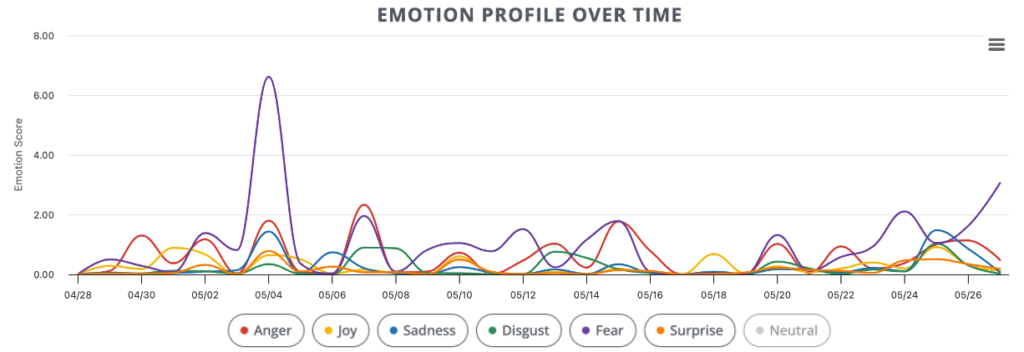
EdgeTheory Emotion Profile Over Time
Emotional spikes surrounding Iván Cepeda throughout May reflected escalating narratives tied to electoral insecurity, political sabotage, and ideological polarization. Fear and anger increased following reports of armed-group intimidation, allegations of coordinated disinformation targeting Cepeda’s campaign, and increasingly existential framing of the election by both political camps.
Early May spikes aligned with Cepeda’s condemnation of FARC dissident-linked violence and voter intimidation, reinforcing concerns surrounding election security and democratic stability. Mid- to late-May spikes corresponded with allegations of right-wing sabotage efforts, tightening polling margins, and intensified rhetoric portraying the election as a binary contest between progressive continuity and conservative rollback. The emotional profile indicates security concerns and polarization remain the dominant drivers shaping perceptions of Cepeda’s candidacy.
Public concerns about an Iván Cepeda presidency generally fall into four categories: security, economic policy, political continuity, and ideological direction. Much of the concern comes from voters who view Cepeda as a continuation of President Gustavo Petro’s government rather than a clean break from current policies. Petro’s approval ratings remain underwater, and dissatisfaction over crime, corruption, armed group violence, and economic uncertainty shapes voter perceptions of Cepeda.
Security is the dominant issue. Critics argue Petro’s “Total Peace” approach toward armed groups—including negotiations and demobilization efforts—has not reduced violence sufficiently, while coca production, insurgent activity, kidnappings, and organized crime remain major concerns. Opponents worry Cepeda would continue those policies without stronger enforcement measures.
Abelardo de la Espriella
Abelardo de la Espriella is a far-right, populist candidate running under the Defensores de la Patria movement. A criminal defense lawyer by profession, he positions himself as an outsider and anti-establishment figure, drawing inspiration from leaders like Nayib Bukele and Javier Milei. His campaign focuses heavily on law and order, promising a tough stance on crime, including proposals for 10 mega-prisons, increased military and police recruitment, and aggressive anti-narcotics policies such as aerial eradication of coca crops. He also pledges to reform and clean up state institutions, including Ecopetrol, and to reduce the fiscal deficit through efficiency savings.
De la Espriella’s support base is largely among conservative, security-focused voters who are frustrated with the current peace process and rising violence. He has gained momentum in recent polls, sometimes surpassing Paloma Valencia for second place. His campaign is marked by controversy, including confrontations with media, allegations of inappropriate conduct, and questions about the legitimacy of his candidacy signatures. He enjoys strong grassroots support but lacks institutional backing.
Strengths:
Weaknesses:
Abelardo de la Espriella supports strengthening security cooperation with the United States and advocates a hardline approach toward organized crime, narcotics trafficking, and insurgent groups. His campaign emphasizes expanded law enforcement authorities, stronger military and police action, and tougher counternarcotics measures, reflecting continuity with more traditional U.S.-Colombia security cooperation frameworks and prior “mano dura” security policies.
De la Espriella has not emphasized China in his foreign policy platform, and there is limited public evidence that he views China as a strategic priority. His campaign has focused primarily on domestic security, institutional order, and economic nationalism, while signaling closer alignment with traditional Western and U.S. security partnerships rather than pursuing broader geopolitical diversification initiatives.
Paloma Valencia
Paloma Valencia is the center-right candidate from the Centro Democrático party, founded by former President Álvaro Uribe. She represents the traditional conservative wing and has the backing of most right-wing parties, including the Conservative Party and La U. Valencia’s campaign emphasizes security, economic growth, and restoring investor confidence. She proposes a modernized Plan Colombia security partnership with the United States, increased military and police funding, and a focus on infrastructure and energy sector revitalization, including reactivating oil and gas exploration. Her vice-presidential running mate, Juan Daniel Oviedo, is a former head of Colombia’s National Statistics Agency and openly identifies as LGBTQ+, signaling a moderate shift on social issues within her ticket.
Valencia’s support base includes institutional right-wing voters, business sectors, and moderate conservatives. She has surged in polls, especially after winning the Gran Consulta primary and securing party endorsements, but her support has fluctuated and is often close to that of de la Espriella. She generally polls better than de la Espriella in runoff scenarios against Cepeda, making her the more competitive right-wing challenger.
Strengths:
Weaknesses:
Paloma Valencia strongly supports robust security cooperation with the United States, advocating tougher counternarcotics measures, expanded military and police capabilities, and closer bilateral coordination to combat organized crime and insurgent groups. Her platform reflects continuity with the Democratic Center’s traditional security posture and signals support for strengthening Colombia’s longstanding strategic partnership with Washington through intelligence sharing, security assistance, and institutional modernization.
Valencia has not prominently emphasized Beijing in her foreign policy platform, and her public positions generally prioritize alignment with the United States and other Western partners. While she would likely remain open to trade and investment opportunities involving China, particularly in non-strategic sectors, there is limited evidence that expanding ties with Beijing is a central policy priority for her campaign.
Current watch data offer few direct indications from the PRC’s influence on Colombia’s 2026 presidential election. However, more China-focused EdgeWatches suggest malign influence risks stem from foreign influence actors seeking regional leverage and information operations aimed at shaping public perceptions and electoral narratives. Notable sources include Telesur English, Orinoco Tribune, Nicaragua Solidarity Campaign Action Group, Vanessa Beeley (a journalist known for Russian-aligned narratives), and Fiorella Isabel (a journalist tagged as pro-Russian alignment with some disinformation risk in Latin America).
PRC influence concerns center on economic leverage, elite engagement, infrastructure investment, and narratives emphasizing economic partnership and reduced dependence on the United States. Current watch reporting also identifies U.S.-Israeli information activity seeking to shape perceptions surrounding candidates and geopolitical alignment.
Chinese Actors
Chinese messaging frequently promotes economic development, technological cooperation, multilateralism, and non-interference principles. These narratives can indirectly shape political environments by positioning China as a stable development partner while reinforcing criticism of Western sanctions, interventionism, and U.S. regional influence.
Current watch data does not identify coordinated PRC election interference activity targeting Colombian voters directly. However, China likely benefits from political outcomes that preserve favorable conditions for trade expansion, infrastructure development, technological partnerships, and reduced U.S. strategic influence in Colombia and the broader region.
As identified by EdgeWatch, China’s likely goals for supporting certain candidates and policies include:

EdgeTheory Narrative Attack Vector.
For example, Chinese-aligned source The Star Online | Asean+ highlights narratives emphasizing economic development and social progress, particularly supporting the continuity of progressive reforms led by Gustavo Petro and his political heir, Iván Cepeda. The narrative underscores the opposition by right-wing candidates to these reforms, portraying the election as a choice between continuation of social gains—such as increased minimum wage and improved rights for workers—and a rollback to neoliberal policies favoring elite interests.
The likelihood of success for Chinese influence through economic narratives is moderate to high, given Colombia’s resource wealth and development needs, which make Chinese investment attractive. However, direct electoral interference by China is not evident, suggesting a more subtle, long-term influence strategy.
US & Israeli Sources
The most active sources in this analysis are the US and Israel, as revealed by the extensive Hondurasgate leaks and related narratives. These expose a coordinated campaign involving former Honduran president Juan Orlando Hernández, Israeli financial backing, and far-right Latin American leaders like Argentina’s Javier Milei. This network is actively working to destabilize leftist governments and influence elections in Colombia, Mexico, and Brazil through disinformation, political pressure, and covert operations.

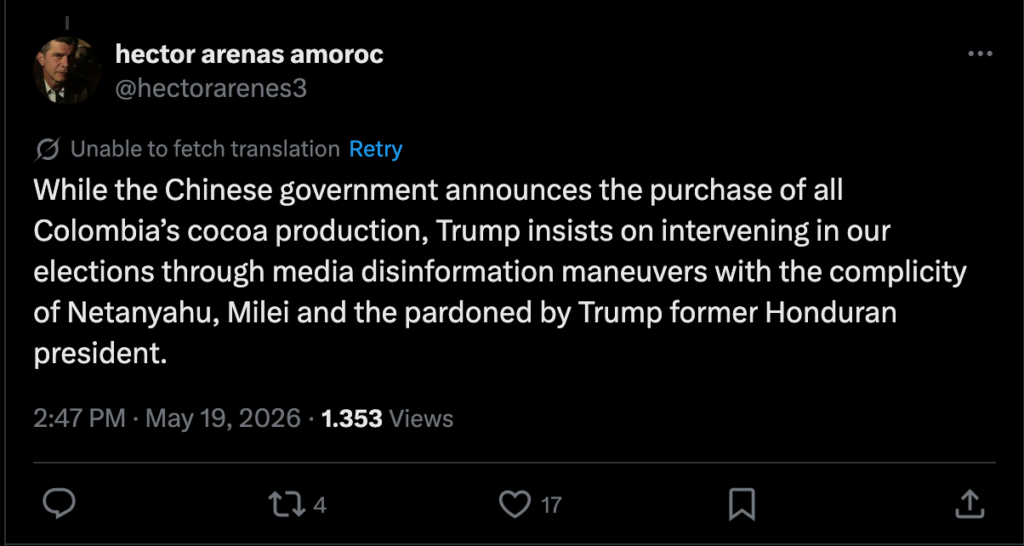
X post by Hector Arenas Amoroc
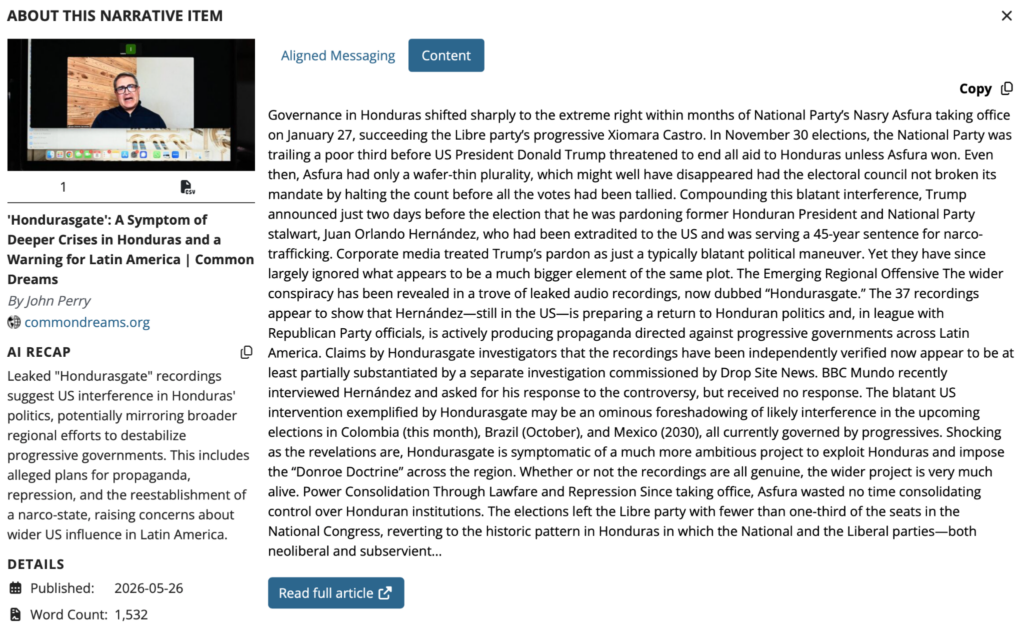
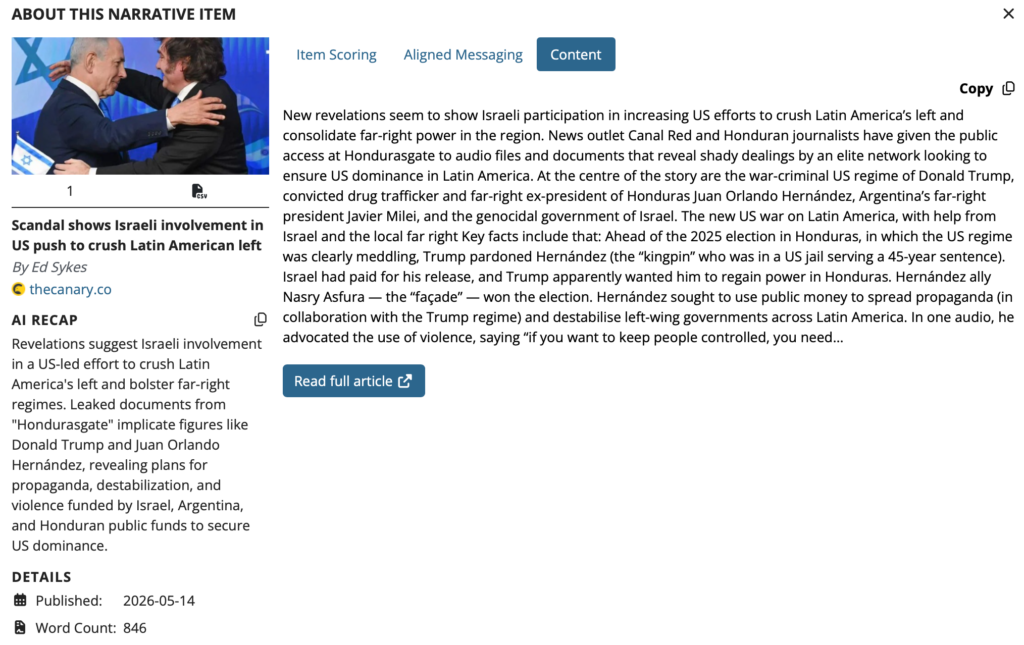
EdgeTheory Narrative Classifier
Narratives are increasingly being used to frame the 2026 Colombian election as vulnerable to external political interference targeting progressive governments in Latin America. The Hondurasgate reporting alleges external political networks supported influence operations, propaganda amplification, and institutional pressure campaigns against leftist actors in Honduras, with Colombia identified as a likely future target due to its regional strategic importance and ideological alignment concerns.
The campaign includes media manipulation, threats against opposition figures, and efforts to undermine progressive candidates like Colombia’s Iván Cepeda, who is aligned with President Gustavo Petro and critical of US and Israeli policies.
US- and Israeli-aligned political networks are increasingly shaping the political and informational environment in Latin America by stressing coordinated security cooperation, and ideological partnerships. In Colombia, Senator Paloma Valencia chairs the Israel Allies Foundation (IAF) caucus and has publicly supported pro-Israel positions while condemning President Gustavo Petro’s anti-Israel policies. Right-wing presidential figures such as Abelardo de la Espriella have similarly aligned themselves with Israeli interests, including support for relocating Colombia’s embassy to Jerusalem.
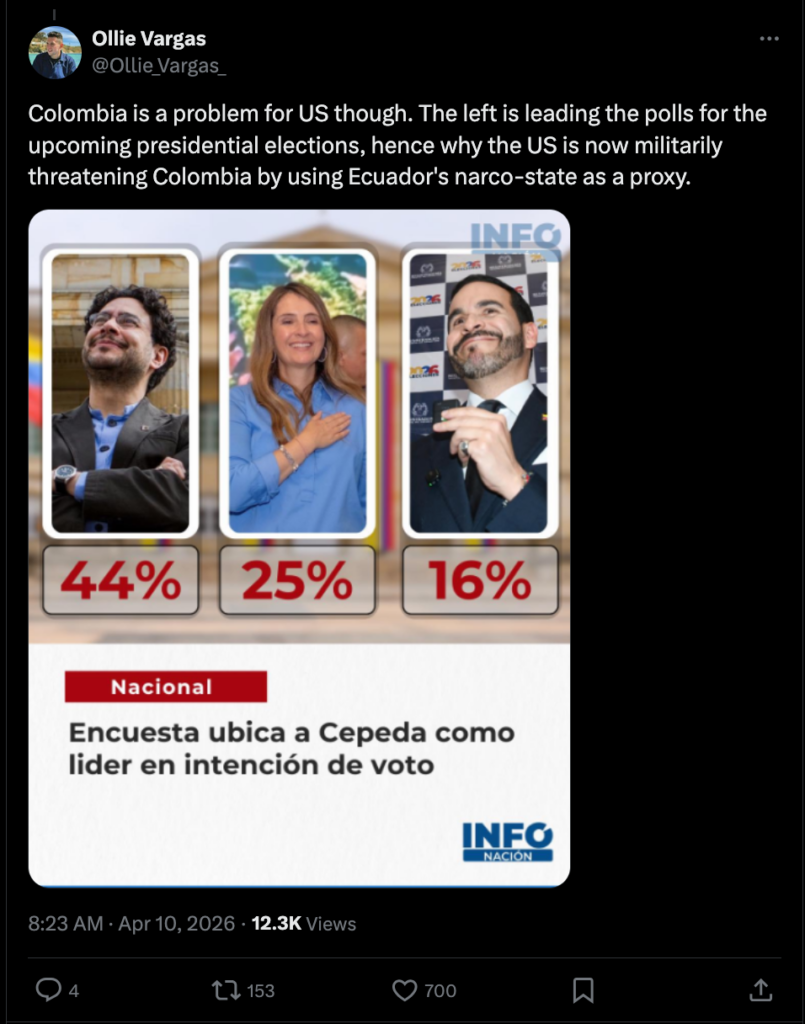
X post by Ollie Vargas
The post constructs an unsubstantiated causal narrative linking Colombia’s 2026 left-wing electoral momentum—particularly Iván Cepeda’s polling strength—to alleged U.S. strategic pressure operating indirectly through Ecuador as a regional security partner or proxy. No evidence is provided to support this linkage, and the argument relies on implied connections between domestic polling trends and regional security activity rather than demonstrated coordination or intent.
The framing compresses distinct developments—Colombian electoral competition, U.S.–Ecuador security cooperation, and regional counternarcotics policy—into a single inferred geopolitical storyline. It uses adjacency-based reasoning, treating parallel political and security developments as causally connected, while depicting Ecuador less as an independent actor engaged in issue-specific cooperation and more as an instrument of broader U.S. leverage.
More broadly, this reflects a recurring anti-U.S. influence narrative in which domestic political outcomes are attributed to external manipulation or pressure. This framing may increase skepticism toward foreign actors, reinforce perceptions of compromised national sovereignty, and shift interpretation of electoral competition toward a broader geopolitical contest rather than a primarily domestic political process.
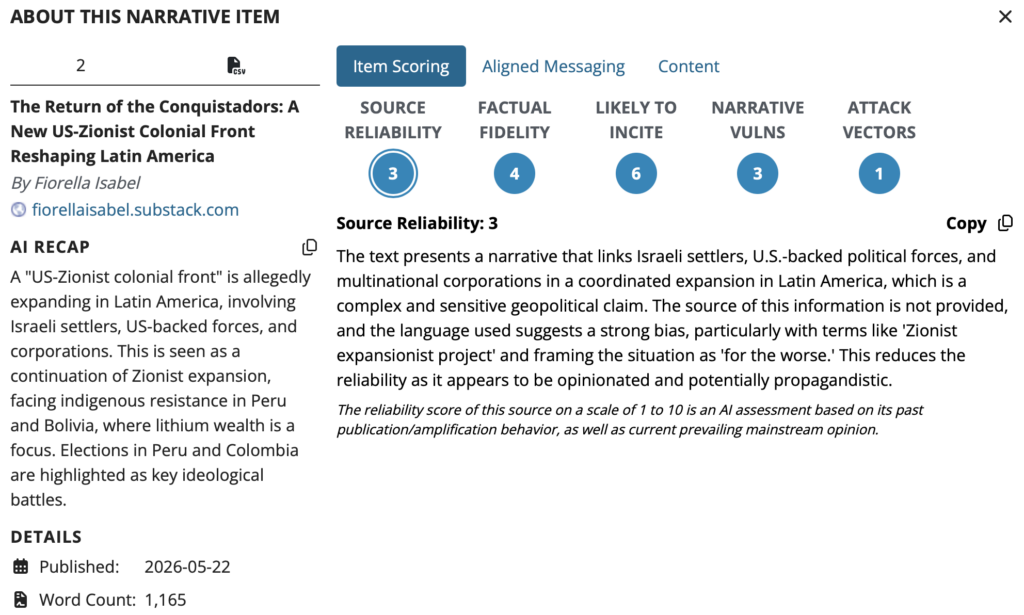
EdgeTheory Narrative Classifier
Iván Cepeda is the most likely first-round leader in Colombia’s 2026 presidential election, but current reporting indicates the race is likely headed to a runoff where the outcome becomes significantly less certain. Multiple recent polls place Cepeda—a left-wing candidate aligned with President Gustavo Petro’s governing coalition—at roughly 33–39% support, driven by strong backing from working-class voters, urban progressives, and voters seeking continuity on social reforms, labor protections, and peace initiatives. EdgeTheory’s watch analytics reinforce this trend, showing narratives emphasizing preservation of Petro-era social gains and worker protections under a potential Cepeda administration.

EdgeTheory Narrative Classifier
However, right-wing candidate Abelardo de la Espriella has rapidly gained support and has narrowed the gap to near statistical parity in some polling, creating a highly competitive runoff environment. EdgeTheory watch data identifies information activity involving alleged fake polling and narrative efforts designed to elevate right-wing candidates, highlighting how information operations may shape voter perceptions in the final phase of the campaign.
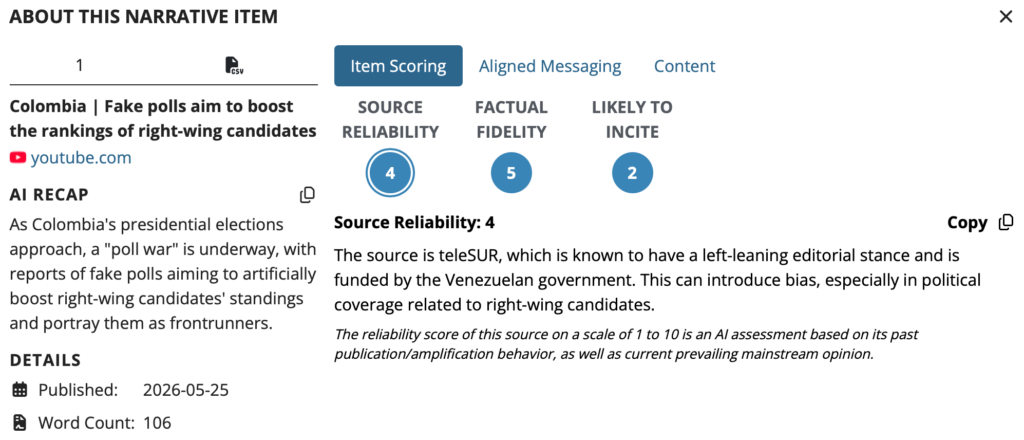
EdgeTheory Narrative Classifier
Current assessment: Cepeda is the strongest candidate entering the first round due to coalition consolidation and polling advantage, but deteriorating security conditions, polarization, and right-wing voter consolidation create a credible pathway for de la Espriella in a second-round contest.
The 2026 Colombian presidential election holds significant implications for U.S.-Colombian relations, primarily shaped by the ideological orientations of the main candidates and their foreign policy stances. If Ivan Cepeda and the progressive Pacto Histórico coalition maintain power, the relationship with the United States may continue to involve some tension, especially given Cepeda's alignment with outgoing President Gustavo Petro's critical stance toward U.S. policies and alliances, particularly regarding issues like the Israel-Palestine conflict. Cepeda's platform also emphasizes social reform and peace processes that diverge from traditional U.S.-backed security approaches in Colombia, potentially leading to shifts away from the militarized policies exemplified by Plan Colombia. Additionally, Cepeda’s government might take a more independent or critical posture in regional geopolitics, aligning with broader leftist movements in Latin America.
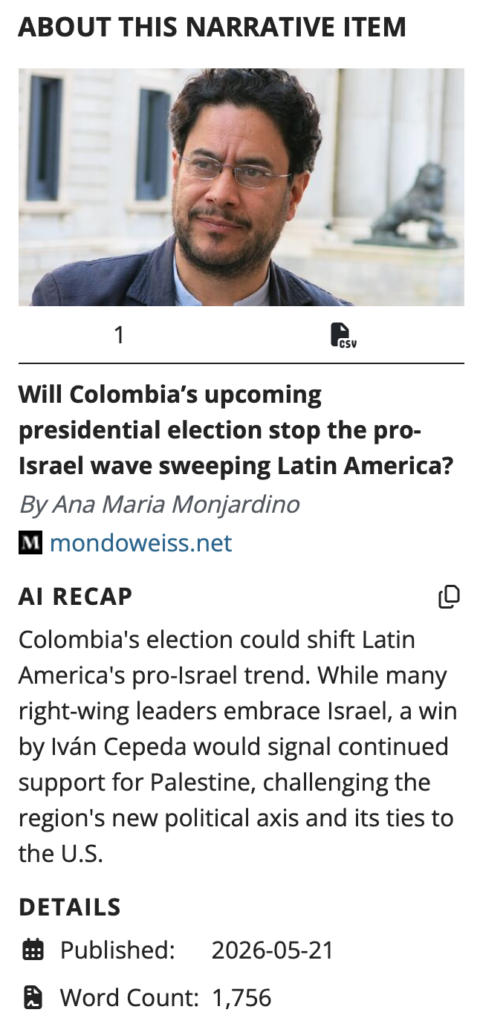
EdgeTheory Narrative Classifier
Conversely, a victory by right-wing candidates such as Abelardo de la Espriella or Paloma Valencia is likely to deepen Colombia’s alignment with U.S. strategic interests. De la Espriella has close ties to right-wing paramilitary groups and promotes a tougher "mano dura" security approach that resonates well with U.S. counter-narcotics and anti-insurgency policies. Valencia has ties to Álvaro Uribe’s political legacy, known for strong cooperation with U.S. security initiatives under Plan Colombia. Also notable is the right-wing inclination toward strengthening ties with Israel, with proposals like moving the Colombian embassy to Jerusalem, reflecting a pro-Israel stance closer to U.S. policy. Beyond political ideology, the election results will affect military and intelligence cooperation, security measures against drug cartels and insurgent groups, and Colombia’s position within U.S.-led regional coalitions such as the "Shield of the Americas," which promotes counter-cartel and broader security cooperation.

X post by Vanessa Vallejo
A victory by Iván Cepeda would likely maintain or strengthen Colombia’s current cooperative stance with China and the broader leftist regional alignment. As Petro’s protégé and political heir, Cepeda represents continuity of the progressive policies that have shaped Colombia’s international relations since Petro took office.
Petro’s government has sought diversified foreign partnerships beyond traditional U.S. influence, including growing ties with China, reflecting a broader Latin American "pink wave" trend of engaging with non-Western powers for economic development and autonomy. Cepeda’s platform emphasizing sovereignty, social reforms, and regional integration suggests he would continue expanding cooperation with China on infrastructure, trade, and technology, supporting strategic resource management in Colombia and neighboring countries.
Additionally, Cepeda’s anti-interventionist and pro-Palestinian stance puts him at odds with the U.S.-Israeli aligned right-wing candidates who advocate closer ties with Israel and stronger alignment with U.S. policies. A Cepeda presidency could reinforce the left’s resistance to U.S. geopolitical pressures in the region and encourage deeper strategic and economic collaboration with China and other global South partners.
However, challenges remain due to internal security issues and economic pressures, but a Cepeda win would likely sustain Colombia’s engagement in multilateral frameworks that include China and promote regional autonomy from U.S. influence.
Colombia’s 2026 presidential election is developing within a contested information environment shaped by polarization, security concerns, competing economic visions, and broader geopolitical competition influencing Latin America. Current reporting indicates electoral risk increasingly extends beyond traditional political competition and includes exposure to narrative amplification, foreign influence activity, and information operations intended to shape perceptions regarding Colombia’s future strategic orientation.
The reporting reviewed in this assessment indicates malign influence activity presently appears more focused on shaping information environments and long-term geopolitical positioning than direct electoral manipulation. Foreign actors benefit from influencing public attitudes surrounding security, economic development, institutional trust, and international alignment while reducing visibility and attribution risk.
The findings also suggest that electoral outcomes will carry implications extending beyond domestic politics into regional security cooperation, strategic competition, and Colombia’s future role within broader hemispheric dynamics. Continued monitoring of narrative ecosystems, candidate momentum shifts, and emerging influence indicators will remain critical as the election approaches and information activity intensifies.

