
Menu
Menu
The US and Iran have maintained a shaky ceasefire since April 7 (1). This pause has allowed Iran a respite from US and Israeli strikes on Iranian defense infrastructure, security apparatuses, and other targets. The US and Iran have exchanged multiple peace proposals and counterproposals but remain at odds over Iran’s highly enriched uranium (HEU) stockpile and its nuclear program. Iranian Supreme Leader Mojtaba Khamenei reportedly expressed a red line against compromise on Iran’s nuclear and ballistic missile programs on 30 April (2). Meanwhile, President Trump—following 15 May comments indicating he could be open to suspension of Iran’s nuclear program—rejected Iran’s most recent peace proposal on 18 May, presumably due to insufficient nuclear concessions (3). Trump then threatened that Iran has “two to three days” before US strikes resume on 19 May (4). Iran has used the ceasefire period to adapt domestically and regionally.


President Trump’s 7 April ceasefire announcement (top). Narrative volume spiked on 18 May after President Trump claimed to postpone planned strikes on Iran (which would have broken the ceasefire) (bottom).
The Iranian regime has used the negotiation period to regroup domestically. First, the regime is taking measures to prepare for renewed domestic unrest. Iranian anti-regime media claimed the Iranian Supreme National Security Council met to address security agencies’ concerns about renewed protests on 27 April (5). Information presented at the meeting reportedly indicated rising prices, unemployment, and US-Israeli strikes’ damage to key industries could trigger renewed unrest. On May 12 the Islamic Revolutionary Guard Corps (IRGC) Mohammed Rasul Ollah Tehran Province unit conducted an exercise to improve combat readiness (6). The unit played a significant role in suppressing previous protests (7). Iranian President Masoud Pezeshkian stated Iran must carry out “sustainable planning” to address economic and social problems on 19 May (8). Pezeshkian has repeatedly warned about the need for economic relief due to the possibility of renewed unrest (9). Widespread protests have not resumed based on observable public reporting but at least one labor protest over wages reportedly occurred in northwest Iran on 19 May (10).
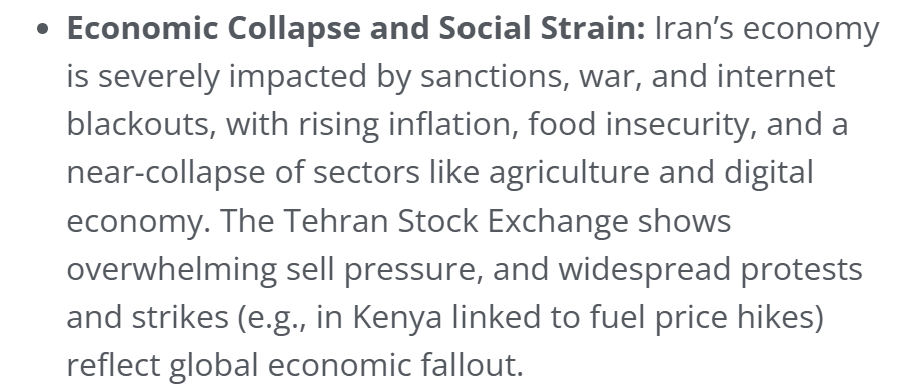
EdgeTheory’s “Control of Iran” EdgeWatch predicted that Iran may experience protracted conflict and state erosion. Part of this erosion includes economic collapse and social strain, which the US blockade is currently exacerbating. Widespread recent protests have not been observed. Iran’s persistent internet blackout may make detecting early signs of such unrest difficult. However, the Mohammed Rasoul Ollah unit’s exercises and Pezeshkian’s comments indicate the regime is likely concerned about renewed unrest driven by economic factors.
Second, the regime is rebuilding key infrastructure destroyed in US-Israeli strikes. Officials familiar with early May US intelligence assessments reportedly stated Iran has regained access to “most” of its missile sites, launchers, and underground facilities (11). Third, the regime is finding alternate routes to mitigate the economic effects of the US’ Hormuz Strait blockade, which has prevented Iran from exporting oil. Iran is reportedly leveraging overland routes through Pakistan and Turkey and maritime trade with Russia via the Caspian Sea. The regime is also reportedly exploring exporting oil to China via rail (12).

Pro-Iranian media likely circulated Iranian threats to disrupt the Hormuz Strait and Gulf (including by “seizing Bahrain and UAE’s coastlines” and turning the Gulf of Oman into a “graveyard”) to keep energy prices high and maximize Iran’s negotiation leverage. As these threats circulated, the regime leveraged the ceasefire to regroup domestically. EdgeTheory’s Emotion Profiles analysis highlights that these narratives heavily relied on language evoking fear.
The regime is also laying the groundwork for a longer-term recalibration in regional strategy that foregrounds the Hormuz Strait. Iran has long relied on a three-pillar regional strategy for power projection and deterrence.
The regime is also laying the groundwork for a longer-term recalibration in regional strategy that foregrounds the Hormuz Strait. Iran has long relied on a three-pillar regional strategy for power projection and deterrence.
These pillars include Iran’s nuclear program, ballistic missile program, and regional proxy network (13). The current conflict has shown the regime that control of the Hormuz Strait is its best source of leverage vis-a-vis the US and therefore a comparable pillar of deterrence worthy of pursuing after the war’s end. Iran has enforced a new commerce protocol and toll system on commercial vessels transiting the Strait (14). On 5 May Iran founded the Persian Gulf Strait Authority, which formalizes Iran’s imposition of the new system (15). IRGC-linked Fars News claimed Iran may also launch an insurance scheme in which the regime extorts commercial vessels in exchange for protection from Iranian attacks (16). The regime is clearly setting conditions for long-term control of the Strait. Meanwhile, Iran continues to protect its nuclear “pillar” (by refusing to offer concessions in negotiations), to rebuild its ballistic missile pillar, and to ensure the continued effectiveness and viability of its proxy pillar—including by adapting its proxy strategy in Iraq.
Iran may be preparing to transform how it leverages its proxies by shifting from overt proxy warfare to a quieter, more politically-focused approach.
IRGC-Quds Force (IRGC-QF) commander Esmail Qaani reportedly traveled to Baghdad for the first time since the Iran war began on April 18 to separately meet with Iraq’s Iran-backed militia leaders and leaders of the Coordinating Framework (17). The Coordinating Framework is the Iraqi parliament’s largest coalition. It primarily contains Shi’a parties, some of which are linked to Iran-backed militias (18). During the meetings, Qaani reportedly discussed finding a “consensus” premier candidate, the possibility of integrating the militias into Iraq’s official security services, and the possibility of some political leaders dissociating themselves from their armed wings. A secular, left-leaning Iraqi outlet later claimed Qaani helped end intra-Shi’a negotiating deadlock over the prime minister (parliament approved Prime Minister Ali Al-Zaidi on 14 May), while proposing a “grand settlement” for militia disarmament and integration into the Iraqi state—a plan first proposed as early as 2025. Phase one of the 2025 settlement reportedly included reducing tensions with the US by “ending the role of renegade factions,” Kata’ib Hezbollah, Harakat Hezbollah Al-Nujaba, and Kata’ib Sayyid Al-Shuhada, in exchange for retaining the Popular Mobilization Forces (PMF) within the state framework. Phase two would reportedly “merge” the PMF into “official security institutions” if phase one fails (19).
Iran may be preparing to transform how it leverages its proxies by shifting from overt proxy warfare to a quieter, more politically-focused approach.
The PMF is already a state security institution that nominally answers to the prime minister. The outlet may therefore be implying that under phase two, PMF units would integrate into older, more established pillars of Iraq's security apparatus like the Iraqi Army or the Federal Police. The outlet claimed the revival of this plan constitutes a shift in Iranian strategy from “direct military presence” to “consolidated influence through political and civil channels” and could result in militia leaders being offered senior security positions in exchange for relinquishing their armed factions (20).

EdgeTheory surfaced an 8 March narrative showing Sadrist Movement (also known as Shi’a National Movement) leader and populist Shi’a cleric Muqtada Al-Sadr calling for all armed factions to join the state. Al-Sadr leads his own militia, Saraya Al-Salam, which he suggested would join the state if other armed factions do so. Al-Sadr is not participating in the current government, and withdrew from the previous one after the Coordinating Framework blocked his coalition from leading government formation. He has longstanding complex ties to Iran, but is not an Iran proxy figure. He is an Iraqi nationalist and populist who often opposes and competes with the Iran-backed militias.
The Coordinating Framework reportedly agreed to form a committee to disarm the factions, likely in support of the above strategy (21). Outgoing Prime Minister Mohammed Shi’a Al-Sudani, incoming Prime Minister Al-Zaidi, and Badr Organization leader Hadi Al-Ameri will lead the committee. An unnamed “informed source” reportedly stated it will oversee the “implementation of mechanisms for disarming the factions, classify the factions in a database, and will then reintegrate the factions’ members into state security or civil institutions (22). One outlet claimed on 9 May that the committee would present the US an “executive plan” to disarm the militias “in the coming days” (23). The outlet noted that the plan may be primarily intended to appease US’ efforts to disarm the militias, and to “convince” the US of Al-Zaidi’s seriousness about disarming the militias. If true, this strategy seems to have worked: Iraq’s parliament swore in Al-Zaidi and his government on May 14, with both US and Iranian officials releasing statements congratulating Al-Zaidi (24).
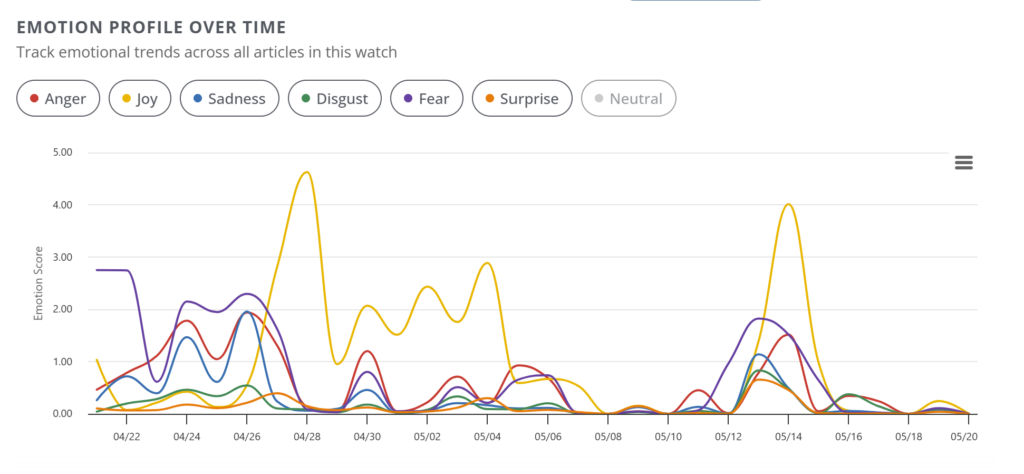
EdgeTheory analysis of narratives discussing Iraq’s elections found that narratives leveraging language evoking “joy” spiked when the Coordinating Framework nominated Ali Al-Zaidi on 27 April, likely because his nomination broke months of intra-Shi’a deadlock over the premiership. Language evoking “joy” spiked again on 14 May when Parliament confirmed Al-Zaidi and 14 members of his cabinet (more below).
Even if the new committee takes steps to disarm and integrate the militias, Al-Ameri’s leading role on the committee provides worrying clues regarding what form such integration could take. Al-Ameri’s militia, the Badr Organization, is Iran’s oldest proxy militia in Iraq, and one of the militias most heavily integrated into Iraqi politics. Like many of Iran’s other militias, it maintains numerous official brigades in the PMF (25). But the Badr Organization also has a long and distinctive history of infiltrating established Iraqi security and government institutions, most notably via the Ministry of the Interior (MoI).
Badr’s domination of the Interior Ministry dates back to 2005. Then-Dawa Party leader Ibrahim Jaafari was confirmed as Iraq’s Prime Minister on 7 April 2005. During the formation of Jaafari’s government, the Supreme Council for the Islamic Revolution in Iraq (the Iran-backed party for which the Badr Organization acted as an armed wing) secured Badr Organization member Bayan Jabr as Interior Minister, replacing outgoing Sunni minister Falah Naqib (26). In doing so, the Badr Organization gained control of thousands of MoI personnel, including the Special Police Commandos Naqib and the US had built and equipped. Jabr transformed the MoI’s forces by bringing in thousands of Badr Organization members as recruits and mid-level commanders, including within the Special Police Commandos (27). The commandos, eventually known colloquially as the “Wolf Brigades,” became notorious for extralegal atrocities against Sunni civilians (28). The Badr Organization’s subsequent infiltration of the MoI’s Federal Police is well documented (29). It is now generally accepted that, like Jabr, Iraq’s Interior Minister in each successive government will be either a Badr member, or acceptable to Badr.
Al-Ameri’s leadership role on the committee is therefore concerning. It suggests that even if the the committee dismantled the PMF entirely (which is unlikely) and integrated all PMF and militia forces into Iraq’s other security structures, Al-Ameri could help ensure that the militias do so in a way that retains their cohesion, lethality, and their ability to advance Iran’s interests—all from within the Iraqi state.
Iran has good reason to pursue a quieter approach in the face of US pressure. Since Iraq’s November 2025 federal elections, the US has insisted that the Iraqi government should not include individuals linked to Iran or the militias.
Several Iran-backed militias won seats in parliament in November, with the Sadiqoun Movement (the political wing of Asa’ib Ahl Al-Haq (AAH)) making notable seat gains (30). While the US has not indicated these parties’ members are forbidden from serving in parliament, the US previously warned the Iraqi government it “would not deal” with a prime minister, minister of foreign affairs, defense, or interior, army chief of staff, counterterrorism service, or intelligence service head affiliated with the armed factions (31). As recently as May 14, an unnamed Coordinating Framework source reportedly claimed the US “placed a veto” on six unspecified armed factions’ participation in the next government (32).
The Iran war also allowed the US to step up direct targeting of Iran-backed militia leaders in Iraq. Prior to the 7 April ceasefire, the US struck numerous Iran-backed militia sites in Iraq during the course of the war (33), killing rank-and-file militia personnel. As the war continued, the US escalated these attacks to include notable decapitation strikes. A likely US strike in Baghdad’s Karrada neighborhood injured Kata’ib Hezbollah (KH) leader Abu Hussein Al-Hamidawi on 13 March (34). A likely US strike killed KH security official Abu Ali Al-Askari on 14 March (35).
Iran has good reason to pursue a quieter approach in the face of US pressure. Since Iraq’s November 2025 federal elections, the US has insisted that the Iraqi government should not include individuals linked to Iran or the militias.
The US has also intensified efforts to isolate and pursue militia leaders in other ways. The US Treasury Department sanctioned seven militia leaders tied to KH, KSS, HHN, and AAH on 17 April for their role in targeting US forces in Iraq (36). These groups have repeatedly targeted the US under the umbrella of the Islamic Resistance in Iraq (37). The US blocked a $500 million cash shipment to Iraq and halted security cooperations with Iraq to pressure the Iraqi government to rein in the militias (38). The US State Department offered $10 million bounties for information on Harakat Ansar Allah Al-Awfiya leader Haydar Al-Saidi and KSS Secretary-General Abu Alaa Al-Wala’i (who subsequently appeared publicly at a Coordinating Framework meeting, prompting backlash from the US) on 27 April (39). On 15 May the Justice Department announced the arrest of senior KH member Mohammed Al-Saadi for his activities as a KH and IRGC operative including attacks and planned attacks in Europe and the United States (40).
Iran can navigate parameter one by facilitating the formation of an Iraqi government that does not contain overtly Iran or militia-linked figures in the ministries previously outlined by the US.
This “quieter” strategy could allow Iran to weather the US’ ongoing efforts to combat the militias in the short term, while insulating many of Iran’s proxies from future targeting in the long term. The US’ political pressure campaign, and accompanying decapitation strikes, have given Iran clear parameters within which it can pursue its interests while avoiding US backlash. Parameter one: the US will not accept Iran or militia-linked figures in certain positions within the new government. Figures known to the US as Iran or militia-linked are off the table as Prime Minister and as key defense and intelligence personnel, as mentioned above. (Recall that a key factor in the US’ opposition to former premier Nouri Al-Maliki’s nomination was his perceived friendliness to the militias) (41). Parameter two: the US will target militia personnel and leaders if they attack US bases and locations.
Iran can navigate parameter one by facilitating the formation of an Iraqi government that does not contain overtly Iran or militia-linked figures in the ministries previously outlined by the US. Thus far, the new Al-Zaidi government seems to achieve this. Al-Zaidi is a prominent Iraqi businessman with no political base or overt political affiliations (let alone discernable ties to Iran or the militias). He is the former chairman of the Al-Janub Islamic Bank, previously banned from conducting US dollar transactions after conducting money laundering for Iran (42). This is not necessarily notable; the US has sanctioned numerous banks for similar reasons (43). Al-Zaidi is also reportedly a managing figure at Dijla TV, a Sunni-oriented Iraqi channel (44). On balance, Al-Zaidi’s background and professional history do not reveal any glaring ties to Iran or the militias. President Trump praised Al-Zaidi’s nomination on 1 May, indicating he finds Al-Zaidi acceptable (45). Al-Zaidi’s new cabinet ministers are similar: pro-Iran and pro-militia figures are present, but in positions and at a level that the US appears to find acceptable. Parliament approved 14 out of 23 ministers on May 14 (46). Parliament appointed Iran or militia-linked candidates to lead multiple valuable non-security ministries. Badr Organization candidates now hold the Ministry of Transport and Ministry of Water Resources, for example. This is not necessarily unusual as the Minister of Transport is typically a Badr Organization member or Badr-approved candidate. More notably, the new Minister of Communications is Mustafa Sanad, a prominent pro-Iran politician linked to KH (47). Sanad himself is not a KH member, but he is an effective political operative. His appointment should concern the US. Finally, Parliament approved Bassem Khudair as Minister of Oil. Khudair is reportedly a “key interlocutor” with Iran (48).

Narrative surfaced by EdgeTheory showing that Prime Minister Al-Zaidi has vowed to restrict weapons to the Iraqi state. Such rhetoric and Al-Zaidi’s lack of apparent connection to Iran or the militias likely make him acceptable to the US. But the US should note that, as outlined above, Al-Zaidi’s cabinet now contains multiple Iran or militia-linked figures—even if they are not occupying key security ministries.
Key ministries including Interior and Defense remain unfilled. Whether or not Qaani directly facilitated Coordinating Framework agreement on Al-Zaidi as the premier (as some Iraqi media has suggested), the Al-Zaidi government thus far allows Iran and its proxies to navigate parameter one while protecting Coordinating Framework interests and even securing powerful ministries (such as the Ministry of Communication) for Iran-friendly figures.
Iran may be able to navigate parameter two—the issue of US targeting—by integrating the militias into Iraq’s security services, and by potentially dissociating certain political leaders from their armed wings (both reported topics of Qaani’s discussions during his 18 April visit). Integrating the PMF more fully into Iraq’s security services could allow Iran to shield rank-and-file personnel from future US targeting. Integration of PMF personnel into Iraqi Army or Federal Police units (for example) would force the US to strike Iraqi Army or Federal Police locations in any future targeting campaign, and could make it more difficult to distinguish security personnel loyal to Iran and the militias from security personnel loyal to Iraq’s Prime Minister. Similarly, Iran may perceive that dissociation of certain leaders from their armed wings (and incorporating them into political or civil roles) could dissuade the US from targeting them in the future. As mentioned above, the Al-Ameri-led disarmament committee could provide Iran and the militias a way to appease the US temporarily. But more concerningly, the committee—and specifically, Al-Ameri’s Badr Organization—could provide Iran a blueprint to integrate the militias into the Iraqi state while maintaining their strategic utility.
This “quieter” strategy, while potentially effective, is suboptimal for Iran and carries risks. US pressure is forcing Iran and its proxies to navigate a narrow playing field. Iran’s “quieter” strategy, while potentially beneficial, may divide the factions who will presumably fight to ensure their material and ideological interests are protected under any disarmament scheme. AAH leader Qais Al-Khazali’s political aide Naim Al-Aboudi reportedly stated AAH’s political wing, Sadiqoun, would “participate in the government after discussing restriction of weapons [from the militias] with the religious authority.” The “religious authority” likely refers to Grand Ayatollah Ali Al-Sistani, Iraq’s highest Shi’a religious authority. Al-Aboudi stated that Sadiqoun, which won 28 seats in the November elections, would “postpone its entitlement” in the current government (likely referring to ministerial or other valuable positions) until this discussion occurs (49). Rather than indicating dutiful referral of disarmament question to Al-Sistani (who is unlikely to issue direct guidance on such a subject), Al-Aboudi’s statement more likely suggests that Sadiqoun, a powerful element of the Coordinating Framework, is holding off on governmental participation until it determines how Al-Zaidi’s government and the Al-Ameri-led committee plan to handle disarmament—and how AAH can benefit. Specifically, Sadiqoun may be determining which valuable government positions it may receive in exchange for disarmament (in keeping with “part two” of Qaani’s potential plan, discussed above). Intra-AAH disagreements regarding disarmament may exist, however, despite AAH’s status as one of the militias that is most heavily integrated into Iraqi politics (similar to the Badr Organization). Sadiqoun member Alaa Al-Haidari previously stated disarmament is tantamount to “breaking the back of the state” on 13 May (50).
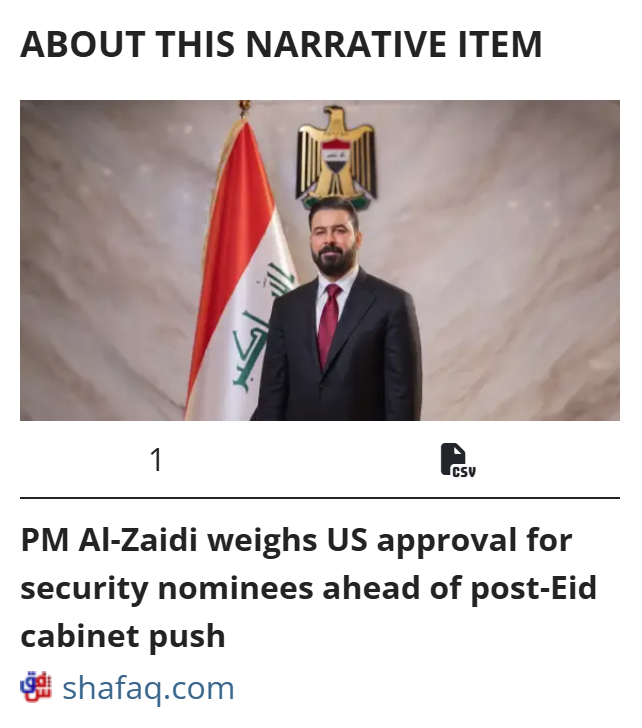
A 16 May item surfaced by EdgeTheory suggesting Al-Zaidi may seek “preliminary approval” from the US on key upcoming security and leadership appointments. The item suggests that if Al-Zaidi obtains such approval, Al-Khazali’s AAH may nominate Qais’s brother, Laith Al-Khazali, as deputy prime minister. Both Qais and Laith have been designated Specially Designated Global Terrorists by the US State Department.
Unlike AAH and Badr, which are heavily politically integrated into the Iraqi state and have expressed some openness to disarmament, Iran’s most lethal and ideological militias—KH, HHN, and KSS—have publicly opposed disarmament.
HHN Secretary-General Akram Al-Ka’abi urged the Axis of Resistance to “reject the very discussion” of disarmament on 6 May, emphasizing that relinquishing the militia’s weapons are a “red line” and declaring HHN will not surrender weapons “as long as we have breath.”
HHN Secretary-General Akram Al-Ka’abi urged the Axis of Resistance to “reject the very discussion” of disarmament on 6 May, emphasizing that relinquishing the militia’s weapons are a “red line” and declaring HHN will not surrender weapons “as long as we have breath” (51).
A spokesperson for one of the three factions reportedly told Al-Sharq Al-Awsat that KH, HHN, and KSS all oppose handing over their weapons on 8 May (52). KH and HHN both reportedly refused to disarm, indicating they do not seek to participate in the government on 14 May (53). It is difficult to determine whether these statements merely reflect KH, HHN, and KSS attempts to protect their reputations, or whether these statements constitute genuine red lines. Time will tell whether these three militias engage in any form of disarmament under the Al-Zaidi government—and what valuable positions they receive in exchange if they do. Ultimately, if these three militias refuse to disarm while the others disarm and integrate into the state, KH, HHN, and KSS will still serve Iran’s interests in the region as a lethal, extralegal vanguard force.
Iraqi militias continue to conduct attacks on Iran’s behalf, allowing Iran to maintain pressure on the US and allies without technically violating the ceasefire.
The Emirati Ministry of Defense stated it intercepted six drones coming from Iraq on 19 May and clarified that the 17 May attack on the Barakah Nuclear Power Plant originated from Iraq shortly after Iran accused the UAE of direct participation in the Iran war (54). Iran blamed Israel and Saudi Arabia for the attacks (55).


EdgeTheory found numerous outlets including Houthi-owned Al-Masirah TV discussed Iran’s accusation of direct UAE involvement in the war (top). NYT reported on 14 May that both the UAE and Saudi Arabia previously conducted covert attacks on Iran in retaliation for Iranian strikes (56). Reuters reported on 13 May that Saudi Arabia also conducted retaliatory strikes against Iran-backed militias in Iraq, as EdgeTheory surfaced above.
History shows that Iran will maintain long-term investment in and cooperation with its Iraqi militias. The benefits they provide make them exceptionally valuable to Iran. However, Iraq’s history also shows that Iran-backed militias can take many forms and can advance Iran’s interests from inside or outside of Iraq’s security structures. Iran and its militias may hope to weather US targeting and political pressure by assuaging the US with the disarmament committee while taking no real action. But if the committee does take tangible steps towards “disarming” the militias and integrating them into the Iraqi state, the US must remember that Iran and the militias—especially the Badr Organization—have done this before. And they are playing the long game to survive.
References
https://www.nytimes.com/2026/05/14/world/middleeast/saudi-arabia-uae-iran-attacks.html
https://truthsocial.com/@realDonaldTrump/posts/116365796713313030
https://www.reuters.com/world/middle-east/no-deal-no-exit-how-us-iran-standoff-risks-fresh-conflict-2026-05-18/ and https://www.iranintl.com/en/202604286852 and https://www.theguardian.com/world/2026/apr/30/iran-supreme-leader-issues-defiant-statement-on-strait-of-hormuz
https://www.wsj.com/livecoverage/iran-us-china-news-2026/card/JDhuKMyUdBCTowctbv4T
https://www.iranintl.com/en/202604279001
https://www.aljazeera.com/news/2026/1/11/irans-pezeshkian-pledges-economic-overhaul-amid-spiralling-protests and https://www.cnbc.com/2026/01/06/iran-protests-us-intervention-trump-economic-crisis-rial-ayatollah-khamenei-tehran.html
https://eyesofiran.com/event/49022
https://www.nytimes.com/2026/05/12/us/politics/iran-missiles-us-intelligence.html
https://oilprice.com/Energy/Energy-General/How-Iran-Is-Bypassing-the-Strait-of-Hormuz-Blockade.html
https://www.criticalthreats.org/analysis/iran-update-february-5-2026
https://www.newsweek.com/iran-announces-new-body-to-manage-strait-of-hormuz-11962513
https://mykn.kuehne-nagel.com/news/article/iran-drafts-hormuz-insurance-scheme-and
https://www.businessinsider.com/iran-bitcoin-strait-of-hormuz-crypto-oil-trump-btc-trump-2026-5
https://almadapaper.net/434016/
https://almadapaper.net/434016/
https://x.com/USAMBTurkiye/status/2054976832156442882 and https://x.com/thenewregion/status/2054978573476265998
The Endgame: The Inside Story of the Struggle for Iraq, from George W. Bush to Barack Obama. Michael Gordon. 2014.
The Endgame: The Inside Story of the Struggle for Iraq, from George W. Bush to Barack Obama. Michael Gordon. 2014.
https://www.cfr.org/backgrounders/shiite-militias-and-iraqs-security-forces
https://home.treasury.gov/news/press-releases/sb0458
https://www.longwarjournal.org/archives/2026/03/iraqi-shiite-militias-claim-attacks-on-us-bases.php
https://thearabweekly.com/choice-ali-zaidi-iraqs-next-premier
https://www.reuters.com/world/five-iraqi-banks-be-banned-us-dollar-transactions-sources-2025-02-16/
https://x.com/RudawEnglish/status/2050252139511885895
https://www.washingtoninstitute.org/policy-analysis/terrorist-wing-iraqi-government-opposes-sharaa-visit and https://www.longwarjournal.org/archives/2026/05/iraq-forms-new-government-with-only-14-of-23-ministers.php
https://ctc.westpoint.edu/iraqi-oil-and-the-iran-threat-network/
https://en.964media.com/47587/
https://www.reuters.com/world/middle-east/uae-says-drone-that-hit-near-its-nuclear-plant-was-launched-iraq-2026-05-19/ and https://amwaj.media/en/media-monitor/iran-accuses-uae-of-direct-role-in-israeli-us-attack-amid-tension-at-brics-summit

