Imagine standing in a crowded room where hundreds of conversations are taking place. Some are animated, others subdued. A few people are arguing, while most are simply talking. Now imagine you've been given a list of words to listen for. Every time someone mentions your company, a competitor, or a particular product, you make a note. You count the mentions, record the tone, and identify the subjects generating the most attention.
By the end of the evening, you've assembled an impressive collection of data. But have you understood what was happening in the room?
Perhaps the most consequential conversation never mentioned your company at all. A handful of people in a quiet corner might have been discussing an emerging industry problem that could fundamentally alter your business. Because their conversation didn't contain any of the words on your list, it escaped your attention entirely.
This illustrates an important limitation of conventional social media monitoring. While it excels at tracking conversations around known subjects, its effectiveness often depends on knowing what to look for in the first place.
Narrative Intelligence approaches the problem differently. Rather than asking only what people are saying about a particular subject, it examines what the sources and audiences that matter to an organization are discussing, how those conversations connect, and what they reveal about emerging beliefs and developments.
The distinction may seem subtle, but its implications for business intelligence are significant.
Social media monitoring and social listening tools have become an important business tool. Organizations use it to track brand mentions, measure sentiment, follow competitors, and identify emerging trends across an enormous range of digital channels. These capabilities provide valuable visibility into public conversations and help companies understand how their products, services, and reputations are being discussed.
The technology continues to improve. Sophisticated social listening platforms can discover related topics, identify patterns, segment audiences, and uncover conversations that might once have escaped notice. Yet monitoring programs built around predefined searches still begin with assumptions about which subjects deserve attention. Those assumptions may be entirely reasonable, but they can also leave important developments outside the scope of analysis.
Consider a manufacturer preparing to enter a new market. Its analysts monitor competitors, products, industry terminology, and consumer sentiment, producing reports that are comprehensive, detailed, and accurate. Meanwhile, a small group of industry specialists is discussing a regulatory change that could reshape the market. Their conversation attracts little public attention, mentions none of the company's competitors, and barely touches on its products. Nevertheless, those specialists may be describing the very development that determines whether the company's expansion succeeds or fails.
The monitoring program hasn't necessarily malfunctioned. It has answered the questions it was asked. The problem is that nobody thought to ask the question that mattered.
The best telescope in the world will show nothing when pointed in the wrong direction. The challenge, therefore, is not simply to improve the precision of monitoring, but to develop an intelligence approach capable of discovering important conversations that an organization may not yet know to investigate.
What would happen if an organization began its intelligence process not with a list of search terms, but with the sources and audiences whose conversations could influence its future?
These might include industry specialists, customers, investors, policymakers, local communities, professional organizations, publications, and institutions that shape how information circulates. Each offers a different perspective on the developments affecting a business, and their conversations can reveal concerns, expectations, and emerging issues that conventional search parameters might overlook.
A source-centered approach begins by identifying these strategically relevant sources and audiences, then examining what they are actually discussing. Rather than limiting discovery to conversations that match predetermined queries, analysts can investigate the subjects, concerns, and interpretations emerging within a relevant information environment. Some will be familiar, while others may be unexpected or only indirectly connected to the organization's immediate interests.
At EdgeTheory, AI-driven analysis helps identify pertinent discussions across selected sources, organize related material, and uncover the narratives taking shape. Analysts can examine how those narratives differ across audiences, how they develop over time, which sources influence them, and what they may mean for the organization.
This approach also provides an opportunity to understand what strategically important audiences are discussing without requiring an organization to anticipate every relevant subject in advance. A conversation that initially appears unrelated to a company may prove significant when examined in the context of broader market conditions, stakeholder concerns, or emerging competitive developments.
Search remains valuable, and the distinction should not be mistaken for a comparison between advanced and outdated technologies. Sophisticated social listening platforms increasingly offer discovery, audience segmentation, and historical analysis capabilities. The difference lies primarily in the organizing principle of the intelligence process.
Where conventional monitoring commonly begins with known subjects and examines the conversations surrounding them, source-centered Narrative Intelligence begins with relevant information environments and investigates the narratives emerging within them. This creates opportunities to discover not only what an organization already knows to look for, but also what it has not yet recognized as important.
Suppose a tire manufacturer discovers that customers are complaining about premature tread wear. This is useful information, but understanding the subject of a complaint is only the beginning of understanding its potential significance.
Elsewhere, other customers are reporting air leaks, automotive reviewers are questioning the company's quality controls, and dealers are expressing doubts about its reliability. Each discussion concerns a different problem, and taken separately, the complaints may appear unrelated. Viewed together, however, they may be contributing to a broader belief that the manufacturer cannot be trusted.
That belief is becoming a narrative, and its implications extend beyond the individual complaints that helped create it. Once a perception of unreliability takes hold, it can influence how audiences interpret subsequent developments. A routine product recall may be viewed as further evidence of incompetence, a factory expansion may raise new questions about quality, and even an unrelated announcement may be greeted with suspicion.
The narrative becomes a lens through which future events are interpreted.
The same process can work in a company's favor. A manufacturer consistently praised for quality, customer service, and innovation may gradually develop a reputation for excellence. That positive narrative can shape how audiences interpret new products, business decisions, and occasional setbacks, providing a measure of credibility that extends beyond any single announcement or customer experience.
Understanding these dynamics requires more than counting mentions or categorizing individual conversations. A topic identifies what people are discussing, while a narrative reveals the broader meaning they are assigning to those discussions and the beliefs that may be forming around them.
Those beliefs can have consequences far beyond the conversations that produced them. They influence expectations, shape reputations, and affect how customers, investors, employees, and other stakeholders respond to future developments.
Imagine a manufacturer announcing that it will move production overseas. The news spreads quickly, generating thousands of posts and a mixture of positive and negative reactions. A social media monitoring platform can measure conversation volume, identify prominent topics, and assess the distribution of sentiment, providing a useful picture of the immediate response.
Yet an aggregate assessment of sentiment may not adequately explain what the announcement means to different audiences.
Investors may interpret the move as a sign of greater efficiency and improved profitability, while employees see a threat to their livelihoods. Customers may question whether the company is abandoning its commitment to domestic manufacturing, and industry analysts may view the announcement as another indication of a broader restructuring of global supply chains.
Although everyone is responding to the same announcement, the narratives developing around it are fundamentally different. An overwhelmingly negative reaction among employees presents a different business challenge from growing skepticism among customers. Enthusiasm among investors may coexist with a deteriorating reputation in communities where factories are closing, and those interpretations may evolve independently as additional information becomes available.
Sophisticated monitoring platforms can segment sentiment and examine audience differences. Narrative Intelligence builds on that analytical foundation by examining the competing interpretations themselves: which audiences are advancing them, which sources sustain them, how they connect to existing beliefs, and whether they are gaining influence.
For decision-makers, the objective is not simply to determine whether the overall response is positive or negative. It is to understand what different audiences believe is happening, why those interpretations are emerging, and how they may affect the organization's future.
Social media monitoring and Narrative Intelligence both provide valuable insights into conversations taking place across the information environment. They are not mutually exclusive, nor are their capabilities separated by rigid technological boundaries. Their most important differences involve where the analysis begins, what it emphasizes, and how the resulting insights are used.
| Dimension | Social Media Monitoring and Listening | Narrative Intelligence |
|---|---|---|
| Starting point | Commonly begins with keywords, brands, topics, or predefined searches | Begins with strategically relevant sources and audiences |
| Primary analysis | Conversation activity, mentions, sentiment, engagement, and trends | Narratives, their relationships, development, and meaning |
| Discovery | Identifies activity around known topics and related trends | Discovers narratives emerging within selected information environments |
| Audience insights | What audiences discuss and how they respond | How narratives and interpretations differ across audience segments |
| Historical analysis | Changes in topics, sentiment, and conversation activity over time | How narratives emerge, persist, evolve, reinforce one another, and reappear |
| Business application | Brand monitoring, communications, marketing, and customer feedback | Strategic intelligence, competitive positioning, reputation, risk, and decision support |
These distinctions describe different analytical priorities rather than exclusive capabilities. Advanced social listening solutions can perform some of the same discovery, segmentation, and historical functions associated with Narrative Intelligence.
The essential difference is the question the organization is trying to answer. Monitoring helps establish what is being said, where attention is concentrated, and how audiences are responding. Narrative Intelligence seeks to explain the underlying stories, beliefs, and relationships shaping those conversations, placing them in a broader context that can inform strategic decisions.
Put Narrative Intelligence to the test. Send us a company, competitor, industry, or emerging issue, and see how EdgeTheory approaches the narratives developing around your topic.
Send Us Your Topic. Get a free Narrative Intelligence snapshot.
Consider a bank that experiences a service outage. Customers complain, social media fills with angry posts, and the institution faces an immediate communications challenge. On the surface, the reaction may look similar to what almost any financial institution would experience following a significant disruption.
But imagine two very different histories. In the first, the bank has suffered repeated outages, and customers have complained for years about unreliable systems and poor service. In the second, the bank has an excellent reputation, its systems have performed reliably for decades, and customers generally trust the institution.
Although the immediate response to the outage might look remarkably similar in both cases, the longer-term consequences could be very different. For the first bank, the disruption reinforces an established narrative of incompetence. For the second, customers may be more inclined to regard the incident as an unfortunate exception.
The difference lies in the history that audiences bring to the event.
Narratives rarely emerge fully formed from individual incidents. They accumulate meaning through repetition, memory, and the interpretations people attach to new information. Some appear suddenly and disappear almost as quickly, while others persist for years, influencing perceptions long after the original circumstances have changed. An event that appears relatively minor in isolation can become consequential when it reinforces an existing belief.
Understanding the present therefore requires more than a snapshot of today's conversation. Historical context can reveal whether an emerging controversy represents a new development, a continuation of a familiar concern, or the reappearance of a narrative that has remained dormant for some time.
EdgeTheory's historical information archive provides a foundation for examining how narratives have developed, identifying recurring patterns, and connecting current discussions to earlier ones. This longer view helps analysts assess whether a narrative is gaining strength, losing relevance, or becoming connected to other developments that could alter its significance.
Without that context, organizations may overreact to temporary controversies or underestimate the importance of persistent concerns. A brief surge in negative attention is not necessarily evidence of a lasting reputational problem, just as a relatively quiet conversation is not necessarily insignificant.
Historical analysis does not replace current intelligence. It makes current intelligence more meaningful by revealing the beliefs and experiences that shape how audiences interpret what is happening today.
Social media platforms reward attention. Conversations that attract engagement become more visible, and the resulting activity can make them appear especially important. For organizations accustomed to measuring mentions, impressions, and sentiment, the volume of discussion often becomes a convenient indicator of significance.
But visibility and strategic importance are not necessarily the same thing.
A celebrity's complaint about a product might generate millions of impressions and dominate online discussion for several days before fading from public attention. Meanwhile, a relatively quiet exchange among regulatory specialists could signal changes that will affect an entire industry. The first conversation may be far more visible, while the second may carry greater long-term consequences for a particular business.
Determining which conversation matters requires an understanding of the organization's objectives, the people participating, and the potential implications of what is being discussed. Conversation volume, engagement, and sentiment remain valuable measurements, but they cannot independently establish strategic significance.
That assessment requires context. Analysts need to understand who is participating, what influence those sources possess, which narratives are developing, and how those narratives relate to existing beliefs, market conditions, or institutional decisions. A conversation among a small number of influential industry participants may warrant attention even when its overall volume is modest.
This distinction has applications across a wide range of business intelligence functions.
A company's reputation is shaped by the narratives people associate with it, including beliefs about trust, product quality, innovation, leadership, and corporate responsibility. Narrative Intelligence helps organizations understand which narratives are influencing those perceptions, how they differ across audiences, and whether emerging interpretations are strengthening or challenging an established reputation.
Competitive positioning is influenced not only by market share or the volume of attention a company receives, but also by the narratives shaping perceptions of industry leadership, innovation, reliability, and quality. Examining those narratives can reveal how competitors are being positioned in the market, which sources are influencing those perceptions, and whether emerging beliefs could alter competitive dynamics.
Emerging threats do not always begin with a sudden increase in negative sentiment. Some develop gradually as concerns gain credibility, attract influential sources, or become connected to broader narratives about a company, industry, or operating environment. Understanding these developments can help organizations recognize potential reputational, financial, operational, or physical risks as they take shape.
During a crisis, the interpretation of an event can change rapidly. A problem initially understood as a product failure may evolve into a broader narrative about leadership, accountability, or organizational trust. Narrative Intelligence helps organizations examine how those interpretations develop, which explanations gain credibility, and how different audiences respond as circumstances change.
Markets are influenced by shifting expectations, emerging beliefs, and competing interpretations of industry developments. By examining the narratives developing among relevant sources and audiences, organizations can identify changes in customer priorities, competitive conditions, and perceptions of products, technologies, or entire industries.
Across these applications, the underlying objective remains consistent: to understand not simply how much conversation is taking place, but what that conversation means for the organization and which developments may warrant attention.
The modern information environment presents organizations with an abundance of data. The challenge is no longer simply obtaining access to conversations, but determining which developments deserve attention, how emerging narratives relate to one another, and what their implications may be for business decisions.
EdgeTheory approaches that challenge through a source-centered model that examines conversations across strategically relevant sources and audiences. AI-driven classification and clustering help identify related discussions and organize them into narratives, allowing analysts to investigate relationships that may not be apparent when topics are considered individually.
Historical analysis adds context by showing how narratives have developed over time. Audience and emotional analysis provide additional insight into why different groups may interpret the same events differently and what concerns or expectations are influencing their responses. Together, these capabilities support a more comprehensive understanding of the information environment.
At EdgeTheory, that understanding supports three essential intelligence functions: Detect, Assess, and Shape.
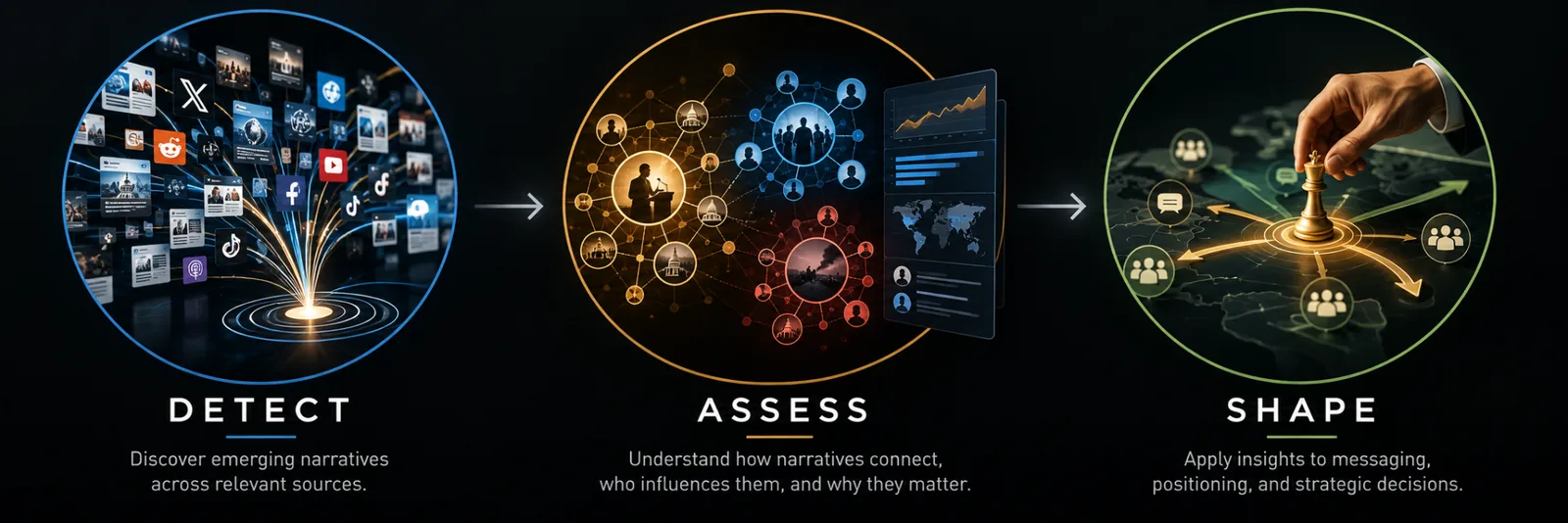
Detect involves identifying emerging narratives, influential sources, and meaningful changes in the information environment. It includes recognizing developments that may not yet appear prominently in conventional monitoring reports but could become important to the organization.
Assess examines how narratives are developing, which audiences they affect, how they connect to existing beliefs, and what their potential strategic implications may be. This analytical process helps distinguish activity that is merely visible from developments that may influence decisions, perceptions, or behavior.
Shape applies that understanding to communications, competitive positioning, strategic planning, and business decisions. Rather than responding solely to the latest conversation or sentiment trend, organizations can use a deeper understanding of the narrative environment to inform their actions and evaluate how their messages may be received.
The value of this approach lies in connecting information to decisions. An organization can possess extraordinary amounts of data and still misunderstand the forces shaping its market, reputation, or operating environment. Decision-ready intelligence emerges when analysts can explain the relationships among sources, audiences, narratives, and events, and place those findings in a context that business leaders can use.
Social media monitoring remains an important part of understanding the information environment. Organizations need to track brand activity, follow competitors, measure engagement, and understand customer feedback. These functions provide valuable visibility into conversations that directly concern the business, and Narrative Intelligence is not intended to replace them.
It addresses a broader analytical challenge: understanding what is taking shape in the conversations that matter to an organization, including those that may not mention the organization at all.
The most consequential development may emerge from a discussion among industry specialists, a changing belief among customers, or a long-standing narrative that suddenly acquires new relevance. It may be developing quietly among sources that attract relatively little public attention, or it may be connected to other conversations whose significance only becomes apparent when examined together.
By the time such a development becomes prominent in conventional monitoring reports, it may already have influenced the expectations and decisions of important audiences. A source-centered approach offers another way to recognize and interpret these developments, helping organizations understand not only what people are saying, but what their conversations reveal about the forces shaping their future.
Knowing what's being said is valuable. Understanding what it means, and why it matters, is the foundation of Narrative Intelligence.
Your monitoring tools may be tracking the conversations you already know to look for. But what about the narratives developing across the sources and audiences that matter to your business?
Put Narrative Intelligence to the test.
Send us a company, competitor, industry, or emerging issue. We'll examine the narratives surrounding your topic and walk you through a complimentary, focused Narrative Intelligence snapshot.
See how EdgeTheory approaches your topic and what a source-centered perspective can reveal.
Send Us Your Topic. Get a free Narrative Intelligence snapshot.
No obligation. Just a focused introduction to Narrative Intelligence using a topic relevant to your business.


