
Menu
What happens when every new controversy becomes connected to the last one?
EdgeTheory used Narrative Intelligence to examine the narratives shaping Target's reputation following its August 2026 Halloween-costume controversy.
The analysis identified something much larger than a single episode of negative publicity.
Five competing narratives are placing different expectations on one of America's most recognizable retail brands — and creating a growing challenge to Target's brand coherence.
The report examines how narratives surrounding diversity, corporate politicization, customer relationships, leadership and business performance are shaping perceptions of Target — and how previous controversies are being reactivated as audiences interpret new events.
Readers will see how Narrative Intelligence can reveal:
Traditional media monitoring can tell organizations what is being said.
Narrative Intelligence helps explain how audiences are interpreting what is happening — and how those interpretations may influence what happens next.
EdgeTheory's analysis examines narratives, actors, sources, emotions, persistence and reactivation across the information environment.
Download the Full Narrative Intelligence Report
Want to understand the narratives shaping your brand, market or competitors? Contact EdgeTheory at info@edgetheory.com
How Five Competing Narratives Are Reshaping the Target Brand
AN EDGETHEORY NARRATIVE INTELLIGENCE REPORT
Commercial Narrative Intelligence Report | Analysis Period: September 2026
EdgeTheory | September 16, 2026
Target’s latest controversy is not simply another reputational crisis. EdgeTheory’s analysis indicates that the incident is activating a much larger set of narratives that have accumulated around the company over several years.
Five distinct narratives currently shape Target’s reputational environment: Target has abandoned its commitment to diversity; Target has become too politicized; Target has lost touch with its customers; Target’s leadership has lost control of the brand; and Target’s cultural problems are becoming business problems.
These narratives originate among different constituencies and frequently contradict one another. Progressive audiences criticize Target for retreating from diversity commitments, while conservative audiences argue that the company has become too involved in contentious social issues. Consumers, activists, business commentators, and investors contribute additional criticism concerning Target’s customer relationships, leadership, and commercial performance.
Collectively, these narratives reveal a larger challenge: Target is attempting to manage increasingly incompatible expectations about what the company and its brand should represent. The result is what EdgeTheory characterizes as a crisis of brand coherence.
The August 2026 controversy surrounding a children’s Halloween costume illustrates this problem. Criticism of the product quickly expanded beyond the immediate incident, with audiences connecting it to Target’s earlier DEI decisions, cultural controversies, and questions about corporate leadership. The costume therefore functions less as the central reputational problem than as a new trigger through which established perceptions of Target have been reactivated.
This process demonstrates an important feature of Target’s current information environment. New controversies increasingly do not exist in isolation. They are interpreted through the company’s accumulated reputational history, allowing previous grievances to reemerge and influence how audiences understand new events.
Importantly, this reputational vulnerability exists alongside improving business performance. Target reported stronger sales and traffic during the second quarter of 2026 and raised its annual sales outlook. Narrative claims that the company is experiencing straightforward commercial collapse therefore exceed what current financial evidence demonstrates. The distinction is significant: reputational narratives can influence future stakeholder behavior even when they do not accurately describe present business conditions.
The principal risk for Target is consequently not the longevity of any individual controversy. It is whether future events continue reinforcing a broader perception that Target no longer possesses a clear understanding of what its brand represents, whom it serves, or how it should navigate competing stakeholder expectations.
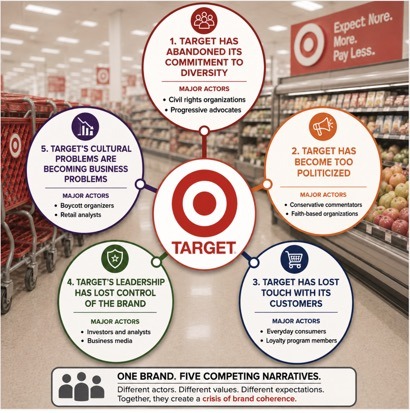
EdgeTheory’s narrative ecosystem map for Target-themed narratives
Introduction
Target occupies an unusual position in American retail. Although fundamentally a mass-market retailer, the company has long differentiated itself through design, lifestyle branding, inclusivity, community engagement, and a corporate identity extending beyond price and convenience. Those characteristics helped create consumer loyalty, but they also created expectations concerning what Target represents.
Those expectations have become increasingly difficult to reconcile.
Recent controversies have generated criticism from constituencies that frequently want opposite things from the company. Some audiences expect Target to maintain visible commitments to diversity and inclusion. Others believe the retailer became excessively involved in cultural and political issues. Still others interpret recurring controversies primarily as evidence that Target no longer understands its customers or that corporate leadership has lost control of the brand.
EdgeTheory’s analysis identifies five major narrative ecosystems currently shaping Target’s reputation:
The significance of these narratives lies not simply in their individual reach but in the incompatible expectations they impose upon the company. Actions intended to reassure one constituency can reinforce criticism from another. Corporate responses can themselves become new narrative events.
This report therefore examines Target’s current reputational environment not as a sequence of unrelated controversies but as a broader problem of brand coherence under pressure from competing narrative ecosystems.
This report uses EdgeTheory’s C2 platform to examine open-source conversations surrounding Target across news media, social platforms, blogs, forums, and other publicly available sources.
Narrative Intelligence differs from conventional media monitoring or social listening in the questions it seeks to answer. Rather than focusing primarily on the number of times a company is mentioned or whether conversation is positive or negative, C2 examines the narratives audiences use to interpret events, the actors and sources amplifying those narratives, the emotions associated with them, and the ways narratives persist, interact, and evolve across the information environment.
This approach is particularly important in Target’s case because the same corporate event can acquire very different meanings among different audiences. A policy change may be interpreted by one constituency as evidence of political activism and by another as evidence that Target has abandoned previously stated principles. Neither interpretation can be adequately understood through sentiment analysis alone.
The following study therefore focuses on the principal narrative claims surrounding Target, the constituencies advancing them, their emotional characteristics, and signs that issue-specific criticism is developing into a broader reputational judgment about the Target brand.
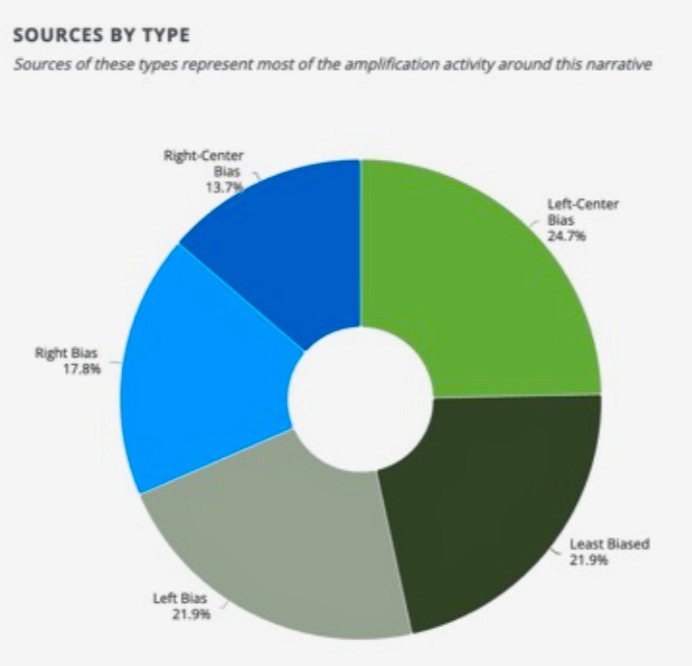
Target's recent controversy has drawn attention from across the political spectrum. Between August 18 and September 2, 2026, left-center and left-bias publications generated 46.6% of the coverage analyzed in C2.
Three developments provide the essential context for Target’s present narrative environment.
The first was the company’s 2023 Pride merchandise controversy, which generated substantial conservative criticism and boycott activity. Target subsequently altered displays and removed some products, producing criticism from LGBTQ advocates who argued that the company had capitulated to political pressure.
The second occurred in January 2025, when Target ended or scaled back several diversity, equity, and inclusion (DEI) initiatives. That decision produced criticism from civil-rights activists and progressive constituencies that viewed the changes as an abandonment of commitments Target had previously incorporated into its corporate identity.
The third occurred in August 2026, when Target withdrew a children’s Halloween clown costume after critics argued that its imagery evoked Blackface and racist minstrelsy. Target apologized and acknowledged that the product should not have entered its assortment.
These events establish the historical foundation for the current analysis. Their importance is not that they constitute a chronological history of Target’s controversies, but that they remain available within the information environment and continue shaping how audiences interpret subsequent Target decisions.
The question for narrative analysis is therefore not simply what happened previously. It is which previous events remain narratively active now.
One of the most prominent narratives surrounding Target argues that the company abandoned previously stated commitments to diversity and inclusion when those commitments became politically or commercially difficult to maintain.
Within this ecosystem, Target’s changes to DEI programs are interpreted not as ordinary corporate restructuring but as evidence that earlier commitments were conditional. This interpretation is particularly powerful because it uses Target’s established brand identity against the company. The more strongly Target previously associated itself with inclusion, the more consequential perceived retreat can become.
The 2026 Halloween-costume controversy provided this narrative with new evidence. Critics connected the approval of imagery they regarded as racially offensive with Target’s earlier DEI decisions, arguing that reduced attention to diversity within corporate decision-making increased the likelihood of culturally insensitive mistakes.
The important Narrative Intelligence finding is not whether that causal claim can be demonstrated. It is that audiences are using an existing narrative to explain a new event.
A merchandising mistake consequently becomes evidence in a much larger argument about corporate values and organizational culture.

Representative narratives suggesting or implying that Target has abandoned its commitment to diversity; collected from EdgeTheory's C2 platform, September 2026
The primary actors within this ecosystem include civil-rights organizations, progressive activists, diversity advocates, and Black community leaders. Emotionally, the narrative is driven primarily by anger, disappointment, betrayal, and moral outrage.
Its principal reputational threat is hypocrisy: Target is not merely accused of making a mistake but of failing to live up to an identity it previously encouraged stakeholders to believe.
A second major narrative reaches almost the opposite conclusion.
Within this ecosystem, Target’s difficulties are interpreted as the consequence of allowing a mass-market retail brand to become too closely associated with contentious political and cultural issues. Conservative commentators, activists, and consumers have argued that initiatives involving Pride merchandise, DEI, and corporate advocacy unnecessarily inserted Target into disputes unrelated to its fundamental retail mission.
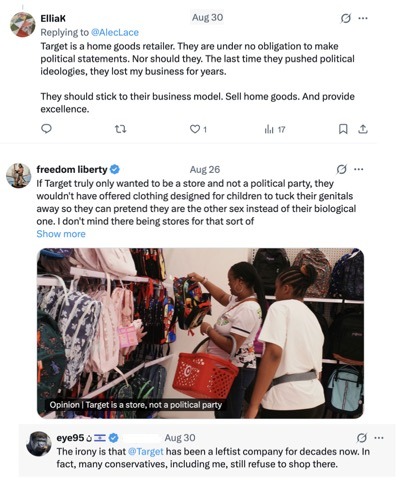
Representative narratives arguing Target has become overly political at the cost of retail quality; collected from X, September 2026
The underlying proposition is straightforward: Target should sell products rather than political or cultural values.
This creates one of the company’s central brand-coherence problems. The actions demanded by critics in the first ecosystem can become evidence for critics in the second. Stronger public commitments to diversity may reassure progressive constituencies while reinforcing conservative claims that Target remains politically engaged.
The reverse is equally true. Efforts to depoliticize the brand can be interpreted by progressive audiences as abandonment of principle.
Target therefore operates in an environment in which apparent neutrality may itself be interpreted politically. Activists can criticize the company for taking a position, changing a position, or refusing to take one.
The principal actors within this ecosystem include conservative commentators, political activists, faith-based organizations, and consumers who favor corporate neutrality. Its emotional structure is dominated by anger, frustration, and perceptions of cultural intrusion.
The reputational risk is not simply continued conservative criticism. It is the difficulty Target faces in defining a corporate identity capable of responding to one constituency without validating another constituency’s grievance.
The third narrative is less explicitly ideological and potentially broader in its appeal.
It argues that Target no longer understands the consumers it is attempting to serve.
Within this ecosystem, cultural controversies merge with conventional retail complaints concerning prices, merchandise, store experience, inventory, quality, and customer service. Individually, these grievances may have little relationship to one another. Narratively, however, they can be organized beneath a common conclusion:
Target has lost its way.
This narrative poses a distinctive threat because audiences do not need to adopt a particular political position to accept it. A progressive consumer dissatisfied with Target’s DEI decisions, a conservative consumer angered by corporate activism, and an ordinary shopper frustrated by price or store experience can all arrive independently at the perception that the company has become disconnected from its customers.
Target’s current operating performance complicates this narrative. Recent improvements in sales and traffic indicate that broad claims of consumer abandonment are not supported by present business results. That distinction is analytically important.
Narrative Intelligence does not require a circulating interpretation to be objectively correct before it becomes consequential. Instead, it asks whether that interpretation is becoming sufficiently persistent, emotionally resonant, or broadly distributed to influence stakeholder expectations and future behavior.
The primary actors within this ecosystem include consumers, retail commentators, customer advocates, and social-media users discussing their experiences with the brand. Dominant emotions include frustration, disappointment, nostalgia, and alienation.
The underlying reputational question is increasingly simple but consequential: Who is Target for?
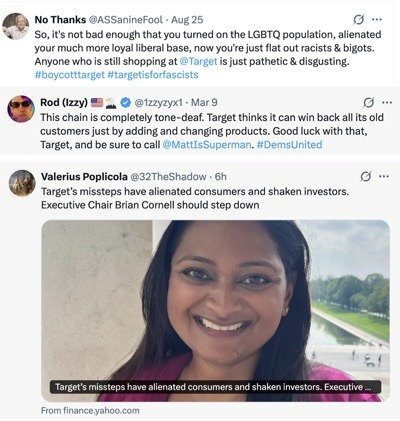
Representative narratives lamenting that Target has lost touch with its customer base; collected from X, September 2026
Repeated controversies increasingly support a fourth narrative centered on corporate competence rather than ideology.
Within this ecosystem, the central question is not whether Target should support DEI, Pride initiatives, corporate neutrality, or any particular social position. It is why the company repeatedly encounters controversies that appear foreseeable.
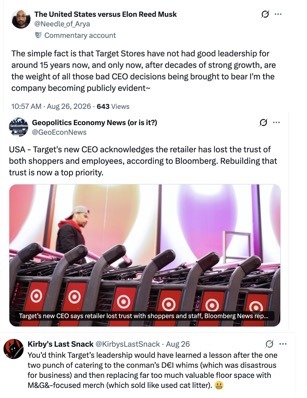
Representative narratives blaming Target's problems on leadership failures; collected from X, September 2026
The Halloween-costume incident illustrates this shift. Once Target acknowledged that the product should never have entered its assortment, criticism naturally moved upstream toward internal review and management processes. How did the product pass through merchandising, presentation, approval, and marketing without the potential reputational problem being identified?
This reframes the controversy from a cultural dispute into a governance and competence narrative.
As similar incidents accumulate, critics can increasingly portray them as evidence of inadequate internal review, inconsistent leadership, fragmented accountability, weak cultural awareness, or reactive crisis management.
This narrative is particularly important because it can extend beyond ideological constituencies. Investors, business media, employees, consumers, and political critics can disagree about the substance of Target’s controversies while still questioning whether management is handling them effectively.
The primary actors include investors, analysts, business journalists, current and former employees, and corporate-governance commentators. The dominant emotions are frustration, concern, skepticism, and declining confidence.
The reputational danger increases when individual controversies cease being interpreted as mistakes and instead become evidence of a perceived pattern.
The fifth narrative connects Target’s reputational disputes with measurable commercial consequences.
Boycott movements from different ideological constituencies have attempted to convert dissatisfaction into changes in consumer behavior. Share-price movements, traffic estimates, quarterly earnings, and sales figures consequently become part of the narrative contest surrounding the company.
This creates an environment in which financial data serves two purposes: measuring actual business performance and providing rhetorical ammunition.
A decline in Target shares can be presented as evidence that a controversy or boycott is succeeding. Weak sales can be attributed to cultural decisions. Conversely, improving performance can be presented as evidence that reputational criticism is commercially irrelevant.
Both interpretations require caution.
Target’s recent financial performance demonstrates why. Improving sales, traffic, and digital performance challenge narratives portraying the company as experiencing straightforward consumer collapse. At the same time, strong current operating results do not eliminate longer-term reputational vulnerabilities.
This distinction is central to Narrative Intelligence. A narrative does not need to accurately describe present financial conditions to influence future expectations, investor perceptions, consumer behavior, or management decisions.
The primary actors in this ecosystem include boycott organizers, investors, financial media, retail analysts, and activists attempting to demonstrate commercial consequences. Dominant emotions include vindication, anxiety, anger, and schadenfreude.
The key analytical task is therefore to distinguish between demonstrated economic effects and narratives that merely claim them.
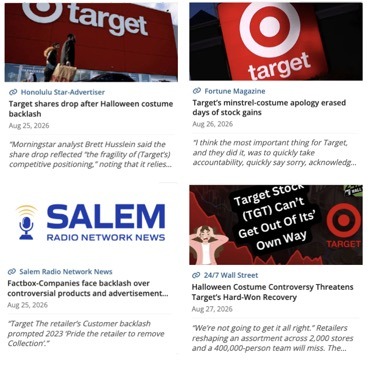
Representative narratives linking Target's cultural issues to its downturn in business performance; collected from EdgeTheory's C2 platform, September 2026
Taken individually, Target’s five narrative ecosystems describe different problems. Considered together, they reveal something larger.
Target is attempting to operate a mass-market brand across constituencies with increasingly incompatible expectations.
One audience expects Target to demonstrate visible commitments to diversity. Another believes those commitments constitute inappropriate political activism. Some consumers interpret cultural controversies as evidence that Target no longer understands them. Business audiences may interpret recurring controversies as failures of leadership. Activists and market commentators then attempt to translate these reputational disputes into claims about commercial performance.
Target therefore faces more than polarization. It faces a brand-coherence problem.
A coherent brand does not require every consumer to share the same values. It does, however, require sufficiently stable expectations about what the company represents and how it will behave.
Target’s current narrative environment makes those expectations increasingly unstable.
The risk is particularly acute because attempts to resolve one reputational problem can create evidence for another narrative ecosystem. Reaffirming diversity commitments may strengthen accusations of politicization. Retreating from them may strengthen accusations of hypocrisy or abandonment. Remaining silent on a controversial issue may itself become evidence that Target has failed to live up to stakeholder expectations.
The strategic problem is therefore not simply choosing the correct response to each controversy. It is maintaining a recognizable corporate identity across repeated controversies without allowing external constituencies to define the brand through their competing expectations.
Target’s current information environment also demonstrates how established reputational narratives persist.
Digital platforms preserve earlier controversies through news archives, social posts, screenshots, video, hashtags, and commentary. When a new incident occurs, audiences can rapidly retrieve older examples and incorporate them into current interpretation.
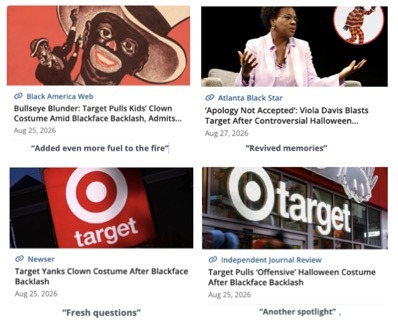
Representative narratives linking Target's current costume controversy to its previous ones; collected from EdgeTheory's C2 platform, September 2026
The Halloween-costume controversy illustrates this mechanism. Discussion quickly expanded beyond the product itself and reactivated arguments concerning Target’s DEI decisions and earlier cultural controversies.
This process can be described as narrative reactivation.
Its importance lies in the reduction of persuasive effort required from critics. Once an audience has accepted a broader proposition—such as “Target abandoned its values,” “Target became too political,” or “Target no longer understands its customers”—a new event does not need to establish that interpretation from the beginning. It can simply be incorporated as additional evidence.
The result is cumulative reputational pressure.
For Target, the key indicator is therefore not merely whether an individual controversy generates substantial attention. It is whether new controversies increasingly reactivate the same underlying narratives.
Unfortunately, the connections made between the current controversy and older ones are extensive and recurrent. Multiple sources present the costume controversy not as an isolated merchandising error, but as the latest episode in Target’s broader sequence of politically and culturally charged disputes.
Emotional Dynamics
The five narrative ecosystems also exhibit different emotional characteristics.
Narratives concerning diversity and cultural sensitivity tend to generate anger and disgust. Narratives concerning political activism often generate similar emotions, frequently tied to broader anxieties about cultural change. Customer-oriented narratives contain greater levels of disappointment, alienation, and nostalgia, while leadership narratives are more likely to generate skepticism and declining confidence.
These distinctions matter because emotion influences how narratives travel. Anger can accelerate mobilization and boycott activity. Disgust can increase sharing of controversial imagery, while betrayal can be especially damaging among previously loyal consumers.
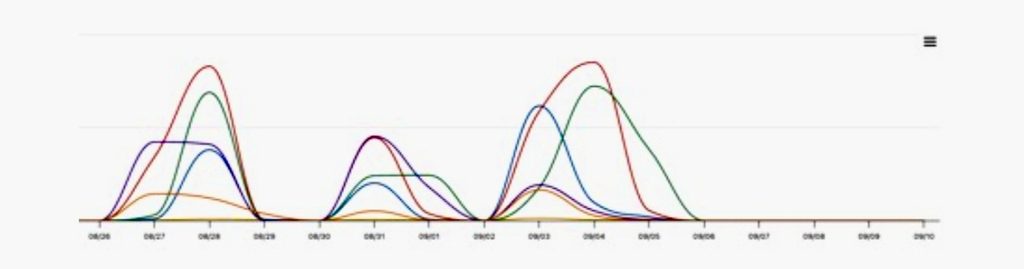
C2 also weighs emotional content, tracking fluctuations over time. The analysis shows repeated spikes in disgust, anger, and sadness between August 26 and September 8.
Analyzing Target conversation as simply positive or negative would obscure these distinctions. The more useful question is which emotions are attached to which narratives, which audiences they resonate with, and whether those emotions are contributing to amplification or action.
In the current Target backlash, the emotional profile is dominated by negative and contentious reactions. Coverage centers on anger, criticism, distrust, and ridicule directed at Target over imagery critics associated with Blackface and minstrelsy. Some of the strongest negative reactions portray the apology as inadequate or connect the incident to Target's earlier DEI decisions.
Between August 26 and September 8, emotional intensity fluctuated considerably, although anger, disgust, and sadness remained the leading indicators. After September 8, the measured emotional profile drops sharply. This should be read primarily as a decline in observed coverage, not as evidence that the underlying reputational narratives have disappeared.
Narrative Actors and Amplification
Target’s reputational environment is shaped by a diverse set of actors, including civil-rights organizations, conservative commentators, progressive activists, advocacy groups, consumers, employees, investors, financial analysts, political figures, and mainstream media.
These actors do not merely increase conversation volume. They perform different narrative functions.
Some actors identify or originate controversies. Others interpret those incidents through established ideological or reputational frameworks. Influencers and advocacy organizations expand their reach. News organizations provide broader visibility. Financial commentators can subsequently translate reputational controversy into questions about business performance.
The most consequential actors may therefore be those capable of connecting a new incident with an existing narrative.
This is particularly important for Target because its accumulated reputational history gives amplifiers a large reservoir of earlier material. A new event can quickly be positioned not as an exception but as evidence of an established pattern.
Future monitoring should therefore focus not only on who is discussing Target but on which actors successfully move an event from one narrative ecosystem into another or revive dormant narratives following a new trigger.
C2 indicates that high-reach national outlets have been among the most influential amplifiers of the current Target narratives, while ideologically aligned commentators add polarization and intensity. Adweek and 24/7 Wall St. have been particularly influential in framing the clown-costume controversy as a corporate failure and a potential threat to Target's brand recovery. 24/7 Wall St. has also emphasized consumer trust, boycotts, and stock-market exposure.
Other outlets, including The Washington Times and The New Republic, have amplified the claim that Target's DEI rollback provides important context for the costume controversy. Actress Viola Davis is the most prominent individual amplifier identified in this narrative, as her rejection of Target's apology has been repeatedly quoted and redistributed.
Target’s principal reputational vulnerability is not any single controversy. It is the possibility that repeated events gradually establish a durable perception that the company lacks clarity about its identity.
Several structural risks contribute to that possibility.
Together, these vulnerabilities create a feedback mechanism. Each new incident has the potential to strengthen an existing narrative; stronger narratives make future incidents easier to interpret as evidence of a pattern; and perceived patterns increasingly shift attention from individual controversies toward the Target brand itself.
That transition represents the most significant long-term risk identified in this analysis.
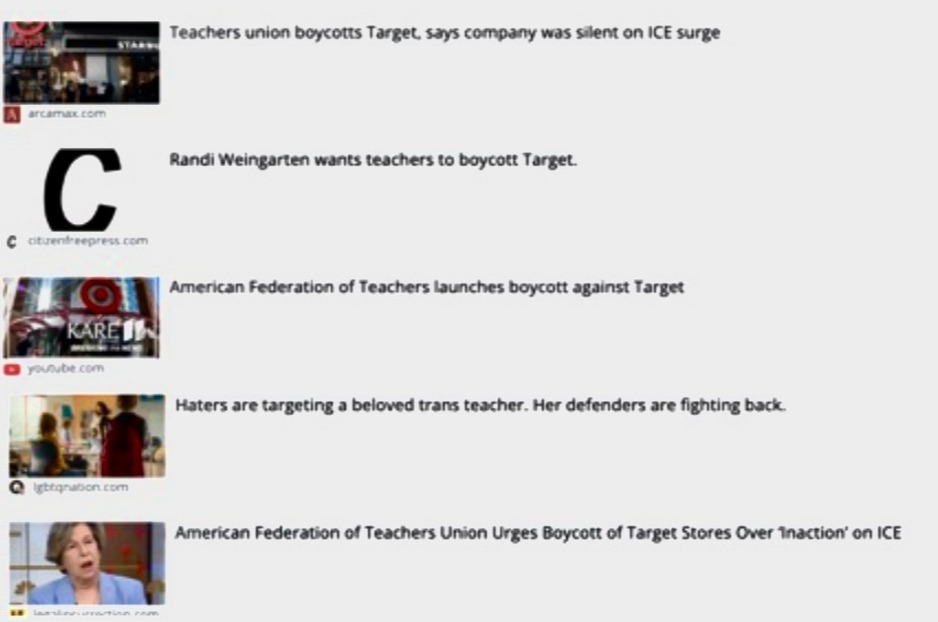
Target has faced backlash from a variety of actors, including the American Federation of Teachers, which has called for a nationwide boycott of the retail chain over its failure to oppose mass deportation; items collected from EdgeTheory's C2 platform, September 2026
The most important signal is no longer the volume of criticism surrounding any single Target controversy. It is whether future events continue reinforcing a broader perception that Target has lost clarity about what its brand represents.
Several indicators would suggest that reputational conditions are deteriorating.
First, analysts should monitor whether new controversies rapidly reactivate older grievances. If references to Pride, DEI, boycotts, or previous merchandising disputes appear almost immediately following an unrelated event, Target’s narrative history is becoming increasingly self-reinforcing.
Second, analysts should watch for criticism shifting from specific decisions toward broader assessments of leadership competence. A complaint about a particular decision is materially different from a broader judgment that Target's leadership no longer understands the company, its customers, or its brand. Increasing prevalence of the latter would indicate that issue-specific criticism is developing into a more durable corporate judgment.
Third, analysts should monitor how frequently cultural controversies become explicitly linked to sales, customer traffic, earnings, share price, or investor confidence. The more routinely reputational events are interpreted through financial performance, the greater the possibility that cultural and commercial narratives will become mutually reinforcing.
Fourth, it is critical to track which of the five narratives persist after the immediate costume controversy fades. Persistent narrative activity after the triggering event disappears would indicate that the conversation has become structurally attached to the Target brand rather than dependent upon a particular news cycle.
One narrative that has recently gained momentum is the claim that Target has abandoned its commitment to diversity. In some coverage, that narrative has shifted from a broad discussion of diversity to a more specific focus on Target's relationship with Black consumers and other constituencies. Actress Viola Davis has amplified this interpretation by publicly arguing that Target's apology was inadequate and that the company's challenge extends beyond a single costume.
Narratives about customer alienation also remain active. Multiple items identified in C2 suggest that the controversy could reinforce or extend existing boycott activity, particularly among Black consumers and Minneapolis-based activists. Other reports describe organizers as maintaining divestment calls despite signs of Target's business recovery.
Fifth, monitoring should identify new actors entering established narrative ecosystems. Expansion from ideological activists into mainstream consumers, employees, financial analysts, business leaders, or other constituencies could indicate that a narrative is escaping its original audience.
Finally, special attention should be given to the next unrelated Target controversy. If a future merchandising problem, executive decision, earnings announcement, store incident, labor dispute, or other event is rapidly incorporated into arguments that Target has lost touch with its customers or no longer understands its own identity, it would provide strong evidence that the brand-coherence narrative is becoming entrenched.
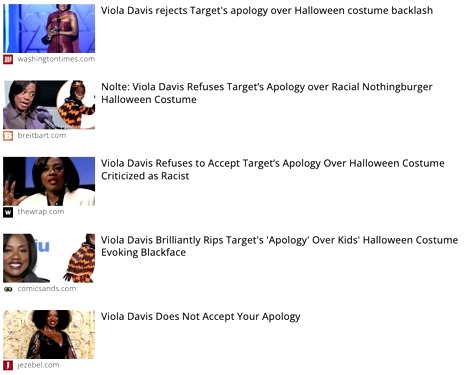
Representative narratives featuring Viola Davis' criticisms of Target; collected from EdgeTheory's C2 platform, September 2026
Signs of improvement would include the opposite pattern: controversies remaining issue-specific; older grievances appearing less frequently; fewer new constituencies adopting existing narratives; declining association between cultural disputes and leadership competence; and sustained business performance occurring without being routinely interpreted through Target’s cultural controversies.
The key question going forward is therefore not whether Target is receiving negative attention. It is whether new events continue reinforcing the same broader interpretation of brand confusion.
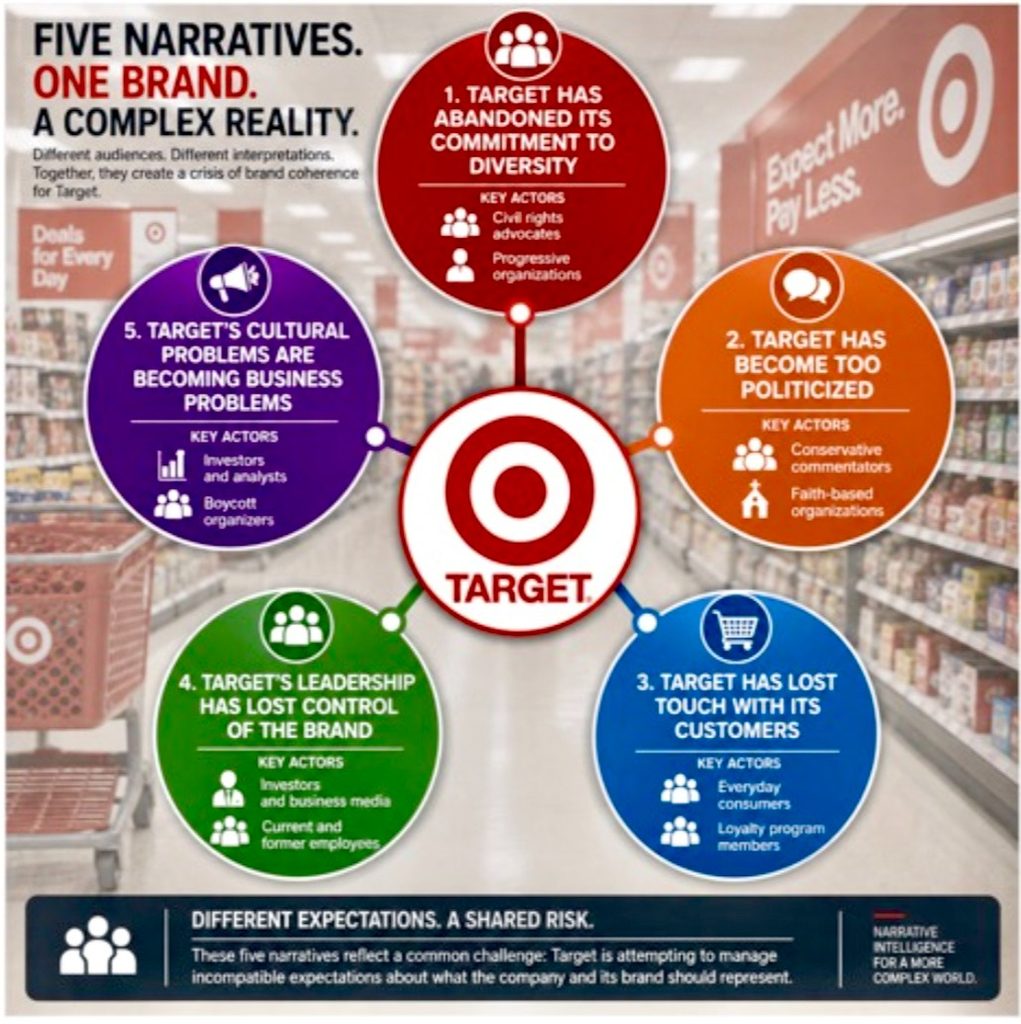
Five competing narratives are placing different expectations on one brand, creating a shared risk to Target's brand coherence.
Conclusion
Target's most consequential reputational challenge is not any single claim about the company's cultural or political positioning.
It is the broader possibility that audiences increasingly perceive Target as lacking a stable understanding of what its brand represents or whom it is attempting to satisfy.
EdgeTheory's analysis identifies five narratives contributing to that pressure: Target has abandoned its commitment to diversity; become too politicized; lost touch with its customers; lost control of the brand at the leadership level; and allowed cultural controversies to become business problems.
These narratives do not need to agree with one another to create reputational pressure. Their significance lies in the incompatible expectations they place on Target and the difficulty of responding to one constituency without creating new evidence for another.
The company’s improving financial performance provides an important counterpoint. Current operating results do not support simplistic claims that cultural controversy has produced straightforward commercial collapse. Yet that does not render the reputational environment irrelevant.
That divergence illustrates the value of Narrative Intelligence. The objective is not simply to determine whether a circulating claim is factually correct today, but to understand how audiences are interpreting events, which narratives are gaining traction, who is amplifying them, and how those interpretations could shape stakeholder behavior tomorrow.
For Target, the larger question is therefore whether the company can restore and maintain brand coherence across future events.
If subsequent controversies remain isolated, the current reputational pressure may dissipate. If unrelated events repeatedly reactivate the same underlying narratives and are increasingly interpreted as evidence that Target has lost clarity about its identity, the company will face a more persistent challenge - one in which the Target brand itself, rather than any individual controversy, becomes the central subject of criticism.
The challenge for decision-makers is that shifts in narratives, trust, and stakeholder perceptions can be difficult to detect before they become visible business problems.
If there is a topic, issue, brand, competitor, or emerging risk you need to better understand, contact EdgeTheory at info@edgetheory.com to learn how Narrative Intelligence can help identify developing narratives, emerging trust deficits, and changing stakeholder perceptions before they become operational challenges.

