
Menu
Menu
Markets do not move on numbers alone—they move as people interpret what is happening around them. In modern Market Intelligence, success depends on how customers, competitors, analysts, and media understand key events. Because people make decisions based not only on what happened but on what they believe it means, analyzing market perception has become just as critical as measuring market size.
As MIT Sloan Management Review research on data-driven decision-making highlights, decision-makers in complex markets struggle not from a lack of data, but from a lack of clarity around conflicting interpretations. Traditional Market Intelligence gives organizations critical visibility into market size, growth, and competitor pricing. Narrative Intelligence adds another dimension: understanding how those conditions are being interpreted, which narratives are forming around them, where those narratives originate, and how they change over time.
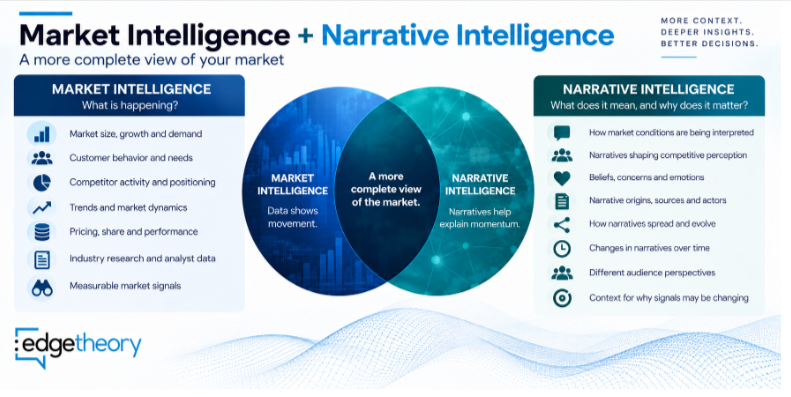
Traditional Market Intelligence gives organizations critical visibility into market size, growth, customer behavior, competitors, pricing, demand, and other measurable conditions. Narrative Intelligence adds another dimension: understanding how those conditions are being interpreted, which narratives are forming around them, where those narratives originate, who is advancing them, and how they change over time.
As organizations gain access to more data and increasingly powerful analytical tools, this ability to explain the market — not simply measure it — is becoming more important.
The next evolution of Market Intelligence is not simply better collection. It is better explanation.
Narrative Intelligence is the systematic analysis of the narratives through which people interpret an issue, organization, competitor, market, or event. It examines where those narratives originate, who advances them, how they spread and evolve, which audiences they reach, and the beliefs and emotions that may help them resonate.
A narrative is more than a topic or collection of keywords. It connects information into an interpretation. It gives events meaning and often contains an implicit explanation of what is happening, why it matters, who or what is responsible, and what should happen next.
Consider the difference between identifying increasing discussion about artificial intelligence and identifying a narrative that rapid AI infrastructure growth is creating unsustainable demands on local energy resources.
The first identifies a topic. The second identifies an interpretation of what is happening.
That interpretation can be traced to particular sources and actors, reinforced by evidence and proof points, challenged by competing narratives, associated with particular emotions or beliefs, and followed as it moves through different audiences.
For Market Intelligence teams, that distinction is important. Traditional analytics can show changes in demand, market share, customer behavior, pricing, or competitive activity. Narrative Intelligence helps analysts examine how the market is interpreting those changes and whether those interpretations themselves may become strategically important.
The objective is not to assume every narrative is true or influential. It is to identify which narratives warrant attention and evaluate the evidence surrounding them.
Narrative Intelligence is not a replacement for Market Intelligence. It expands what Market Intelligence teams can understand.
Traditional Market Intelligence is exceptionally good at answering questions about measurable market conditions. Narrative Intelligence introduces another set of questions about how people are interpreting those conditions.
| Market Intelligence commonly examines | Narrative Intelligence adds |
| Market size, growth and demand | How market conditions are being interpreted |
| Competitor activity and positioning | Narratives shaping competitive perception |
| Customer behavior | Beliefs, concerns and emotions surrounding behavior |
| Market and industry trends | Narratives developing around those trends |
| Media and social conversation | Narrative origins, sources, actors and movement |
| Significant market events | How narratives change before and after those events |
| Changes over time | Narrative persistence, evolution and competing interpretations |
| Quantitative market signals | Context that can help explain why those signals may be changing |
Suppose Market Intelligence shows that a competitor is gaining momentum. Traditional analysis would appropriately examine product capabilities, pricing, market share, distribution, customer reviews, marketing activity, financial performance, and recent announcements.
Narrative Intelligence adds another line of inquiry: What is the market beginning to believe about that competitor?
Perhaps the competitor has successfully reframed the category around a buying criterion it is well positioned to own. Customers may increasingly associate the company with lower risk or easier implementation. Analysts and influential industry sources may be reinforcing its position. Or a broader narrative about the market may have changed the context in which customers evaluate all of the available alternatives.
The analysis can go further by examining the proof points supporting those perceptions. A company may claim leadership, innovation, security, reliability, or ease of adoption, but those positions become more consequential when customers, analysts, partners, media, or other influential sources begin repeating the evidence that supports them.
This creates an important distinction between a position a competitor is promoting and one the market is beginning to validate.
None of these observations, by themselves, prove why a competitor is gaining share or attention. But they provide intelligence that conventional market measures may not capture.
Market data identifies movement. Narrative Intelligence provides another way to investigate the forces contributing to momentum.
The information problem facing Market Intelligence teams has changed.
For years, obtaining enough information was itself a major challenge. Today, most organizations face the opposite problem. They have access to enormous amounts of news, research, social content, customer feedback, analyst commentary, earnings calls, competitor communications, reviews, market data, and other sources.
Generative AI is accelerating that shift. Searching, collecting, categorizing, and summarizing information is becoming dramatically easier.
But easier access to information does not necessarily produce better intelligence.
A sudden increase in mentions may matter, or it may simply reflect a temporary news cycle. A negative sentiment score may combine frustration, fear, distrust, anger, and uncertainty — emotions with very different implications. A widely repeated idea may appear to represent broad market opinion when much of its amplification can be traced back to a relatively small group of sources.
Conversely, a narrative with limited volume may deserve attention because it is appearing among sources that have disproportionate influence over a particular market or audience.
The intelligence challenge is increasingly not finding more information. It is determining which information matters and understanding why.
Social listening and media monitoring platforms play an important role in understanding the market information environment. They help organizations track mentions, measure conversation volume, monitor sentiment, identify trending topics, and understand how brands and issues are being discussed across media and social channels.
Narrative Intelligence addresses a different analytical question.
Rather than starting primarily with what is being said about a predefined topic, brand, or keyword, Narrative Intelligence examines how ideas and interpretations form across the sources that shape an issue or market. It looks at the narratives connecting individual conversations, where those narratives originate, which sources and actors are advancing them, how they move across the information environment, and how they change over time.
That distinction becomes particularly important when an organization does not yet know what it should be looking for.
An emerging competitive narrative, customer concern, market belief, or risk may develop outside the keywords and topics an analyst is already monitoring. A source-centered approach can help reveal what is emerging within the information environments that matter, including developments an analyst may not have known to search for in the first place.
Social and media monitoring provide valuable visibility into the conversation. Narrative Intelligence adds context about the narratives shaping that conversation and why they may matter.
Narrative Intelligence becomes most useful when it moves beyond simply identifying narratives and begins helping analysts understand the relationships among narratives, sources, evidence, audiences, emotions, and market behavior.
Organizations naturally develop their own vocabulary for products, capabilities, and categories. The market does not necessarily use the same language.
A company may emphasize that its product is advanced while customers increasingly talk about simplicity, confidence, security, control, or implementation risk. Those differences can reveal the mental models through which customers evaluate their choices.
Narrative Intelligence goes beyond identifying frequently used words. It examines how those ideas connect. If customers repeatedly discuss complexity, implementation time, internal resources, and career risk, those may not be four separate topics. They may be components of a broader narrative about the perceived difficulty of adopting a new solution.
Understanding that distinction can change how an organization thinks about positioning, product strategy, customer engagement, and competitive differentiation.
Traditional Competitive Intelligence tells us a great deal about what competitors are doing. Narrative Intelligence helps us understand how those actions are being interpreted.
A competitor may be attempting to position itself as innovative, proven, secure, affordable, or easy to adopt. The more interesting intelligence question is whether that position is taking hold.
Are customers repeating it? Are analysts reinforcing it? Which sources are validating it? What proof points are being used to support it? Are competing interpretations emerging? Is the narrative strengthening, weakening, or changing?
Understanding the evidence supporting a narrative is particularly important. Repetition alone does not necessarily equal validation. Analysts need to distinguish between multiple independent sources reinforcing an idea and many sources simply repeating the same originating claim.
Competitive Intelligence asks what competitors are doing. Narrative Intelligence also asks what competitors are trying to make the market believe — and whether the market appears to be accepting that frame.
A narrative separated from its sources can be misleading.
Ten thousand mentions do not necessarily represent ten thousand independent signals. A highly visible narrative may originate with a small number of sources and then be repeated throughout the information environment. An apparently organic conversation may be heavily influenced by a particular company, publication, analyst, community, advocacy organization, or other actor.
The opposite can also be true. An emerging narrative may initially have very little volume but appear among sources with significant influence over a particular market.
That is why Source Intelligence is an important component of Narrative Intelligence. Analysts need to understand not only what narrative is present, but where it came from, which sources are carrying it, which actors are advancing or challenging it, and how it moves between sources over time.
Tracing provenance also improves analytical confidence. When analysts can identify where a narrative originated and understand how it has been repeated, modified, or amplified, they are better equipped to distinguish independent evidence from repetition.
Sentiment analysis has become common in market and media analytics, but positive, negative, and neutral classifications provide only a limited view of human response.
Two people can react negatively to the same development for entirely different reasons. One may be frustrated. Another may be fearful. Another may distrust the company involved. Another may simply be confused about what the development means.
Those differences matter because emotion can affect how narratives resonate and contribute to very different behaviors.
A narrative driven by anger behaves differently from one driven by anxiety. A narrative built around aspiration can create different opportunities than one built around distrust.
For Market Intelligence teams, the objective is not simply to attach an emotion to every conversation. It is to understand whether particular emotional patterns help explain why a narrative is resonating with a particular audience and what that could mean for the decisions that audience makes.
Narratives should not be analyzed as static objects.
They emerge, evolve, compete, weaken, disappear, and sometimes return. They can change as they move from one source to another or from one audience to another. New events can strengthen an existing narrative, introduce a competing interpretation, or fundamentally change what an established narrative means.
That makes persistence an important intelligence signal.
A concern that appears briefly after a news event may have little long-term significance. A similar concern that continues appearing over several months, attracts new sources, moves into new audiences, and adapts to new events deserves a different level of attention.
Major market events can be particularly revealing. A product launch, industry conference, earnings announcement, regulatory decision, competitor move, or market disruption creates an opportunity to examine the narrative environment before and after the event.
Which narratives strengthened? Which weakened? Did language introduced by an organization move into analyst, media, customer, or industry conversation? Which messages were amplified? Did competing narratives emerge? Did the event materially change how important audiences framed the issue?
This moves analysis beyond measuring how much attention an event received to understanding whether the event actually changed the market conversation.
One of the easiest mistakes in Market Intelligence is talking about the market as though it were a single audience.
It is not.
A customer may interpret a development differently from an investor. An industry analyst may see an opportunity where a regulator sees risk. Employees, executives, journalists, policymakers, competitors, partners, and consumers can all encounter the same information and reach different conclusions.
Even within the same customer market, perspectives can differ significantly. A message that resonates with an existing customer may do little to overcome the concerns preventing a noncustomer from considering the company. A narrative that appeals to a technical buyer may fail to address the risk concerns of the executive approving the purchase.
Industry context can create additional differences. The same technology, product, risk, or competitive position may be understood very differently in a highly regulated industry than in a less regulated market.
Narratives therefore need to be understood in relation to audiences. Understanding these differences gives Market Intelligence teams a more realistic view of how meaning forms across a market.
There is no single metric that determines whether a narrative matters. Strong Narrative Intelligence evaluates several signals together:
Volume remains useful, but it needs context. A high-volume narrative is not necessarily influential. A low-volume narrative is not necessarily insignificant.
The most useful Narrative Intelligence comes from understanding the relationships among these signals rather than reducing a complex information environment to a single score.
Narrative Intelligence becomes strategically valuable when it helps an organization understand something it needs to decide.
Every strategic plan contains assumptions about the market. Organizations judge what customers value, how competitors will behave, which technologies will matter, where risk is increasing, how categories will evolve, and what will differentiate one company from another.
Narrative Intelligence can help make some of those assumptions more visible and testable.
A company may believe customers care primarily about cost while market narratives increasingly center on implementation risk. Leadership may assume a competitor is succeeding because of superior technology while influential sources increasingly position that competitor as the safer choice. An organization may dismiss a market concern as a temporary reaction while persistent monitoring shows the narrative continuing to evolve, attracting new sources and appearing among new audiences.
Narrative Intelligence can also help connect changes in perception to business questions. If a particular narrative is gaining traction, could it affect consideration, adoption, loyalty, reputation, competitive position, or perceived risk? If a competitor is successfully establishing a new market frame, could that frame change the criteria customers use to evaluate alternatives?
These questions move Narrative Intelligence beyond understanding conversation and connect the information environment to decisions the organization actually needs to make.
Narrative Intelligence should not force analysts to choose between qualitative interpretation and quantitative evidence. The strongest analysis uses both.
Identifying a narrative provides meaning and context. Analysts should also be able to examine the evidence surrounding it: how frequently it appears, which sources contribute to it, how persistent it is, whether its prevalence is changing, how it compares with competing narratives, and whether it is moving into new audiences or information environments.
This becomes particularly important when intelligence is presented to executives or used to support strategic decisions. A compelling interpretation is not enough. Decision-makers need to understand the evidence supporting it and the confidence they should place in the conclusion.
Quantitative measures without narrative context can tell an incomplete story. Narrative interpretation without supporting evidence can become subjective.
Bringing the two together makes Market Intelligence more useful.
At EdgeTheory, we think about the progression from information to action as Detect, Assess, Shape.
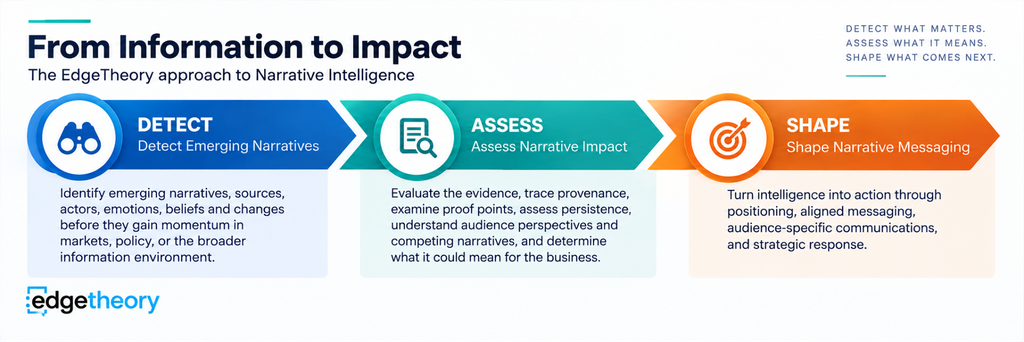
Detect identifies the narratives, sources, actors, emotions, beliefs, and changes in the information environment that deserve attention.
Assess determines what those signals actually mean. Where did the narrative originate? Who is influencing it? What evidence and proof points sustain it? How persistent is it? Which audiences are responding? What competing interpretations exist? What evidence supports or challenges the analysis? And why might any of this matter to the organization?
Shape is where intelligence becomes useful. The organization determines whether the analysis should influence strategy, positioning, customer engagement, risk planning, communications, investment, market entry, product priorities, or another decision.
The objective is not to respond to every narrative. It is to identify the narratives that matter, understand why they matter, and determine what, if anything, the organization should do about them.
Even sophisticated analysis can become misleading when several common mistakes are not addressed:
These disciplines matter because the goal of Narrative Intelligence is not to construct a persuasive story from available data. It is to develop the most defensible understanding of what is happening in the information environment and why it may matter.
Markets ultimately consist of people making decisions under conditions of imperfect information.
Customers interpret risk. Executives form expectations. Investors assess confidence. Analysts develop points of view. Employees respond to uncertainty. Competitors attempt to influence how categories are understood. Policymakers and regulators evaluate potential consequences.
Traditional Market Intelligence remains essential because it provides evidence about markets and what people actually do.
Narrative Intelligence contributes something different: evidence about how people are making sense of the environment in which those decisions occur.
Done properly, Narrative Intelligence requires analytical discipline. It means identifying sources, tracing provenance, distinguishing evidence from interpretation, examining proof points, testing competing explanations, understanding different audience perspectives, quantifying patterns where appropriate, and monitoring change over time.
It is not another name for social listening, media monitoring, sentiment analysis, Competitive Intelligence, or market research. It is an intelligence capability that can work alongside each of them by helping organizations understand how meaning forms and moves through the information environment.
As AI makes information easier to find, summarize, and analyze, that capability becomes increasingly important. The advantage will not come simply from collecting more information. Organizations already have more information than most teams can effectively use.
The advantage will come from understanding which information matters, what it means, who is shaping that meaning, how perceptions are changing, and what those changes could mean for the decisions ahead.
The next evolution of Market Intelligence is not simply better collection. It is better explanation.
That is the role of Narrative Intelligence in today's Market Intelligence.
Your market is already being shaped by narratives across customers, competitors, analysts, media, industry sources, and other influential voices.
See how EdgeTheory can help you identify the narratives that matter, trace where they originate, understand the sources and audiences shaping them, and assess what they could mean for your business.
Request a Narrative Intelligence Demo
See how Narrative Intelligence can be applied to a market, competitor, issue, or business question relevant to your organization.

