
Menu
Understand the Narratives Shaping Your Brand, Your Competitors, and Your Market
Traditional brand intelligence tells you what is happening around your brand. Narrative Intelligence adds another dimension by helping you understand why it is happening, what is shaping it, and how those perceptions are changing over time.
EdgeTheory gives brand, marketing, communications, and strategy teams a new way to understand the market by identifying the narratives becoming associated with their company, showing where they originate and who is advancing them, revealing how different audiences are responding, and comparing those narratives with competitors and the broader market.
The result is a richer understanding of your brand and better intelligence for deciding how to position it, communicate it, strengthen it, and differentiate it.
Every company works hard to define its brand through positioning, messaging, advertising, content, communications, customer experience, and the countless other ways it presents itself to the market. But the company is only one participant in that process.
Customers talk about their experiences. Journalists decide which aspects of a company are worth covering. Analysts interpret strategy and performance. Employees discuss culture and leadership. Competitors introduce their own claims and points of view. Industry experts, influencers, and online communities add their interpretations.
All of those conversations intersect. Some disappear almost immediately, while others continue to surface in different places and among different audiences. Over time, certain ideas, stories, claims, and perceptions begin to stick.
That is where narratives take shape.
A narrative is more than a mention, topic, or trending conversation. It is a recurring way of understanding something that becomes increasingly associated with a company, product, executive, competitor, or market.
For a brand leader, understanding those narratives can be just as important as understanding awareness, sentiment, engagement, or share of voice. Ultimately, it provides a much richer answer to one of the most fundamental questions in brand management:
What is the market actually coming to believe about us?
Brand teams already have enormous amounts of data. Most sophisticated organizations use some combination of social listening, media monitoring, brand tracking, customer research, search data, web analytics, competitive intelligence, sentiment analysis, and share-of-voice reporting.
Each provides an important part of the picture. The difficulty comes when you try to understand what is happening underneath those measurements.
Suppose sentiment toward your company changes. You can measure the change, but the number itself does not tell you what is behind it. It could be a reaction to a specific event that will disappear in a few days. The same criticism might be beginning to surface in unrelated conversations. A competitor may have introduced a new way of framing the category. Or a perception once limited to a small audience may be spreading into the broader market.
The opposite can happen as well. Your overall brand metrics may remain relatively stable while a new narrative is beginning to develop underneath them. It may not yet be large enough to materially affect sentiment or share of voice, but it is appearing more often, moving between audiences, and becoming more closely associated with your company.
Those situations can look remarkably similar in aggregate data, yet they can have very different implications for the brand.
Rather than treating thousands of articles, posts, comments, reports, and conversations as disconnected data points, EdgeTheory identifies the recurring stories, themes, claims, perceptions, sources, and actors within them and shows how those narratives develop over time.
Narrative Intelligence does not replace the brand intelligence you already have. It provides the context that helps explain what is driving it — and what may deserve your attention.
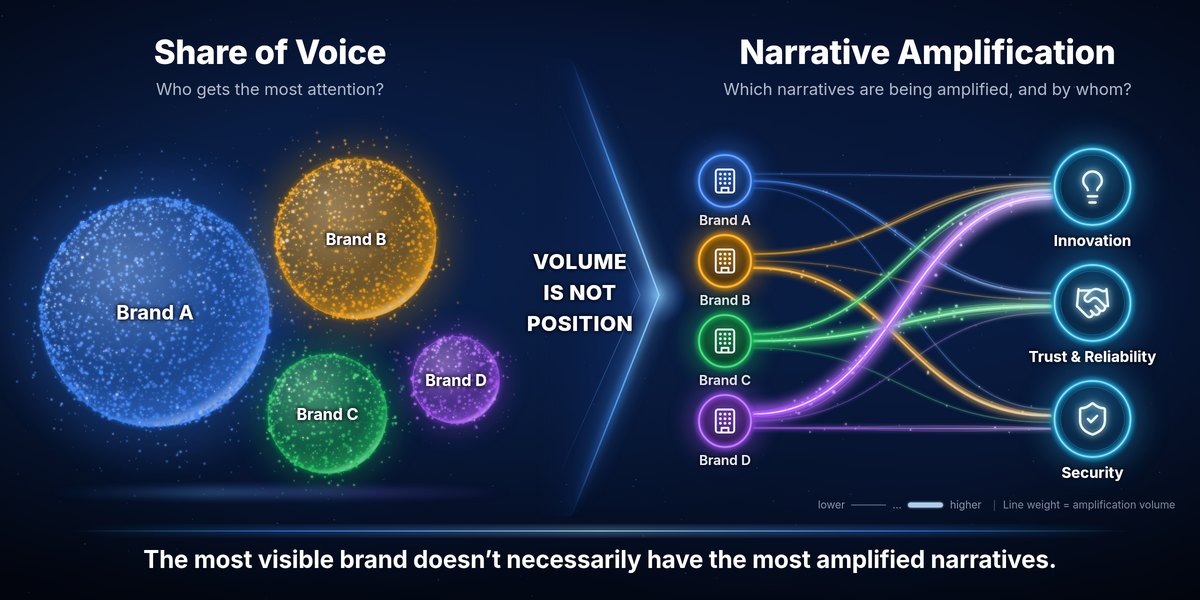
Share of Voice has long been an important measure of competitive brand presence. It answers a useful question: How much of the conversation in our market is about us compared with everyone else?
But conversation volume does not necessarily tell you which ideas are gaining traction or what is driving them.
A company can dominate the overall conversation while a competitor's narratives around innovation, trust, performance, value, leadership, or security are being more actively amplified by the sources and actors shaping the market.
Narrative Intelligence adds that context.
EdgeTheory helps teams understand which narratives are being amplified, which sources and actors are driving that amplification, how amplification volume is changing over time, and how those patterns compare across brands and competitors.
This provides a different view of competitive position. A competitor does not need to generate the most overall attention to gain ground around an idea that matters to the market. By understanding the narratives being amplified around each brand—and the sources and actors behind that amplification—teams can see changes in competitive positioning that Share of Voice alone may not reveal.
One of the limitations of traditional sentiment analysis is that it compresses a complicated human response into a simple classification: positive, negative, or neutral.
Those measures are useful, but people do not actually experience brands that way. Someone may trust a company but question its leadership. A customer may be excited about a new product while remaining skeptical about whether the company can deliver it. Customers can be frustrated with an experience while still feeling confident in the brand, just as investors can be optimistic about a strategy while expressing concern about its execution.
Those distinctions provide important context for understanding brand perception.
EdgeTheory examines the narratives and emotions surrounding a brand to provide a more nuanced picture that can include trust, skepticism, confidence, excitement, frustration, concern, anticipation, and other responses that reveal how people are interpreting what they see and hear.
More importantly, those emotions can be understood in the context of the narratives producing them.
Instead of simply learning that negative sentiment has increased, a brand team can begin to understand what people are concerned about, which narratives are creating that concern, where those narratives originated, who is advancing them, and which audiences are responding.
That provides a much stronger basis for determining whether a change in perception requires action and what kind of response makes sense.
There is rarely a single marketplace perception of a company. Customers may associate your brand with one set of ideas while employees associate it with another. Investors may be focused on strategy and growth, journalists may be framing the company around an industry issue, analysts may view it through competitive performance, and prospective customers may be responding to something else entirely.
All of those perceptions can exist at the same time, which is why an overall sentiment score can sometimes conceal as much as it reveals.
Narrative Intelligence allows brand teams to examine how narratives appear across different audiences and understand where perceptions align and where they diverge. A narrative may be gaining momentum among customers while having little presence in the media. A theme that has been well established among employees may begin appearing in external conversations. An idea strongly associated with your company among industry insiders may barely register with prospective customers.
You may also discover that a competitor's positioning is resonating particularly well with an audience important to your growth, or that the brand position your organization believes it owns is understood very differently by the people you are trying to reach.
Seeing those differences gives teams a clearer picture of how brand perception is actually being formed and provides better intelligence for audience strategy, positioning, messaging, and communications.
Not every story that generates attention will change the way people think about your brand. A product announcement, executive comment, customer complaint, or piece of media coverage can produce a significant spike in conversation and then disappear almost as quickly as it arrived. Other stories behave differently. They continue to resurface, get picked up by new sources, move into different audiences, and gradually become part of the way the market talks about a company.
That persistence is what begins to turn a story into a narrative.
The important signal is not simply how much attention something receives at a particular moment, but what happens to it over time. Is the same idea continuing to appear in different conversations? Are new people and sources beginning to use similar language or framing? Is it spreading from one audience to another? And, most importantly, is the idea becoming more closely associated with the brand itself?
This can happen around positive perceptions as easily as negative ones. A company may gradually become known for innovation because the idea keeps appearing in product coverage, customer conversations, analyst commentary, and industry discussions. A concern about service, leadership, pricing, reliability, or trust can develop in much the same way. No single conversation creates the perception; the accumulation of those conversations does.
EdgeTheory follows that movement over time, helping brand teams distinguish between something that is simply receiving attention and something that is beginning to have a more lasting effect on how the company is understood.
That distinction matters because the two situations call for very different decisions. A temporary burst of attention may require little more than monitoring. A narrative that is gaining momentum, spreading across audiences, or becoming more strongly associated with the brand may deserve a communications response, a change in messaging, or a broader strategic discussion.
The same intelligence can also reveal when the opposite is happening: a narrative that once influenced how the market viewed your brand may be losing momentum, providing a clearer picture of how perception is changing rather than simply where it stands today.
A brand does not develop its position independently of its competitors or its market. Every competitor is contributing messages, making claims, generating experiences, receiving coverage, and accumulating its own set of market perceptions. At the same time, the category itself is changing as new technologies, customer expectations, cultural trends, economic conditions, and industry developments introduce new ideas into the conversation.
Within that environment are narratives that matter to the market. Some are well established, some are emerging, some are strongly associated with particular companies, and others remain contested or have yet to become closely associated with anyone.
This creates a different way to think about competitive brand position. The question is no longer simply how much your company is being discussed, but what your brand is becoming known for — and what your competitors are becoming known for.
If innovation is becoming increasingly important in your market, which companies are most closely associated with it? If trust is becoming a deciding factor, who has the strongest position? If a competitor is becoming associated with an attribute your company has historically considered a strength, how quickly is that shift occurring? And if an important new market narrative is emerging, has anyone established a strong connection to it yet?
That is narrative territory.
EdgeTheory makes that landscape more visible by showing how brands, competitors, audiences, sources, emotions, and narratives relate to one another over time. The objective is not to chase every emerging conversation, but to understand which narratives matter to your business, where your brand already has strength, where competitors are establishing an advantage, and where there may be an opportunity to build a stronger position.
The value of Brand Narrative Intelligence is ultimately determined by the decisions it helps an organization make.
For CMOs, communications leaders, brand strategists, and marketing executives, that means moving beyond monitoring the market to understanding how the brand competes within it and where action can make a difference.
Understand where your brand already has credibility and momentum, and reinforce the ideas most important to the position you want to establish.
Recognize important category narratives that are emerging but have not yet become strongly associated with a competitor, creating an opportunity to establish a position before the territory becomes crowded.
See when competitors are beginning to gain association with attributes, ideas, or narratives important to your brand, giving your team an opportunity to respond before those associations become deeply established.
Distinguish temporary attention from recurring narratives that may be changing how customers, media, employees, investors, and other stakeholders understand your company.
Understand which narratives are resonating, with whom, and in what context so teams can make more informed decisions about messaging, content, campaigns, and communications.
Compare the position your organization intends to establish with the narratives the outside market is actually associating with your company, revealing where the two reinforce one another and where a gap may be developing.
Together, these capabilities turn Brand Narrative Intelligence from another source of market data into decision-ready intelligence for managing and strengthening the brand.
Brand leaders make decisions every day about positioning, messaging, communications, competitive strategy, and where to focus their attention. Narrative Intelligence gives them a different set of questions to bring into those decisions:
Answering those questions requires more than monitoring. It requires the ability to connect sources, conversations, audiences, emotions, competitors, and changes over time into a coherent understanding of the narrative environment.
That is what turns a fragmented information environment into intelligence leaders can use.
Every company has a story it wants to tell, but the market is continuously forming its own version of that story through the experiences, conversations, interpretations, and perceptions surrounding the brand.
The differences between those two stories can be extremely important. They can reveal where your positioning is working, where perception is beginning to change, where competitors are gaining ground, and where new opportunities are emerging.
EdgeTheory Brand Narrative Intelligence gives you a clearer view of that story, not as a snapshot of what people happen to be saying today, but as something that is continually forming, moving, and changing.
Understanding your brand is no longer just about measuring how much people are talking about you or whether the conversation is positive or negative. It is about understanding the narratives shaping what your brand means in the market — and using that intelligence to make better decisions about what happens next.
Request a Narrative Intelligence Demo
