
Menu
This EdgeTheory report examines the distinction between AI Sovereignty and Sovereign AI, using Narrative Intelligence (NARINT) analysis to show how governments, industry, and media frame these competing concepts to advance different strategic goals around technological autonomy. The report finds that AI Sovereignty (control and governance over AI systems and data) is primarily promoted by Western actors, while Sovereign AI (domestic infrastructure, compute, and models) is primarily advanced by China, Russia, India, and other emerging powers - fragmenting the global AI market into regionally aligned ecosystems.
What you'll learn
- The core distinction — AI Sovereignty is the goal of controlling AI governance and data, while Sovereign AI is the means of achieving that goal through domestically built infrastructure, compute, and models.
- Why the Houthi Movement resumed attacks on Saudi Arabia and imposed a maritime embargo, and how this serves Iranian strategic interests
- Who's promoting which narrative — AI Sovereignty coverage is dominated by Chinese-aligned (43.8%) and Russian-aligned (25%) sources, while Sovereign AI coverage is similarly China-heavy (46.7%) but with stronger Indian representation (26.7%) and little Russian presence.
- Emotional framing differs by narrative — Sovereign AI content is almost exclusively fear-driven (97%), signaling urgency around building domestic capability, while AI Sovereignty content mixes fear (58%) and anger (39%), reflecting frustration over foreign dependence and governance failures.
- Country-specific positioning — China is best-positioned for Sovereign AI via open-weight models and Global South partnerships; Europe leads on AI Sovereignty through regulation (e.g., the EU AI Act) but remains dependent on U.S. chips and cloud; India is pursuing a hybrid strategy; Russia faces semiconductor and isolation constraints despite strong political will.
- Geopolitical and market stakes — Both narratives aim to reduce dependence on U.S. technology, which is fragmenting the global AI market into regionally distinct ecosystems and could gradually erode U.S. leverage over infrastructure, standards, and supply chains — even as narratives largely remain low-incitement and evidence-based, with isolated exceptions like Geopolitics & Empire's high-incitement framing.
Download the report
Artificial intelligence is increasingly viewed as a strategic national asset, but the terms AI Sovereignty and Sovereign AI are often used interchangeably despite representing different approaches to achieving technological autonomy at the national level. Understanding this distinction, and how different source networks engage with each, is increasingly important as governments adopt competing AI strategies that influence infrastructure investment, regulatory frameworks, and international partnerships.
This assessment identifies how competing actors are shaping the future of AI governance, infrastructure, and international technological competition.
This report examines the competing concepts of AI Sovereignty and Sovereign AI to assess how governments, industry, and media promote strategic outcomes by framing narratives around technological autonomy, governance, and domestic AI development. Specifically, by leveraging Narrative Intelligence (NARINT), it seeks to answer four research questions:
By distinguishing evidence-based reporting from narrative amplification, this assessment identifies how competing actors are shaping the future of AI governance, infrastructure, and international technological competition. Understanding the distinction between AI Sovereignty and Sovereign AI is critical for AI and national security stakeholders because each reflects different approaches to technological control, dependence, and strategic competition. Tracking how these concepts are promoted and implemented can help stakeholders anticipate shifts in AI partnerships, infrastructure investment, regulatory priorities, and dependence on U.S. or foreign technology.
AI Sovereignty prioritizes governance, regulation, and control over AI systems, and is primarily advanced by Western governments seeking to secure national data, regulate foreign AI providers, and preserve strategic decision-making. Sovereign AI prioritizes domestic AI infrastructure, compute, and foundation models, and is primarily promoted by China, Russia, India, and other emerging powers seeking to reduce dependence on Western technology while expanding their own technological influence.
China is the best positioned to achieve Sovereign AI through sustained investment in domestic compute, open-weight models, and AI infrastructure. Europe is well positioned to advance AI Sovereignty through governance and regulation but remains constrained by its reliance on U.S. cloud and AI infrastructure.
China is the best positioned to achieve Sovereign AI through sustained investment in domestic compute, open-weight models, and AI infrastructure. Europe is well positioned to advance AI Sovereignty through governance and regulation but remains constrained by its reliance on U.S. cloud and AI infrastructure. India's hybrid strategy of combining domestic investment with international partnerships is likely to strengthen its long-term technological autonomy, provided it addresses talent, semiconductor, and capital constraints. Russia's Sovereign AI ambitions are supported by strong political backing and energy resources but will likely remain limited by restricted access to advanced semiconductors and broader geopolitical isolation.
U.S. export controls are reinforcing domestic AI leadership while encouraging countries to reduce dependence on U.S. technology. China is expanding alternative AI ecosystems through open-weight models and Global South partnerships, Europe is advancing AI Sovereignty through regulation and governance, and Russia and India are investing in domestic AI capabilities. Together, these strategies are creating regionally aligned AI ecosystems with different infrastructure, governance frameworks, and technology providers. For the United States, this preserves near-term leadership but may accelerate long-term investment in competing Sovereign AI ecosystems.
This assessment relied on three primary analytic workflows: determining differences between AI Sovereignty and Sovereign AI narratives, expanding source coverage with EdgeRunner, and identifying narrative actors and assessing strategic implications. Reporting and social media data from commercial, market intelligence, and adversarial information environments were aggregated into Watches and automatically structured into narrative clusters for analysis. These workflows combined quantitative narrative scores, emotional analysis, and network mapping to distinguish evidence-based market trends from narrative amplifications.
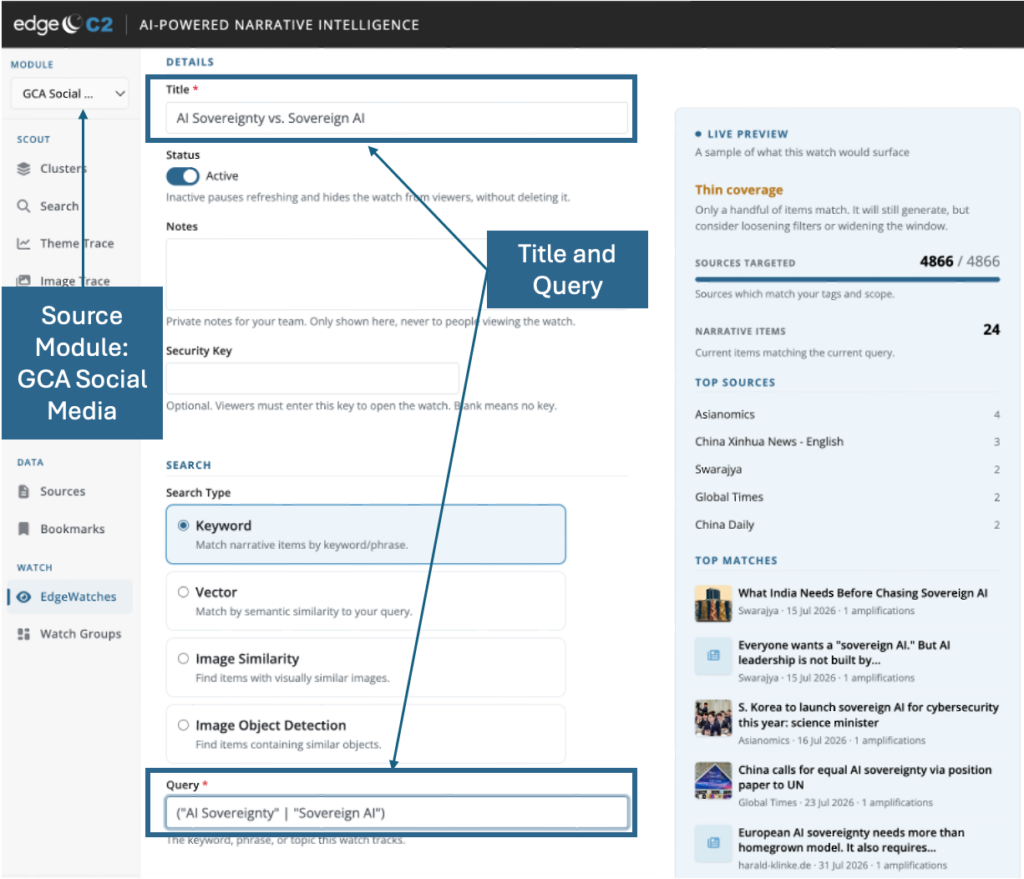

The EdgeWatch was created using Sovereign AI search terms within the GCA Social Media module, which comprises social media accounts of known actors supporting the interests of Russia, Iran, China, and others.
First, analysts created separate EdgeWatches using the search terms "AI Sovereignty" and "Sovereign AI" across multiple modules, including GCA Social Media, sources dedicated to Artificial Intelligence topics, and a module composed of market research firms, technology news, and developer forums. The resulting Watches were compared using Narrative Scores (Source Reliability, Factual Fidelity, and Likelihood to Incite), emotion profiles, source alignment distributions, amplification timelines, network analysis, and custom analytic sections to identify differences in narrative priorities, technical requirements, and geopolitical framing.
The resulting Watches were compared using Narrative Scores (Source Reliability, Factual Fidelity, and Likelihood to Incite), emotion profiles, source alignment distributions, amplification timelines, network analysis, and custom analytic sections to identify differences in narrative priorities, technical requirements, and geopolitical framing.
Second, analysts identified the most influential publishers, organizations, and source domains from each Watch and used them to develop targeted EdgeRunner discovery queries. Using EdgeRunner, the team added Telegram and Bluesky sources covering government, industry, research, and independent commentary on AI sovereignty, sovereign AI infrastructure, data governance, export controls, and national AI strategies. The additional sources broaden regional coverage across Russia, China, Europe, the Asia-Pacific, and emerging markets, addressing gaps in monitoring official narratives, policy developments, and technical ecosystems. These sources improve visibility into how state and non-state actors frame AI sovereignty, infrastructure investment, regulatory activity, and geopolitical competition.
Using EdgeRunner, the team added Telegram and Bluesky sources covering government, industry, research, and independent commentary on AI sovereignty, sovereign AI infrastructure, data governance, export controls, and national AI strategies.
Third, analysts used the enriched Watches to distinguish evidence-based reporting from coordinated narrative amplification. This distinction enabled analysts to identify the most influential actors and source networks and assess how competing stakeholders advanced AI Sovereignty and Sovereign AI narratives to shape AI governance, technology development, and geopolitical competition.
AI Sovereignty is the principle of maintaining control and governance over AI technologies, data, models, and infrastructure. It emphasizes autonomy over where data is stored, who operates AI systems, and the legal and operational frameworks governing them to ensure compliance and reduce dependence on foreign providers. Applications include local data center deployments, hybrid cloud infrastructures with sovereign capabilities, AI governance and audit frameworks.
Sovereign AI is the implementation of AI control through , compute, infrastructure, and models that are developed, deployed, and operated within a nation's or organization's jurisdiction. Sovereign AI applications manifest as national or regional AI platforms such as France's Mistral AI, Japan’s Noetra project aligned with physical AI, South Korea’s AI infrastructure expansions, UAE’s sovereign AI compute offerings, and enterprise platforms built on localized data and GPU infrastructure.
The key difference is that AI Sovereignty is the goal of controlling AI capabilities and governance, while Sovereign AI is the means of achieving that goal through domestically or locally controlled AI systems and infrastructure.
AI Sovereignty is the goal of controlling AI capabilities and governance, while Sovereign AI is the means of achieving that goal through domestically or locally controlled AI systems and infrastructure.
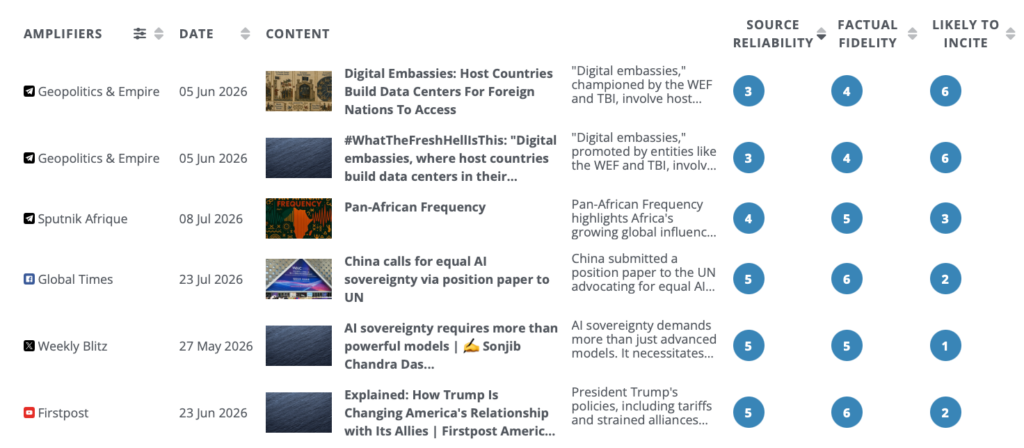
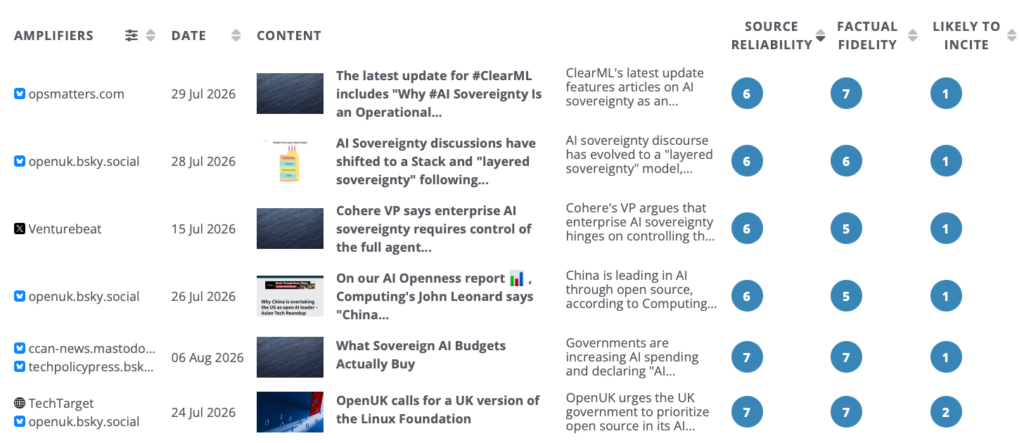
Our EdgeWatch NARINT monitors on both topics revealed both narratives are based on moderately to highly reliable, factually grounded reporting, although “Sovereign AI” demonstrates slightly stronger technical credibility. Coverage of “Sovereign AI” is dominated by government agencies, state-backed media, and regional news outlets, including China Xinhua, Arab News, Swarajya, Asianomics, and South Korea's science ministry. Most of the articles published by these outlets score 7–8 for Source Reliability and Factual Fidelity, reflecting credible reporting. AI Sovereignty narratives are similarly credible, led by sources such as China Daily, WION News, The Nation Thailand, and Global Times, but show greater variation.
Edge Theory Narrative Scoring
While most reporting scores 6–7, the inclusion of lower-confidence sources such as Geopolitics & Empire (3/4) introduces more policy commentary and opinion, making the overall dataset less consistent than the Sovereign AI watch.


Emotion Profiles Sovereign AI (left) vs. AI Sovereignty (right)
The profile on the left represents content retrieved for the Sovereign AI EdgeWatch, while the right profile represents content retrieved for the AI Sovereignty monitor. Each profile reflects the aggregate emotional signals identified across the sources returned for that respective query.
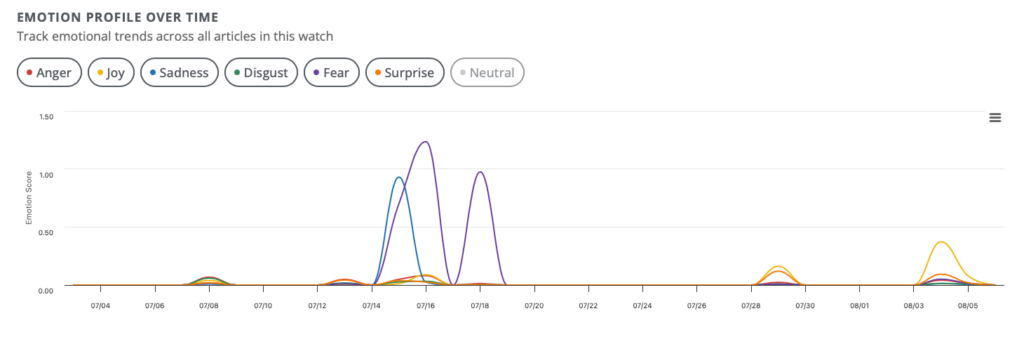
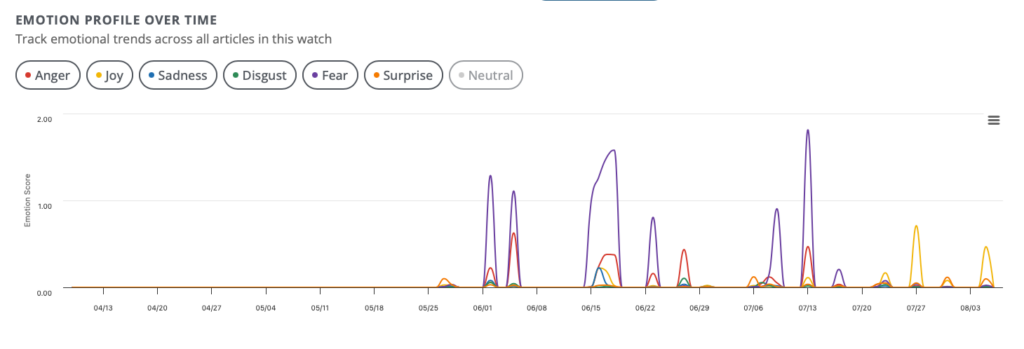
Emotion Profiles over time Sovereign AI (left) vs, AI Sovereignty (right)
Sovereign AI profile exhibits an almost exclusively fear-based response (97% fear), suggesting a narrative centered on urgency and the need to build domestic AI capabilities. In contrast, the AI Sovereignty profile is more emotionally mixed (58% fear, 39% anger), indicating that alongside concerns about strategic risk, these narratives also emphasize frustration or blame regarding foreign dependence, governance failures, and control over AI systems and data.
Both narratives are fear-dominant, indicating that discussions of both Sovereign AI and AI Sovereignty are framed primarily through strategic risk and competition. However, the Sovereign AI profile exhibits an almost exclusively fear-based response (97% fear), suggesting a narrative centered on urgency and the need to build domestic AI capabilities. In contrast, the AI Sovereignty profile is more emotionally mixed (58% fear, 39% anger), indicating that alongside concerns about strategic risk, these narratives also emphasize frustration or blame regarding foreign dependence, governance failures, and control over AI systems and data. This aligns with the broader distinction between the two concepts: Sovereign AI focuses on building national AI capabilities, whereas AI Sovereignty focuses on governing and controlling AI.
Analysis of individual narrative items also identified specific policy positions within the broader AI Sovereignty discussion. One narrative criticized Europe’s reliance on regulation, arguing that the EU AI Act and similar governance measures cannot independently deliver AI sovereignty without greater access to compute power, semiconductors, and supporting infrastructure.
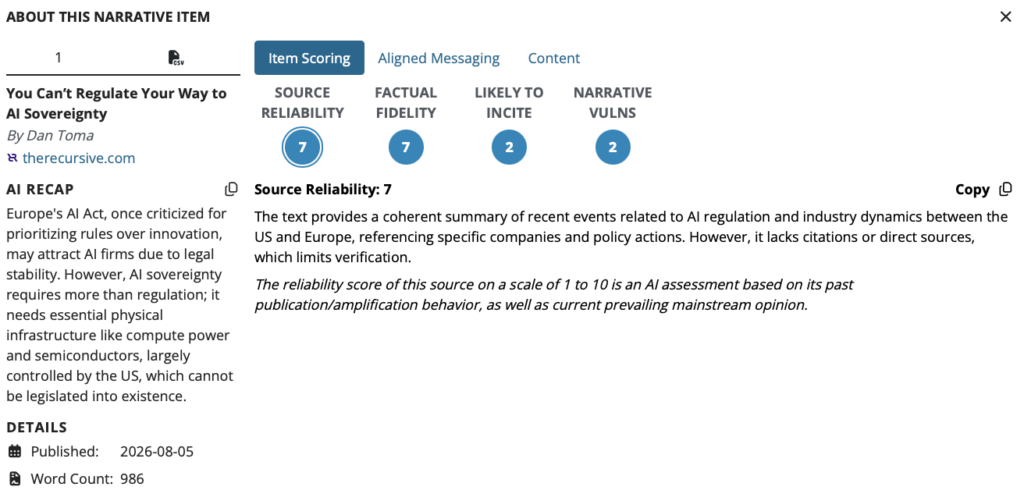
EdgeTheory Narrative Classifier: AI Sovereignty narrative criticizing Europe’s regulation-focused approach
This demonstrates that AI Sovereignty narratives are not limited to questions of who governs AI and data, but also include competing views over how governments should pursue technological independence.
Neither narrative is highly inflammatory. Most content scores 1–2 for incitement, indicating predominantly informational rather than mobilizing narratives. The primary exception is content published by Geopolitics & Empire, which receives an Incitement score of 6. Rather than discussing digital sovereignty as a technical or governance issue, the article portrays digital embassies and international AI governance initiatives as mechanisms for "total surveillance and control," characterizes organizations such as the World Economic Forum and Tony Blair Institute as "unelected globalist entities," and warns that these efforts could culminate in a "digital gulag" governed by "technocratic overlords." This emotionally charged framing transforms a policy discussion into a narrative of existential political threat.
AI Sovereignty narratives are somewhat more likely to attract ideological or conspiratorial framing than Sovereign AI discussions.
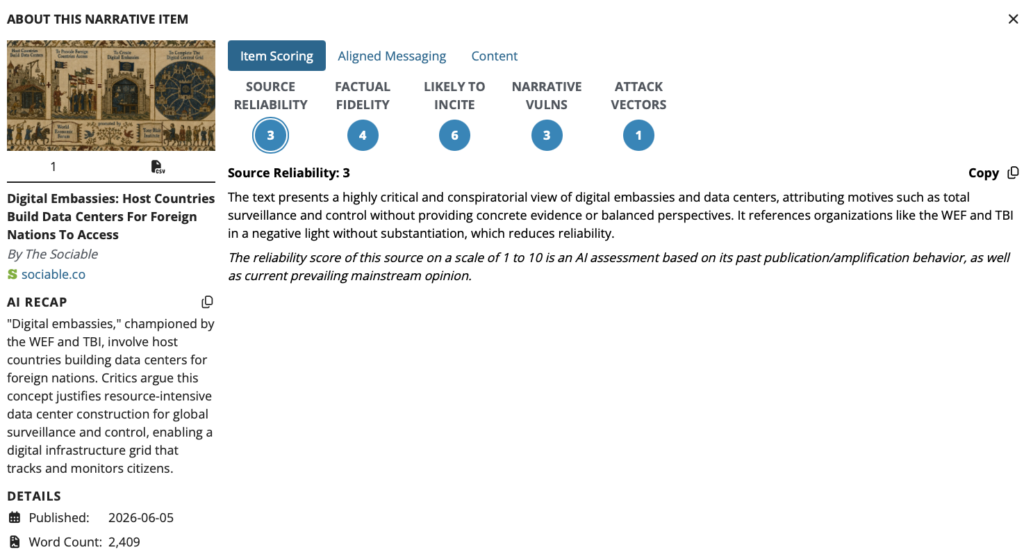
EdgeTheory Narrative Classifier with a high likelihood to incite (6)
Comparable examples are absent from Sovereign AI narratives, whose reporting remains consistently low-incitement even when discussing strategic competition. This suggests AI Sovereignty narratives are somewhat more likely to attract ideological or conspiratorial framing than Sovereign AI discussions.
The source networks also differ in who is amplifying each narrative. AI Sovereignty is dominated by Chinese-aligned (43.8%) and Russian-aligned (25%) sources, with Indian sources representing another 12.5%. Sovereign AI is similarly China-heavy (46.7%), but Indian sources account for 26.7% and Russian-aligned sources are absent from the leading categories. This suggests Russian-aligned networks place greater emphasis on AI Sovereignty and control over foreign technology, while Chinese-aligned networks promote both approaches and Indian sources more strongly amplify Sovereign AI and domestic capability development.
The two narratives reflect different political uses of technological autonomy. AI Sovereignty allows actors such as the EU to reduce foreign dependence through regulation, data controls, and market-access requirements without replacing foreign technology entirely. For middle powers such as Singapore and Malaysia, this approach can preserve flexibility between U.S. and Chinese technology ecosystems. Sovereign AI, by contrast, seeks greater technological independence through domestic models, compute, and infrastructure. For China and Russia, this can reduce U.S. leverage from export controls and technology restrictions, while India can use domestic development to diversify between U.S., Chinese, and indigenous providers. Politically, AI Sovereignty seeks leverage over technological dependence, while Sovereign AI seeks to reduce or redirect that dependence.
Sovereign AI narratives prioritize the development of indigenous AI capabilities, emphasizing domestic compute infrastructure, foundation models, data residency, and national control over AI systems. These narratives are primarily promoted by Russia, China, India, and several Global South countries, as well as state-aligned media including Russia Today, TASS, China Daily, Beijing Bulletin, and InfoBrics. South Korea’s plan to launch a sovereign AI model trained on domestic security data demonstrates how the narrative translates into policy. The initiative prioritizes domestic control over security-sensitive AI, supporting the conclusion that Sovereign AI encourages investment in national models and infrastructure to reduce foreign dependence.
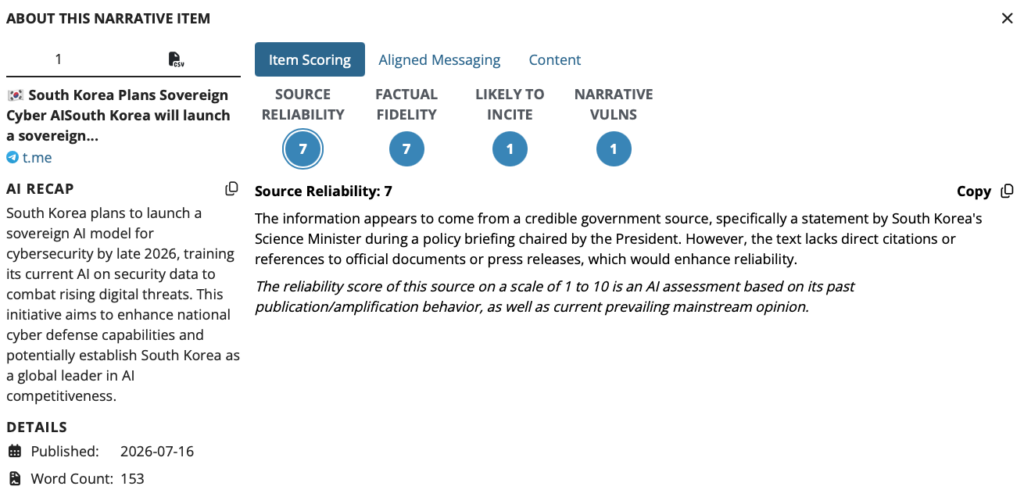
EdgeTheory Narrative Classifier: South Korea’s planned sovereign cybersecurity model
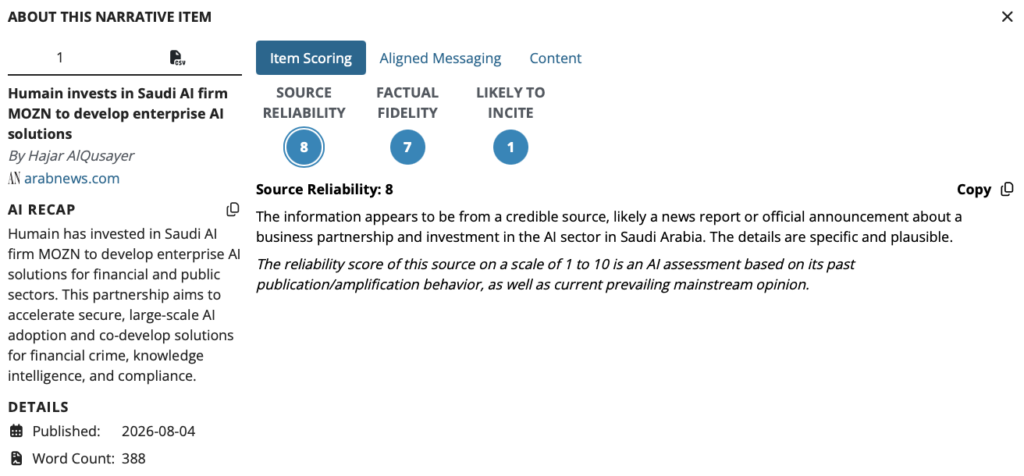
EdgeTheory Narrative Classifier: Saudi AI firm developing solutions for financial and public sectors
Narratives like this article present AI as strategic infrastructure and, in many cases, a shared public good that should not be dominated by a small number of Western technology companies or governments. Rather than advocating governance reforms, the article focuses on building domestic AI companies, infrastructure, and sector-specific applications. If states follow through on these narratives by operationalizing technological autonomy at the national level, they could reduce dependence on U.S. technology providers and weaken U.S. leverage over global AI infrastructure, standards, and supply chains.
EdgeTheory’s source modules reveal that the technical requirements emphasized for AI Sovereignty and Sovereign AI vary by source network. Sovereign AI requires greater control across the technology stack, including compute, data centers, energy, domestic models, secure datasets, and technical talent. AI Sovereignty instead emphasizes regulation, data governance, trusted infrastructure, interoperability, and oversight, allowing states to maintain control while still relying on foreign technology.
Sovereign AI coverage from Chinese and Indian sources emphasizes lower-cost models, localization, and domestic deployment, presenting technological autonomy as increasingly accessible. Russian sources similarly promote domestic models, compute, energy, and data control, despite Russia’s limited access to advanced chips, a constraint that could increase costs and limit performance. This gap suggests these narratives may encourage states to view Sovereign AI as achievable despite significant technical dependencies, potentially reducing reliance on U.S. models, cloud providers, and technology restrictions.
By contrast, AI Sovereignty coverage more closely acknowledges continued technological dependence. European approaches rely on regulation, data controls, and market-access rules while remaining dependent on U.S. chips and cloud infrastructure. The source networks therefore promote different paths to autonomy: Sovereign AI coverage emphasizes replacing or localizing foreign capabilities, while AI Sovereignty coverage emphasizes controlling them.
Sovereign AI and AI Sovereignty are driving the emergence of competing national and regional AI ecosystems. Both reduce dependence on a small number of U.S. technology companies, but they reshape the market in different ways.
Sovereign AI narratives promote creating direct competitors to U.S.-controlled AI infrastructure and models. China is using open-weight models such as Kimi and Qwen to give developing countries a cheaper alternative to closed U.S. platforms and is framing their rollout as mutually beneficial given the customer-nation’s ability to move one step closer to Sovereign AI.
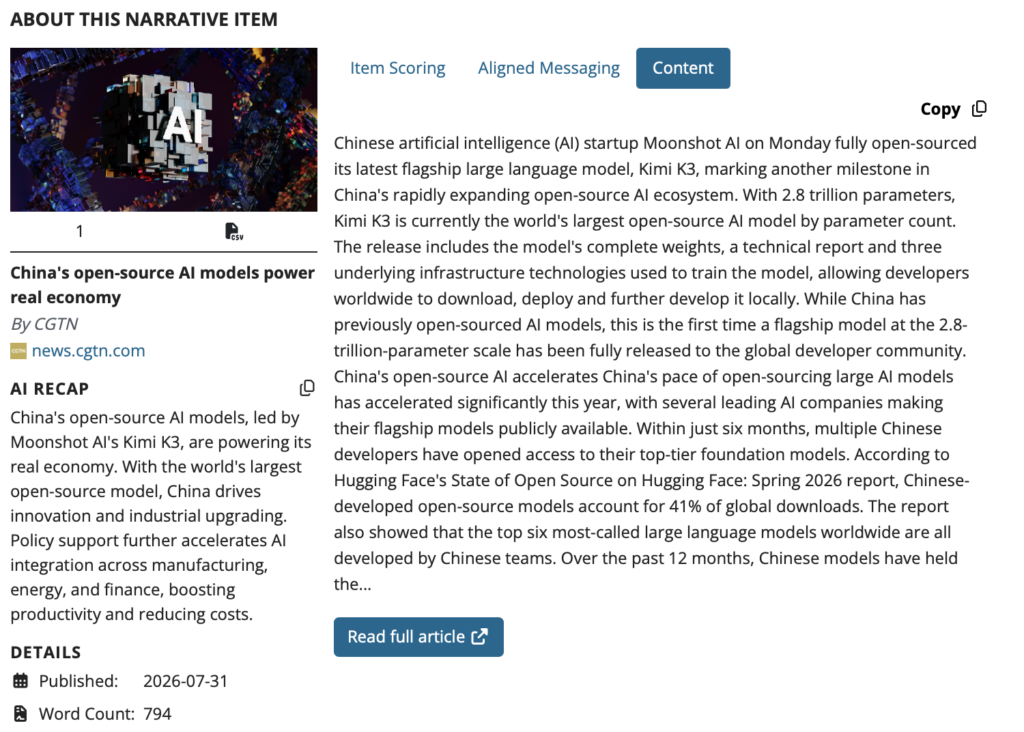
EdgeTheory Narrative Classifier on China’s open-source AI models surfaced from GCA social media
China is also promoting international cooperation through initiatives such as the World Artificial Intelligence Cooperation Organization. This allows China to build influence by supplying the models, standards, and technical support used by Global South countries. Even when these states gain more control over deployment, they may replace dependence on U.S. providers with dependence on Chinese models and infrastructure.
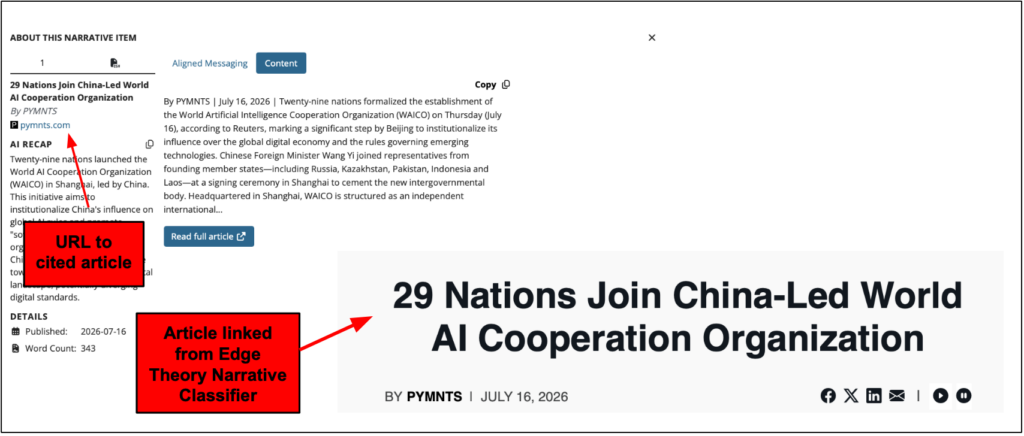
EdgeTheory Narrative Classifier linking directly to the cited PYMNTS article, surfaced from GCA social media
According to the EdgeAgent, Russia is pursuing Sovereign AI as a national-security and sanctions-resilience strategy. The narrative was surfaced through the Sovereign AI EdgeWatch within the GCA Social Media module and is amplified by Russian state-owned media, including Russia Today, alongside reporting citing President Putin and other Russian officials. Its focus on domestic models, compute, energy, and data control is intended to preserve access to AI capabilities despite Western technology restrictions. If acted upon, this narrative requires physical investment in domestic data centers, energy capacity, compute infrastructure, and secure data storage. However, Russia’s limited access to advanced chips could restrict performance and increase development costs, limiting its ability to create a globally competitive alternative.
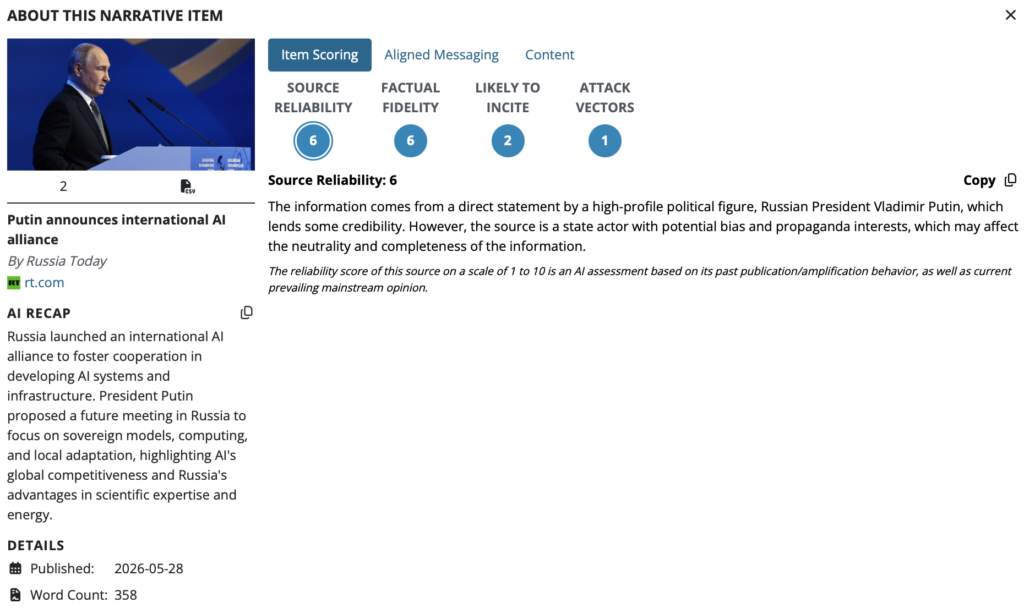
EdgeTheory Narrative Classifier on Russia’s new international AI alliance
This Narrative Classifier illustrates how Russian state messaging frames Sovereign AI as a national security imperative centered on domestic models, compute, and international AI cooperation, reinforcing Russia's broader strategy of reducing dependence on Western technology.
India is taking a more flexible approach. The IndiaAI Mission, investment in companies such as Sarvam AI, and efforts to develop lower-cost models for Indian languages support domestic capacity. At the same time, Indian companies are adopting Chinese open-source models because they are cheaper than U.S. alternatives. India is therefore unlikely to align fully with either the United States or China. Instead, it is using competition between providers to lower costs, gain technology access, and develop its own industry. This could make India an important independent AI market and a testing ground for mixed U.S., Chinese, and domestic technology stacks.
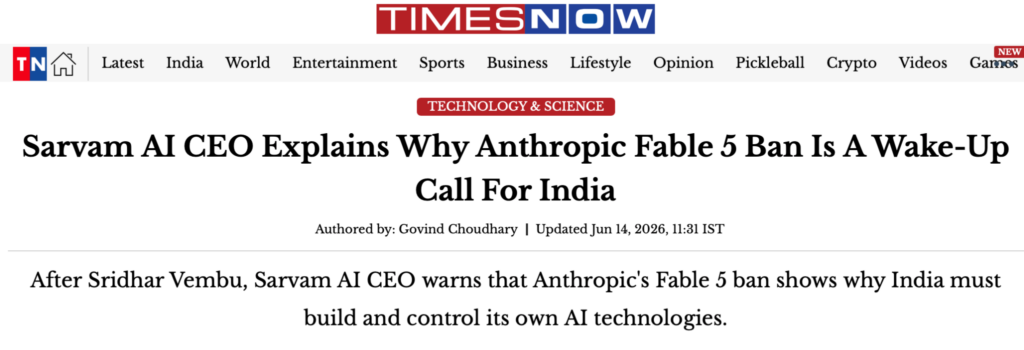

Article By Times Now sourced from EdgeTheory Emotion Profile Classifier
This article, surfaced through EdgeTheory Watches, illustrates how U.S. export restrictions have become a catalyst for India's sovereign AI strategy. By framing Anthropic's model restrictions as a "wake-up call," the article argues that India must accelerate investment in domestic AI infrastructure and capabilities to reduce vulnerability to future disruptions in access to foreign AI technologies.
These narratives can also translate information effects into physical and financial activity. Messaging that frames foreign AI dependence as a national-security vulnerability can encourage governments and firms to invest in domestic data centers, compute capacity, energy infrastructure, and indigenous models, while redirecting procurement toward domestic or non-U.S. providers. China’s promotion of lower-cost open-weight models and AI cooperation could similarly encourage Global South states to adopt Chinese models and technical standards. If these narratives drive investment decisions, their impact extends beyond information operations by reshaping AI supply chains, infrastructure development, and technology partnerships in ways that could reduce U.S. market access and technological leverage.
China is also promoting international cooperation through initiatives such as the World Artificial Intelligence Cooperation Organization. This allows China to build influence by supplying the models, standards, and technical support used by Global South countries.
AI Sovereignty has a different market effect because it focuses on control rather than full domestic production. Europe, for example, is using the AI Act, digital-market regulation, local cloud requirements, and partnerships with firms such as Mistral to reduce exposure to U.S. hyperscalers. Europe still depends on U.S. chips and cloud infrastructure, so its strongest geopolitical leverage comes from setting market-access rules rather than replacing the full U.S. technology stack. Companies that want access to the European market will have to meet European requirements for data handling, transparency, and oversight.
AI Sovereignty and Sovereign AI represent two complementary but distinct responses to the growing strategic importance of artificial intelligence. AI Sovereignty focuses on governing AI through regulation, data control, and legal authority, while Sovereign AI seeks to build domestic AI capabilities through infrastructure, models, and compute. Although these approaches differ, both are driven by the same geopolitical objective: reducing dependence on foreign technology and increasing national control over critical AI capabilities.
Taken together, these initiatives are dividing the AI market into competing layers. The United States retains major advantages in advanced chips, cloud services, and frontier models. China is competing through affordable open-weight models and Global South partnerships. Russia is building a protected domestic system, while India is balancing between blocs and developing its own capabilities. Europe is using regulation to gain control despite continued technical dependence. The likely result is a more fragmented market in which countries use different combinations of chips, models, clouds, and governance rules based on their geopolitical alignment and tolerance for foreign dependence.
The likely result is a more fragmented market in which countries use different combinations of chips, models, clouds, and governance rules based on their geopolitical alignment and tolerance for foreign dependence.

