
Menu
This EdgeTheory report examines how the collapse of the US-Iran ceasefire framework in July has reshaped the regional conflict, with a particular focus on Iraq's emerging role as a critical battleground. As fighting between the US, Iran, and their respective allies intensified—drawing in Saudi Arabia, the Houthis, and Iran-backed Iraqi militias—Baghdad has become central to US efforts to curb Iranian influence through disarmament negotiations, anti-corruption crackdowns, and billions in new economic investment.
What you'll learn
- How the US-Iran memorandum of understanding broke down beginning July 7, and the strikes, blockades, and retaliatory attacks that followed
- Why the Houthi Movement resumed attacks on Saudi Arabia and imposed a maritime embargo, and how this serves Iranian strategic interests
- How Iran-backed Iraqi militias have continued attacks—including a bounty offer targeting President Trump—despite a broader informal pause in fighting
- What the "June Agreement" entails, and how Prime Minister Al-Zaidi's government has tied US investment to militia disarmament and financial crackdowns
- The scope and political fallout of Iraq's "Dawn Sweep" anti-corruption campaign, including which factions and officials were targeted
- Why Iraq's militias are unlikely to fully disarm by the September 30 deadline, and the risks this poses for Al-Zaidi's government How Saudi Arabia's direct entry into the conflict alongside the US signals a broader regional realignment against Iran
Download the report
A fragile MoU between the US and Iran collapsed beginning on 7 July (1). Iran continued striking vessels in the Hormuz Strait following the MoU’s signing, leading the US to resume its blockade of Iranian ports on 14 July (2). CENTCOM conducted nightly strikes on Iranian military sites, communication and surveillance capabilities, drone facilities, and maritime assets through 23 July to degrade Iran’s ability to threaten Hormuz Strait shipping (3). Iran targeted US personnel and assets in Bahrain, Kuwait, Qatar, Saudi Arabia, and Jordan, and expanded strikes to include non-military targets including datacenters to erode the US’ will to continue strikes and to pressure regional countries not to house US forces (4).
While the MoU breakdown was not inevitable, it is hardly surprising. A strict reading of the MoU’s fifth clause merely required Iran to make its “best efforts” for the safe passage of commercial vessels through the Strait, without clarifying what such efforts must entail (5). The MoU notably did not require restoration of full freedom of navigation in the Strait. Iran exploited this vague language (which it likely incorporated deliberately) to continue striking ships in the Strait under the guise of ensuring their adherence to regime-approved, “safe” routes. In this way, Iran continued asserting control over the Strait after the MoU was signed.
Iran exploited this vague language (which it likely incorporated deliberately) to continue striking ships in the Strait under the guise of ensuring their adherence to regime-approved, “safe” routes.
Indirect negotiations resumed on 27 July, but rapidly deteriorated. President Trump claimed the US halted strikes on Iran at Iran’s request on 27 July (6). The halt coincided with an Omani delegation’s trip to Tehran to discuss administration of the Hormuz Strait (7). Initial reports also suggest Pakistan and Qatar proposed the US and Iran halt fighting and are pushing for both parties to return to the MoU (8). A Ukrainian strike on Iranian vessels in the Caspian Sea - intended to prevent transfer of military materials between Iran and Russia - may have also prompted the US to suspend strikes if the US assessed Iran would interpret them as Ukraine entering the conflict (9). President Trump stated the US would resume strikes if talks do not progress on 27 July (10). Meanwhile, Iranian Foreign Ministry spokesman Esmail Baghaei stated Iran is not in peace talks with the US and will not allow the US to “determine the timing of war and peace” (11).
While Iran largely ceased targeting gulf states during the strike pause, the regime maintained pressure on the US via proxies and regional allies. The Houthi Movement resumed strikes on Saudi Arabia on 13 July, after a four year pause, after the Saudi-backed Presidential Leadership Council struck the Sana’a International Airport to prevent the first attempt by an Iranian plane to land in a decade (12). The Houthi Movement announced an embargo on Saudi ships transiting the Bab Al-Mandeb Strait on 20 July, extending the embargo to apply to all vessels using Saudi ports on 21 July (13). The group then targeted multiple Saudi vessels to enforce the embargo. The two sides have continued exchanging fire, including during the US’ pause in Iran strikes on 25-26 July. The Houthis are likely escalating against Saudi Arabia primarily to defend their own interests. But their escalation and enforcement of the embargo benefit Iran’s strategic goals by limiting transit through one of the primary alternatives to the Strait of Hormuz.
Iran-backed Iraqi militias have also continued to attack over the last month, including during the strike pause. The Islamic Resistance in Iraq reiterated their commitment to resistance and vowed not only not to disarm but to develop their military capabilities in a 10 July statement following former Supreme Leader Ali Khamenei’s funeral ceremony in Najaf (14). Likely Iran-backed militias conducted multiple days of drone attacks in Erbil and targeting Saudi Arabia (15). The Islamic Resistance in Iraq notably offered 10 million dollars to anyone who kills president Trump on 16 July (16).
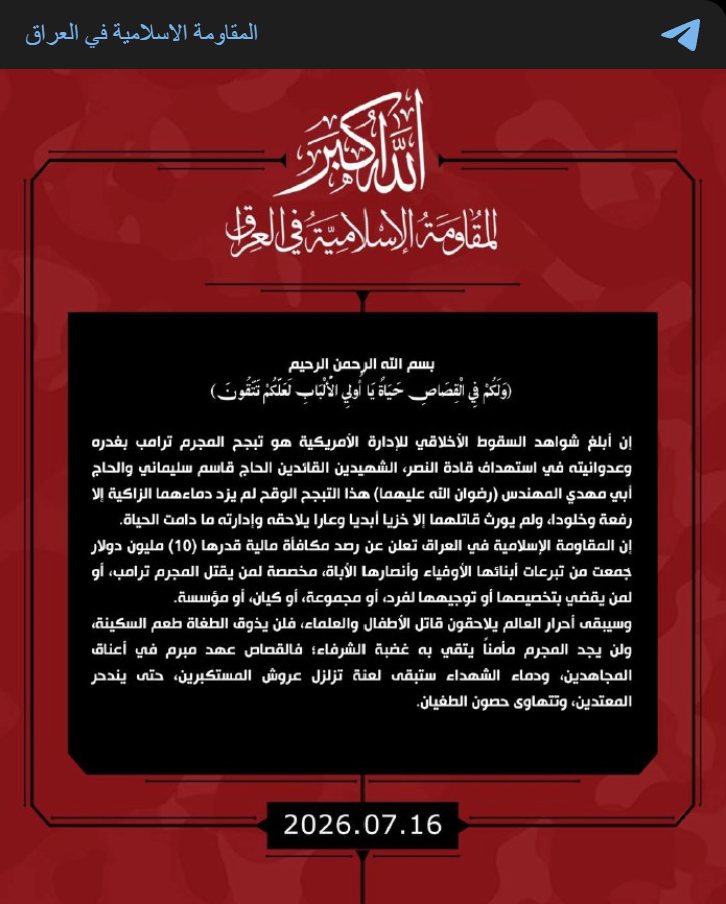
The Islamic Resistance in Iraq’s 16 July offer of a 10 million dollar reward for killing President Trump, published on their Telegram channel. The statement criticizes Trump for boasting about his administration’s role in killing IRGC-QF commander Qassem Soleimani and PMF Chief of Staff Abu Mahdi Al-Muhandis in 2020.
The informal strike pause ended when Iran conducted a surprise ballistic missile attack on US forces in Jordan on 28 July (17). In response, the US and Saudi Arabia carried out unprecedented joint strikes on numerous Iran-backed militia targets across eastern Iraq on 28 July, marking Saudi Arabia’s first public entrance into the war (18). The US also retaliated against Iran directly in renewed strikes on 28 July (19).
Saudi Arabia’s entrance into the conflict marks a new phase in the war, in which a longtime regional rival of Iran becomes an active participant in confronting Iran’s regional influence.
Saudi Arabia’s entrance into the conflict marks a new phase in the war, in which a longtime regional rival of Iran becomes an active participant in confronting Iran’s regional influence.
As US and regional allies enter this new phase, the informal “June Agreement” offering Iraq US investment in exchange for militia disarmament has progressed. In mid-June, Iraqi Prime Minister Ali Al-Zaidi met with US Presidential Envoy for Iraq Tom Barrack, and Barrack reportedly conveyed several US conditions for supporting Al-Zaidi’s government, including disarming the militias, cutting off their funding sources, dismantling their financial networks, and “removing” their leaders (20). Iraqi media has described the outcome of these discussions as the “June Agreement,” in which the US offered investment in Iraq in exchange for Iraq limiting the militias’ influence along the above lines (21).
There are several signs that the Trump Administration approves of Al-Zaidi’s initial progress towards fulfilling Iraq’s conditions under the Agreement. First, the US resumed dollar shipments to Iraq on 2 July (22). The US had halted shipments and paused US funding to some security cooperation programs in April to pressure Iraq to rein in the militias (23). Second, the Trump administration’s rhetoric surrounding Al-Zaidi’s official visit to the US and the parties’ signing of 48 economic agreements. Al-Zaidi arrived in the US on 13 July, met with President Trump on 14 July, and Secretary of Defense Hegseth on 15 July (24). The Trump administration’s positive rhetoric towards Al-Zaidi, and the signing of the economic agreements - the promised “investment” in exchange for disarmament - both indicate the Trump administration approves of Al-Zaidi’s progress under the June Agreement.
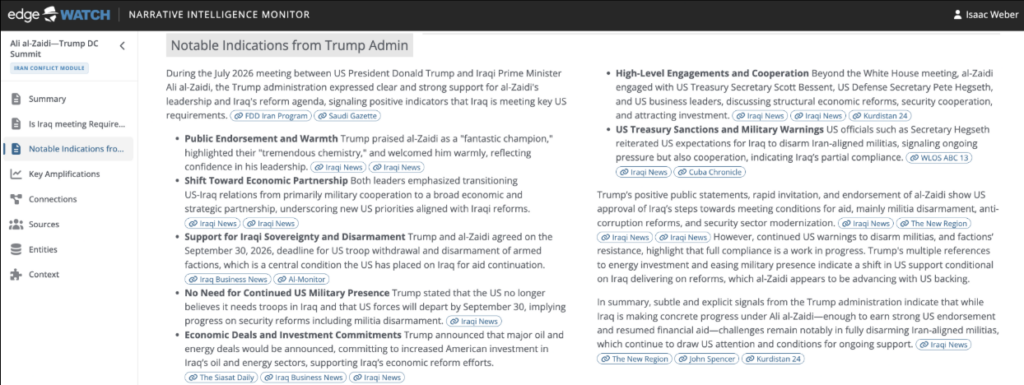
EdgeTheory’s Iraq Module highlighted the Trump administration’s positive rhetoric towards Al-Zaidi, noting that President Trump described him as a “strong and capable partner.” Analysis of the Trump administration’s rhetoric also noted the Administration reiterated that economic cooperation is tied to progress on Iran-backed militias’ disarmament (reflections of the June Agreement).

EdgeTheory performed targeted monitoring over two weeks examining whether Al-Zaidi is meeting the US’ conditions under the Agreement. EdgeTheory found that Al-Zaidi is partially meeting them. He has cracked down on corrupt financing, and some armed factions publicly agreed to disarm. However, as discussed below, the disarmament efforts in particular remain cosmetic thus far. Such progress appears to have been sufficient for the Trump administration to deliver new US investment.
The 48 economic agreements, reportedly collectively valued at over $60 billion, spanned the energy, healthcare, and technological sectors (25).
Al-Zaidi reportedly met with Halliburton, Baker Hughes, Honeywell, and Weatherford representatives to discuss economic partnerships. He also reportedly met KBR, Chevron, ExxonMobil, HKN Energy, GE Vernova, Phontif, Google, Commerce PLC, BP-ConocoPhilips, and JP Morgan representatives as well as the Chief Executive Officers of Starlink and Excelerate Energy.
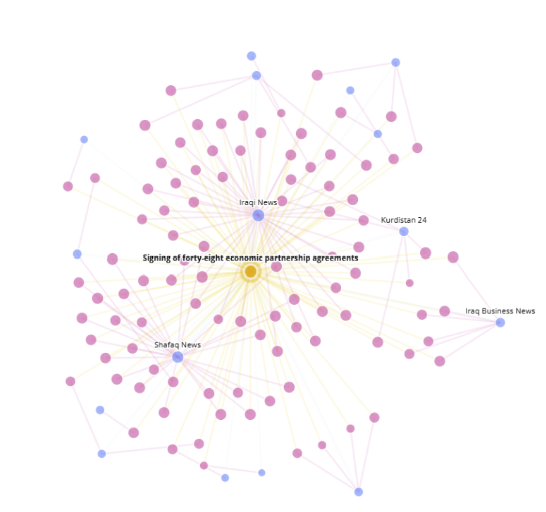
The 48 agreements with the US were heavily covered across various outlets monitored by EdgeTheory.
During the visit, the parties announced plans for the “Energy City” project on Iraq’s Al-Faw Peninsula. Finally, the US and Iraq announced an agreement between the US and Central Bank of Iraq (26). Iraqi media has framed the visit and the Agreement as a turning point in US-Iraq relations that will set the tone for the relationship when the US-led Global Coalition to Defeat ISIS in Iraq’s mission ends in September (27).
Al-Zaidi reportedly met with Halliburton, Baker Hughes, Honeywell, and Weatherford representatives to discuss economic partnerships. He also reportedly met KBR, Chevron, ExxonMobil, HKN Energy, GE Vernova, Phontif, Google, Commerce PLC, BP-ConocoPhilips, and JP Morgan representatives as well as the Chief Executive Officers of Starlink and Excelerate Energy.
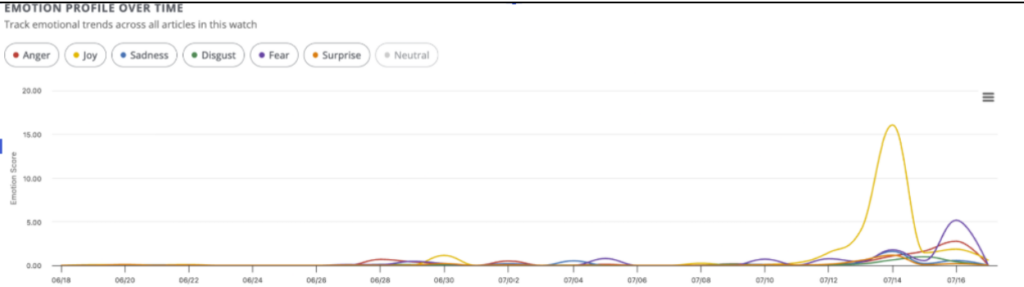
EdgeTheory found narrative items using language evoking joy spiked during Al-Zaidi’s visit to the US. The visit and its outcomes received generally positive coverage.
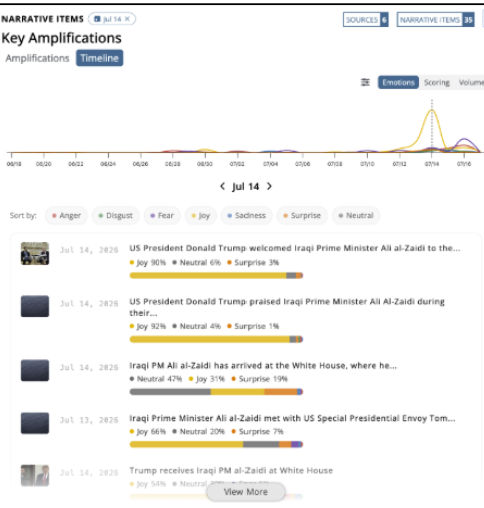
Narrative items specifically covering President Trump’s meeting with Prime Minister Al-Zaidi during the visit contributed significantly to the spike in language evoking “joy.”
The notable spike in language evoking fear two days later was prompted by separate narrative items. First, the Islamic Resistance in Iraq’s 16 July offer of a reward to anyone who kills President Trump. Second, an Al-Ahad video claiming President Trump viewed Al-Zaidi as “politically naive,” and sought to “test” him. The commentators suggest Trump wanted to embarrass Al-Zaidi, but that Al-Zaidi weathered the attempts. Al-Ahad is owned by Asa’ib Ahl Al-Haq.
Despite the Trump administration’s positive reception, Al-Zaidi’s disarmament plans have not yet yielded significant, irreversible results and defer the task of substantive disarmament to after the US’ mission ends. An Iraqi government spokesman stated on 29 June that Al-Zaidi gave the militias a 30 September deadline to disarm, coinciding with the end of the US-led mission in Iraq (28). As mentioned in our previous analysis, two key Iran-backed militias, Asa’ib Ahl Al-Haq and Kata’ib Al-Imam Ali, have publicly announced disarmament as of 28 July (29). Nationalist, populist Shi’a cleric Muqtada Al-Sadr announced his militia Saraya Al-Salam would also disarm on 27 May (30).
Al-Sadr has a longstanding complex relationship with Iran, but is not an Iran proxy figure. Despite these highly publicized announcements, militias are reportedly handing old or inoperable missiles and drones to the government while retaining substantive arsenals including heavy weapons and ballistic missiles, or outright denying they possess such weapons (31).
Al-Sadr has a longstanding complex relationship with Iran, but is not an Iran proxy figure. Despite these highly publicized announcements, militias are reportedly handing old or inoperable missiles and drones to the government while retaining substantive arsenals including heavy weapons and ballistic missiles.
Such denials implicitly challenge the Iraqi government to seize the weapons - a challenge the militias are betting the government will hesitate to act on.
The US laid the initial groundwork for the Al-Zaidi government to fulfill the June Agreement’s requirement for Iraq to cut off the militias’ funding and dismantle their financial networks. The US suspended dollar shipments to Iraq in April to pressure the Iraqi government to rein in the militias, as mentioned above, and intensified pressure on Iran-backed militias’ smuggling networks by imposing new sanctions. In May, the US Treasury Department sanctioned Deputy Oil Minister Ali Ma’arij Al-Bahadli for diverting Iraqi oil for Iran and Asa’ib Ahl Al-Haq’s benefit (32). The Treasury simultaneously sanctioned Asa’ib Ahl Al-Haq economic committee member Mustafa Al-Bahadli (Sayyid Awn) for facilitating AAH’s dominance in Iraq’s metal industry and fuel oil theft and two Kata’ib Sayyid Al-Shuhada officials for collaborating with Hezbollah financiers, purchasing weapons, and providing material support to KSS (33).
Both Deputy Oil Minister Al-Bahadli and Sayyid Awn are reportedly linked to the North Refineries Company and the Baiji Oil Refinery, according to an unnamed oil industry source speaking to Iraqi media (34). These entities provided the basis for Al-Zaidi’s subsequent “Dawn Sweep” crackdown when a Central Criminal Anti-Corruption Court and Integrity Commission investigation into the oil sector identified the North Refineries Company, and specifically Deputy Oil Minister for Refining and North Refineries Director-General Adnan Al-Jumaili, as a target (35). The Central investigation also reportedly concluded Al-Jumaili financed unspecified politicians’ campaigns by awarding them inflated contracts. An FBI team reportedly assisted the Al-Zaidi government’s investigation on-site in Baghdad (36).
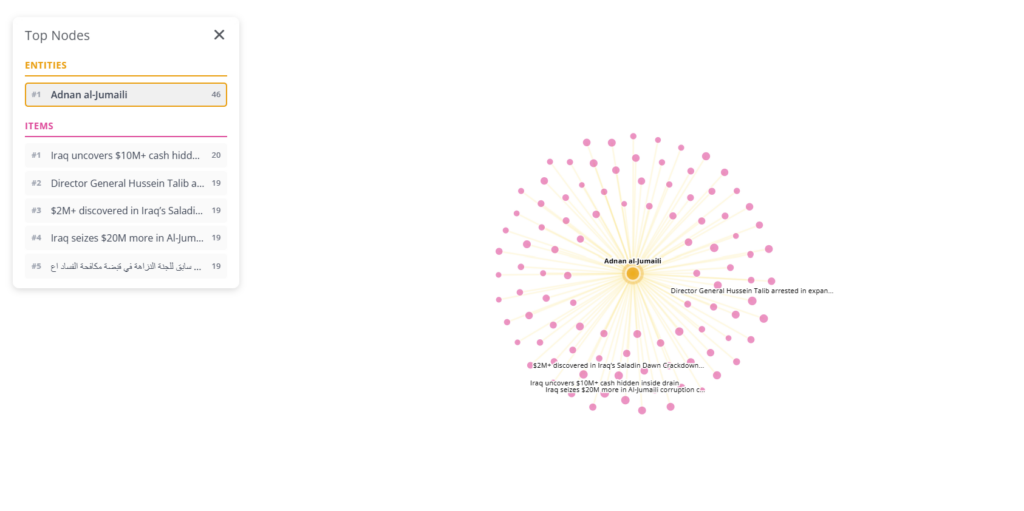
Adnan Al-Jumaili was the top entity covered by EdgeTheory’s monitoring of Al-Zaidi’s corruption crackdown. As we discuss below, Al-Jumaili’s arrest and confession formed the cornerstone of the broader anti-corruption crackdown.
The Iraqi government’s initial arrest of Al-Jumaili was notable, given his influential position and links to Asa’ib Ahl Al-Haq-controlled financial entities. Iraqi security forces and an Integrity Commission team reportedly arrested Al-Jumaili in Salah Al-Din province on 30 May (37). Al-Jumaili’s arrest struck at the heart of an interconnected network of AAH and Iranian smuggling effectuated via the North Oil Refineries Company and Baiji Oil Refinery, which AAH has controlled for years (38). His arrest, and subsequent confessions, formed the cornerstone of the Al-Zaidi government’s broader arrest campaign; after Al-Jumaili’s arrest, Al-Zaidi, President Nizar Amedi, Speaker of Parliament Haibat Al-Halbousi, and Supreme Judicial Council president Faiq Zaydan met on 10 June. Al-Zaidi reportedly requested Al-Halbousi lift the immunity of various MPs under investigation. Al-Halbousi reportedly stated “an agreement was reached” to lift their immunity, without providing details (39).
However, later arrests primarily targeted former Prime Minister Mohammed Shia’ Al-Sudani’s administration, and Sunni politicians. At dawn on 28 June, the Counterterrorism Service (CTS) launched coordinated arrests across Iraq on an unprecedented scale, arresting numerous politicians and senior officials, including in Baghdad’s Green Zone.
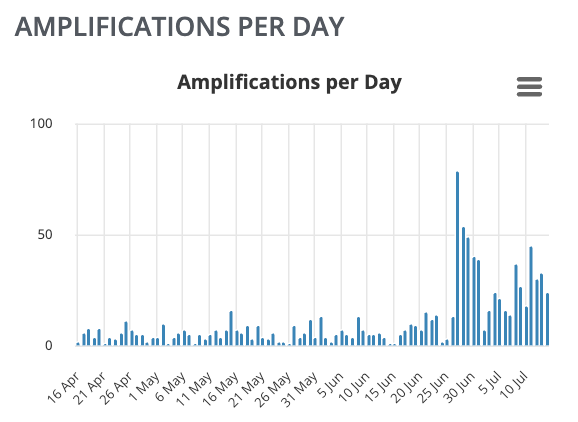
Narrative volume spiked on 28 June, underscoring the widespread nature of the crackdown. Media coverage emphasized the unprecedented nature of the government’s decision to conduct arrests in the Green Zone.
Over 50 politicians were reportedly arrested in the initial wave, with CTS reportedly recovering billions of Iraqi dinars, millions of US dollars, gold, luxury vehicles and other valuables (40).
Al-Zaidi offered to exclude Taqadum from the crackdown, and to target the party’s rivals, in exchange for Speaker Haibat Al-Halbouis’s agreement to lift parliamentarian’s immunity.
EdgeTheory analysis underscores the level of officials targeted in the sweep, including members of parliament, a former Iraqi governor, the director of Iraqi Airways, a tribal chief, and Sunni Azim Alliance leader Muthanna Al-Sammarai.
The arrests targeted numerous officials in Prime Minister Al-Sudani’s Reconstruction and Development coalition, or linked to him personally, including: Reconstruction and Development members Bihaa Al-Nouri, Abdul Rahman Al-Luwaizi, Bushra Al-Qaisi, and Mohammed Sayhoud; Abbas Al-Sudani (the former Prime Minister’s brother), former Prime Minister’s Office head Abdul Karim Al-Sudani, government adviser Sami Al-Sudani, and former prime ministerial senior advisor Ibrahim Al-Sumaidaie (41). Officials also arrested Alia Nassif, a former State of Law coalition member who resigned from State of Law in 2024 and since turned towards Reconstruction and Development (42). Regional media also alleged her son previously worked for Al-Sudani (43).
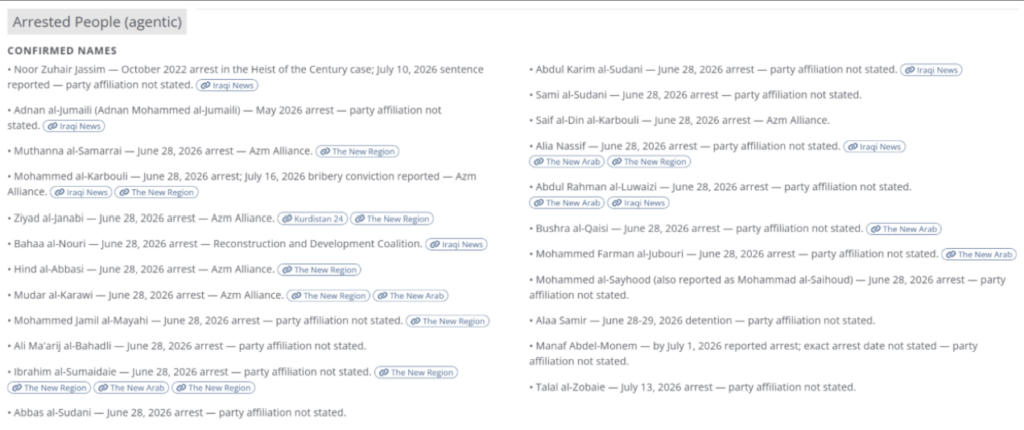
EdgeTheory analysis extracted the names of those arrested from various sources. As shown above, Azim Alliance members were disproportionately represented in the arrests.
The government also arrested numerous Sunni politicians, primarily affiliated with the Azim Alliance, one of Iraq’s main two Sunni parties. Azim Alliance leader Muthanna Al-Samarrai was the highest-profile arrest. Other Azim figures arrested include MP Mohammed Al-Karbouli, Ziyad Al-Janabi, Hind Al-Abbasi, Mudhar Al-Karawi, Azim Alliance office director Saif Al-Din Al-Karbouli, and former Parliamentary Integrity Committee head and Azim member Talal Al-Zobaie (44). The campaign’s focus on Azim is notable given that its primary Sunni competitor, the Taqadum Party, holds significantly more seats in Parliament.
It is possible that Al-Zaidi offered to exclude Taqadum from the crackdown, and to target the party’s rivals, in exchange for Speaker Haibat Al-Halbouis’s agreement to lift parliamentarian’s immunity. Al-Halbousi is a Taqadum member.
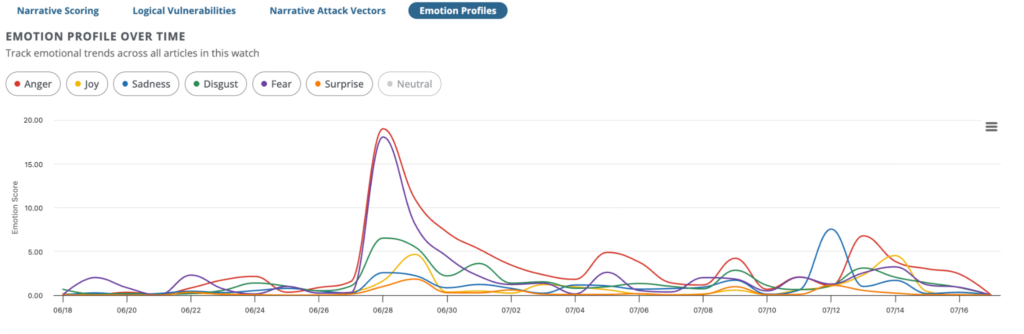
Among the Iraq sources monitored by EdgeTheory, language evoking anger and fear spiked in conjunction with the Dawn Sweep. Language evoking disgust spiked during the same time frame. The language evoking anger and disgust likely reflects the public perception of entrenched corruption as a longstanding issue in the Iraqi government. The language evoking fear could also reflect politicians’ criticism of the campaign.
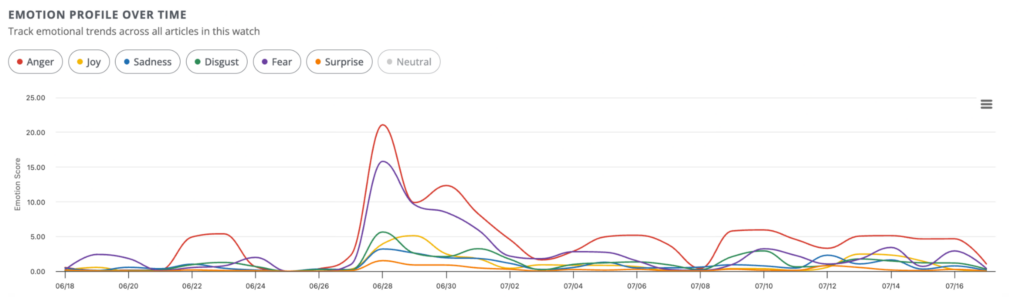
Similar to the Iraq module sources, Iran module sources monitored by EdgeTheory showed a spike in language evoking anger and fear following the Dawn Sweep. It is possible that this could reflect coordinated media behavior as Iran likely does not support the crackdown.
...the Al-Zaidi government’s limited arrests of militia figures can be interpreted as a warning communicating the possibility of higher-level or more widespread arrests should the militias fail to disarm.
Beyond the AAH-linked figures targeted at the start of the campaign, the government has conducted limited arrests of officials linked to other Iran-backed militias. As mentioned above, the sanctioning and subsequent arrests of Deputy Oil Minister Al-Bahadli and Deputy Oil Minister for Refining and North Refineries Director-General Al-Jumaili delivered AAH’s and Iran’s oil smuggling network a notable blow. EdgeTheory was unable to confirm whether the AAH economic committee member sanctioned by the US, Sayyid Awn, is currently in custody.
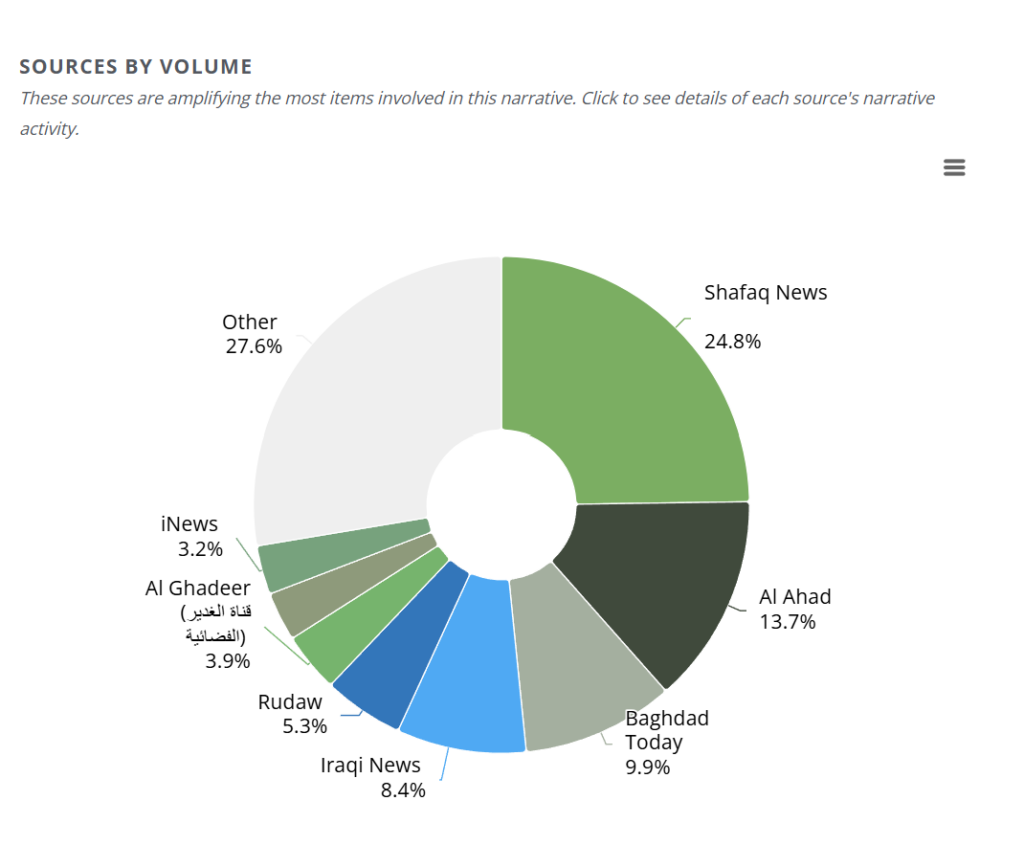
It is unsurprising that Al-Ahad constituted a significant proportion of coverage discussing the Dawn Sweep. As mentioned above, Al-Jumaili was linked to AAH financiers via the North Refineries Company.
Beyond AAH, Hoquq Movement leader Hussein Munis reportedly fled the country before he could be arrested in late June (45). The Hoquq Movement is the political wing of Kata’ib Hezbollah. The incident prompted Kata’ib Sayyid Al-Shuhada Kadhim Al-Fartousi to criticize Al-Zaidi, the Coordinating Framework, and the judiciary in an angry 13 July television appearance (46). Al-Fartousi accused the government of “fighting corruption selectively” and compared Al-Zaidi to former Prime Minister Mustafa Al-Kadhimi, whom Iran backed militias vehemently opposed and attempted to assassinate in November 2021 (47). The Iraqi government later reportedly raided farms linked to former Labor Minister and Kata’bi Jund Al-Imam leader Ahmad Al-Asadi and Kata’ib Al-Imam Ali and Khadamat Alliance leader Shibl Al-Zaidi in Baghdad’s Zaafraniya neighborhood on 19 July (48). Al-Asadi denied he was wanted by the judiciary on 20 July, and stated he was out of the country for medical treatment (49). The government also arrested former Wasit Governor Mohammed Jamil Al-Mayahi, a former Wisdom Trend member who is reportedly close to AAH, and Manaf Abdul Munim, the director-general of Iraqi Airways (50). Monem’s exact political affiliations are not clear from publicly available reporting. While the militia-linked investigations are significant, Iran-backed militias and their affiliated parties emerged from the Dawn Sweep and its aftermath largely unscathed.
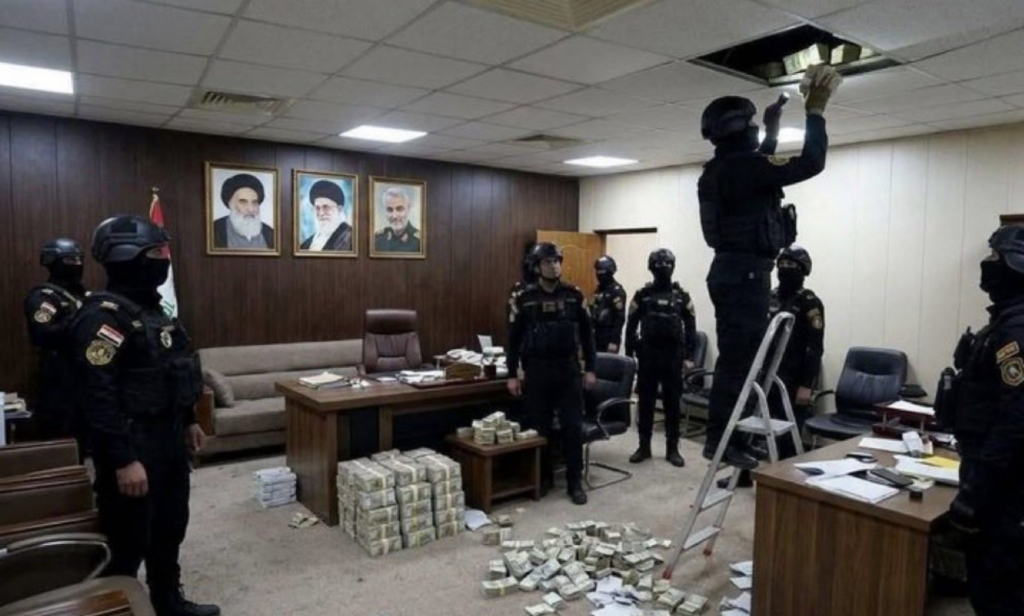
Iraqi security forces recovering cash from an unspecified political parties’ office during the crackdown. Unverified social media accounts claimed the office belonged to Munis. The portraits displayed in the office include (from right to left) Grand Ayatollah Ali Al-Sistani, former Iranian Supreme Leader Ali Khamenei, and former IRGC-QF commander Qassem Soleimani.
Still, Iran-backed militias likely interpret the arrests as a warning from the Al-Zaidi government ahead of the 30 September disarmament deadline. Iraqi media, citing a Sunni politician, claimed the Al-Zaidi government will use the anti-corruption campaign to target militias who refuse to disarm after the September 30 deadline (51).
In this light, the Al-Zaidi government’s limited arrests of militia figures can be interpreted as a warning communicating the possibility of higher-level or more widespread arrests should the militias fail to disarm.
In our previous assessment we noted Al-Zaidi threatened the factions with “legal and military prosecution” - not military confrontation - if they fail to disarm by the deadline (52). The government likely favors prosecutions over direct seizure of weapons as an enforcement mechanism because direct seizure would risk open confrontation between government and militia forces.
To prepare, powerful Shi’a parties, including militia-linked parties, are publicly supporting the crackdown while privately seeking to cut deals with the government or to constrain Al-Zaidi’s efforts. The Coordinating Framework announced its endorsement of the campaign on 30 June (53). The Sadiqoun Movement, the political wing of Asa’ib Ahl Al-Haq, announced its support on 9 July, despite the major role of AAH-linked arrests like Jumaili’s in fueling the arrest campaign (54). The Sadiqoun Movement is part of the Coordinating Framework. Meanwhile, regional media claimed the corruption crackdown caused “disputes” between the government and Coordinating Framework leaders on 7 July. The Coordinating Framework appears to be confronting them by negotiating with the government or influencing the investigation process. Initial reports suggest the government may be open to negotiation. The same outlet claimed the government is creating a “settlement mechanism” with specific unspecified officials, in which officials may avoid prosecution by returning embezzled funds (55). The Supreme Judicial Council announced it would work with Al-Zaidi to reduce sentences for individuals who voluntarily return stolen funds (56). The Coordinating Framework also reportedly seeks to “engineer” the prosecution procedures against specific figures (57). Meanwhile, political forces appear to be attempting to constrain the scope of Al-Zaidi’s campaign. Iraqi media claimed an “unwritten agreement” to prevent corruption investigations into former prime ministers, senior leaders, or other “fathers of the political process” exists between unspecified political forces (almost certainly including the CF) and the government. These political forces reportedly “frustrated” Al-Zaidi by instructing him to keep the campaign focused on the Ministry of Oil. Iraqi media further suggested Al-Zaidi risks removal from office (potentially via a vote of no confidence), or assassination (58). The outlet added that Al-Zaidi’s 23 July trip to Iran “shattered” his remaining hopes of the corruption campaign reaching truly high-level officials (59).
The militias are highly unlikely to disarm and integrate into the government by 30 September. This could force Al-Zaidi to choose between a risky showdown with the militias, or abandoning Iraq’s June Agreement obligations. In June, Al-Zaidi opened the door to integrating 35,000 militia personnel into Iraqi security and military institutions, including the Counterterrorism Service, as discussed in previous assessments (60). This arrangement contains some clear benefits for the militias, like expanded access to government funds, access to influential positions, and further entrenchment of their (and Iran’s) influence in the state. However, multiple powerful militias have repeatedly refused to disarm (61). Furthermore, on 26 June, Al-Zaidi merged the Joint Operations Command, Office of the Commander-in-Chief’s Personal Secretary, and National Operations Center into a single Office of the Commander in Chief of the Armed Forces, which has not existed since 2014 (62). This merger likely makes government integration less appealing to the militias because it centralizes Al-Zaidi’s authority over the institutions into which they could integrate. The Office will reportedly oversee the Ministry of Defense, Interior, the Counterterrorism Service, the intelligence and national security service, the Popular Mobilization Forces, border crossings, and military manufacturing (63). Then-prime minister Nouri Al-Maliki established the Office during his tenure to exert personal influence over Iraq’s military and to consolidate authoritarian control over the armed forces (64). While Al-Zaidi may not push the office’s constitutional limitations as Al-Maliki did, this history may make the militias especially. Meanwhile, the Coordinating Framework reportedly “refuses to confront” the militias to pressure them to disarm by the deadline (65).
This leaves Al-Zaidi with a dangerous choice after 30 September: confront the militias (legally or militarily), or capitulate. Confrontation would be risky. The militias and their affiliated parties are wary of the possibility of prosecution in the corruption probe, and may seek to remove Al-Zaidi or target him if his government opens investigations into militia leaders. Military confrontation would be even more risky. The militias are well-armed and would pose a significant threat. Iran could also intervene by centrally coordinating the militias’ response to any widespread government seizure attempt. Capitulation would also be dangerous, however. Numerous Iraqi prime ministers have previously sought to bring the militias under the government’s purview, with limited success (66). The Al-Zaidi government failing to enforce disarmament after the deadline would confirm to the militias and to the Iraqi public that the government is unwilling (or unable) to enforce its monopoly on the use of force. It would also call Iraq’s fulfillment of its responsibilities under the June Agreement into question, thereby risking US dollar flows and investment in Iraq. If Al-Zaidi capitulates, the militias will continue wielding weapons against Iraq, regional countries, and US personnel on Iran’s behalf, without the benefit of US funding and (potentially) without the benefit of a formal US force presence.
Regardless of what Al-Zaidi chooses, his anti-corruption campaign and moves towards disarmament take on a greater significance in the context of the war with Iran. Unlike past prime ministers’ efforts to rein in Iran and the militias, Al-Zaidi’s efforts are occurring within an intensified push by the US and regional allies to disarm Iran’s proxies and to shift regional power away from Iran. The US is pursuing initial steps to disarm key Iran proxy Hezbollah via the US-Israeli-Lebanese Trilateral Framework Agreement (67). The Trump Administration announced an agreement with Hamas to disarm on 30 July, which the IRGC reportedly discouraged Hamas from accepting (68). The US signed a nuclear agreement with Saudi Arabia on 22 June (69). Saudi Arabia entered the war by conducting joint strikes with the US on Iran-backed Iraqi militias on 28 July, after Bahrain and Kuwait reportedly covertly struck Iran in July (70). Meanwhile, the US and allies are building contingencies and safeguards to loosen Iran and its proxies’ hold on the region’s energy supply. Regional media has described US Presidential Envoy Tom Barrack as “reshaping” the regional power balance by forging agreements between Iraq and Syria to open oil routes that do not depend on the Hormuz Strait (71). Saudi Arabia proposed a multinational maritime defense coalition to protect shipping in the Red Sea on 30 July, likely to constrain the Houthis’ ability to threaten the global energy supply in the Sea and the Bab Al-Mandeb Strait (72). Several regional Sunni-majority countries reportedly support the coalition (73).
The militias and Iran may instead contextualize his efforts, even if they are unsuccessful, as part of an unprecedented, even existential threat in which its proxies and allies face disarmament, emboldened Sunni neighbors actively combat Iran alongside the US, and in which Iraq’s particular role as a financial and paramilitary haven is shrinking.
Al-Zaidi’s moves are therefore more than revivals of previous governments’ efforts to roll back militia influence. The militias and Iran may instead contextualize his efforts, even if they are unsuccessful, as part of an unprecedented, even existential threat in which its proxies and allies face disarmament, emboldened Sunni neighbors actively combat Iran alongside the US, and in which Iraq’s particular role as a financial and paramilitary haven is shrinking.
The US must therefore be wary that the conflict is entering uncharted territory on both sides. And Iraq, not Iran, could become the epicenter of a wider regional conflict between the US and its allies, and Iran and its proxies.
References:

