EdgeTheory / Reputational Risk Intelligence
Reputational threats often develop long before they become public controversies. They emerge as influential sources introduce, repeat, and amplify narratives that begin changing how customers, investors, employees, and other stakeholders perceive an organization.
A customer complaint can become a broader question about product quality. An executive statement may raise concerns about leadership judgment. A supplier controversy can introduce doubts about corporate values. Over time, seemingly separate concerns may reinforce one another, creating a larger reputational problem that is difficult to recognize through traditional monitoring alone.
EdgeTheory delivers Narrative Intelligence that enables organizations to identify emerging reputational concerns, analyze the sources driving them, and assess which narratives present strategic business risks. Our source-centered approach provides decision-ready intelligence to help leadership understand developing threats to stakeholder trust and determine where attention or action may be warranted.
Reputational risk is the possibility that stakeholder perceptions of a company, its products, or its leadership will negatively affect its value, relationships, or ability to operate. It can arise from business decisions, operational failures, product concerns, executive conduct, employee experiences, or external controversies.
Yet reputational damage is not determined solely by what happens. It is also shaped by how events are interpreted, discussed, and understood. A company may resolve a product problem while questions about its reliability continue to circulate. An allegation may prove inaccurate but still influence public confidence. In both cases, the narrative can outlast the event that created it.
Effective reputational risk management therefore requires more than tracking negative coverage or measuring sentiment. Organizations need to understand the claims gaining credibility, the sources influencing those conversations, and whether developing perceptions could affect important business relationships or decisions.
In both cases, the narrative can outlast the event that created it.
For many organizations, reputational risk becomes apparent when negative coverage increases, a story attracts mainstream attention, or stakeholders begin asking difficult questions. By that point, however, the underlying narrative may have been developing for weeks or months.
An issue may first appear in an industry publication, specialized forum, employee discussion, or small network of influential accounts. As additional sources repeat, reinterpret, or connect the concern to other issues, it can gain credibility and reach audiences beyond the original conversation.
These changes are not always reflected in a dramatic increase in mentions. A narrative may become more influential because credible sources adopt it, new communities begin discussing it, or previously unrelated events reinforce the same perception. Understanding these developments requires examining the relationships between sources, content, and narratives over time.
By that point, however, the underlying narrative may have been developing for weeks or months.
Not every negative conversation represents a meaningful threat to corporate reputation. An isolated complaint, a temporary controversy, and a persistent narrative questioning an organization's integrity may all attract attention, but their potential business consequences can be very different.
EdgeTheory helps organizations examine five dimensions that provide a more complete understanding of developing reputational risks.
The influence of a narrative depends partly on the sources carrying it.
A concern raised by a recognized industry analyst, credible journalist, influential customer, or trusted community voice may carry different implications than the same concern appearing among a handful of low-influence accounts.
EdgeTheory identifies the sources publishing and amplifying narratives, helping analysts understand who is shaping the conversation, how those sources are connected, and which voices may be contributing to its credibility.
Reputational concerns can gain influence as they move between sources, communities, and audiences.
An issue that begins in a specialized discussion may become more consequential when it reaches industry publications, broader media coverage, or conversations involving investors and customers.
EdgeTheory helps identify patterns of amplification, recurring claims, changes in source activity, and characteristics that may indicate coordinated promotion.
Reputational narratives often carry emotional signals that influence how issues are framed and understood.
Fear surrounding product safety, anger over perceived misconduct, or frustration with leadership decisions can contribute to broader concerns about an organization's credibility and trustworthiness.
EdgeTheory's Emotions Profile analyzes the emotional composition of narrative content, identifying patterns of fear, anger, sadness, disgust, joy, surprise, and neutral tone. Analysts can examine how these patterns change over time and explore the underlying narrative items and sources contributing to them. This provides a more detailed understanding of the emotional framing surrounding an emerging reputational concern.
Some controversies generate intense attention and disappear quickly.
Others persist, resurface after new events, or become associated with an organization's broader reputation. A narrative questioning product reliability, for example, may reappear whenever another product issue occurs, even when the underlying events are unrelated.
Tracking narratives over time helps organizations distinguish temporary attention from recurring concerns that could gradually weaken trust.
A narrative becomes strategically important when it has the potential to influence decisions that matter to the business.
Concerns about corporate integrity may affect customer confidence, while questions about leadership credibility may influence investors, employees, business partners, or regulators.
Connecting narrative activity to potential business consequences helps organizations determine which developments deserve attention, which require further assessment, and which should continue to be monitored.
The objective is not to treat every negative conversation as a threat. It is to understand which narratives matter, why they matter, and how their development could affect the organization.
EdgeTheory delivers decision-ready Narrative Intelligence through a source-centered approach to understanding the information environment. Rather than relying exclusively on keywords, mentions, or sentiment, the platform organizes intelligence around relevant sources, identifies related narratives across content, and examines how those narratives develop over time.
This approach helps organizations move beyond observing conversations to understanding the forces shaping them.
See what is forming before it becomes a headline.
EdgeTheory establishes persistent monitoring of relevant sources surrounding your organization, executives, products, competitors, and priority business issues. These sources may include media outlets, websites, social media accounts, forums, organizations, and other public information channels.
AI-assisted source discovery helps identify additional relevant sources and connected accounts, while semantic analysis connects related claims and themes even when different sources use different language. As new information becomes available, organizations maintain an updated view of developing conversations and emerging concerns that might otherwise remain fragmented across multiple monitoring tools.
Evaluate the development, influence, and significance of emerging risks.
Detecting a narrative is only the beginning. Effective reputational risk management requires understanding how that narrative is changing, which sources are advancing it, and what its development could mean for the organization.
EdgeTheory helps analysts examine recurring claims, source influence, amplification patterns, emotional profiling, narrative momentum, and historical context. Its Emotions Profile adds insight into the emotional characteristics of individual narrative items and how those patterns change over time. Analysts can investigate the underlying content and sources to better understand the narratives contributing to a particular trend.
Together, these capabilities provide a basis for distinguishing routine discussion from developments that may warrant closer investigation or executive attention. The analysis can be organized into intelligence assessments and executive summaries tailored to the questions leadership needs answered.
Respond with a clearer understanding of the narrative environment.
Once an organization understands a developing narrative, it can make better-informed decisions about whether to monitor, engage, clarify, correct, or escalate. Some situations call for immediate attention, while others require additional investigation or continued observation.
EdgeTheory supports communications and leadership teams by providing context about the claims, sources, and persuasive characteristics shaping the conversation. AI-assisted message drafting can help develop communications aligned with organizational positions, objectives, and audiences.
Continued analysis allows teams to evaluate how the narrative environment changes following organizational action.
Reputational risk management is an ongoing process of identifying potential threats, assessing their significance, prioritizing responses, and monitoring how conditions change. It requires coordination across corporate communications, marketing, investor relations, public affairs, risk management, and executive leadership.
Narrative Intelligence strengthens that process by providing a connected view of the external conversations influencing stakeholder perceptions. Rather than evaluating isolated mentions or incidents, organizations can examine how related claims develop across sources, whether they are gaining influence, and how they connect to broader concerns about the business.
This helps teams establish a more consistent basis for reputational risk assessment, communicate emerging issues to leadership, and make decisions informed by the changing narrative environment.
EdgeTheory's Emotions Profile analyzes the emotional composition of narrative content, identifying patterns of fear, anger, sadness, disgust, joy, surprise, and neutral tone.
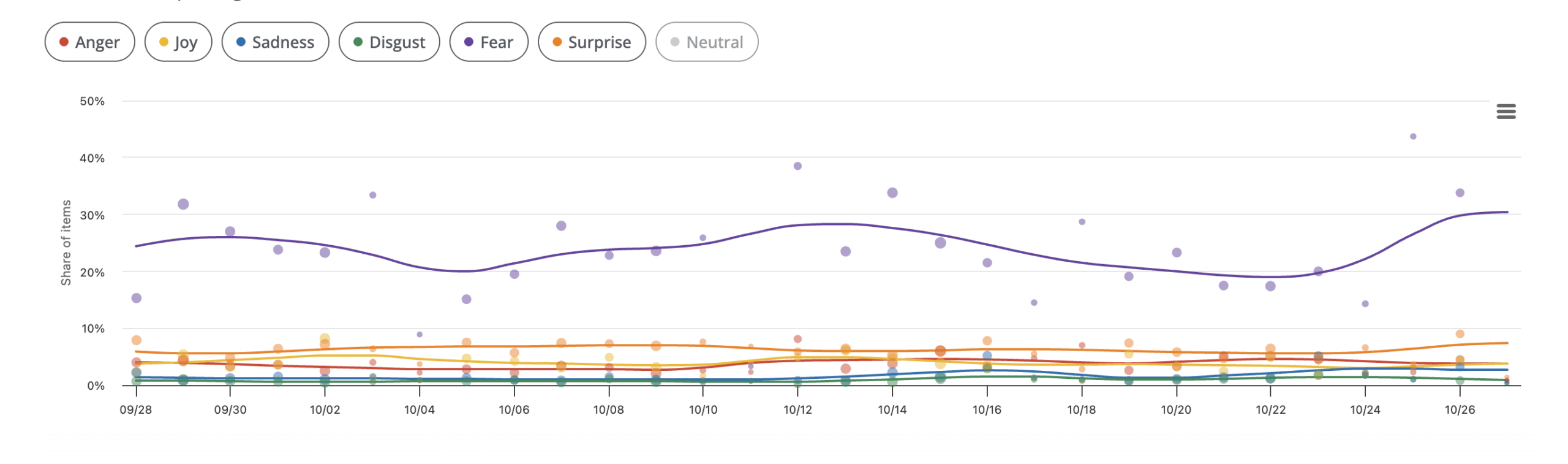

Analysts can examine how these patterns change over time and explore the underlying narrative items and sources contributing to them.
Traditional reputation monitoring provides valuable information about media coverage, mentions, conversation volume, and sentiment. These signals help organizations understand what people are saying, where conversations are occurring, and when attention is increasing.
Narrative Intelligence adds context by examining the sources, claims, relationships, and developments behind those signals.
The two approaches are complementary. Reputation monitoring provides visibility into activity, while Narrative Intelligence helps explain what is driving that activity, how it is developing, and why it could matter to the business.
Reputational risk is not confined to corporate communications. It can affect customer relationships, investor confidence, workforce stability, strategic partnerships, and an organization's ability to operate. EdgeTheory helps teams examine developing narratives across multiple areas of the business.
Understand narratives concerning corporate integrity, transparency, business practices, organizational values, and public confidence. Identify when individual concerns begin developing into broader perceptions of the company.
Examine narratives surrounding senior leadership, executive conduct, public statements, major announcements, and leadership transitions. Dedicated source monitoring helps executive communications teams understand emerging concerns and assess how leadership narratives evolve.
Identify when recurring product or service concerns develop into broader questions about safety, reliability, performance, or organizational competence. Understand whether those concerns are spreading beyond their original sources.
Examine external narratives involving workplace practices, organizational culture, employee experiences, labor relations, and leadership decisions. Understand when these conversations begin influencing perceptions among prospective employees, customers, investors, and the public.
Understand how controversies involving suppliers, distributors, partners, and other associated organizations may create reputational exposure through questions about corporate judgment, oversight, or values.
Track narratives involving competitors, industry controversies, regulatory developments, and changing stakeholder expectations. Comparing related conversations across organizations helps identify shared vulnerabilities and emerging reputational concerns.
A connected view of these conversations helps organizations recognize when seemingly separate issues are reinforcing a broader perception of the business.
Not every reputational concern becomes a crisis. But many crises involve narratives that have been developing before the situation attracts widespread attention. A product complaint may become a safety controversy, an employee allegation may raise broader questions about corporate culture, or a leadership decision may develop into a debate about organizational integrity.
Reputation Risk Intelligence helps organizations identify and assess these developing concerns while they are still taking shape.
When a situation escalates, EdgeTheory's Issues and Crisis Intelligence capabilities help teams understand how narratives are evolving, which sources are influencing the conversation, and how the information environment is changing.
For broader external threats affecting markets, operations, supply chains, and business relationships, EdgeTheory's Risk Intelligence provides additional context.
Together, these capabilities support a more continuous understanding of the external narratives influencing an organization.
Reputational risk can arise from corporate decisions, product problems, operational failures, executive conduct, employee experiences, business relationships, or external controversies. Its consequences depend partly on how stakeholders interpret those events and how related narratives develop across influential sources.
Effective reputational risk management involves identifying emerging concerns, assessing their potential consequences, determining appropriate responses, and monitoring how conditions change. Narrative Intelligence supports this process by helping organizations understand developing narratives, influential sources, amplification patterns, and potential business implications.
Reputation monitoring typically tracks mentions, media coverage, conversation volume, and sentiment. Reputation Risk Intelligence adds analysis of the narratives behind those signals, including source influence, recurring claims, historical context, narrative development, and potential business consequences.
Some reputational risks can be identified while the underlying narratives are still developing. Monitoring and analyzing relevant sources may reveal emerging concerns before they attract widespread attention. Not every crisis produces detectable early signals, however, and early identification does not guarantee that escalation can be prevented.
Narrative Intelligence helps organizations identify and examine conversations surrounding CEOs and senior executives. It provides visibility into recurring claims, influential sources, emerging concerns, and changes in how leadership is portrayed, supporting preparation for major announcements, leadership transitions, and other high-visibility events.
Some narratives continue influencing perceptions long after the original event has passed. They may resurface when new developments occur or reinforce existing concerns about an organization. Understanding narrative persistence helps distinguish temporary attention from issues that could have longer-term reputational consequences.
Traditional social listening emphasizes mentions, engagement, keywords, and sentiment. EdgeTheory uses a source-centered Narrative Intelligence approach to identify related narratives, analyze source activity, examine amplification and persuasive characteristics, and provide contextual intelligence to support business decisions.
Your reputation is shaped every day by conversations taking place across sources, communities, and stakeholder networks you do not control.
EdgeTheory helps you understand the narratives behind those conversations, identify emerging reputational risks, and assess how changing perceptions could affect your business.
Move beyond monitoring reputation to understanding the forces that shape it.


