Menu
Meta has become one of the world's most influential technology companies—and one of its most scrutinized. As the parent company of Facebook, Instagram, WhatsApp, and Threads, its decisions increasingly shape conversations about privacy, artificial intelligence, misinformation, corporate power, and public trust.
But reputations are rarely defined by a single event.
Using EdgeTheory's C2 Narrative Intelligence Platform, this report analyzes thousands of news articles and online conversations to uncover the five narrative ecosystems shaping Meta's public reputation—and introduces Narrative Convergence, EdgeTheory's Narrative Intelligence framework for understanding how independent conversations reinforce one another and evolve into lasting institutional beliefs.
What You'll Learn
- Why Meta's reputation extends beyond individual controversies.
- How five narrative ecosystems converge to shape institutional trust.
- Why fear and anger consistently reinforce reputational risk.
- How Artificial Intelligence amplifies existing trust narratives.
- Why Narrative Intelligence provides earlier warning than traditional media monitoring.
- How organizations can identify emerging narrative risks before they become strategic challenges.
Download the Report
This report examines the five converging narrative ecosystems shaping Meta's public reputation, drawn from EdgeTheory's C2 Narrative Intelligence Platform.
| Most Important Insight |
| Meta's harshest critics are frequently insiders and mainstream business press, not fringe voices — its own employees have filed AI-related lawsuits and regulators and journalists across the political spectrum are converging on the same concerns. That gives the criticism unusual credibility and staying power. |
| Primary Risk |
| Five distinct narrative ecosystems — Privacy & Surveillance, Social Harm, Political Influence, Corporate Power, and Artificial Intelligence — are converging into a single, self-reinforcing question about institutional trust. |
| Why It Matters |
| Convergence compounds reputational risk. Once audiences link disparate stories into one narrative, resolving any single issue no longer improves perception — the underlying story remains intact and simply absorbs the next headline. |
| What Narrative Intelligence Reveals |
| Convergence compounds reputational risk. Once audiences link disparate stories into one narrative, resolving any single issue no longer improves perception — the underlying story remains intact and simply absorbs the next headline. |
| Strategic Lesson |
| Organizations that map their own narrative ecosystems before they converge can intervene while individual issues are still separable — before they harden into a single, durable master narrative about trust. |
Meta has become one of the most influential companies in the modern information environment. As the parent company of Facebook, Instagram, Threads, WhatsApp, and an expanding portfolio of artificial intelligence technologies, its platforms shape how billions of people communicate, consume information, conduct business, and engage in public discourse. That influence has also made it one of the world's most scrutinized organizations. Virtually every major societal debate — privacy, artificial intelligence, elections, youth mental health, misinformation, corporate power — has, at some point, centered on the company.
Most organizations experience reputational challenges through isolated events. Meta illustrates a different phenomenon: individual controversies rarely stay isolated. They accumulate into interconnected narratives that reinforce one another, shaping how future events are interpreted regardless of their individual circumstances.
This report examines five dominant narrative ecosystems that collectively shape Meta's public reputation:
Each represents a distinct area of public discussion. Together, they converge around a single, enduring question: can an organization with technological influence also be trusted to exercise that influence responsibly? That convergence is the defining characteristic of Meta's current reputation — and, across nearly every ecosystem examined, two emotions consistently drive it: fear and anger.
This report matters beyond Meta. Every organization develops narrative ecosystems, and every organization is judged less on isolated events than on the interconnected story those events add up to. Reputation cannot be managed effectively by responding to headlines one at a time; it requires understanding the narrative environment those headlines are interpreted within. Executives who recognize these patterns early are positioned to intervene before individual issues harden into a single, durable belief about the organization.
AN EDGETHEORY PERSPECTIVE
Meta's greatest reputational challenge is not any single controversy. It is the convergence of five narrative ecosystems into one question: can extraordinary influence be trusted?
This report explains how that convergence happens — and what it means for any organization operating at scale.
Information now moves continuously across a global network of news organizations, digital publishers, social platforms, policymakers, and independent creators. Individual stories rarely stay isolated — they spread across audiences, accumulate emotional resonance, and influence how future events are interpreted. For organizations operating at global scale, these dynamics have become as strategically significant as financial performance or regulatory compliance.
Few organizations illustrate this more clearly than Meta. The company is simultaneously a technology developer, advertising platform, media company, communications provider, and AI innovator whose platforms connect billions of users. Decisions involving privacy, AI, content moderation, advertising, and election integrity routinely become subjects of international debate, evaluated simultaneously through technological, political, ethical, economic, and cultural lenses.
This breadth is what makes Meta distinctive. Unlike organizations associated with a narrow set of reputational issues, Meta is routinely drawn into discussions spanning privacy, youth mental health, election integrity, misinformation, competition policy, and national security — conversations that originate from governments, regulators, journalists, advocacy groups, investors, and ordinary users alike. Technological decisions frequently become public policy debates: an algorithm change becomes a political-influence story; a new AI capability revives privacy concerns; a moderation policy becomes a free-expression fight. These issues begin as separate conversations, but they consistently reinforce one another.
This report applies EdgeTheory's Narrative Intelligence methodology to identify the ecosystems driving that reinforcement — Privacy & Surveillance, Social Harm, Political Influence, Corporate Power, and Artificial Intelligence & Emerging Technologies — and to trace how they converge into a single narrative about institutional trust.
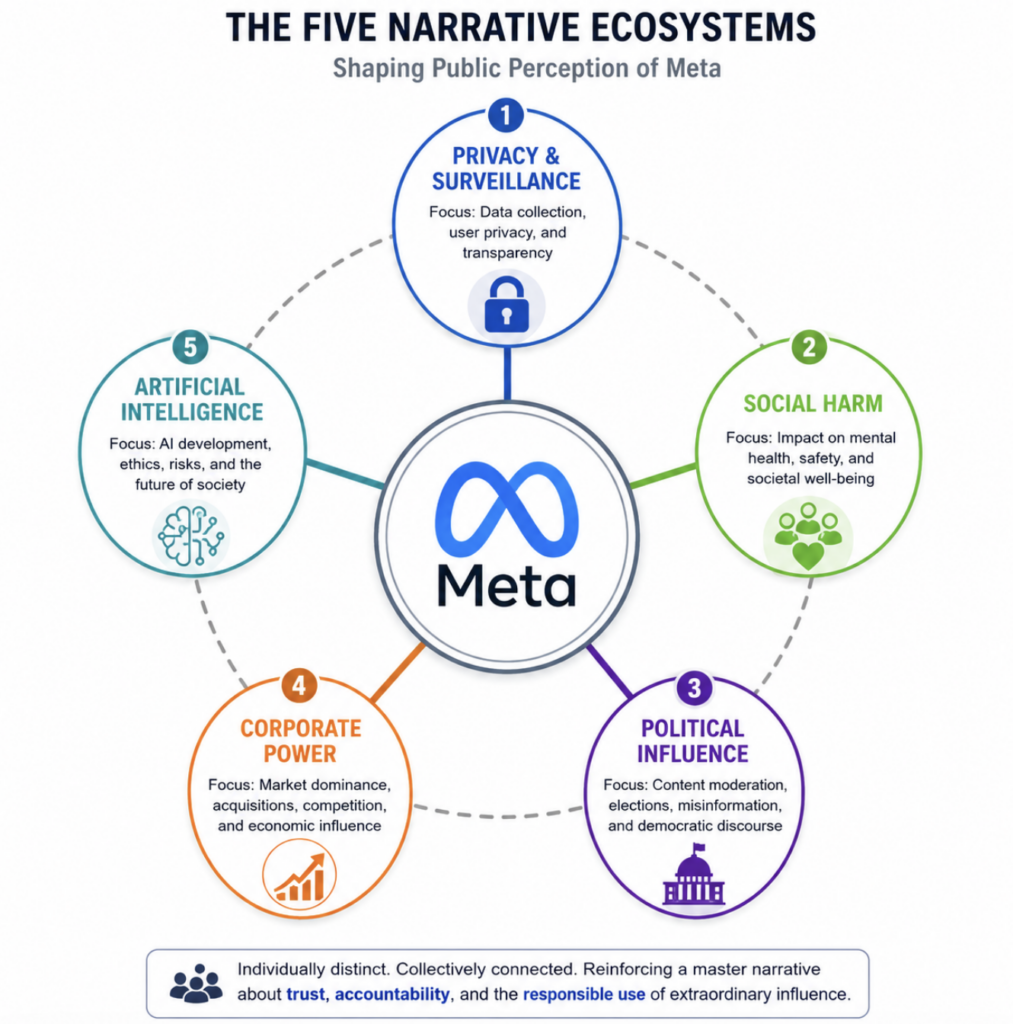
Figure 1. EdgeTheory's narrative ecosystem map for Meta-themed narratives.
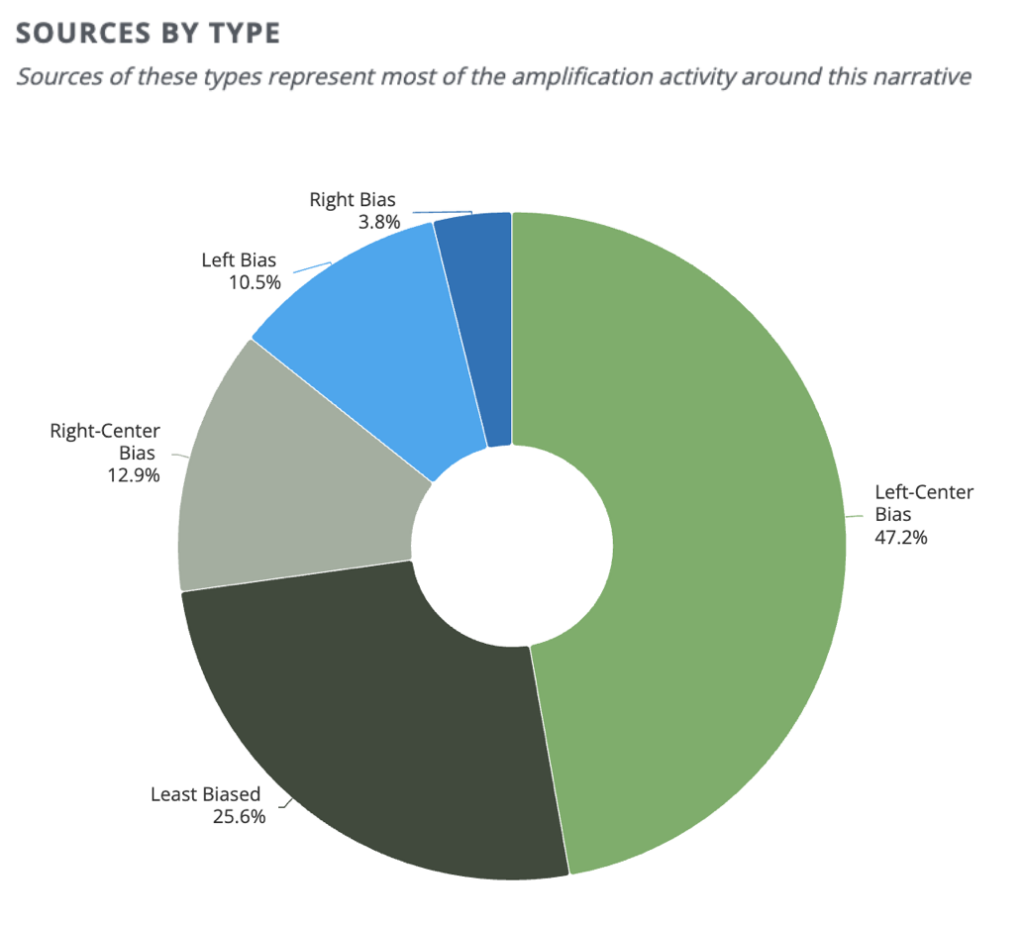
Figure 2. Political orientation of publications discussing Meta, July 13–28, 2026.
During the period analyzed, left-center media outlets contributed nearly half (47.2%) of all Meta-related publications — evidence that Meta's reputation is shaped by ideologically diverse audiences that, despite their differences, converge on the same underlying concerns about transparency and accountability.
The findings in this report are derived from content collected and analyzed through EdgeTheory's C2 Narrative Intelligence Platform, which continuously aggregates news, business publications, digital media, blogs, forums, and social media to identify emerging narratives and measure how discussions evolve, spread, and reinforce one another.
Unlike traditional monitoring, which measures mentions or sentiment, C2 also performs emotional profiling: analyzing thousands of publications to identify which emotions dominate a narrative, how those emotions shift over time, and which stories are most likely to sustain long-term engagement. That emotional layer explains why some narratives fade quickly while others persist for months — insight that raw volume or sentiment scores alone cannot provide.

Figure 3. Distribution of Meta-related content by publication type, July 13–28, 2026.
Business and investment publications — led by The Motley Fool and 24/7 Wall Street — generated the greatest volume of coverage during the analysis period, reflecting continued investor interest in Meta's financial performance and AI strategy. Technology and policy publications also contributed significant discussion, while traditional news organizations represented a smaller, though still influential, share of overall activity.
Few issues have shaped Meta's public reputation more consistently than privacy. The underlying narrative has remained remarkably resilient: Meta collects vast amounts of personal information while giving users only limited visibility into how it is gathered, shared, and used. Privacy is no longer a standalone issue — it has become the lens through which audiences interpret nearly every other Meta decision, from AI initiatives to platform governance.
That matters beyond compliance. When institutional trust in this domain declines, new products are viewed with skepticism before they are understood: AI initiatives raise questions about training data, wearables prompt surveillance concerns, and platform updates become transparency debates rather than innovation stories.
This is also why privacy criticism rarely stays confined to data-collection headlines. It has become interwoven with debates over AI training data, biometric wearables, and algorithmic transparency — meaning almost any Meta product announcement can reactivate the same underlying concern about trust.
Five recurring themes organize most privacy discussions surrounding Meta.
Meta's business model is widely portrayed as dependent on transforming personal information into commercial value — users as the product, advertisers as the real customer.
Discussions of behavioral profiling and targeted advertising reinforce the sense that commercial incentives outweigh privacy interests, regardless of the specific technology involved.
A broader narrative depicts Meta as part of a wider digital surveillance ecosystem, aggregating behavioral data across websites, apps, and devices.
Individuals are portrayed as having only limited understanding of, or control over, how continuously their digital behavior is monitored.
Meta's privacy policies and data practices are frequently characterized as unnecessarily complex, making informed consent difficult.
Within this narrative, complexity itself becomes evidence of insufficient transparency, even when information is technically disclosed.
Critics argue that legal consent rarely equals informed consent — users formally agree to data collection while lacking practical understanding of its scope or downstream uses.
This distinction between legal compliance and ethical responsibility appears alongside broader debates about digital ethics and consumer rights.
Many privacy discussions conclude that voluntary governance is insufficient, and that meaningful protection requires legislation, enforcement, or updated competition policy.
That call consistently augments adjacent narratives about antitrust and corporate accountability, illustrating how individual ecosystems reinforce one another.

Figure 4. Representative coverage illustrating dominant privacy and surveillance narratives, July 13–28, 2026.
The underlying events vary — from AI training data to wearable technology — but they consistently reinforce the same broader narrative about institutional trust. Each article addresses a different issue, yet collectively they strengthen one conclusion about Meta's stewardship of personal information.
Fear and anger consistently dominate privacy-related discussions. The most significant spike occurred July 14, after reports that Meta had allegedly collected detailed employee data without sufficient consent for AI model development — a story that quickly widened into a larger debate about responsible AI development.
A second spike in fear followed on July 27, after news that Meta's new smart glasses had reportedly been covertly recording users without consent, reviving fears of a mobile surveillance state. Though the products and circumstances differed, audiences interpreted both stories through the same privacy framework.
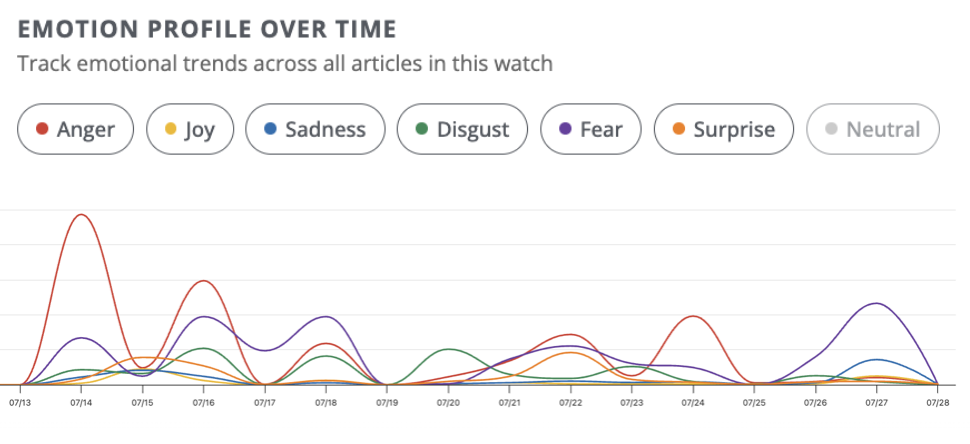
Figure 5. Emotional profile of Meta privacy narratives, July 13–28, 2026.
Rather than fading after individual events, these emotions persist across stories — reinforcing a durable narrative centered on transparency and accountability that outlasts any one news cycle.
Executive Takeaway
Privacy is no longer a compliance issue.
It is the narrative through which stakeholders evaluate every new Meta initiative.
Organizations that lose trust in one domain often discover that every future innovation is interpreted through that same lens.
While Privacy narratives focus on how Meta manages personal information, the next ecosystem examines a different dimension of institutional trust: the company's perceived impact on individual and societal well-being.
Few narratives generate as much sustained attention as Meta's perceived impact on individual and societal well-being. Unlike privacy narratives, which focus on corporate practices, social harm narratives examine consequences for people and communities — mental health, cyberbullying, misinformation, and polarization are framed not as isolated incidents but as consequences of platform design itself.
These narratives are moral rather than technical: they ask not what the technology can do, but what the company should do. That framing produces unusual durability — concern for children's safety, for instance, crosses ideological lines in a way few other issues do — making this one of the most powerful drivers of institutional trust in Meta's reputation.
Critics generally acknowledge that many of these problems predate social media itself. The narrative that persists is less about origin and more about obligation: whether Meta is accused of accelerating, amplifying, or simply failing to mitigate harms it did not create.
Six recurring themes shape public perceptions of Meta's societal impact.
Discussions frequently associate prolonged social media use with anxiety, depression, and diminished self-esteem, particularly among adolescents.
This framing casts Meta not simply as a communications tool but as a designer of environments that intensify psychological vulnerability, shifting criticism from user behavior to product architecture.
Coverage of cyberbullying, online predators, sextortion, and age verification generates strong emotional engagement and bipartisan political attention.
Because concern for children transcends ideological divisions, this theme has become one of the most resilient components of Meta's reputation.
Critics argue Meta engineers its products — infinite scroll, notifications, algorithmic recommendations — to maximize engagement rather than well-being.
The comparison to addictive design, borrowed from behavioral psychology, reinforces a perception that commercial incentives outweigh user welfare.
Engagement-driven algorithms are widely blamed for amplifying emotionally provocative content, contributing to declining civic trust and fragmented discourse.
This theme serves as a bridge into the Political Influence ecosystem that follows, showing how individual ecosystems rarely stay isolated.
Harassment, hate speech, and scams reinforce a broader argument that platform governance has not kept pace with the scale of harmful behavior across billions of daily interactions.
Criticism centers less on individual bad actors than on the practical limits of moderation at global scale.
Underlying nearly every discussion is a single question: how responsible should a technology company be for behavior occurring on its platform?
Increasingly, Meta is treated less like a communications provider and more like an institution with public-infrastructure obligations.
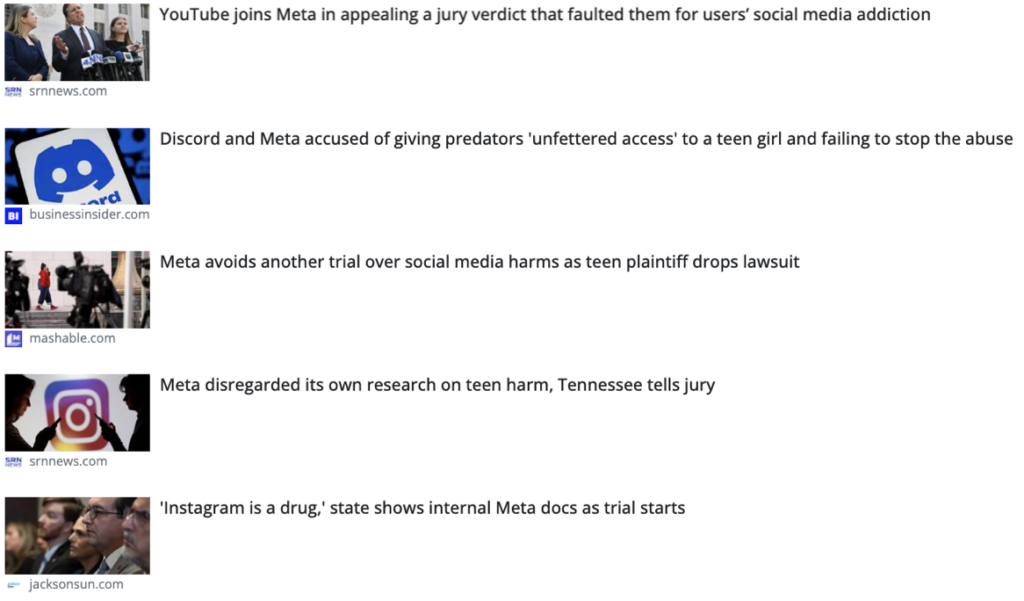
Figure 6. Representative coverage illustrating dominant social harm narratives, July 13–28, 2026.
Stories ranging from mental health litigation to online abuse collectively reinforce one narrative: a question about Meta's responsibility for societal outcomes. Audiences rarely compartmentalize these stories — they fold them into one larger judgment.
Fear and anger again dominate. On July 22, sadness briefly overtook both after a widely supported mental health lawsuit against Meta was suddenly dropped.
By July 24, that sentiment had shifted to disgust, likely in response to Meta's dismissive remarks about the case and the plaintiff — a reminder that emotional narratives rarely stay tied to the event that created them; they reinforce whatever belief about Meta's character already exists.
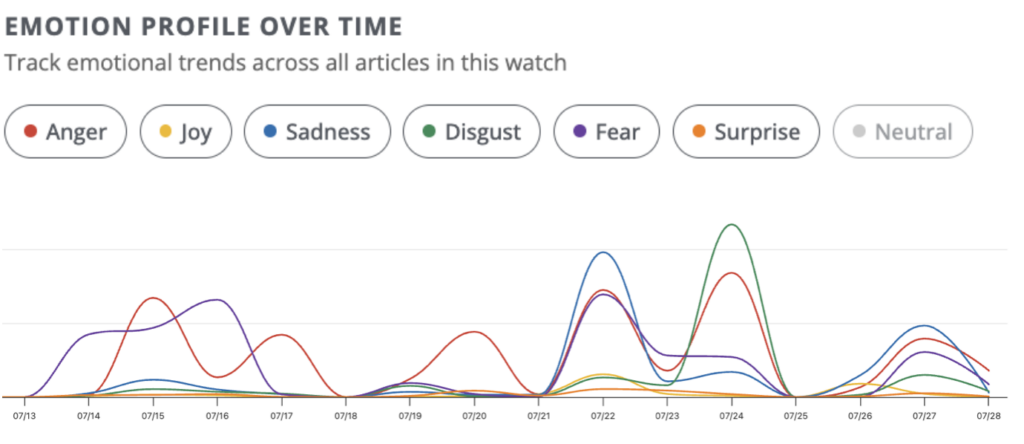
Figure 7. Emotional profile of Meta social harm narratives, July 13–28, 2026.
Fear and anger remain the dominant drivers throughout, with sadness and disgust surfacing around specific legal developments before settling back into the baseline pattern.
Executive Takeaway
Social harm narratives turn product decisions into questions of moral responsibility.
Stakeholders now expect companies to anticipate societal consequences, not just comply with regulation after the fact.
That standard extends far beyond social media — into any industry whose products touch daily life at scale.
While Social Harm narratives focus on the impact of Meta's platforms on individuals and society, the next ecosystem examines a different dimension of institutional trust: the company's influence over political discourse, democratic institutions, and the global flow of information.
Few organizations occupy a more prominent position in political discourse than Meta. Unlike traditional media, whose influence flows from producing news, Meta provides the infrastructure through which billions discover information and engage in public debate — a role that pulls the company into elections, protest movements, and geopolitical conflicts it did not create.
The defining feature of this ecosystem is contradiction: Meta is criticized simultaneously for removing too much content and too little, for suppressing speech and for permitting misinformation. These competing criticisms rarely cancel out — instead, they reinforce a single conclusion, that Meta wields significant influence over public discourse without matching accountability.
That contradiction is precisely what makes this ecosystem strategically significant. Individual political disputes evolve constantly, but they consistently reinforce the same broader concern about transparency and institutional trust regardless of which side of a given controversy is winning.
Six recurring themes organize political debate about Meta.
Recommendation algorithms, News Feed ranking, and moderation policy are viewed as mechanisms that shape public opinion.
This narrative rarely alleges intentional manipulation — only that scale itself creates political consequence, regardless of intent.
Critics from opposing political camps accuse Meta of bias in both directions — over-moderation and under-moderation.
This apparent contradiction nonetheless reinforces the same underlying perception of outsized, insufficiently accountable influence.
Election claims, manipulated media, and coordinated inauthentic behavior fuel arguments that Meta has not exercised sufficient oversight.
This is the mirror image of the censorship narrative, ensuring nearly every moderation decision draws criticism from someone.
Fake accounts and state-sponsored propaganda networks are frequently discussed in relation to Meta's platforms.
The company is held responsible for detection and disruption regardless of where a given campaign originates.
Decisions about acceptable speech and election advertising increasingly carry constitutional weight despite being made by a private corporation.
This narrative fuels calls for regulatory oversight and clearer standards for digital public spaces.
Operating across hundreds of legal systems and cultural contexts, Meta faces the practical impossibility of applying consistent moderation standards worldwide.
These tensions extend the company's political challenges well beyond any single country's domestic debate.
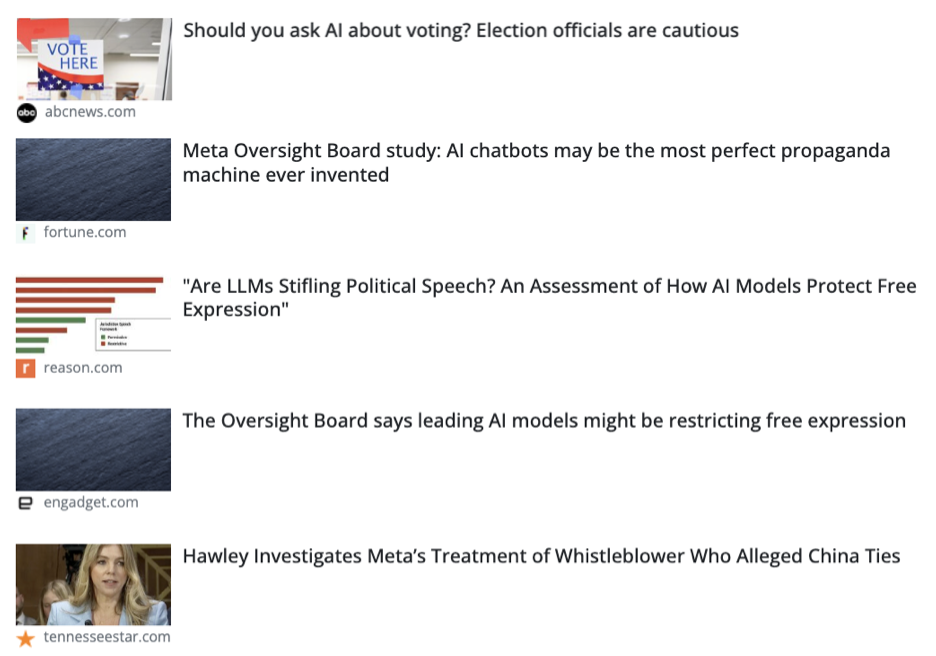
Figure 8. Representative coverage illustrating dominant political influence narratives, July 13–28, 2026.
From election integrity to foreign influence operations, individual stories reinforce a common question about institutional authority and democratic accountability, regardless of the specific policy dispute in play. Narrative Intelligence reveals how these discussions gradually form a durable perception of Meta's role in shaping public discourse.
Fear and anger remain dominant. The most noticeable spike in both appeared July 23, on news that significant super PAC spending now involves AI companies and leaders on both sides of the regulation debate.
Earlier spikes correlated with allegations that Meta cooperated with the Chinese Communist Party to limit access to critical materials — the kind of story that, because it touches identity and civic participation, tends to produce unusually durable emotional reactions.
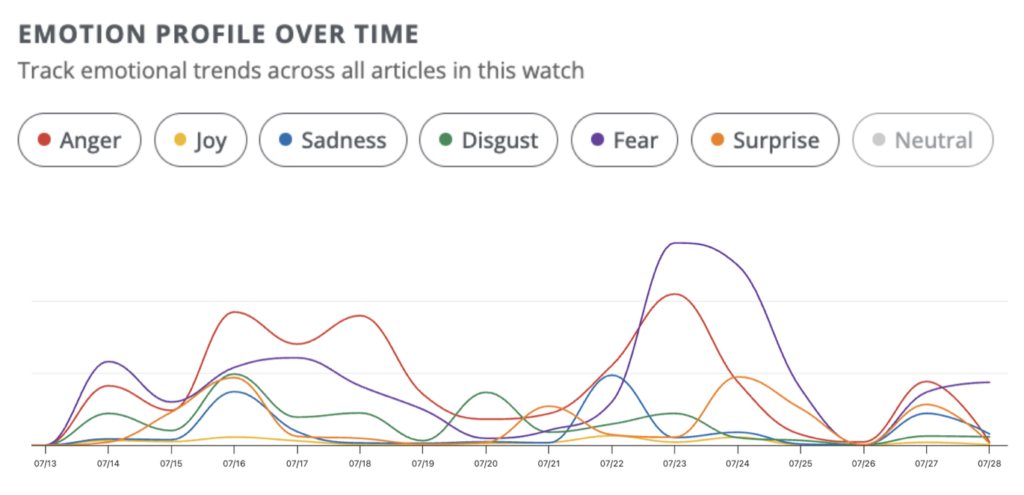
Figure 9. Emotional profile of Meta political influence narratives, July 13–28, 2026.
Political narratives produce particularly durable emotional responses, allowing future developments to be interpreted through previously established assumptions about Meta's institutional role.
Executive Takeaway
Every content, AI, and platform decision Meta makes now carries political weight.
As companies gain influence over public life, they inherit expectations of transparency and accountability once reserved for public institutions.
That expectation doesn't fade — it compounds with every subsequent decision.
While Political Influence examines Meta's role within democratic systems and public discourse, the next ecosystem explores another fundamental dimension of its reputation: the growing perception that the company's size, market position, and technological reach have created a level of corporate influence extending well beyond traditional business competition.
As Meta has grown from a social network into one of the world's most influential technology companies, public discussion has shifted from individual products to the broader question of corporate power. Advertising markets, AI, virtual and augmented reality, messaging, and commerce all now fall under the same reputational umbrella.
Unlike narratives that depend on allegations of misconduct, Corporate Power narratives often emerge simply from scale. Scale creates visibility; visibility creates scrutiny; scrutiny creates narrative. Increasingly, the debate is no longer just about what Meta does, but about what it is capable of doing because of its size.
This shift matters because it changes what counts as evidence. A single acquisition, product launch, or lobbying disclosure is no longer evaluated on its own merits — it becomes one more data point in a cumulative story about how much influence one company should be allowed to hold.
Six recurring themes define discussion of Meta's institutional power.
Billions of users, a global advertising business, and expanding AI investment are cited as evidence that scale itself has become a reputational issue.
This narrative shifts attention away from individual products and toward broader questions of institutional legitimacy.
A recurring narrative frames Meta's acquisition history and network effects as cumulative evidence that emerging competitors face structurally difficult odds.
The focus is rarely one acquisition alone but the compounding effect of years of expansion.
Meta's data resources and targeting capabilities are portrayed as giving it disproportionate influence over digital marketing.
Advertisers are frequently described as dependent on its platforms to reach audiences at all, reinforcing perceptions of structural market power.
Publishers, nonprofits, and creators who rely on Meta's platforms for visibility illustrate a broader concern.
Entire sectors of the digital economy now depend on decisions made by a single company, extending the debate beyond competition law.
Calls for stronger antitrust enforcement and transparency requirements reflect a widespread view that existing regulatory frameworks have not kept pace with the growth of large technology companies.
As a result, regulation becomes not just a legal matter but a reputational one.
Meta's investments in AI, wearables, and robotics are read by supporters as long-term vision and by critics as further institutional expansion.
Either interpretation reinforces public awareness of the company's growing footprint across digital life.
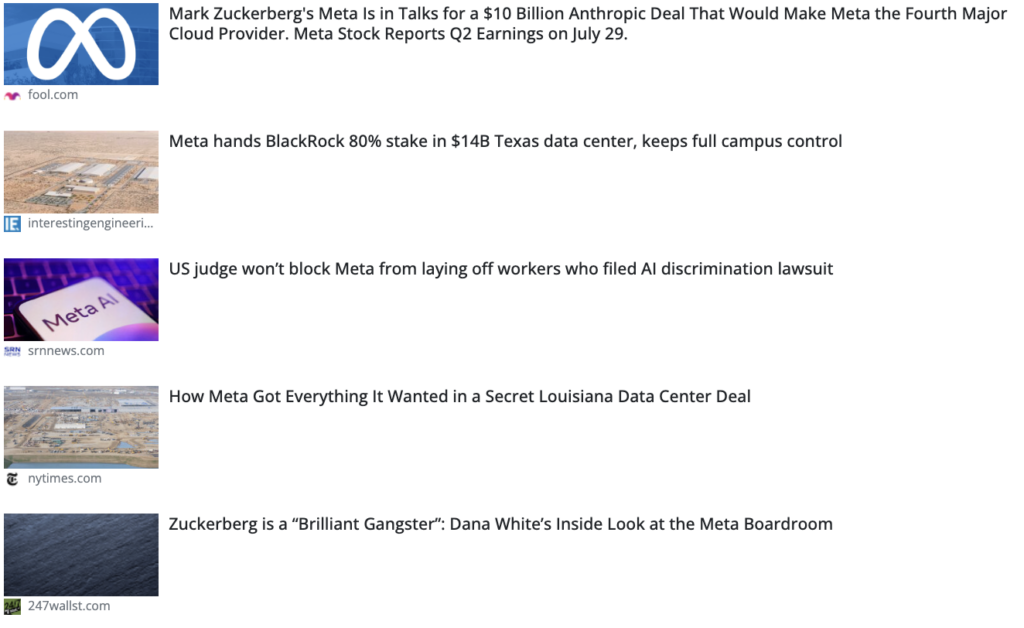
Figure 10. Representative coverage illustrating dominant corporate power narratives, July 13–28, 2026.
Stories spanning acquisitions, advertising, and AI investment reinforce one conclusion: that Meta's economic and technological power has outpaced traditional mechanisms of accountability. The underlying stories vary considerably, yet they consistently contribute to the same larger conversation.
Fear and anger dominate. The most noticeable spike in fear appeared July 20, following a report that Meta AI's native image-detection accuracy dropped significantly after cropping or tampering.
Anger peaked on July 23, following news that AI firms are contributing heavily to political campaigns and super PACs — discussions that derive their intensity less from direct personal impact than from a perceived imbalance of power.

Figure 11. Emotional profile of Meta corporate power narratives, July 13–28, 2026.
Audiences evaluate Meta's growth through concerns about concentration of power and institutional accountability rather than any single business decision.
Executive Takeaway
Scale has become a reputational liability in its own right.
As Meta expands into new markets and technologies, stakeholders judge not just what it builds, but how much power it accumulates while building it.
Success attracts scrutiny — and that scrutiny doesn't discriminate between good and bad decisions.
The Corporate Power ecosystem examines how Meta's expanding influence shapes public perception today. The final narrative ecosystem looks ahead, exploring how artificial intelligence and emerging technologies are accelerating many of these same discussions while introducing entirely new questions regarding trust, governance, innovation, and the future relationship between technology and society.
Artificial intelligence has become one of the fastest-growing drivers of Meta's public reputation. Its investments in large language models, generative AI, wearables, and open-source models have expanded the narrative beyond social media. Increasingly, Meta is viewed as one of the organizations shaping the future of AI itself. Unlike the other four ecosystems, which are rooted in historical events, AI narratives are forward-looking: public discussion centers as much on what the technology might enable as on what it already has.
That uncertainty raises the stakes. Every AI announcement now prompts questions well beyond technical capability — can it be trusted, who governs it, who benefits, who bears the risk — and Meta rarely answers those questions in an open manner. Audiences interpret new AI initiatives through beliefs about privacy, transparency, and corporate influence the company has already built.
That is what makes AI different from the four ecosystems that precede it in this report. It is not a sixth, separate narrative — it is the convergence point where the other five consistently reappear.
Six recurring themes shape perceptions of Meta's role in emerging technology.
The absence of universally accepted standards for transparency and safety testing frames Meta as a participant in a competitive race.
That race's pace may exceed governments' ability to establish meaningful regulatory safeguards.
Training data, behavioral prediction, and biometric information tie AI directly back to longstanding privacy narratives.
Audiences see AI as amplifying, not replacing, the risks associated with large-scale data collection.
Deepfakes and automated propaganda place Meta in a dual role: developer of capable AI technologies and steward of the platforms responsible for detecting synthetic content.
That dual responsibility significantly raises expectations for transparency and moderation.
Meta's commitment to open models draws praise for accelerating innovation and criticism for lowering barriers for malicious actors.
Both readings reinforce the same broader conversation about responsibility for downstream use of technology a company releases into the world.
Workforce displacement and changing skill requirements place Meta's AI leadership at the center of broader debates about automation.
These conversations link Meta to societal-scale questions about the future relationship between humans and technology.
Investments in AI assistants, smart glasses, and robotics reinforce a narrative that Meta is shaping tomorrow's digital ecosystem.
Supporters read this as visionary leadership; critics read the same investments as further institutional expansion.
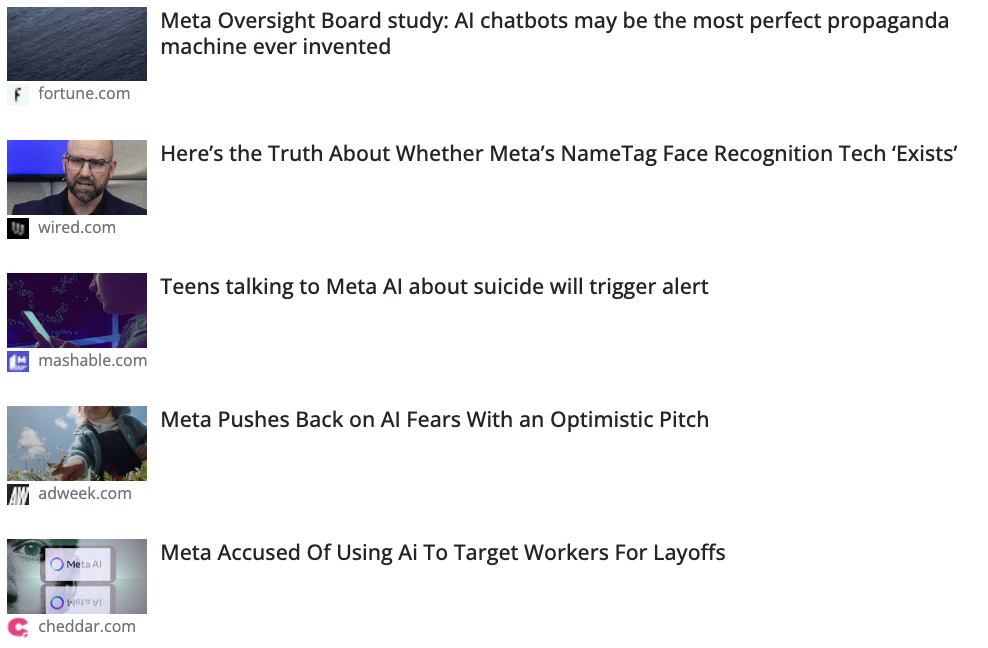
Figure 12. Representative coverage illustrating dominant artificial intelligence and emerging technology narratives, July 13–28, 2026.
Coverage spanning open-source models, workforce automation, and synthetic media reinforces one theme: institutional responsibility for the future governance of AI. Rather than existing as isolated technology stories, these developments feed directly into Meta's broader reputation for innovation and accountability.
Fear and anger remain dominant. Fear first spiked July 26, after 26 Meta employees filed a lawsuit alleging discriminatory use of AI in layoffs, and resurged July 23 when a federal judge declined to halt the layoffs.
A final elevation in fear occurred July 27, alongside revelations that Meta's AI is configured with potential covert-recording and facial-recognition capabilities. Anger peaked earlier, on July 15, coinciding with an AI-driven layoff affecting roughly 10% of Meta's workforce.
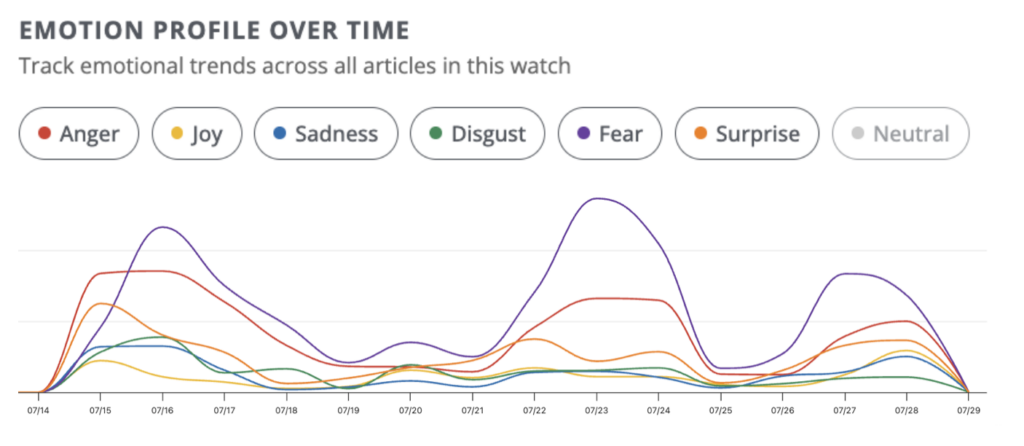
Figure 13. Emotional profile of Meta artificial intelligence narratives, July 13–28, 2026.
AI-related emotion is driven as much by uncertainty as by observable events — giving these narratives exceptional capacity to reinforce, and be reinforced by, the four ecosystems examined earlier in this report.
Executive Takeaway
AI is the point where every other narrative converges.
Privacy, social harm, political influence, and corporate power all resurface the moment Meta introduces a new AI capability.
New technologies don't enter a neutral environment — they inherit the trust an organization has already earned, or lost.
Throughout this report, five distinct narrative ecosystems have been examined:
Individually, each represents a meaningful area of reputational risk. Collectively, they reveal something more significant: they do not exist independently. Audiences rarely evaluate a new Meta story on its own merits — they connect it to everything they already believe. Privacy concerns shape how AI initiatives are read; Social Harm reinforces criticism of Political Influence; Political Influence feeds Corporate Power; Corporate Power raises new questions about AI governance; and AI, in turn, revives privacy, transparency, and accountability concerns from the beginning. That closed loop — Narrative Convergence — is why resolving any one issue rarely improves Meta's overall reputation: the underlying story stays intact and simply absorbs the next headline.
Individual headlines are temporary; narratives persist; institutional beliefs persist longer still. As audiences encounter repeated stories about platform governance and corporate influence, they connect those issues with a broader judgment about Meta's values and trustworthiness. Eventually, individual stories matter less than the conclusion audiences have already reached — which is why organizations sometimes see disproportionately negative reactions to otherwise routine announcements. The announcement isn't driving the response; the existing narrative is.
Convergence changes what reputational risk looks like in practice. New events become easier to interpret through an existing lens, beliefs become more resistant to change, emotional responses stay consistent across unrelated stories, and public trust becomes progressively harder to rebuild. For executive leaders, that means reputation cannot be managed by responding to individual stories — it requires understanding, and ideally mapping, the larger narrative environment those stories will be interpreted within, before disparate issues harden into one conclusion.
EXECUTIVE INSIGHT
Organizations don't lose trust because of one event. They lose trust because multiple narratives converge into one belief.
Meta's reputation is not defined by a single controversy, product launch, or regulatory action. It is shaped by a dynamic ecosystem of interconnected narratives that continuously reinforce one another and influence how future events are interpreted. Nearly every organization operating at scale now faces the same dynamic — reputation shaped by customers, employees, policymakers, investors, and competitors whose conversations reinforce each other long before traditional business metrics register any impact.
For executive leaders, that changes the nature of reputational risk. Managing reputation is no longer just a communications challenge — it is a strategic intelligence challenge. Organizations that monitor only headlines or sentiment tend to recognize emerging issues only after stakeholders have already folded them into broader institutional beliefs, which are far harder to change. Narrative Intelligence asks a different set of questions:
Organizations that understand their own narrative ecosystems gain earlier visibility into emerging risk and move from reactive reputation management to proactive planning. As AI accelerates the speed and scale of information creation, that advantage will only compound.
Meta is one example of this dynamic, but the pattern is not unique to technology companies. Any organization operating at scale accumulates narrative ecosystems of its own, whether or not anyone is tracking them. The organizations that succeed will not simply be the ones that communicate most effectively. They will be the ones that understand the narrative environment their next announcement will be received into, before they even make it.
See What Narratives Are Shaping Your Organization
Every organization has narrative ecosystems influencing customers, investors, policymakers, employees, and the public.
The question is whether you can identify them before they shape critical business decisions.
Schedule a personalized Narrative Intelligence briefing and see how EdgeTheory uncovers the emerging narratives, emotional drivers, and reputational risks impacting your organization today.
Request Your Personalized Briefing →
EdgeTheory is a narrative intelligence company. Its C2 platform continuously aggregates news, business publications, digital media, blogs, forums, and social media to help organizations understand not just what is being said about them, but why certain stories persist, which emotions sustain them, and how seemingly unrelated narratives converge into lasting institutional beliefs.
Clients use EdgeTheory to get ahead of reputational risk rather than react to it — identifying emerging narrative ecosystems while individual issues are still separable, before they harden into the kind of single, durable master narrative examined throughout this report.
This report was produced using publicly available, open-source content collected and analyzed between July 13 and July 28, 2026. It is intended to illustrate EdgeTheory's methodology and does not constitute investment, legal, or public relations advice.

