EdgeTheory Logo
Request a Demo
EdgeTheory Logo
CONTACT

Market Intelligence · Narrative Intelligence

Market Intelligence That Reveals What’s Shaping Your Market

Understand emerging narratives before they become conventional wisdom.
 
request a personalized demo

The New Perspective

Narrative Intelligence Adds a New Perspective to Market Intelligence

Traditional Market Intelligence shows you what is happening across customers, competitors, market trends, and industry conditions. EdgeTheory’s Narrative Intelligence adds another layer of understanding by revealing the narratives, sources, perceptions, emotions, and audience dynamics that may be shaping those conditions.
See emerging beliefs as they develop. Trace where they originate. Understand what is gaining momentum, who is influencing it, and what it could mean for your business.
The Strategic Gap

The Strategic Gap in Traditional Market Intelligence

Market Intelligence teams have access to more information than ever. Market research, competitive intelligence, news, earnings calls, social and media monitoring, customer feedback, industry analysis, and market analytics can provide an extraordinarily detailed picture of what is happening.
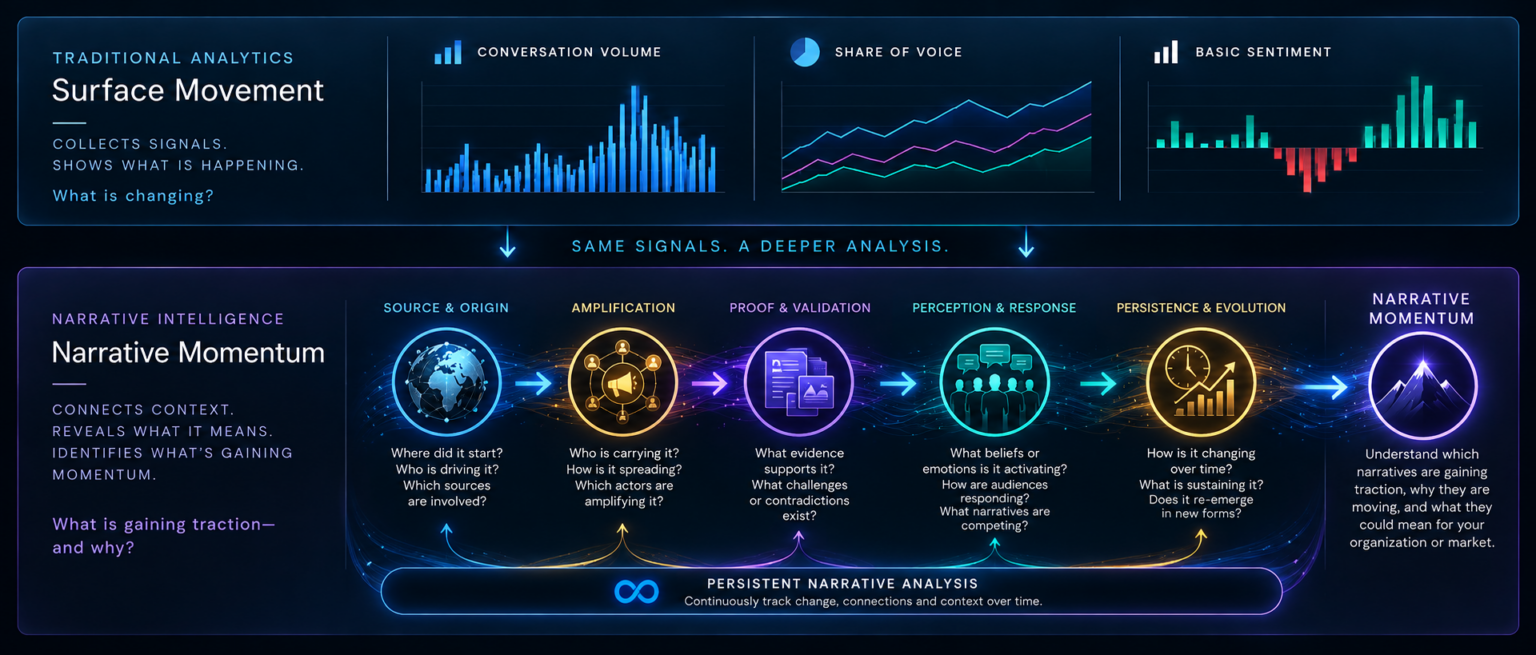
Data Shows Movement. Narrative Intelligence Explains Momentum. 
The challenge is that more information does not necessarily create greater understanding. A dashboard may show that customer sentiment has changed, a competitor is gaining attention, or conversation around an issue is accelerating. But those signals alone may not explain what is driving the change, where it began, who is influencing it, or whether it is likely to matter.
Narrative Intelligence adds that missing context. By examining the narratives, sources, beliefs, emotions, and audience dynamics surrounding market activity, EdgeTheory helps analysts investigate why perceptions are shifting and what those shifts could mean for the business.

Three Gaps Narrative Intelligence Helps Address


THE SEARCH BARRIER

Most monitoring begins with something you already know to look for—a keyword, competitor, brand, topic, or question. That works well for known issues, but emerging market narratives do not always use the language an organization expects. EdgeTheory’s Source-First approach helps surface developing narratives and beliefs outside predefined searches, allowing analysts to discover potentially important changes they did not know to look for.

THE VOLUME TRAP

The most visible narrative is not necessarily the most influential. Thousands of mentions may trace back to a small number of repeated sources, while a lower-volume idea gaining traction among influential customers, analysts, or industry voices may have much greater strategic significance. EdgeTheory traces provenance, sources, actors, and amplification to help analysts understand what is actually driving a narrative and how much weight to give it.

THE SENTIMENT BLINDSPOT

Traditional sentiment analysis can tell you whether conversation is positive, negative, or neutral, but it may not explain the reason behind that reaction. Frustration, distrust, uncertainty, fear, confidence, and aspiration can all influence behavior differently. EdgeTheory’s Emotions Profiling adds this deeper context, helping teams understand not simply how an audience is reacting, but what may be driving that response.
How Narrative Intelligence Extends Market Intelligence

How Narrative Intelligence Extends Market Intelligence Analytics

Narrative Intelligence does not replace your existing Market Intelligence tools, research, or data. It adds an analytical layer that helps explain the narrative forces behind the conditions those systems measure.

Market data might show that demand is changing, a competitor is gaining attention, or customer sentiment is moving. Narrative Intelligence helps analysts investigate the beliefs and perceptions behind those changes, where they originated, which sources are reinforcing them, and how they are evolving over time.

Market Intelligence Commonly Examines

Market size, growth and demand

EdgeTheory Narrative Intelligence Adds
How audiences interpret changing market conditions
Competitor actions, products and pricing
Competitive narratives, perceptions and supporting proof points.
Market events and conversation spikes
How narratives emerge, change, persist and reappear
Customer and audience sentiment
The emotions, beliefs and concerns underlying response
Keyword and mention tracking
Source provenance, actor influence and narrative movement
Market trends and behavioral data
Narrative context that can help explain changing perceptions and behavior
Narrative Momentum
How Narrative Intelligence Strengthens Your Market Analysis

How Narrative Intelligence Strengthens Your Market Analysis

Market analysis becomes more valuable when it can explain not only what is measurable, but what may be influencing it. EdgeTheory gives Market Intelligence teams a deeper view of the perceptions, sources, audiences, and narratives operating behind traditional market signals.

Competitive Intelligence & Competitor Analysis

Competitive Intelligence tells you what competitors are doing. Narrative Intelligence helps reveal what competitors are trying to make the market believe—and whether that positioning is gaining traction.

EdgeTheory helps analysts understand how competitors are being perceived, which claims and messages are being repeated, what proof points are reinforcing those claims, and which sources are helping establish credibility. That added context can help distinguish a temporary burst of competitive attention from a narrative that may be changing how the market evaluates the category.

Customer & Audience Intelligence

Markets do not have a single point of view. Customers, prospects, analysts, investors, media, partners, policymakers, and other stakeholders can interpret the same company, product, competitor, or market event very differently.

Narrative Intelligence helps reveal those differences, including the language audiences use, the beliefs behind their decisions, the concerns influencing consideration, and the narratives that may be shaping adoption, loyalty, or resistance.

Market Trends & Emerging Issues

Not every important market trend begins as a measurable trend. A new concern, belief, competitive frame, or interpretation may begin developing among influential sources well before it becomes visible in search volume, surveys, revenue data, or other conventional indicators.

EdgeTheory helps identify and track these emerging narratives as they develop, providing another source of intelligence for evaluating market change, opportunity, and risk.

Source Intelligence & Market Monitoring

A narrative separated from its sources can be misleading. Understanding where an idea originated and how it is moving can be as important as understanding the narrative itself.

EdgeTheory’s Source-First approach helps analysts trace where narratives originate, who is advancing them, which sources are reinforcing or challenging them, and how they move across the information environment. This provenance helps teams evaluate whether apparent market consensus reflects independent validation, repeated amplification, or something in between.

Brand & Reputation Intelligence

Brand and reputation are shaped by more than mentions. What matters is what customers and other influential audiences are beginning to believe—and why.

EdgeTheory helps organizations identify the narratives and perceptions forming around a company, product, executive, issue, or category and understand the sources, audiences, beliefs, and emotions contributing to them. Instead of simply measuring whether conversation is increasing or decreasing, teams can investigate what is actually shaping perception.

Sentiment & Emotion Analysis

Two audiences can both register as negative while responding for entirely different reasons. One may be frustrated. Another may be distrustful. Another may be anxious about risk or uncertain about change.

EdgeTheory’s Emotions Profiling moves beyond broad sentiment classification to reveal the emotional context surrounding a narrative. Understanding those differences gives teams a more useful basis for interpreting audience response and determining how to respond.

The Questions

What Is Your Market Beginning to Believe?

Market Intelligence can tell you that something changed. Narrative Intelligence helps you investigate why.

EdgeTheory gives Market Intelligence, Strategy, Competitive Intelligence, Insights, Brand, and Communications teams a way to explore questions that traditional market data may not answer on its own:
  • Why is a competitor gaining market momentum?
  • What is the market beginning to believe about our company, product, or category?
  • Which customer concerns could affect consideration or adoption?
  • What competitive messages and proof points are gaining traction?
  • Which sources are influencing market perception?
  • How are different audiences interpreting the same development?
  • How did a product launch, earnings announcement, regulatory development, industry event, or competitor move change the conversation?
  • Which narratives are strengthening, weakening, persisting, or re-emerging?
  • What is emerging in our market that we are not already monitoring?
EdgeTheory turns these questions into intelligence that can be investigated, monitored, and connected to business decisions.
The Framework

How EdgeTheory’s Narrative Intelligence Works in Market Intelligence

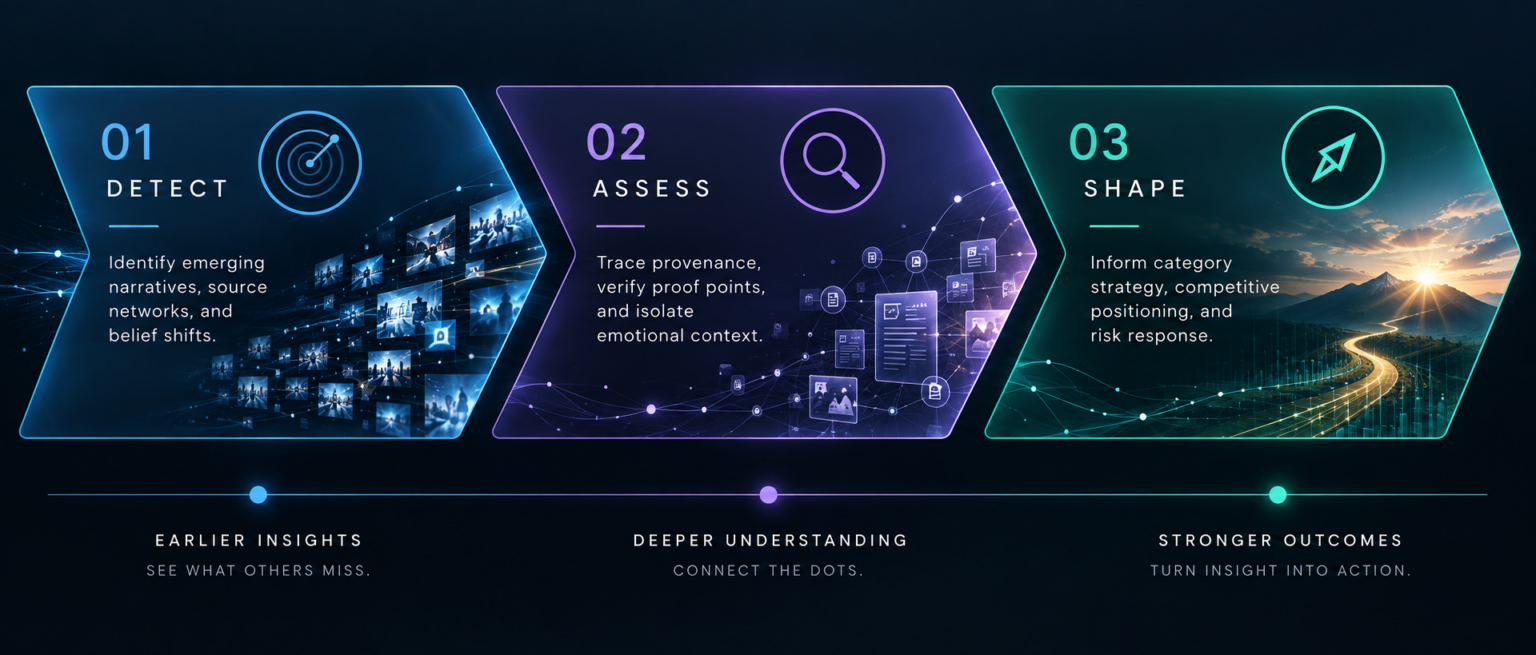
EdgeTheory provides a continuous intelligence framework for moving from information to understanding—and from understanding to action.
Detect_Asses_Shape Workflow

Step 01 · Detect

Detect Emerging Narratives

Surface emerging narratives, influential sources, actors, emotions, beliefs, and changes across the information environment before they necessarily register in conventional market metrics.

Step 02 · Assess

Assess Narrative Impact

Determine what those narratives could mean. EdgeTheory helps analysts understand where a narrative originated, who is advancing it, how it is spreading, why it is gaining traction, which audiences it is reaching, what evidence supports or challenges it, and how it may affect the business.

Step 03 · Shape

Shape Narrative Messaging

Turn intelligence into action. Use what you learn to inform market positioning, competitive strategy, aligned messaging, audience-specific communications, reputation management, and strategic response.

ViewPoint

See Your Market Through the Audiences That Matter

One Market. Different Points of View.

The market you see may not be the market your customers see. Investors may interpret a development differently from customers. Analysts may see opportunity where buyers see risk. Technical users may focus on different concerns than the executives approving a purchase.

EdgeTheory’s ViewPoint analysis uses agentic AI to examine narratives through different stakeholder perspectives. Instead of assuming that every audience sees an issue the same way, teams can explore how a market, competitor, event, or issue may be interpreted by the people whose decisions matter.

Understand the market from their point of view—not just yours.
Where It Applies

Market Intelligence for Decisions That Matter

Narrative Intelligence becomes valuable when it changes what an organization understands and improves the decisions that follow. EdgeTheory can apply that intelligence across a range of commercial priorities.

Competitive Strategy

Understand competitive positioning, market perception, emerging narratives, and changes that could affect competitive advantage.

Customer Intelligence

Identify the beliefs, concerns, emotions, and narratives influencing customer consideration, adoption, and loyalty.

Brand & Reputation

Understand the narratives and sources shaping brand, corporate, and executive perception.

Market Risk & Emerging Issues

Detect developing concerns and narrative shifts before they become established market perceptions.

Strategic Planning

Add narrative context to quantitative Market Intelligence to challenge assumptions, evaluate market changes, and improve decision-making.

Strategic Communications

Translate intelligence into positioning, messaging, audience engagement, and strategic response.

The Bigger Picture

From More Information to Better Explanation

Organizations already have access to enormous amounts of market data, research, media coverage, social content, customer feedback, competitive information, and industry analysis. The problem is rarely a lack of information.

The greater challenge is determining which information matters, what it means, where it came from, who is shaping that meaning, how perceptions are changing, and what those changes could mean for the business.

That is where Narrative Intelligence adds a new dimension to Market Intelligence.

The next evolution of Market Intelligence is not simply better collection. It is better explanation.

chevron-down