
Menu
The 2026 Cyclospora outbreak began with a relatively straightforward public-health question: What was making people sick?
But as the outbreak spread, the questions became much bigger.
Who was responsible? Was Taco Bell to blame? What did Taylor Farms' role say about the food supply chain? Was imported produce putting consumers at greater risk? And had government oversight failed to keep Americans safe?
The FDA provides the factual baseline. But the narratives surrounding those facts extend much further.
A specific lettuce outbreak becomes a question about the safety of fresh produce. Traceback to a Mexican supplier becomes concern about imported food. Exposure at Taco Bell becomes a debate over brand responsibility. And a complex federal investigation becomes evidence, for some audiences, that government oversight is failing.
Using EdgeTheory's C2 Narrative Intelligence Platform, this report examines the six major narratives shaping the 2026 Cyclospora outbreak—along with the sources and actors amplifying them, the emotions giving them momentum, and their potential implications for brands, consumer behavior and business performance.
Facts establish what happened. Narratives shape what those facts come to mean.
What This Narrative Intelligence Analysis Reveals
- How a food-safety outbreak became a much broader crisis of trust.
- Why Taco Bell, Taylor Farms, imported produce, and government oversight became part of the same narrative environment.
- Who helped shape and amplify the narratives—and which emotions gave them momentum.
- How narratives can move beyond online conversation to influence brand reputation, consumer behavior and business outcomes.
From Foodborne Outbreak to Crisis of Trust
The immediate health threat will eventually subside. The narratives it created may not.
Taco Bell can remain associated with illness. Taylor Farms can become associated with repeated food-safety incidents. Mexican produce can become part of broader arguments about imports. And regulatory difficulties can reinforce existing distrust of government institutions.
That distinction is central to Narrative Intelligence. Understanding not only what happened, but how people interpret what happened, who shapes those interpretations, and how they spread, can provide organizations with a clearer view of emerging brand, reputation and business risk.
The most important question, then, is no longer only Is this lettuce safe? It becomes:
Can I trust the nation's food supply?
Download the report
The Narrative Fallout of a Public Health Threat
AN EDGETHEORY COMMERCIAL NARRATIVE INTELLIGENCE REPORT
Analysis Period: July–August 2026
EdgeTheory | August 2026
This report examines the six narratives shaping the reputational fallout of the 2026 Cyclospora lettuce outbreak, drawn from EdgeTheory's C2 Narrative Intelligence Platform.
| Most Important Insight |
| What began as a lettuce contamination story has expanded into multiple narratives affecting Taco Bell, Taylor Farms, imported produce, food-supply transparency, and government oversight. The reputational impact is no longer confined to the contaminated product or a single company. |
| Most Important Insight |
| Six narratives are shaping the conversation: fresh produce is unsafe; Taco Bell failed its customers; Taylor Farms represents a supply-chain vulnerability; the food supply chain is too complex to trust; imported produce puts Americans at risk; and government food-safety oversight is failing. |
| Most Important Insight |
| A food-safety incident can quickly move beyond the original event and begin shaping perceptions of brands, suppliers, and entire product categories. Understanding which narratives gain traction—and which sources and actors give them momentum—can reveal reputational risk that mention counts and sentiment alone may miss. |
| Most Important Insight |
| Narrative Intelligence looks beneath the volume of coverage to identify the beliefs shaping an issue, where those narratives originate, who is amplifying them, how emotion influences their spread, and how they may affect brand and category perception. |
Executive Summary
The recent Cyclospora outbreak associated with iceberg lettuce has developed from a conventional food-safety investigation into a broader narrative event involving consumer trust, supply-chain transparency, and government oversight. The outbreak has become particularly visible through its association with Taco Bell, where investigators identified a solid link between illnesses and shredded lettuce served at restaurants. Traceback investigations subsequently converged on Taylor Farms de Mexico, a major produce supplier who voluntarily removed suspected lettuce from the U.S. market.
The narratives generated by the outbreak now extend beyond questions about a single contaminated ingredient. Consumers and critics have used the episode to question the safety of fresh produce generally, the nation's dependence on imported produce, and the effectiveness of federal food-safety oversight. These themes are then reinforced by the emotional characteristics of the outbreak. Cyclospora—a microscopic intestinal parasite associated with prolonged gastrointestinal illness—naturally generates fear and disgust, while uncertainty over the precise source of contamination contributes to distrust.
The most consequential development may therefore be narrative convergence. Individually, concerns about Taco Bell, Taylor Farms, Mexican produce, food traceability, and federal regulation are relatively discrete. Together, however, they can support a much broader proposition: that the system responsible for placing safe food on American tables cannot be trusted.
Introduction
The 2026 Cyclospora outbreak associated with shredded iceberg lettuce provides a useful case study in how a discrete public-health event can generate narratives extending well beyond the immediate source of contamination. What began as an investigation into illnesses linked to lettuce served at Taco Bell quickly expanded to encompass questions about the restaurant's responsibility to its customers, the safety of imported produce, and the effectiveness of government food-safety oversight. Together, these issues demonstrate how uncertainty surrounding a single outbreak can encourage audiences to reconsider the reliability of the broader system responsible for producing and distributing food.
The following report examines six principal narrative ecosystems that have developed around the outbreak and considers how they interact, converge, and acquire greater influence through amplification. Particular attention is given to the emotional forces underlying the conversation—particularly fear and disgust—and to the various actors responsible for shaping and spreading competing interpretations of events. By examining narrative output and amplification, the study seeks to determine whether concern remains centered on a specific contaminated product (i.e., lettuce) or is evolving into a more consequential narrative about the safety of the American food system.
Background: The 2026 Cyclospora Outbreak
Cyclospora cayetanensis is a microscopic parasite capable of causing cyclosporiasis, an intestinal illness most commonly characterized by frequent diarrhea, along with loss of appetite, stomach cramps, nausea, fatigue, and weight loss. Unlike many familiar foodborne pathogens, it generally does not spread directly from one person to another. Instead, contaminated food or water serves as the principal means of transmission.
Federal investigators announced in July that they were investigating a multistate outbreak associated with shredded iceberg lettuce served at Taco Bell restaurants. Epidemiological interviews indicated that many of those who became ill had eaten at Taco Bell before developing symptoms. Traceback work by the Food and Drug Administration subsequently identified convergence on Taylor Farms de Mexico, which supplied shredded iceberg lettuce used at implicated Taco Bell locations. Taylor Farms responded on July 17 by voluntarily removing iceberg lettuce sourced from central Mexico from the U.S. market, while Taco Bell announced that it had removed affected Taylor Farms lettuce from restaurants nationwide.
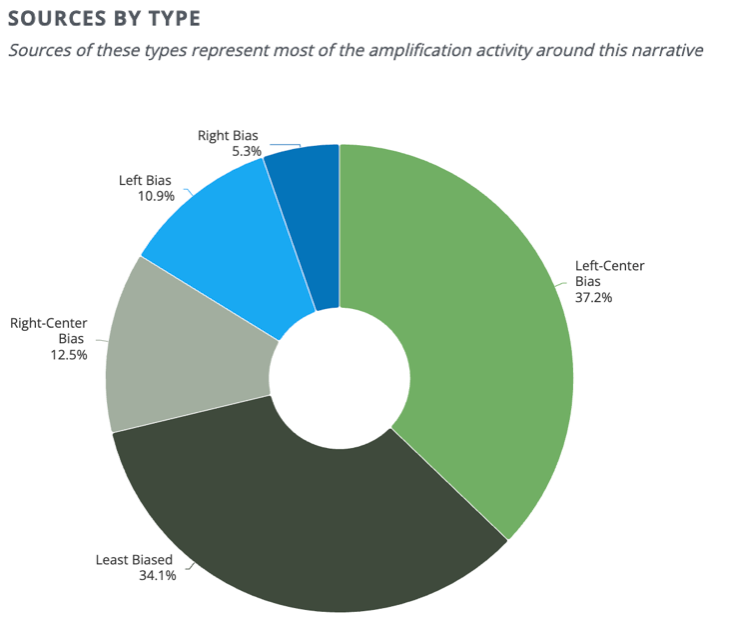
Narratives about the Cyclospora outbreak have drawn attention from across the political spectrum, but in the period between July 18 and August 26, 2026, publications with a left-center bias contributed nearly forty percent (37.2%, per EdgeTheory's C2 platform) of the narratives.
As of August 20, FDA reported 10,930 illnesses across 17 states, including 454 hospitalizations and two deaths.
An initially reported positive Cyclospora test involving Taylor Farms lettuce was subsequently determined by FDA laboratory experts to be a false positive. FDA emphasized, however, that the corrected laboratory result did not change the basis for its investigation or the epidemiological and traceback evidence supporting the Taylor Farms recall. As of August 20, FDA continued to describe the outbreak as linked to iceberg lettuce sourced from central Mexico and recalled by Taylor Farms de Mexico.
The outbreak has nevertheless become exceptionally large and has significantly affected public perceptions of lettuce. Subsequent food-safety concerns involving Taylor Farms, including a Salmonella outbreak, have further complicated the narrative environment. What began as an investigation into a particular ingredient has consequently become a wider discussion of how food is grown, processed, distributed, served, and regulated.
The findings in this report are derived from content collected and analyzed through EdgeTheory's C2 narrative intelligence platform. C2 continuously aggregates news articles, social media posts, blogs, forums, and other open-source content worldwide, enabling analysts to identify emerging themes, monitor sentiment, and measure narrative amplification across diverse information environments.

EdgeTheory's C2 platform compiles publication data for each narrative it tracks. This pie graph displays all of the outlets publishing lettuce-themed narratives between July 17 and August 18, 2026, with CBS News producing the most content of any single publisher.
Sources and Amplifications
As is common in the current information environment, concerns about tainted lettuce appear to have surfaced first on social media before leapfrogging across to traditional media outlets. This is to be expected. Whereas social media users are free to speculate and theorize in a public forum, standard media outlets are not. Their credibility rests on the fact that they operate on a factual basis.
Some of the earliest posts linking lettuce to Cyclospora appeared around July 4th, as cases rose but before the more formal Michigan health department statement on July 13 identifying lettuce as a potential source.
These early posts often offer general produce-washing instructions, or advise audiences to avoid lettuce out of caution. Speculative or precautionary mentions of Taco Bell pulling lettuce appeared around July 11, but official confirmation of a link to Cyclospora came later.
Interestingly enough, these first actors were not fringe groups or conspiracy theorists intent on proving a coverup. They appear to have been well-intentioned users meaning to share factual information to help others avoid illness. Instructive content offered users advice on such matters as safe eating, handwashing, and so forth.
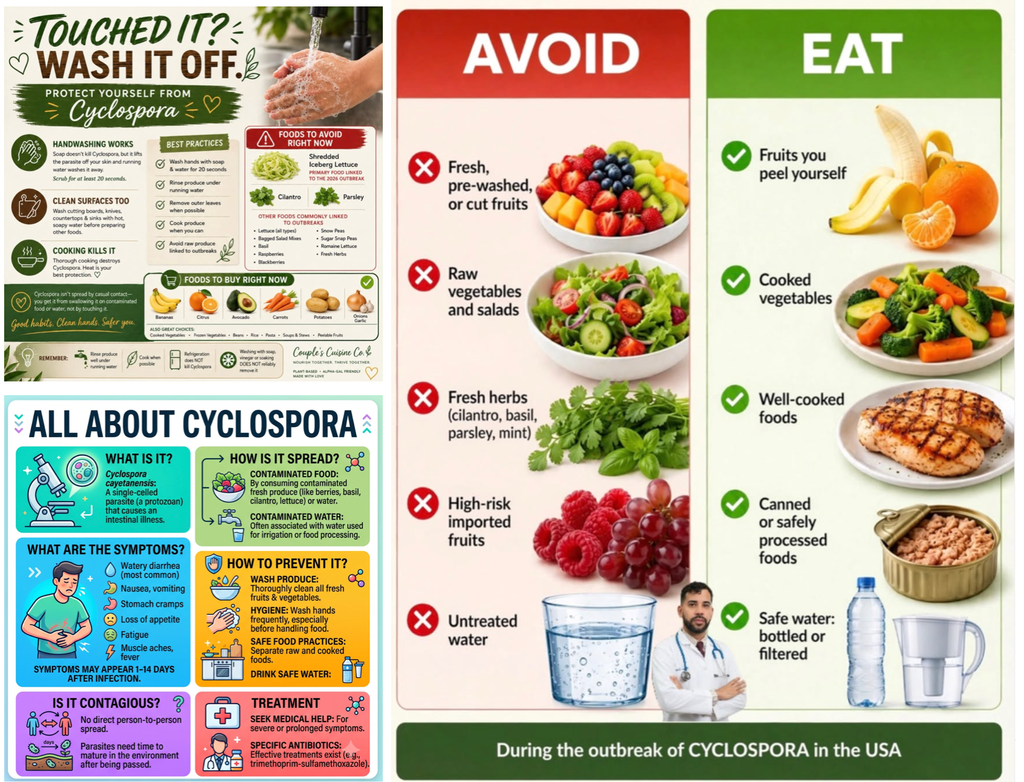
Representative altruistic Cyclospora narratives from early July 2026; taken from X.
On the heels of this altruistic trend quickly came a wave of sensationalist posts to platforms like X and Instagram. The purpose of this content was not to caution users so much as it was to generate clicks and revenue. Unfortunately, it also appears to have generated a considerable amount of fear as well. In their quests for larger audiences, these fringe publishers sensationalized their content, leaving readers panicky in the process.

Representative sensationalized Cyclospora narratives from July 2026; taken from X.
Many of these narratives were already in circulation when the first media stories began to appear, so that a developing panic was already underway when evening wire services broke news of the infection on July 16th. In fact, so noticeable was the panic that it became part of the story as well. Indeed, some outlets commenced their coverage not with stories of the disease itself but of the fear it had generated in large swaths of the nation.
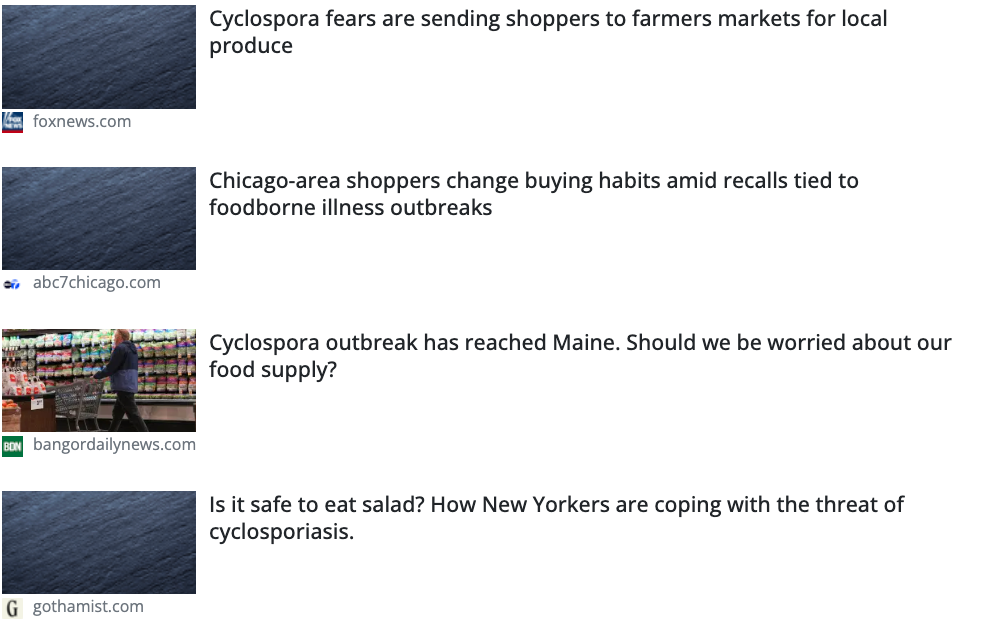
Representative Cyclospora panic narratives from July 2026; collected from EdgeTheory's C2 platform, August 2026.
In describing this wave of fear, media outlets may have inadvertently contributed to it, though this is far from certain. In any case, an environment of fear and anger was in the making. The fear was likely a response to Cyclospora itself, a simple anxiety about contracting an infection. The anger, however, has been more diffuse and channeled into six distinct narratives that ultimately seek to assign blame and responsibility for the outbreak. These narratives target a number of players, including the food supply chain, Taco Bell, Taylor Farms, food inspectors, and even the federal government.
Narrative I: Lettuce and Fresh Produce Are Unsafe
One of the broadest narratives to emerge from the outbreak depicts lettuce—and, by extension, fresh produce—as inherently difficult to trust. This narrative represents an important example of risk generalization. Public concern has increasingly extended beyond the recalled product to questions about whether lettuce itself is safe to consume.
The characteristics of Cyclospora make this narrative especially powerful. Contamination cannot be detected through appearance, smell, or taste, leaving consumers without an obvious means of independently assessing risk. Federal officials have stressed that conventional antimicrobial washing treatments may not adequately control Cyclospora, further undermining the intuitive assumption that consumers can simply wash questionable produce and protect themselves.
The resulting narrative conflicts with the traditional image of lettuce and salads as healthy foods. Consumers selecting fresh produce generally believe they are choosing a health-conscious lifestyle, which makes the presence of an intestinal parasite particularly troubling. Lettuce, a product associated with healthy eating, now becomes the vehicle for a serious gastrointestinal threat.
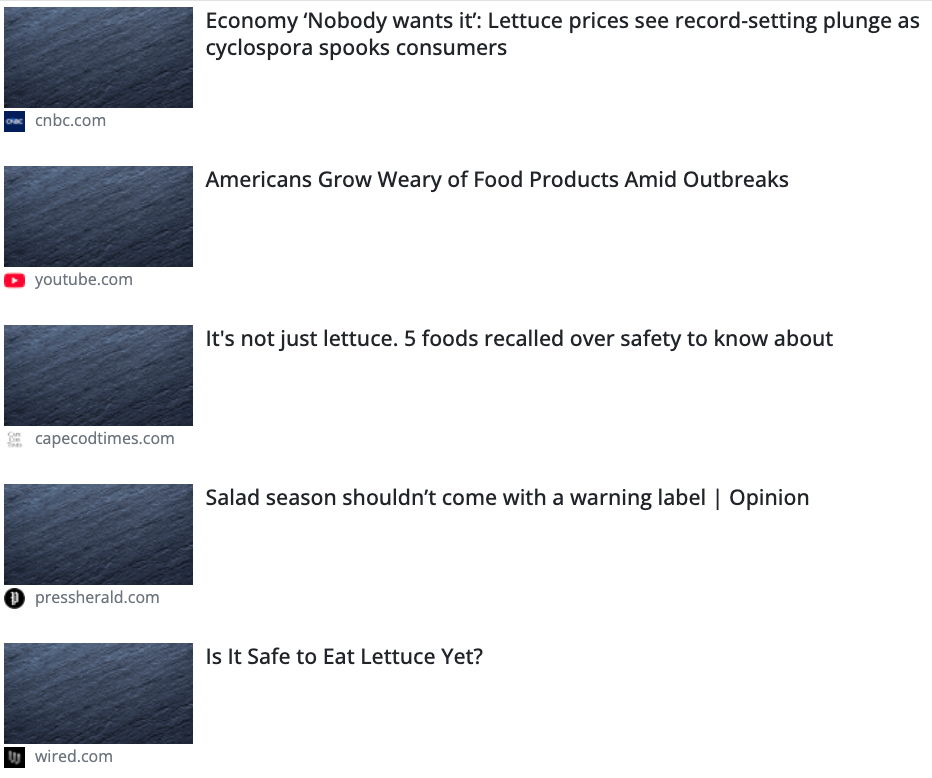
Representative narratives from July and August 2026 call attention to the perceived dangers of consuming lettuce and other produce, collected from EdgeTheory's C2 platform, August 2026.
Evidence of declining consumer confidence can also be seen economically. Lettuce prices fell sharply during July as demand weakened, while news coverage increasingly addressed the basic question of whether consumers could safely resume eating lettuce. Federal officials eventually made public efforts to reassure Americans that fresh produce remained safe to consume.
The narrative risk lies in persistence. If audiences distinguish recalled iceberg lettuce from lettuce generally, consumer confidence can recover quickly as the outbreak subsides. If they instead begin treating salads, bagged produce, or raw vegetables as categories carrying invisible contamination risks, a specific outbreak can produce reputational consequences for an entire sector.
Narrative II: Taco Bell Failed Its Customers
For most consumers, the outbreak was not initially a Taylor Farms story. It was a Taco Bell story. The restaurant chain provided the recognizable consumer-facing brand through which thousands of people encountered information about Cyclospora, making Taco Bell an obvious focus for anger, disgust, and demands for accountability.
The central narrative holds that restaurants have an obligation to ensure that food served to customers is safe regardless of where contamination originated. From this perspective, supply-chain complexity does not absolve Taco Bell. After all, customers transact with the restaurant rather than with farms, processors, or distributors. Lawsuits arising from the outbreak reinforce this framework by placing the chain alongside suppliers in efforts to establish responsibility for illnesses.

Representative narratives leveling blame for the Cyclospora outbreak at Taco Bell; collected from X, August 2026.
The nature of the illness creates an additional reputational problem. Taco Bell has long been subjected to joking cultural associations with gastrointestinal concerns. An actual outbreak involving prolonged diarrhea can therefore attach itself easily to preexisting humor about the brand. Such narrative compatibility matters: new information tends to spread readily when it reinforces familiar stereotypes, even when those stereotypes were previously unserious.
Taco Bell has advanced a competing interpretation. The company announced that it swiftly removed affected Taylor Farms lettuce from its restaurants nationwide and characterized food safety as a shared responsibility among restaurants, suppliers, and public authorities. Under this narrative, Taco Bell was not the originator of the problem but rather the final link in a supply chain that received an ingredient believed to be safe and acted once authorities identified a potential threat.
The central narrative contest therefore concerns responsibility. Taco Bell can be portrayed either as a restaurant that served unsafe food or as a company that became a highly visible victim of contamination occurring upstream. Which narrative persists will influence whether Cyclospora becomes permanently linked with the Taco Bell brand or gradually separates from it as the outbreak recedes.
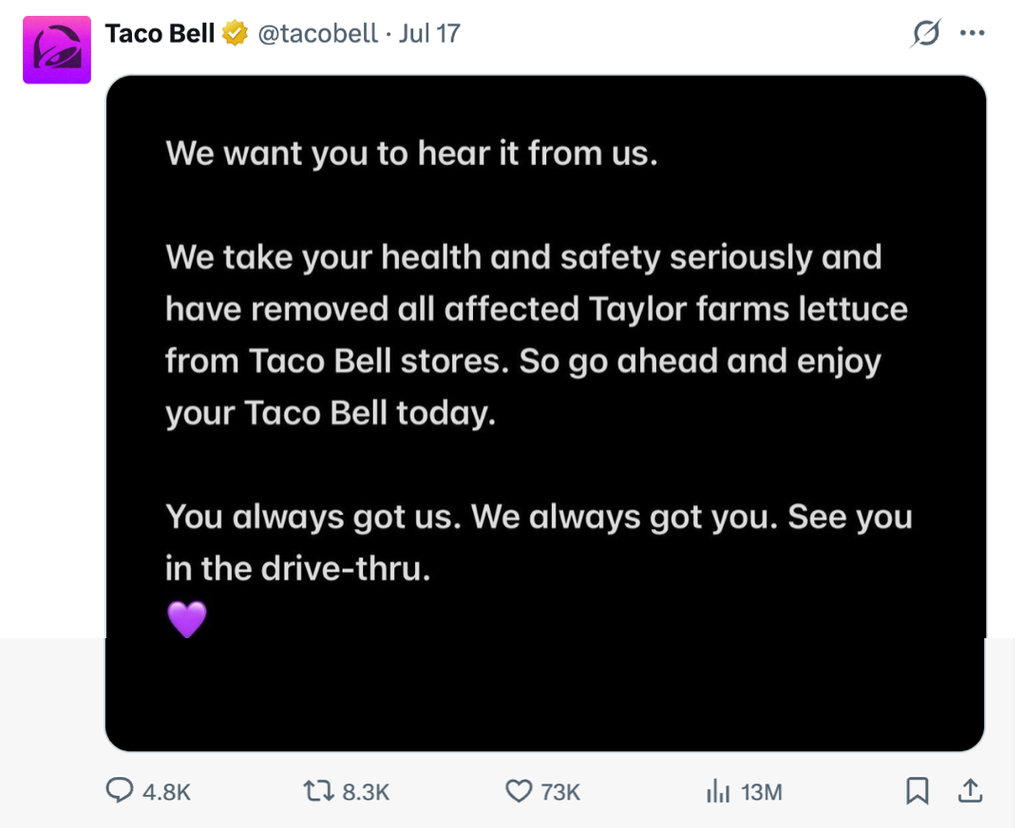
Narrative item from Taco Bell positioning itself as a caretaker of public health; posted to X on July 17, 2026.
Narrative III: Taylor Farms Is a Liability
As traceback investigations moved upstream, Taylor Farms emerged as the second major corporate actor in the narrative ecosystem. Unlike Taco Bell, however, Taylor Farms is less familiar to ordinary consumers despite occupying a substantial position within the North American fresh-food supply chain. The outbreak therefore introduced many consumers to a company whose products they may have consumed repeatedly without recognizing its name.
This discrepancy between low public visibility and enormous supply-chain reach provides fertile ground for narratives about concentrated vulnerability. A large supplier can distribute food through numerous restaurant, retail, and institutional channels, meaning a contamination problem originating at one point can potentially produce consequences far removed from its source. Taylor Farms' recall extended across numerous states, for instance, and included both retail and food-service products.
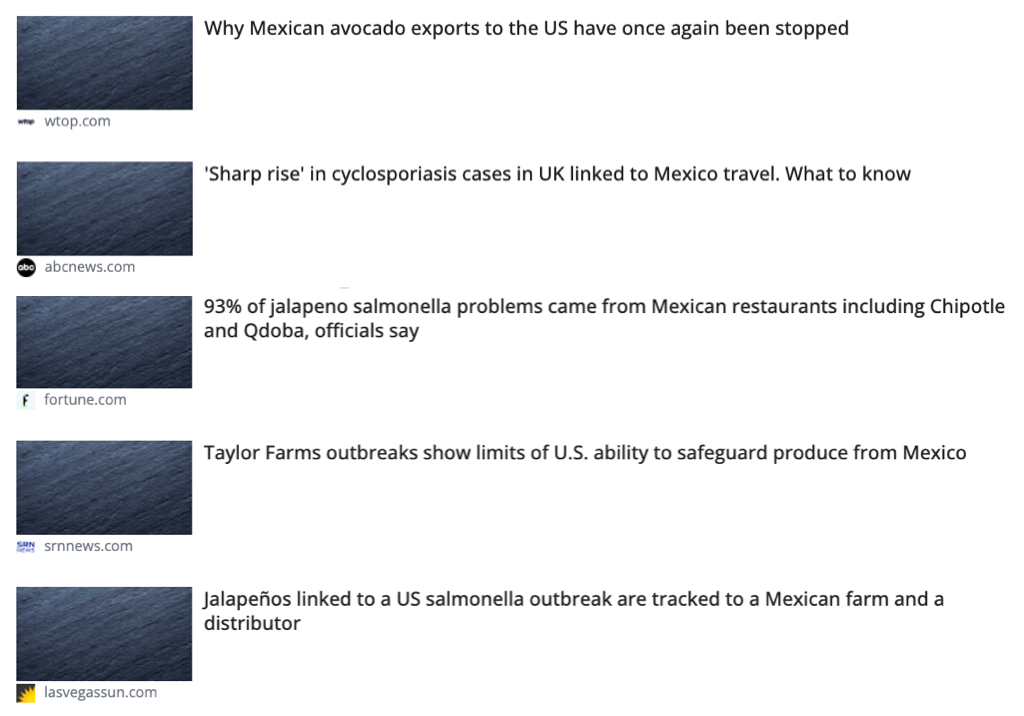
Representative narratives finding fault with Taylor Farms; collected from EdgeTheory's C2 platform, August 2026.
Taylor Farms has stated that it stopped receiving product from the implicated lot, suspended distribution of the relevant central Mexican iceberg lettuce, notified customers, and cooperated with federal and state authorities. Nevertheless, a subsequent recall involving Taylor Farms products containing jalapeños associated with a separate Salmonella outbreak creates the possibility of narrative accumulation. Separate events involving different foods, suppliers, and pathogens can become psychologically consolidated into a simpler proposition: Taylor Farms repeatedly appears in food-safety stories.
That interpretation does not require the incidents to share a common cause. Narrative formation frequently depends upon pattern recognition rather than actual causes. Once audiences perceive a pattern, previous incidents may be rediscovered and incorporated as supporting evidence.
The resulting challenge for Taylor Farms is therefore larger than determining responsibility for a single outbreak. It is preventing unrelated or partially related incidents from converging into a durable narrative that the company's scale itself represents a vulnerability within America's food system.
Narrative IV: America's Food Supply Chain Is Too Complex to Trust
The outbreak has also highlighted a reality largely invisible to everyday consumers: modern food travels through complicated networks connecting farms, processors, distributors, packagers, restaurants, retailers, and regulators. The consumer is the last stop in this byzantine process.
This complexity becomes conspicuous during a crisis. Investigators must reconstruct where outbreak victims ate, identify common ingredients, determine suppliers, trace products backward through distribution networks, and ultimately attempt to identify farms or facilities where contamination occurred. Because symptoms may emerge well after contaminated food is consumed, patients must often remember meals eaten days or weeks before. Laboratory testing and reporting can introduce additional delays.
The erroneous initial positive test further strengthens narratives about uncertainty. Although FDA stated that the corrected laboratory result did not change the epidemiological and traceback evidence supporting the recall, public audiences may interpret changing information differently. A positive result followed by its withdrawal can be presented as evidence that investigators do not know what happened—even when the broader investigative evidence remains unchanged.
The narrative also risks shifting from claims of contamination to accusations of opacity. Consumers may conclude not merely that unsafe food occasionally enters the marketplace, but that neither corporations nor regulators can contain the problem. In that environment, uncertainty itself becomes a source of reputational damage.
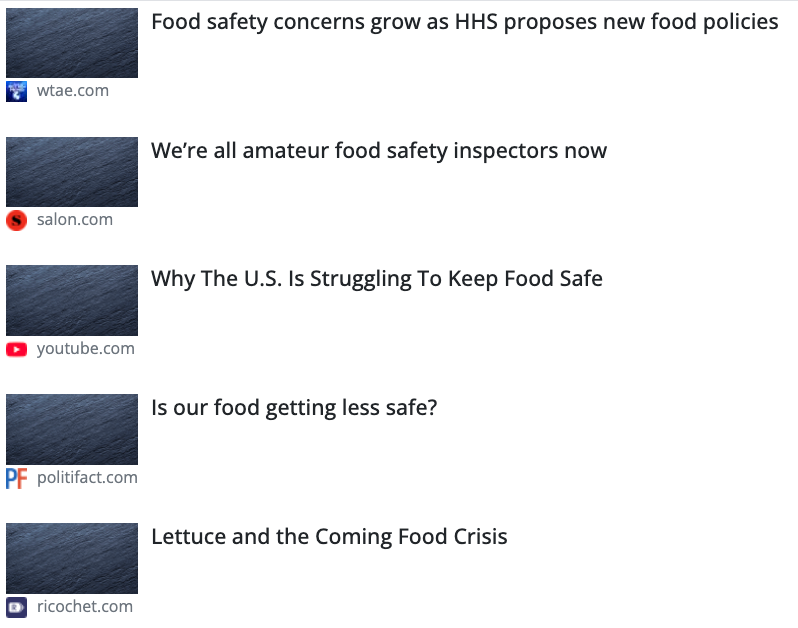
Representative narratives alleging an insecure food supply chain; collected from EdgeTheory's C2 platform, August 2026.
Narrative V: Imported Produce Is Putting Americans at Risk
The involvement of lettuce sourced from central Mexico introduces another powerful narrative: that American dependence on imported produce exposes consumers to risks occurring beyond the effective reach of American regulators.
The economic backdrop makes this narrative particularly resonant. American agricultural imports from Mexico have expanded enormously during the past several decades, resulting from consumers expecting year-round access to fresh fruits and vegetables. The ensuing agricultural integration has produced economic benefits but also supply chains extending across numerous regulatory jurisdictions.
Critics can therefore use the Cyclospora outbreak to argue that imported produce is grown under conditions that American authorities can't adequately supervise. Concerns include irrigation-water quality, sanitation, worker hygiene, inspection frequency, and the FDA's inability to enforce American safety expectations on foreign farms and facilities. Previous Cyclospora outbreaks associated with produce from Mexico provide historical material capable of reinforcing these claims.
The narrative also fits easily into broader political debates over trade, globalization, border security, and domestic production. Food safety can consequently become evidence for arguments whose ultimate subject is not lettuce at all. Calls for tighter import controls or greater reliance on American agriculture may acquire additional emotional force when tied to fears of illness.
Narrative intelligence should therefore distinguish between legitimate concerns over foreign inspection capacity and broader claims suggesting that imported produce is inherently unsafe. The latter transforms a food-safety investigation into a political narrative about foreign dependence.
Representative narratives highlighting food pathogens and other risks associated with Mexican food imports; collected from EdgeTheory's C2 platform, August 2026.
Narrative VI: Government Oversight Is Failing
Perhaps the most consequential narrative emerging from the outbreak concerns government oversight. It is the federal government, after all, that consumers most expect to prevent unsafe food from reaching them.
Criticism focuses partly on speed. By the time investigators identify a contaminated product, much of it may already have been consumed. Cyclospora presents particularly difficult investigative challenges because symptoms may not appear immediately and the organism is difficult to identify through conventional means. Yet those scientific limitations can easily be misinterpreted as institutional incompetence.
The laboratory-testing controversy strengthens this narrative. The false positive gives critics a straightforward example of investigative failure, even though the broader epidemiological evidence continued to implicate the supply chain under investigation.
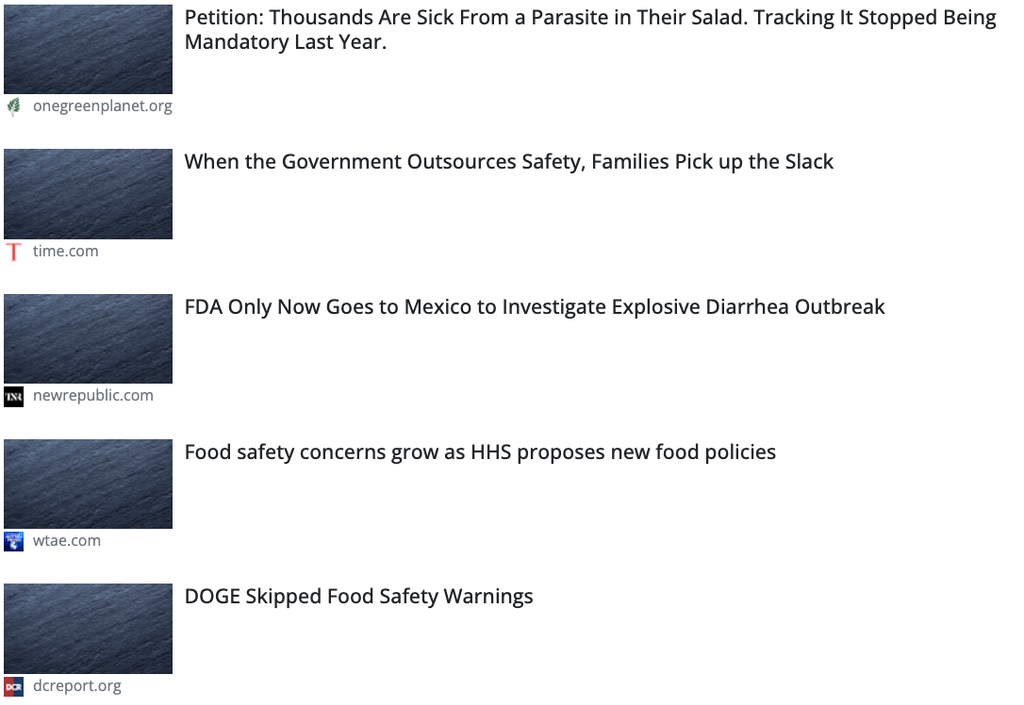
Representative narratives blaming government inaction for the recent Cyclospora outbreak; collected from EdgeTheory's C2 platform, August 2026.
More systemic criticisms concern regulatory capacity. Recent reporting has highlighted reductions in FDA staffing and foreign inspections at the same time that U.S. dependence on imported produce has increased. Meanwhile, implementation of enhanced food-traceability requirements has been delayed for years. Together, these realities support a narrative that the regulatory system has failed to keep pace with the increasing complexity and globalization of the food supply.
Federal authorities have offered a competing narrative emphasizing prevention and continued consumer confidence. Updated FDA guidance for fresh-cut produce stresses sanitation, supplier verification, refrigeration, water safety, and supply-chain controls. Officials have also urged Americans not to abandon fresh produce as contaminated products disappear from the marketplace.
The fundamental narrative dispute therefore concerns whether the outbreak represents an unavoidable challenge successfully identified by public-health surveillance or evidence of a regulatory system reacting too slowly after prevention mechanisms failed.
Narrative Actors and Amplification
The outbreak's narrative environment involves actors with substantially different interests. Mainstream news organizations and food-safety publications provide the factual infrastructure through which most consumers encounter the story, while federal and state public-health agencies attempt to communicate evolving investigative findings and health guidance.
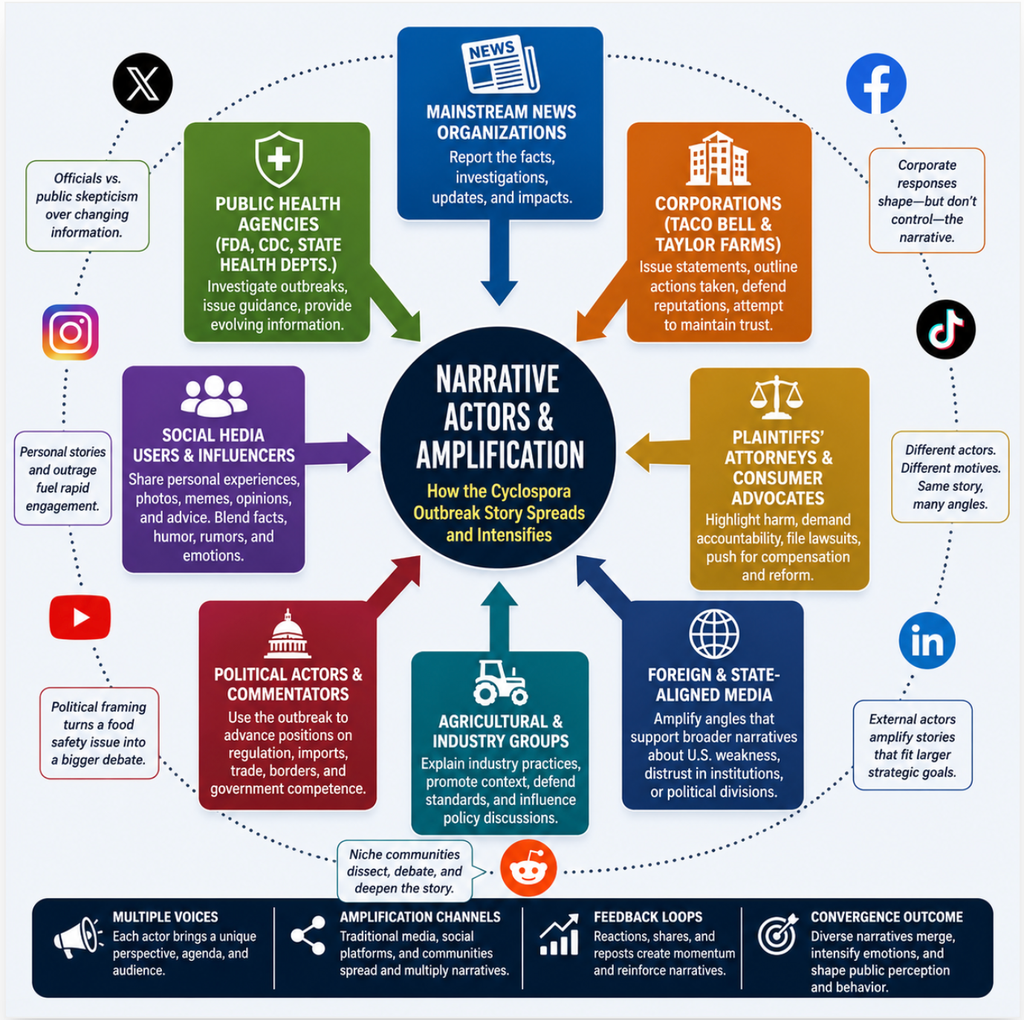
A wide range of actors have come together to create and amplify Cyclospora narratives.
Taco Bell and Taylor Farms function simultaneously as information sources and interested corporate actors. Their communications emphasize precautionary actions, cooperation with authorities, and commitment to consumer safety. Plaintiffs' attorneys and consumer advocates emphasize harm and accountability, helping personalize an outbreak otherwise expressed through abstract case counts.
Agricultural organizations and food-industry interests participate in broader debates over traceability, regulation, imports, and compliance costs. Political actors can incorporate the outbreak into arguments over federal regulatory capacity, government staffing, international trade, or Mexican imports. Mexican authorities provide an important counterweight by challenging claims unsupported by laboratory confirmation.
Social media adds another layer, collapsing technical distinctions into emotionally resonant shorthand. Humor, personal illness accounts, photographs, political commentary, corporate criticism, and news reporting coexist within the same information environment. Foreign or state-aligned media may also exploit the outbreak where it supports broader narratives about American regulatory dysfunction, declining institutional competence, or the weaknesses of U.S. consumer capitalism.
Understanding amplification therefore requires distinguishing organic public concern from strategic interpretation. The same outbreak can simultaneously function as a legitimate public-health story, corporate reputation crisis, consumer grievance, regulatory debate, trade controversy, and political narrative.
Narratives by Volume
Volume refers to the frequency with which narratives are shared and amplified. The greater the volume, the more audiences have engaged with them. With regard to the current lettuce fears, three narratives have had considerably greater volume than the others.
Lettuce and fresh produce are unsafe — This is, by far, the most dominant narrative in the aftermath of Cyclospora. Because of it, more than 26 million households reportedly stopped buying salads and fresh greens in July, while restaurants also saw steep drops in traffic and sales.
Taylor Farms is a liability — Narratives consistently identify Taylor Farms as the probable source of the recalled lettuce, linking the company to the subsequent outbreak. Additional coverage scrutinizes Taylor Farms' prior food-safety incidents, political contributions, lobbying, and workplace record.
Government oversight is failing — This has been the stance taken in opinion, investigative, and political coverage. Narratives cite staffing and funding reductions at federal and state health agencies; delayed inspections; reduced disease surveillance; delayed implementation of new protocols; and perceived shortcomings in outbreak communication.
| SOURCE & FACT-CHECK NEEDED |
| Before publication, confirm and footnote the 26-million-household figure and the restaurant traffic/sales decline above, the lettuce-price decline cited in Narrative I, and the FDA/state staffing and inspection figures (above and in Narrative VI). The 37.2% left-center-bias figure (Background section) is EdgeTheory C2 platform data and should be labeled as such rather than externally sourced. An earlier draft also referenced outbreak “deaths” in this section; that reference has been removed here since no death count is established elsewhere in the report — reinstate only with a confirmed source. |
Emotional Analysis
The Cyclospora outbreak contains an unusually potent combination of emotions. Fear likely derives from the invisible nature of contamination and the consumer's inability to identify unsafe food. Disgust perhaps arises from both the nature of the illness itself and the perceived lackadaisical response of those involved. Together, these emotions can produce strong avoidance behavior.
Anger becomes more prominent as narratives shift from illness toward responsibility. Consumers may direct it at Taco Bell for serving the lettuce, Taylor Farms for supplying it, agricultural producers for contamination, or regulators for failing to prevent the outbreak.
Surprise is associated with scale and interconnectedness. Consumers who rarely consider food supply chains may be surprised to discover how widely one supplier distributes products or how difficult investigators find tracing a familiar ingredient such as lettuce.

EdgeTheory's C2 platform also weighs the emotional content found in each narrative item, tracking fluctuations in sentiment over time. The graph shown here details the emotional content of Cyclospora narratives between August 3 and 18, 2026. Though a variety of emotional indicators were present, fear and disgust outweighed all others.
Finally, distrust provides the emotional bridge connecting the individual narrative ecosystems. Uncertainty surrounding laboratory findings, sourcing, inspection, corporate responsibility, and regulatory effectiveness allows distrust to persist even after the immediate health threat diminishes.
Emotional analysis should therefore assess not merely which emotion dominates the conversation but how emotions change as narratives move from personal health risk toward questions of accountability and institutional competence.
Narrative Convergence
The greatest narrative risk surrounding the Cyclospora outbreak arises when these separate themes cease operating independently.
The progression is relatively straightforward:
Contaminated lettuce → Taco Bell → Taylor Farms → Mexican produce → inadequate inspections → weak traceability → regulatory failure → distrust of the food system
Each element supplies evidence for the next. Illnesses associated with Taco Bell encourage questions about its supplier. Identification of Taylor Farms moves attention toward Mexican sourcing. Mexican sourcing raises questions about foreign inspections. Difficulty establishing the precise contamination point encourages scrutiny of traceability. Regulatory delays then reinforce broader claims that government oversight is inadequate.
Narrative convergence matters because audiences do not need detailed knowledge of any individual component. A consumer may know little about Cyclospora epidemiology, Taylor Farms' corporate structure, FDA inspection procedures, or agricultural water standards while nevertheless absorbing the overarching conclusion that something is wrong with the system.
The subsequent Salmonella-related Taylor Farms recall is especially important in this respect. Although involving a different pathogen and product, its proximity to the lettuce outbreak allows separate events to reinforce one another. Narrative logic can transform coincidence or unrelated failures into evidence of systemic dysfunction.
At that point, the conversation is no longer fundamentally about iceberg lettuce. The subject becomes institutional trust: whether corporations know where their ingredients originate, whether suppliers can control sprawling distribution networks, whether regulators can supervise imported food, and whether consumers are given accurate information quickly enough to protect themselves.

With narrative convergence, disparate narratives come together to create a larger one. In this instance, various narratives about Cyclospora have converged to yield the basic narrative that the nation's food system is insecure.
From Narrative Risk to Business Impact
The consequences of the outbreak extended beyond public-health reporting and online conversation. As concern intensified, effects became visible in consumer behavior, restaurant performance, produce demand, and investor reaction.
The significance is not that every change in sales, traffic, or market value can be attributed directly to a narrative. Rather, the outbreak demonstrates how quickly a public-health event can develop into a broader information environment capable of influencing consumer confidence, corporate reputation, and business decisions.
Narrative Intelligence provides the ability to identify that progression while it is developing—not simply measure attention after the consequences become visible.
Conclusion: From Foodborne Outbreak to Crisis of Trust
The 2026 Cyclospora outbreak began with a relatively straightforward public-health question: what was making people sick? Its narrative evolution has produced a much broader set of questions involving who bears responsibility for food safety and whether the institutions charged with protecting consumers remain capable of doing so.
The FDA's investigation provides an important factual baseline. As of August 20, the agency linked the outbreak to iceberg lettuce sourced from central Mexico and recalled by Taylor Farms de Mexico, while reporting 10,930 illnesses across 17 states, 454 hospitalizations, and two deaths. But the narratives surrounding those facts extend much further. A specific lettuce outbreak becomes a question about the safety of fresh produce. Traceback to a Mexican supplier becomes concern about imported food. Exposure at Taco Bell becomes a debate over brand responsibility. And a complex federal investigation becomes evidence, for some audiences, that government oversight is failing.
Those interpretations can outlast the event that produced them. Taco Bell can remain associated with illness; Taylor Farms can become associated with repeated food-safety incidents; Mexican produce can become incorporated into broader arguments about imports; and regulatory difficulties can reinforce existing distrust of government institutions.
This distinction is central to Narrative Intelligence. Facts establish what happened. Narratives shape what those facts come to mean—and those interpretations can influence trust, reputation, consumer behavior, and business outcomes.
The most important question, then, is no longer only “Is this lettuce safe?” It becomes: “Can I trust the nation's food supply?”

